Key Points:
- Arthur Mensch dismisses claims that China lags in AI, calling them a “fairy tale.”
- Mistral AI positions itself as Europe’s open-source alternative to U.S. and Chinese giants.
- Global AI leadership is shifting toward parallel innovation rather than a single dominant winner.
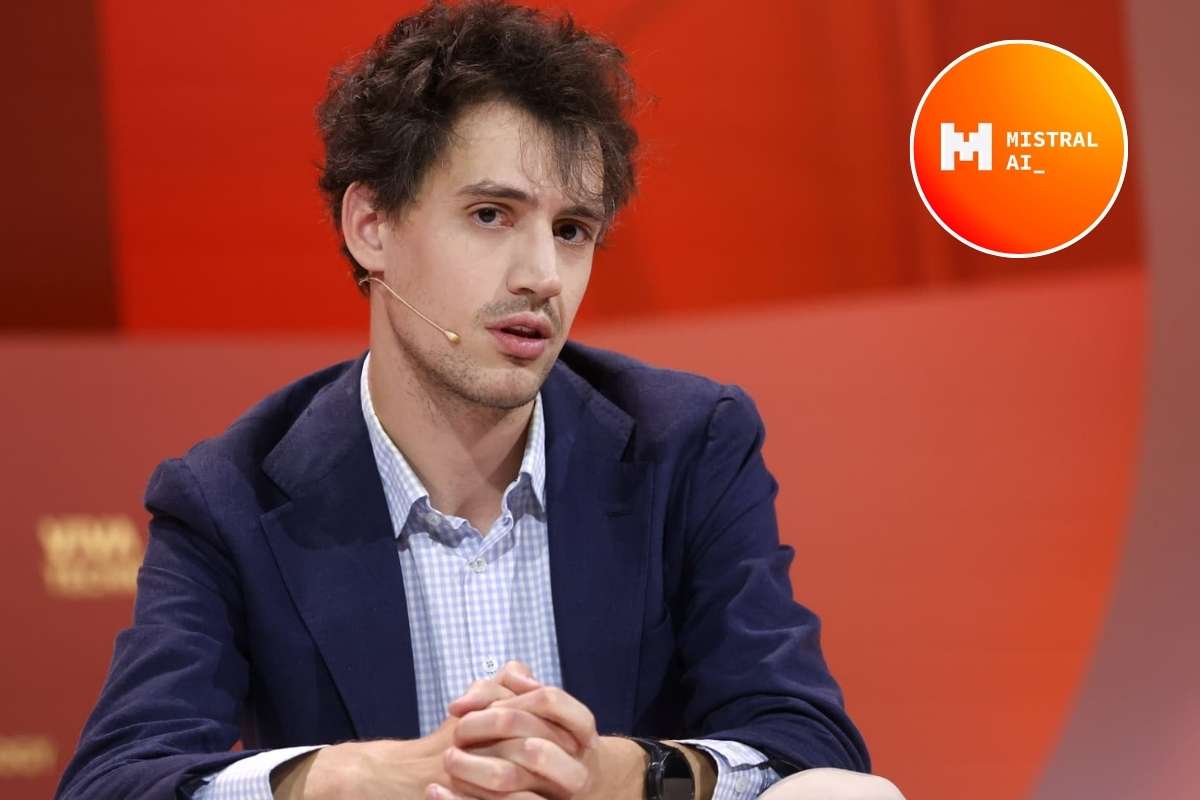
Arthur Mensch, Chief Executive Officer of French artificial intelligence firm Mistral AI, has dismissed the widely held belief that China is trailing the West in artificial intelligence development, calling the claim a “fairy tale.” Speaking during discussions at the World Economic Forum in Davos, Mensch argued that the perception of China lagging behind countries such as the United States oversimplifies a far more complex and competitive reality.
According to Arthur Mensch, China’s AI ecosystem has progressed rapidly through large-scale investment, strong engineering talent, and extensive deployment of open-source models. He suggested that Western narratives often underestimate China’s capacity to innovate outside the public spotlight, leading to misleading comparisons. Mensch noted that while the U.S. continues to dominate headlines with high-profile AI firms, China’s parallel advancements are significant and increasingly difficult to ignore.
His remarks arrive at a time when governments and corporations are reassessing their assumptions about global AI leadership, particularly as generative AI becomes central to economic growth, national security, and technological sovereignty.
Mistral AI’s Growing Role in the Global AI Landscape
Founded in 2023, Mistral AI has rapidly emerged as one of Europe’s most prominent artificial intelligence startups. The company focuses on developing advanced large language models, emphasizing efficiency, transparency, and open-source innovation. Under Mensch’s leadership, Mistral has positioned itself as a European alternative to dominant U.S. and Chinese AI players.
The company has experienced rapid growth and rising demand for its models across enterprise and infrastructure use cases. Mistral’s strategy blends open-source accessibility with commercial deployment, allowing developers and businesses to build AI applications without being locked into a single ecosystem.
Arthur Mensch has consistently advocated for AI independence, particularly for Europe, warning that over-reliance on foreign AI models could create long-term strategic vulnerabilities. He has stressed that AI capability should not be measured solely by visibility or marketing dominance, but by real-world performance, scalability, and adaptability.
This philosophy aligns with his broader view that global AI leadership cannot be reduced to a single winner, but instead reflects multiple centers of innovation operating simultaneously.
Broader Implications for the Global AI Race
Arthur Mensch’s comments have intensified debate within the technology sector over how AI progress is evaluated across regions. Analysts increasingly argue that framing AI development as a simple race between nations fails to capture differences in regulatory models, infrastructure priorities, and deployment strategies.
China’s strength in rapid implementation and open-source model iteration, combined with its massive domestic market, presents a competitive dynamic distinct from the venture-capital-driven ecosystem of the United States. Meanwhile, Europe is attempting to carve out a third path focused on ethical frameworks, regulatory clarity, and technological autonomy.
As generative AI continues to evolve, industry leaders suggest the conversation is shifting away from who is “ahead” toward how responsibly and sustainably AI systems are developed and deployed. Mensch’s remarks underscore the need for a more nuanced understanding of global competition—one that recognizes parallel innovation rather than linear dominance.
With AI becoming a foundational technology across industries, reassessing long-held assumptions about global leadership may prove critical for policymakers, investors, and technology firms alike.