Were you aware that the businesses with a high level of employee engagement? They make 21% higher salaries? Team building has advanced well beyond the awkward icebreakers of the past. And changed in today’s fast-paced global marketplace. Bridging the gap between remote, hybrid, and in-office teams is now strategically essential. This is turning a collection of disparate contributors into a unified powerhouse.
The key to improved creativity and smooth cooperation is strong team dynamics. Productivity increases when people have mutual trust. This helps to revitalize your workplace culture and produce results supported by research. This guide looks into 40 effective team-building ideas at work. They range from short virtual challenges to immersive off-sites.
Why Team Building Ideas for Work Matter? Backed by Science:
High-performing teams are primarily driven by social cohesion, according to numerous studies. Gallup reports that highly engaged teams experience a 41% decrease in absenteeism. Proving the protective effect of strong workplace relationships against burnout. Intentional team building promotes psychological safety and cross-departmental collaboration. By removing organizational silos. This is Google’s Project Aristotle. It is found to be the most important indicator of team success. Shared experiences are the remedy for loneliness in remote settings.
According to studies, teams with high levels of trust are 50% more productive. Because they can innovate more freely and solve problems more quickly. In the end, team building is more than just “fun”. It is a data-driven tactic to raise spirits. Along with boosting innovation and gaining a competitive advantage in any sector.
Types of Team Building Activities:
Team building activities foster collaboration across cultures and contexts. Here’s an inclusive framework:
Social & Icebreaker Activities:
- Focus: Trust, personal connections, and informal bonding.
- Best For: New or multicultural teams looking to break the ice.
- Examples: “Two Truths and a Lie” or cultural story shares.
- Why it works: These low-pressure interactions lower social barriers. It also fosters empathy by revealing the human side of colleagues. They are essential for creating a sense of belonging from day one.
Problem-Solving & Skill-Building Challenges:
- Focus: Critical thinking, strategy, and communication under pressure.
- Best For: Analytical groups or teams facing complex project cycles.
- Examples: Virtual escape rooms, bridge-building simulations, or collaborative Lego builds.
- Why it works: By mimicking workplace stressors in a safe environment. These activities reveal team dynamics and highlight individual strengths. They teach teams how to navigate friction and reach a consensus efficiently.
Physical & Outdoor Activities:
- Focus: Energy, wellbeing, and real-world collaboration.
- Best For: High-energy teams or those needing a break from screen fatigue.
- Examples: Obstacle courses, team hikes, or scavenger hunts in urban parks.
- Why it works: Physical movement boosts endorphins. It also improves cognitive function, leading to a “reset” in team morale. These shared adventures build lasting memories that translate into stronger office rapport.
Virtual & Hybrid Activities:
- Focus: Digital connection and equity for remote teams.
- Best For: Distributed workforces using tools like Zoom, Teams, or Slack.
- Examples: Online scavenger hunts, digital trivia (Kahoot), or “remote coffee” pairings.
- Why it works: These activities bridge the geographic divide. This ensures that remote employees feel seen and valued as their in-office counterparts. They utilize interactive technology to maintain a vibrant company culture across time zones.
Here are the Top 40 Team Building Ideas for Work That Actually Work!
This is a thorough analysis of 40 team-building ideas for work. They are arranged according to their main objective. Every activity is made to be globally applicable. They guarantee inclusivity for workforces that are dispersed and diverse.
Social & Icebreaker Activities
These activities focus on lowering social barriers and building psychological safety. They are perfect for integrating new hires. Also helping multicultural teams find common ground through informal storytelling and shared experiences.
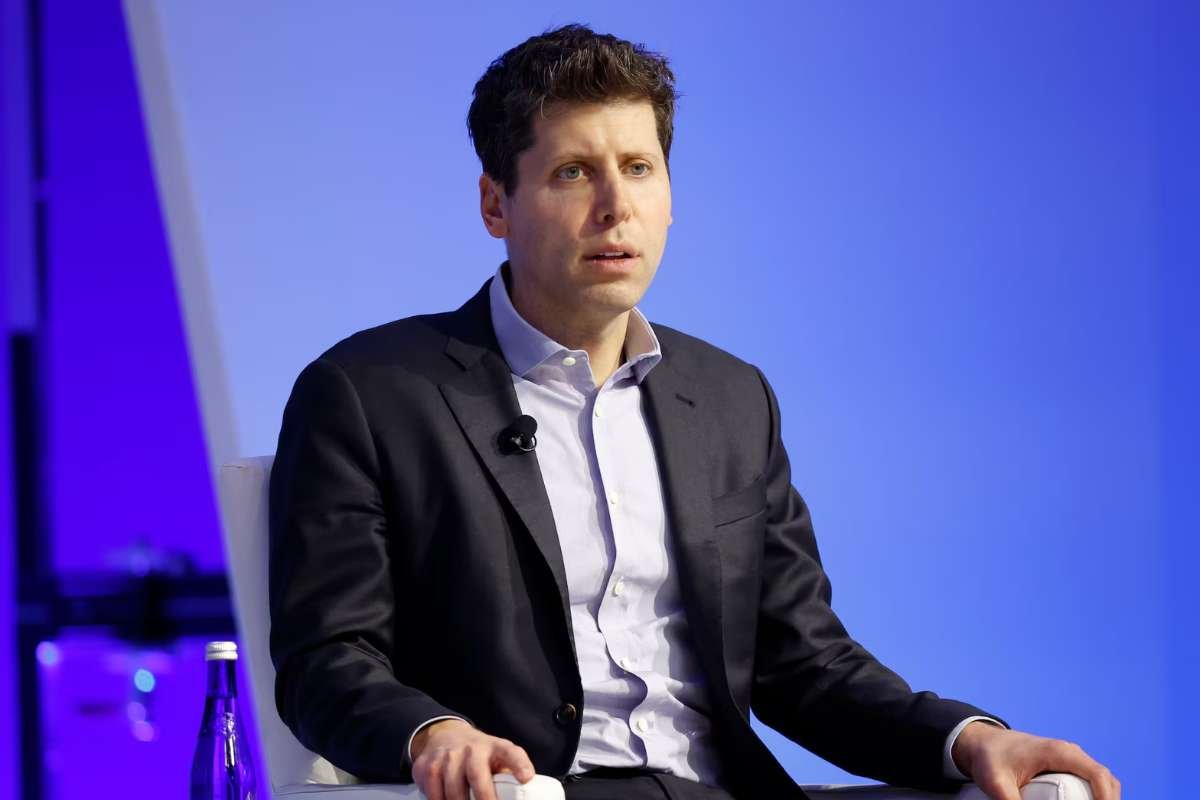
1. Two Truths and a Lie
- Group Size: 3–10 per sub-group.
- Time: 15–20 minutes.
- Goals: Improve active listening; spark personal curiosity.
A classic game where members share three “facts,” one of which is false. It is one of the most popular team building ideas for work. Because it helps coworkers discover surprising personal stories. This also builds immediate rapport and sparks curiosity.
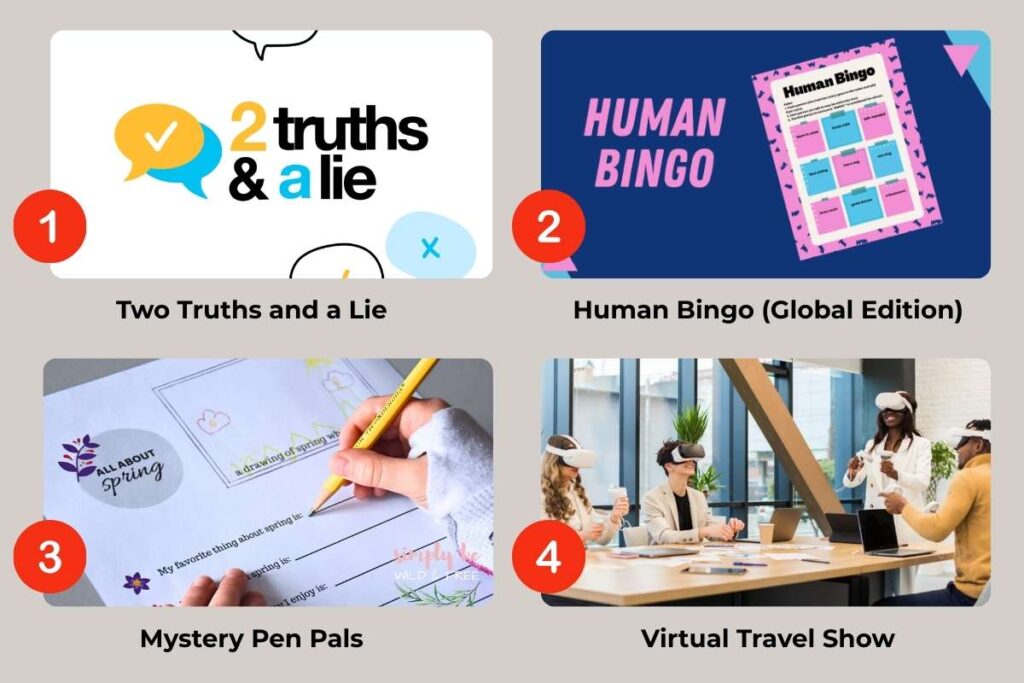
2. Human Bingo (Global Edition)
- Group Size: 10–50+.
- Time: 20–30 minutes.
- Goals: Encourage networking; celebrate cultural diversity (e.g., “Has lived in 3+ countries”).
Participants receive a grid with various traits or experiences. They must find colleagues who match them. This encourages everyone to move around and chat. This makes it an excellent choice for Team Building Ideas for work. Especially when you need to mix different departments.
3. Mystery Pen Pals
- Group Size: Any (Even numbers).
- Time: Ongoing (weekly/monthly).
- Goals: Bridge regional silos; foster long-term one-on-one connections.
Pair employees from different regions. Make them exchange digital or physical notes for a month. This fosters long-term, one-on-one connections that are often missing in large corporations. Proving that the best team building ideas for work are sometimes the simplest ones.
4. Virtual Travel Show
- Group Size: 5–20.
- Time: 30 minutes.
- Goals: Share cultural heritage; improve presentation skills in a low-stakes setting.
Team members give a 5-minute presentation on their favorite city or hometown. It is a fantastic way to celebrate cultural diversity. It also helps people see the world through their colleagues’ eyes. During your scheduled team-building activities.
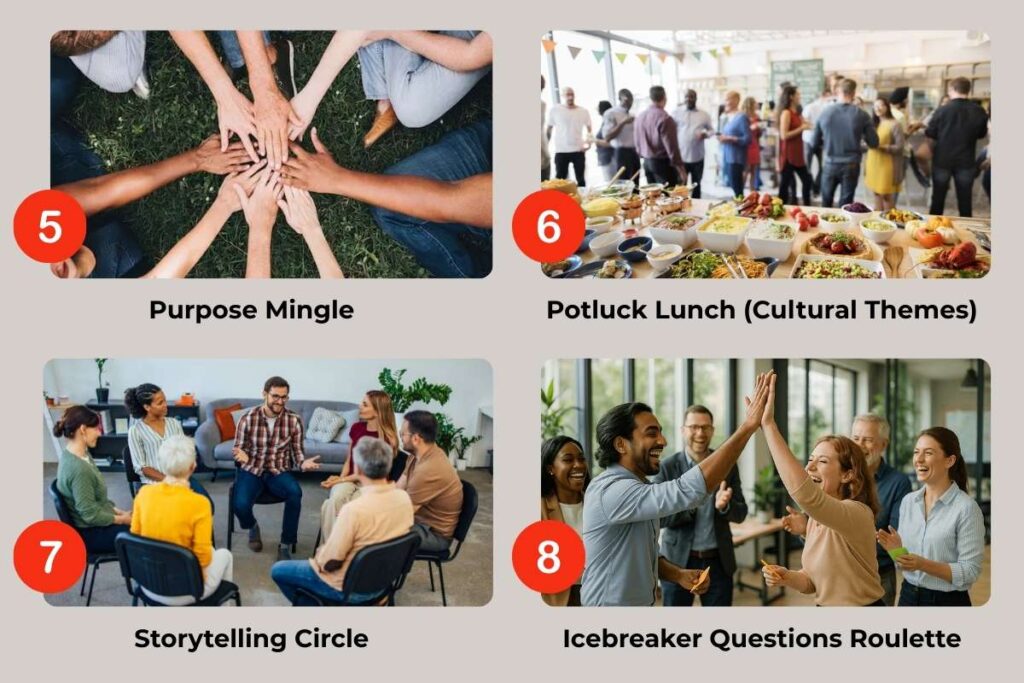
5. Purpose Mingle
- Group Size: 10–30.
- Time: 10 minutes (pre-meeting).
- Goals: Align individual motivations with team objectives.
Before a meeting. Spend ten minutes discussing why the current project matters to each individual. This aligns personal values with company goals. Making it highly effective. It becomes a mission-driven example of team-building ideas for work.
6. Potluck Lunch (Cultural Themes)
- Group Size: 5–30 (in-person).
- Time: 60 minutes.
- Goals: Build community through shared culinary traditions.
Everyone brings a dish that represents their heritage or a personal favorite recipe. Sharing a meal is a universal bonding experience. It creates a warm, inclusive atmosphere. This is why food-based events are a staple Team Building Ideas & tool for work.
7. Storytelling Circle
- Group Size: 4–12.
- Time: 30–45 minutes.
- Goals: Develop empathy; improve narrative communication.
Facilitators provide a prompt like “a time I overcame a challenge.” This builds deep empathy and psychological safety. By allowing people to be vulnerable. This is a key outcome for impactful Team Building Ideas & concepts for work.
8. Icebreaker Questions Roulette
- Group Size: 2–100 (using breakout rooms).
- Time: 10–15 minutes.
- Goals: Rapid rapport building; breaking the “standard” work talk.
Use a digital tool to randomly assign fun questions to small groups. This keeps energy high and prevents the “awkward silence.” Which can sometimes happen during more formal team-building concepts. Or networking sessions.
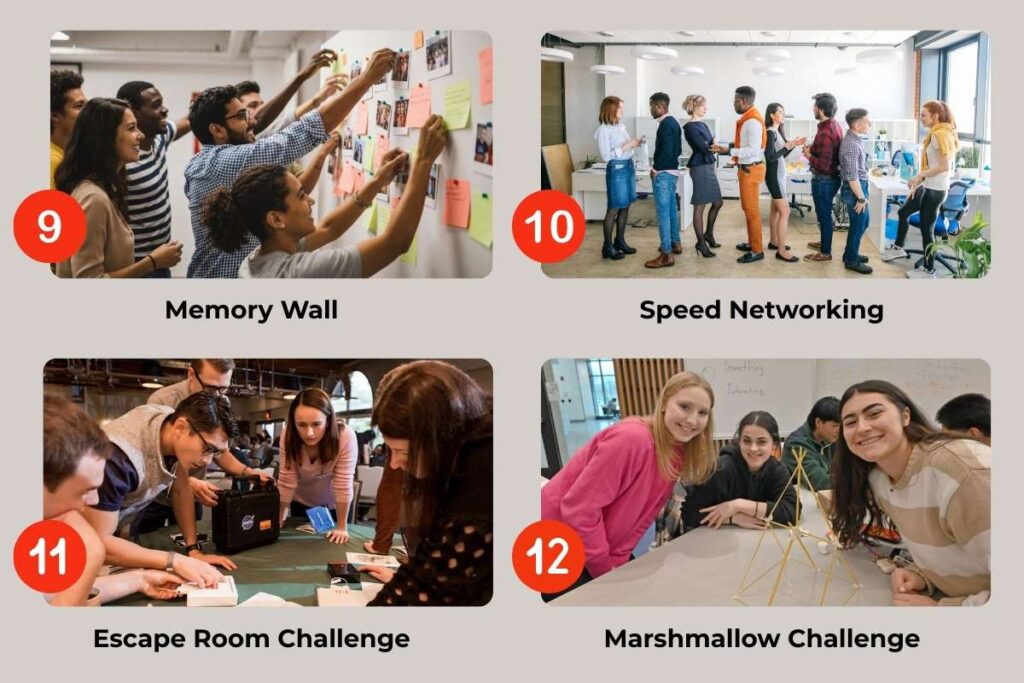
9. Memory Wall
- Group Size:5–40.
- Time: 20 minutes + ongoing display.
- Goals: Visualize team success; boost morale through shared history.
Create a physical or digital space where the team posts photos and notes of past successes. Looking back at collective wins boosts morale. It also reminds employee of their shared history. It reinforces the value of ongoing team-building ideas for work.
10. Speed Networking
- Group Size: 10–100.
- Time: 30 minutes (3-minute intervals).
- Goals: Efficient internal networking; identifying cross-departmental synergies.
Just like speed dating. Employees have three minutes to introduce themselves before moving to the next person. It is a high-energy way to ensure everyone has spoken to one another. This makes it a very efficient choice for team-building ideas for work.
Problem-Solving & Skill-Building Challenges
Designed to mimic high-pressure work scenarios. These challenges require teams to think critically and iterate quickly. They are ideal for technical or analytical groups. Those who are looking to sharpen their strategic communication skills.
11. Escape Room Challenge
- Group Size: 4–8 per room.
- Time: 60–90 minutes.
- Goals: Enhance delegation; identify leadership roles under pressure.
Teams are “locked” in a room and must find clues to get out within an hour. This tests how people handle pressure and who naturally steps into a leadership role. This makes it one of the most immersive team building ideas for work.
12. Marshmallow Challenge
- Group Size: 4 per team.
- Time: 20 minutes.
- Goals: Teach iterative design; emphasize the importance of prototyping.
Groups try to build the tallest structure using spaghetti, tape, and a marshmallow. It sounds silly, but it teaches teams the importance of prototyping. They learn from failure, which is vital for any team building concepts for work strategy.
13. Blind Drawing
- Group Size: Pairs.
- Time: 10–15 minutes.
- Goals: Improve precision in communication; highlight “sender vs. receiver” gaps.
One person describes an object. While their partner tries to draw it without seeing the original. This highlights how easily instructions can be misinterpreted. This helps the group refine its communication skills. Especially during their team building thoughts for work sessions.
14. Hackathon Sprint
- Group Size: 3–6 per team.
- Time: 4–24 hours.
- Goals: Rapid innovation; cross-functional collaboration.
A short, intense period where groups work together. They help to solve a specific technical or process problem. This encourages “out of the box” thinking. It also proves that team building for work can lead to real business innovations.
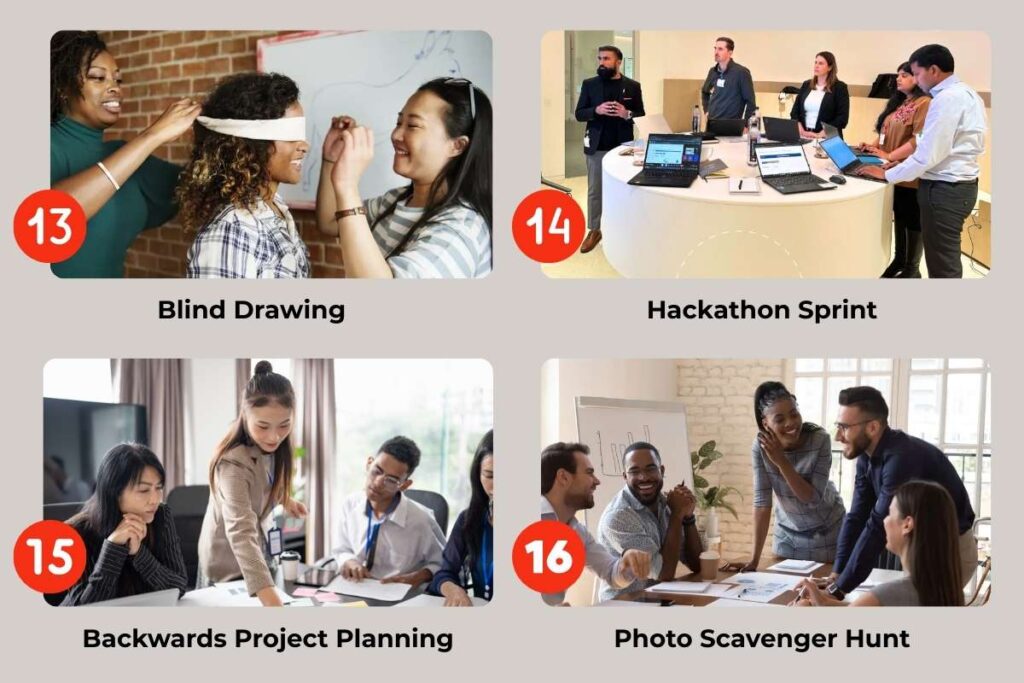
15. Backwards Project Planning
- Group Size: 5–15.
- Time: 45 minutes.
- Goals: Identify hidden risks; improve strategic forecasting.
Teams start with a successful “finished” project. They work backward to identify the steps needed to get there. This helps identify potential roadblocks early. And it is a very practical, logic-based addition to your team building ideas for work.
16. Photo Scavenger Hunt
- Group Size: 4–6 per team.
- Time: 60 minutes.
- Goals: Creative problem solving; time management.
Give teams a list of weird items or scenarios they need to photograph around the office or city. It requires coordination and creativity. This provides a fun and active break from the usual team-building tasks for work.
17. Strategy Board Game Tournament
- Group Size: 4–20.
- Time: 1–2 hours.
- Goals: Analyze competitive vs. cooperative strategies.
Use games like “Catan” or “Pandemic” to see how teams negotiate and cooperate. These games provide a safe environment to practice competitive strategy. Making them excellent, low-stress team-building ideas for work.
18. Blind Puzzle Exchange
- Group Size: 4–8.
- Time:30 minutes.
- Goals: Foster resource sharing; demonstrate the “big picture” mentality.
Give each group a puzzle, but hide some of their pieces in the boxes of other groups. This forces teams to trade and collaborate with “competitors.” This emphasizes that internal departments are all on the same side.
19. Group Code of Conduct Creation
- Group Size: Entire team.
- Time: 60–90 minutes.
- Goals: Establish psychological safety; define shared values.
Collaboratively write a “team manifesto” on how you will treat each other. This builds a foundation of respect. It is one of the most foundational team-building ideas for work for any new department.
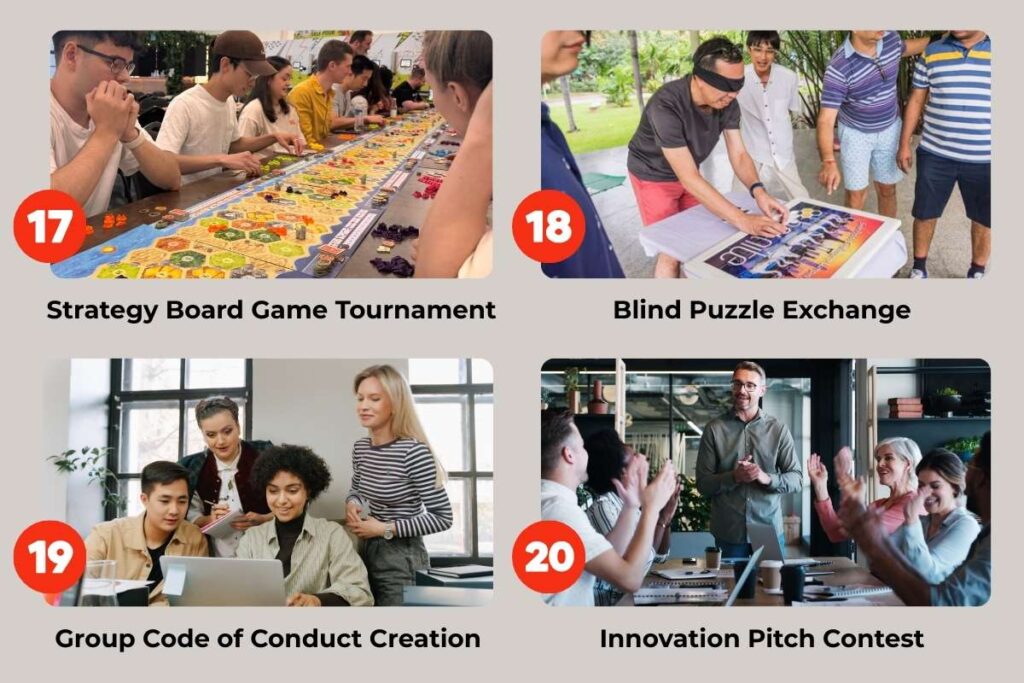
20. Innovation Pitch Contest
- Group Size: 3–5 per team.
- Time: 2 hours.
- Goals: Refine persuasion skills; drive internal product/process improvement.
Like “Shark Tank,” teams pitch new ideas to a panel of judges. This builds public speaking confidence. It also allows employees to feel their voices are heard. This is a major goal for corporate team building ideas for work.
Physical & Outdoor Activities
Focusing on well-being and energy. These activities get teams out of their chairs and into the real world. They are highly effective for boosting endorphins and resetting team morale.
21. Team Olympics
- Group Size: 15–100.
- Time: 2–3 hours.
- Goals: Foster healthy competition; celebrate diverse physical/mental talents.
Organize a series of light physical games like egg-and-spoon races or tug-of-war. These events are great for blowing off steam and building a sense of “team spirit.” It carries back into the office long after the games end.
22. Beach or Park Team Day
- Group Size: Any.
- Time: Half or Full Day.
- Goals: Stress reduction; informal bonding in a relaxed environment.
A simple day out in nature with no specific work agenda. This allows for organic conversations to happen and helps reduce stress. Proving that sometimes the best activities are the ones that feel like a vacation.
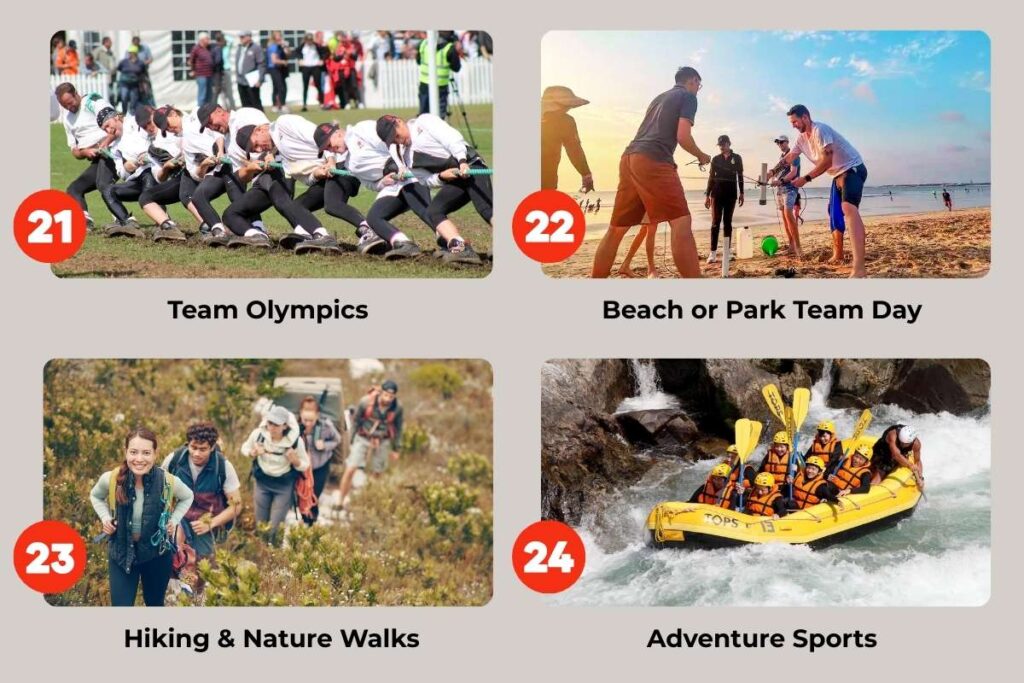
23. Hiking & Nature Walks
- Group Size: 5–20.
- Time: 2–4 hours.
- Goals: Promote wellness; encourage deep, distraction-free conversations.
Walking side-by-side in the fresh air makes it easier for people to open up compared to sitting across a desk. It promotes wellness. It also gives the team a much-needed digital detox from their screens and phones.
24. Adventure Sports
- Group Size: 5–15.
- Time: 3–5 hours.
- Goals: Build extreme trust; overcome personal and collective fears.
Activities like zip-lining or white-water rafting require intense trust in your teammates. These high-adrenaline experiences create incredibly strong bonds along with shared memories that can last for an entire career.
25. Charity Run/Walk Together
- Group Size: Unlimited.
- Time: 1–2 hours.
- Goals: Align team values with social impact; promote fitness.
Signing up for a local 5k race as a group gives the team a shared goal outside of work. It links the company to a good cause. This boosts employee pride and strengthens the overall workplace culture.
26. Scavenger Hunt Across a City
- Group Size: 5 per team.
- Time: 2–3 hours.
- Goals: Navigation and teamwork; local cultural exploration.
Teams use a map and clues to find landmarks and complete tasks. This requires quick thinking and effective navigation. This makes it a perfect way to explore a new city during a company retreat or off-site.
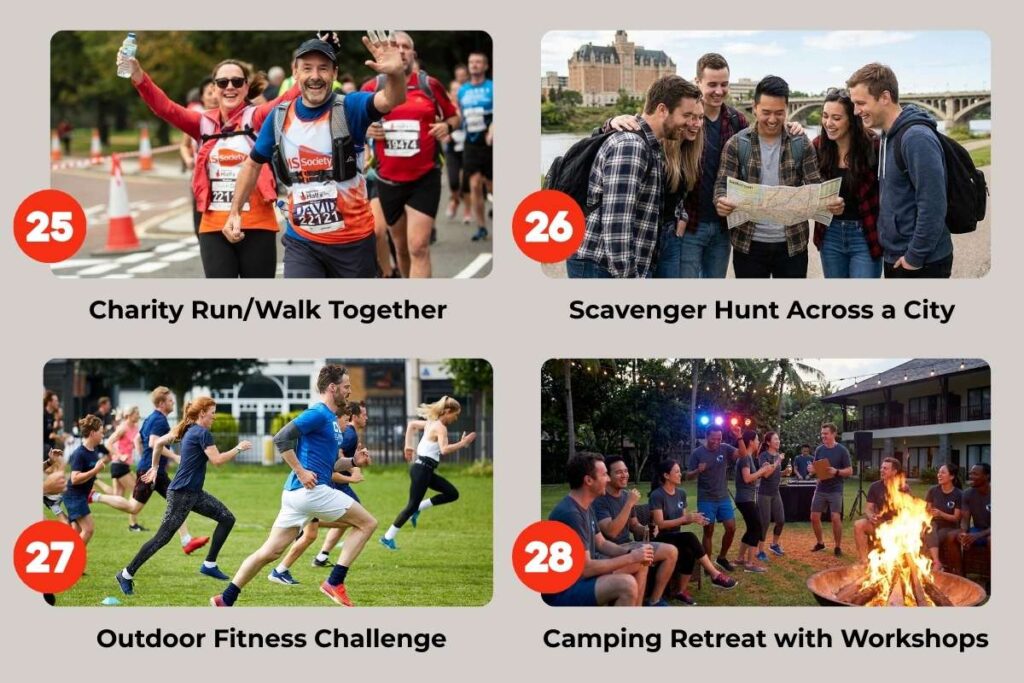
27. Outdoor Fitness Challenge
- Group Size: 10–30.
- Time: 45–60 minutes.
- Goals: Energy boost; promoting a culture of health.
A guided session of yoga or a light boot camp in a local park. This focuses on physical health. And shows that the company cares about employee well-being. This is a cornerstone of modern team engagement.
28. Camping Retreat with Workshops
- Group Size: 10–25.
- Time: 2 days (Overnight).
- Goals: Intensive bonding; deep-dive strategic alignment.
Spending a night under the stars removes all the formal barriers of the office. Combining outdoor fun with indoor strategy sessions. This allows for a perfect balance of deep bonding and professional planning.
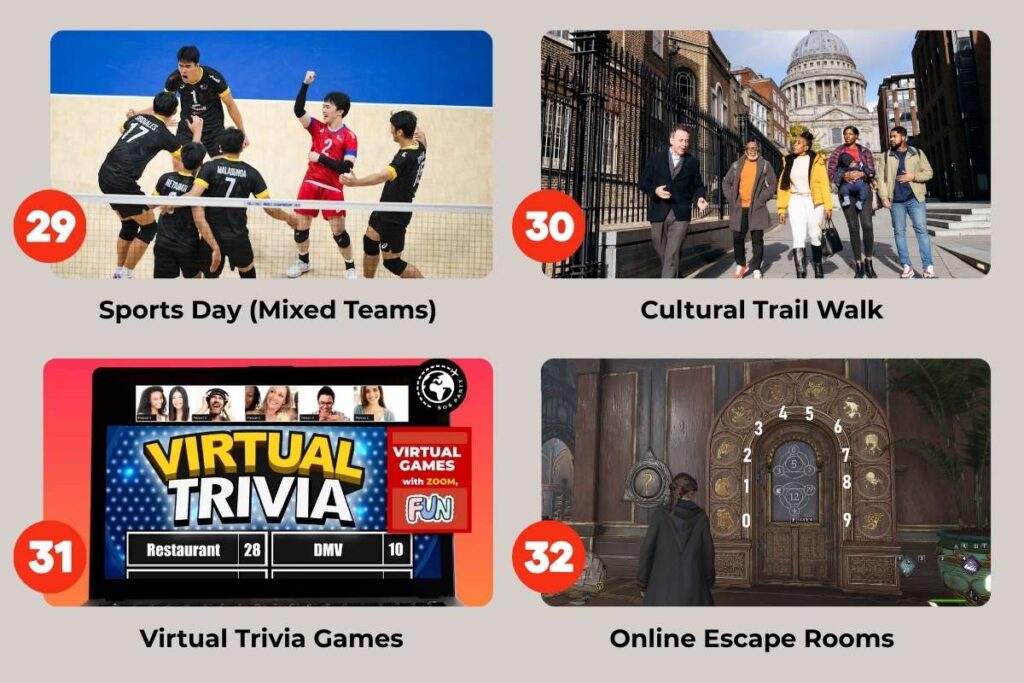
29. Sports Day (Mixed Teams)
- Group Size: 20–100.
- Time: 3–4 hours.
- Goals: Break down departmental silos through play.
Organize a casual soccer or volleyball game. Where teams are made of people from different departments. This breaks down the walls. It also encourages people to make friends outside of their immediate working circle.
30. Cultural Trail Walk
- Group Size: 5–20.
- Time:1.5–2 hours.
- Goals: Global mindset; learning local history and context together.
Take a guided tour of local historical or artistic landmarks. This adds an educational element to the outing. It is particularly great for international teams. Those who want to learn more about the city where they work.
Virtual & Hybrid Activities
Specifically curated for the digital-first workspace. These ideas use technology to ensure equity of experience. They help eliminate the “loneliness” factor of remote work. By creating intentional digital interaction.
31. Virtual Trivia Games
- Group Size: 5–100.
- Time: 45 minutes.
- Goals: Engagement; fun-based knowledge sharing.
32. Online Escape Rooms
Host a live quiz show via video call using themes like pop culture or company history. It is an easy way to get everyone laughing and participating. Regardless of where they are located in the world.
- Group Size: 3–6 per “room.”
- Time: 60 minutes.
- Goals: Virtual collaboration; digital literacy.
Teams use a digital dashboard to solve puzzles and “unlock” virtual doors. It requires the same level of logic and teamwork as a physical room. This makes it an ideal solution for teams with members in different time zones.
33. Remote Cooking Show & Tell
- Group Size: 5–15.
- Time: 45 minutes.
- Goals: Humanize the remote workspace; celebrate home life.
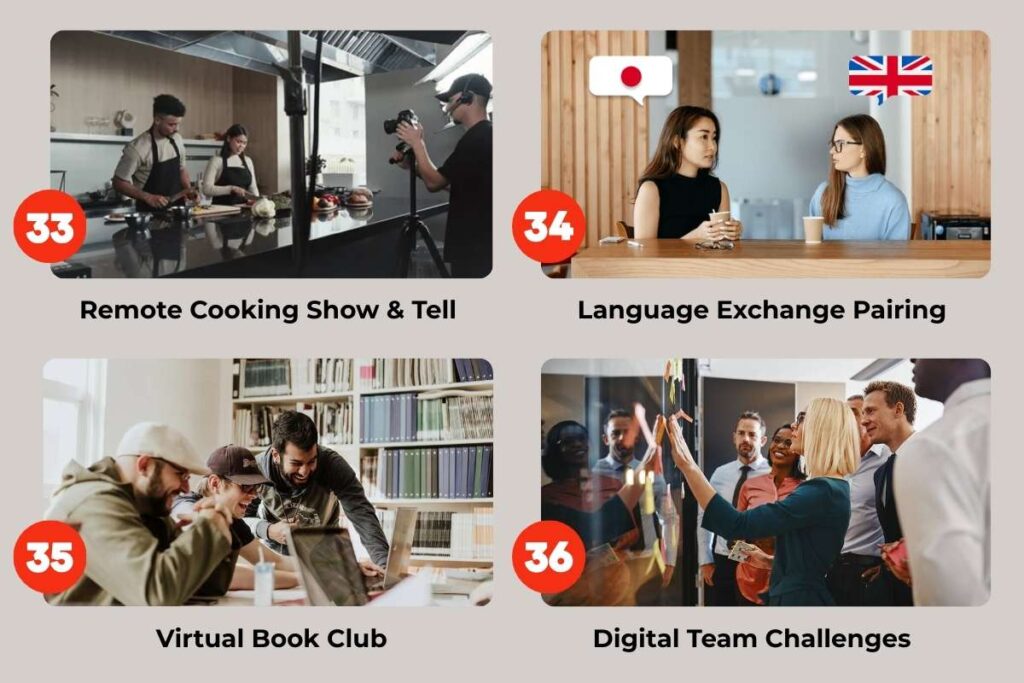
One team member teaches the rest of the group how to make a simple local dish over video. This humanizes the workspace. This allows people to share a piece of their home life with their colleagues.
34. Language Exchange Pairing
- Group Size: Pairs.
- Time: 30 minutes (weekly).
- Goals: Support global communication; personal development.
Match coworkers who want to learn each other’s native languages. This promotes global inclusivity. It also helps bridge communication gaps. This makes the team much more effective at working across international borders.
35. Virtual Book Club
- Group Size: 5–12.
- Time: 60 minutes (monthly).
- Goals: Critical thinking; deep discussion of industry or personal topics.
Choose a book each month and meet for an hour to discuss it. This encourages “deep work” and critical thinking. While also providing a consistent social touchpoint for remote workers. Those who might feel isolated.
36. Digital Team Challenges (Timed Tasks)
- Group Size: 4–10.
- Time: 15–30 minutes.
- Goals: Improve digital agility and responsiveness.
Use an app to set small, timed tasks like “take a photo of something blue” or “solve this riddle.” These quick bursts of interaction keep the team’s energy high throughout the week. Without taking up too much time.
37. Workspace Scavenger Hunt
- Group Size: 5–50.
- Time: 15 minutes.
- Goals: Break the “screen barrier”; share personal workspace context.
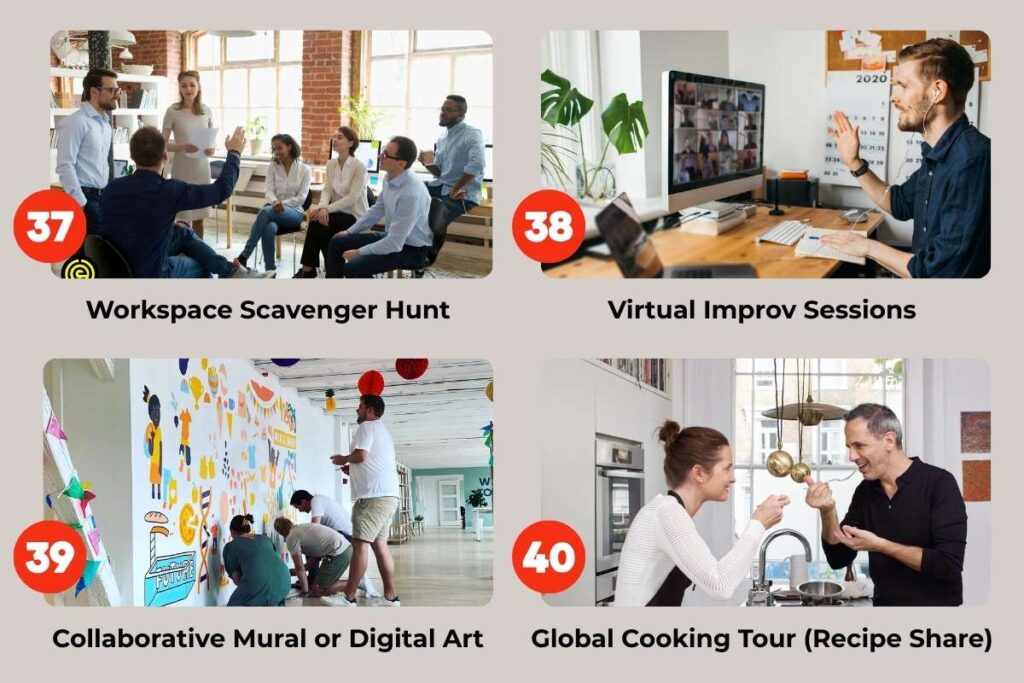
Ask everyone to find an item in their own home that fits a description, like “the oldest thing on your desk.” It is a fun, fast-paced way to learn about the personalities. And the environments of your remote coworkers.
38. Virtual Improv Sessions
- Group Size: 8–15.
- Time: 60 minutes.
- Goals: Boost confidence; improve adaptability and “yes-and” thinking.
A professional coach leads the team through “yes, and” games over video. This builds massive confidence and teaches people how to think on their feet. This is a valuable skill for any fast-moving business.
39. Collaborative Mural or Digital Art
- Group Size: 5–30.
- Time: 30–60 minutes.
- Goals: Visualizing team identity; creative expression.
Use a digital whiteboard tool like Miro to have everyone contribute to a single piece of art or a vision board. This creates a visual representation of the team’s shared goals. Along with their collective creativity.
40. Global Cooking Tour (Recipe Share)
- Group Size: 5–20.
- Time: 30 minutes.
- Goals: Cultural appreciation; building community across borders.
Similar to a potluck but done virtually. Where everyone follows the same recipe simultaneously. It creates a shared sensory experience (smell and taste). Even though the participants are thousands of miles apart.

Benefits of Team Building Activities:
Putting money into professional development is a calculated strategy that pays off. Building a solid foundation for long-term success. It is the main reason organizations prioritize team-building ideas for work. Aside from the immediate enjoyment.
➣ Strengthened Communication & Trust: Shared challenges remove social masks. This allows members to understand individual communication styles. And also build the psychological safety necessary for high-stakes projects.
➣ Better Problem-Solving & Innovation: Exposure to diverse perspectives during low-stakes activities. It translates to “outside-the-box” thinking. When tackling real-world business hurdles.
➣ Increased Morale and Engagement: Regular interaction reduces the “loneliness epidemic” in modern offices, lowering stress and decreasing turnover rates.
➣ Enhanced Productivity: Research proves that teams aligned on shared goals and interpersonal trust. They deliver higher-quality output with fewer internal bottlenecks.
➣ Inclusivity Across Remote & Onsite Teams: Purposeful activities bridge the geographic gap. This ensures every employee, regardless of location. They feel like a valued contributor to the company’s mission.
How to Choose the Right Team Building Idea?
Selecting the perfect activity requires a balance between logistical constraints and cultural goals. To ensure your team building ideas for work actually drive results. You can follow this three-step framework:
- Assess Dynamics: Match the activity to your team’s size and current culture. A small startup might thrive on high-intensity adventure sports. A large multicultural corporate department may benefit more from inclusive virtual travel shows.
- Define Objectives: Be intentional. Are you trying to resolve communication bottlenecks and spark innovation? Or simply celebrate a win?
- Measure and Iterate: Use post-event surveys to collect feedback. Understanding what resonated helps you refine future team building ideas for work. This ensures they remain a valuable investment rather than a mandatory chore.
Conclusion:
Today’s market leaders are defined by their ability to collaborate. It is no longer an option. You can turn everyday tasks into a journey of mutual trust and growth. Simply incorporate these team-building ideas for work. The right activity can bridge any gap and inspire long-lasting innovation. Whether you are in charge of a small local group or a large global network. By just starting small, maintaining consistency. You can see how your team develops into a strong, capable force. This team can further take on any task.
FAQ:
1. Why are team building ideas for work important in modern workplaces?
Team building ideas for work are essential. Today’s workplaces are increasingly remote, hybrid, and multicultural. Well-planned activities reduce silos, strengthen relationships, and improve engagement. It also helps teams align with shared goals. This leads to higher productivity and job satisfaction.
2. How often should companies organize team-building activities?
Most experts recommend team-building activities at least once per quarter. With lighter activities (like icebreakers or short challenges) incorporated monthly. The frequency should depend on team size, workload, and goals. Rather than on a fixed schedule.
3. How do team-building ideas support global and multicultural teams?
Team building ideas for work help global teams. By building cultural awareness, mutual respect, and stronger communication. Activities like cultural exchange sessions, virtual storytelling, and collaborative projects. It allows employees from different regions to understand perspectives and work better together. for work help global teams. By building cultural awareness, mutual respect, and stronger communication. Activities like cultural exchange sessions, virtual storytelling, and collaborative projects. It allows employees from different regions to understand perspectives and work better together.