You always have a “calm button” with you, did you know that? Breathing is something you do 20,000 times a day without even realizing it. Most of us are unaware that our breathing can alter our emotions, even though it keeps us alive. Your breath is the quickest way to tell your brain to calm down when things get hectic or noisy.
Everyone experiences stress in our modern world. Fortunately, breathwork is a free tool that anyone can use whenever they want. Finding peace doesn’t require any special equipment. The basic science behind the effectiveness of deep breathing will be explained in this guide. Additionally, you will discover simple, step-by-step breathing exercises for relaxation and improve your mood in a matter of minutes.
The Science Behind Breathing and Relaxation:
Understanding why breathwork works is like finding the manual for your body’s internal computer. It isn’t just “good vibes.” It is biology in action.
How Breath Affects the Nervous System?
Your body has two main modes. When you are stressed, the “fight-or-flight” system takes over. Deep breathing flips the switch to the “rest-and-digest” mode (parasympathetic activation). Many licensed therapists and stress-management coaches recommend paced breathing as a first-line stress regulation tool. Because it is simple, safe, and immediately accessible. In clinical settings, structured breathwork is often introduced before cognitive techniques to stabilize the nervous system.
Calming the Brain: Slow breaths signal the amygdala, the brain’s “alarm center,” to stand down.
Hormone Control: This process lowers cortisol, the primary stress hormone that keeps you feeling on edge.
Physiological Effects Supported by Research
Science shows that structured breathing creates immediate physical changes:
➢ Better Vitals: It helps lower your heart rate and blood pressure while improving how your body uses oxygen.
➢ Mental Clarity: Research published in peer-reviewed journals has shown that slow, paced breathing can reduce anxiety levels. And it can improve attention control. For example, studies referenced by institutions. Such as Harvard Health Publishing and the National Institutes of Health (NIH). They highlight how diaphragmatic breathing activates the parasympathetic nervous system and lowers stress markers.
Connection to Mindfulness & Sleep
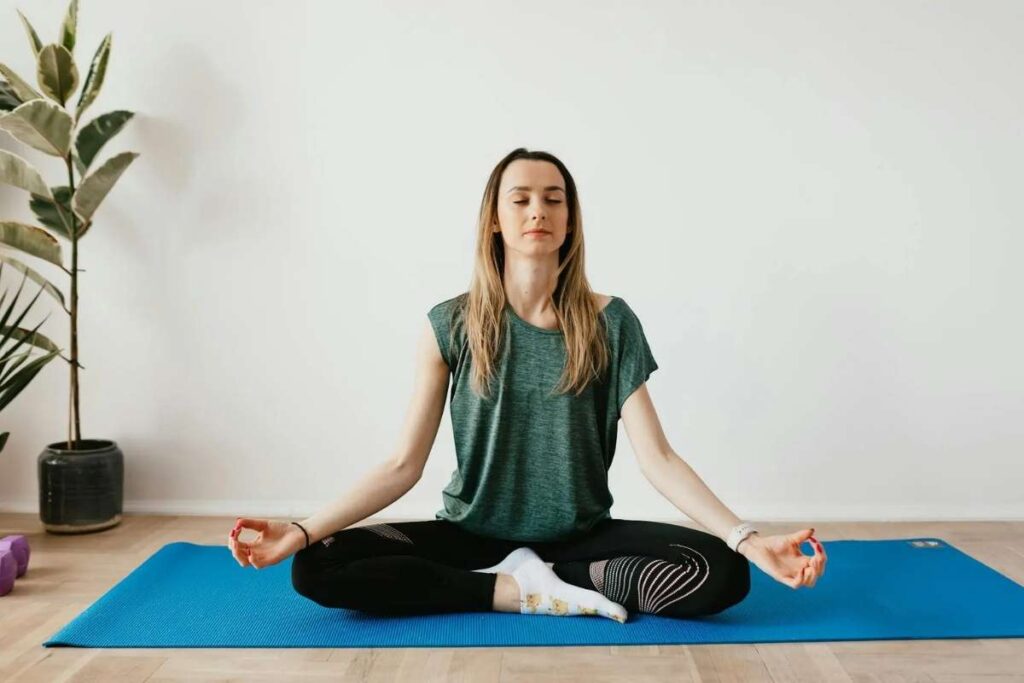
Breathing is the bridge between the body and mind. It creates a feedback loop that helps you stay present, making it the foundation of all meditation. By calming the nervous system before bed, you signal to your brain that it is safe to drift into a deep, restorative sleep.
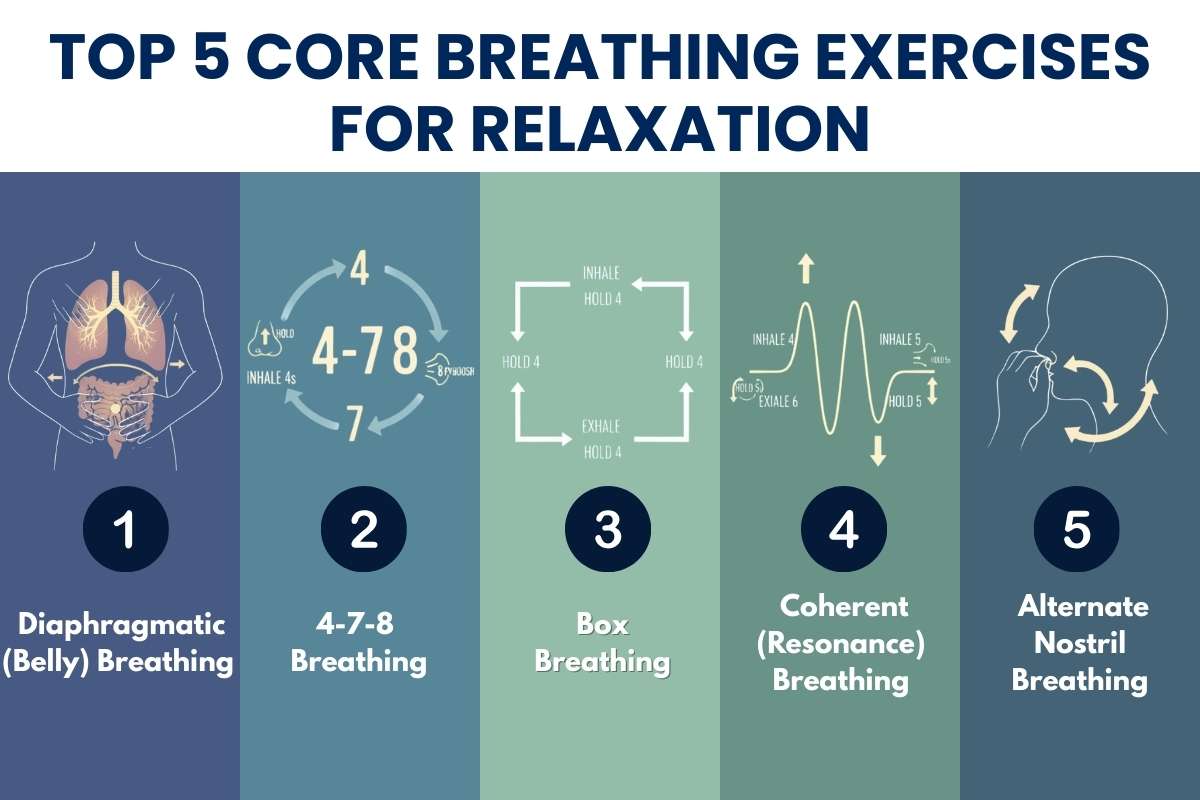
Here are the Top 5 Core Breathing Exercises for Relaxation:
Ready to try it yourself? Think of these techniques as different tools in a toolkit. You can pick the one that fits your mood or your schedule.
1. Diaphragmatic (Belly) Breathing
This is the foundation of all breathwork. Most people breathe shallowly in their chests, which can actually increase stress.
➢ How to: Sit or lie down comfortably. Place one hand on your chest and the other on your belly. Inhale slowly through your nose, feeling your belly push your hand out while your chest stays still. Exhale slowly through pursed lips.
➢ Benefit: It sends a direct signal to your brain to relax.
➢ When to use: Anytime you feel overwhelmed or “tight” in your body.
Imagine your belly is a small balloon. To do this exercise, sit or lie down in a cozy spot. Put one hand on your chest and the other on your belly. Breathe in slowly through your nose. As you do, try to make your belly push your hand up, while your chest stays very still. Then, let the air out slowly through your mouth like you are blowing through a straw. This is one of the best breathing exercises for relaxation because it uses your whole lungs. It tells your body that you are safe and can calm down right away.
2. 4-7-8 Breathing
This technique acts like a natural tranquilizer for the nervous system.
➢ How to: Breathe in quietly through your nose for 4 seconds. Hold your breath for7 seconds. Exhale forcefully through your mouth, making a “whoosh” sound for 8 seconds.
➢ Benefit: The long exhale helps slow your heart rate quickly.
➢ Best for: Moments of high anxiety or falling asleep.
This technique is like a magic trick for your brain. First, breathe in through your nose while you count to 4 in your head. Next, hold that breath inside for a count of 7. Finally, blow all the air out of your mouth with a “whoosh” sound for a count of 8. This long exhale helps your heart slow down. It is perfect to use at bedtime if you can’t stop thinking or if you feel a little scared or worried.
3. Box Breathing
Used by Navy SEALs, this method is perfect for staying calm under pressure.
➢ How to: Inhale for 4 seconds, hold for 4 seconds, exhale for 4 seconds, and hold the “empty” breath for 4 seconds. Imagine drawing the four sides of a square as you go.
➢ Benefit: It balances your attention and stops panic before it starts.
➢ Best for: Pre-meeting jitters or performance anxiety.
Box Breathing is widely known for its use in high-performance training environments, including military programs. Such as U.S. Navy SEAL training. This is where maintaining composure under stress is critical. Today, the same method is also recommended by performance psychologists and executive coaches. This helps to improve focus and emotional control. Beyond high-performance settings, many therapists and mindfulness instructors also teach paced breathing as a foundational stress-management skill. Because it helps regulate the nervous system quickly and safely.
4. Coherent (Resonance) Breathing
This is all about finding a steady, natural rhythm.
➢ How to: Inhale for 5 seconds, then exhale gently for 5 to 6 seconds. Don’t hold your breath; just keep a smooth, continuous flow.
➢ Benefit: It improves heart rate variability (HRV) and keeps you “in the zone.”
➢ Best for: Daily practice while working or driving.
This exercise is all about a smooth, steady flow, like waves on a beach. You don’t need to hold your breath at all. Just breathe in gently for 5 seconds, and then breathe out gently for 5 seconds. Keep going back and forth without stopping. This helps your heart and your lungs work together in a perfect beat. It is a great “everyday” exercise you can do while you are doing homework or watching TV.
5. Alternate Nostril Breathing
This ancient technique helps balance your physical and mental energy.
➢ How to: Use your thumb to close your right nostril and inhale through the left. Close the left nostril with your ring finger, release the right, and exhale. Then inhale through the right, switch, and exhale through the left.
➢ Benefit: It balances the left and right sides of the brain and clears “mental fog.”
➢ Best for: Preparing for meditation or deep focus.
This one feels a bit like a game. Use your thumb to close the right side of your nose and breathe in through the left side. Then, use a different finger to close the left side and breathe out through the right. Next, breathe in through the right side, switch, and breathe out through the left. This helps the two sides of your brain talk to each other better. It clears away “brain fog” and makes you feel balanced and peaceful.
A Simple Guided Practice Routine:
Breath regulation directly affects heart rate and emotional control. Many research-based wellness programs introduce breathing exercises before advanced mindfulness or cognitive techniques. Ready to start? You don’t need a gym. You need just a quiet chair or a soft rug. Using breathing exercises for relaxation works best when you follow a simple plan. Try these routines to match your day:
Beginner Routine (7–10 Minutes)
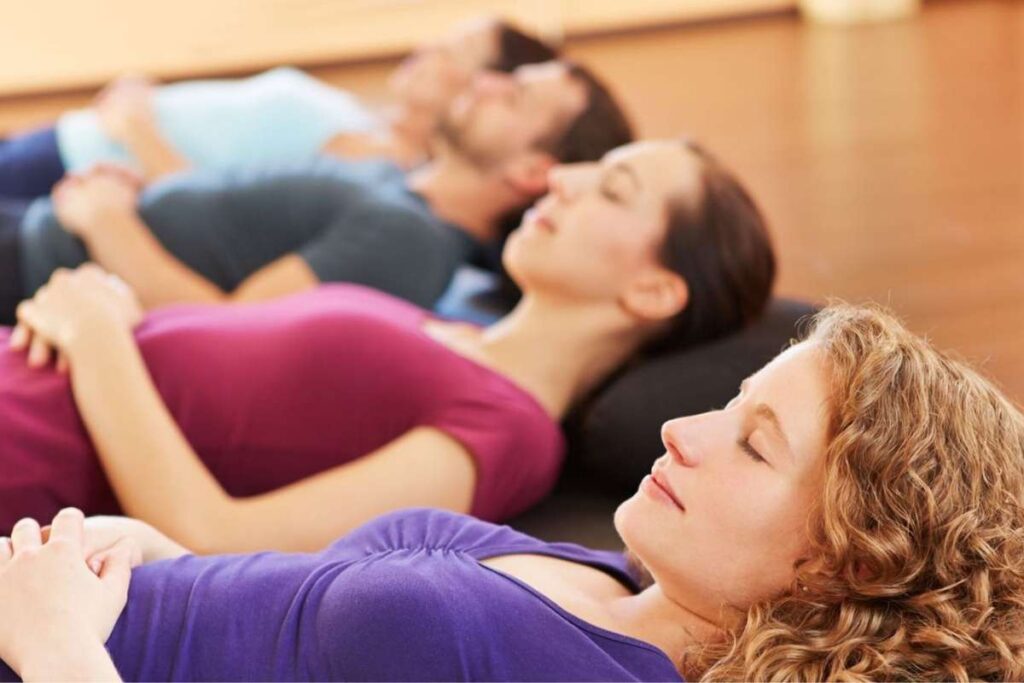
- Start with Diaphragmatic Breath (3 min): Get cozy and breathe into your belly to wake up your “calm” signals.
- Move to 4-7-8 Breathing (2 min): Use this to deeply relax your muscles and slow your heart.
- Finish with Box Breathing (2–3 min): End your session feeling steady, balanced, and ready for anything.
Advanced Sequence (15 Minutes)
- Coherent Breathing (5 min): Find a smooth, 5-second rhythm to sync your heart and lungs.
- Alternate Nostril (3 min): Focus on switching sides to balance your mind.
- Free Breath Focus (7 min): Sit quietly and just notice your natural breath flowing in and out.
Quick Stress Relief (2–3 Minutes)
If you are in a rush, do 3 cycles of 4-7-8 breathing. It is the fastest way to use breathing exercises for relaxation during a busy day. Using a timer or a breath-pacing app can help you stay on track!
Tips for Success:
To get the most out of breathing exercises for relaxation. Remember that being consistent is more important than practicing for a long time. Even doing just 3 to 5 minutes every day can make a huge difference in how you feel. It is like a workout for your brain!
How to Make it Work:
- Get Comfortable: Sit up straight or lie down in a quiet spot. Never force your breath. Let it feel natural and smooth.
- Listen to Your Body: If you ever feel dizzy or light-headed, stop and breathe normally for a moment. Everyone has a different pace.
- Pair it with Routines: Try practicing right after you wake up, during a school break, or as part of your bedtime ritual.
- Track Your Progress: Keep a small journal to write down how you feel after each session. Seeing your “calm” grow can be very motivating!
A Quick Note: While these tools are wonderful for stress, they are not a replacement for professional help. If you feel very overwhelmed, it is always okay to talk to a doctor or a counselor.
Expert Insight:
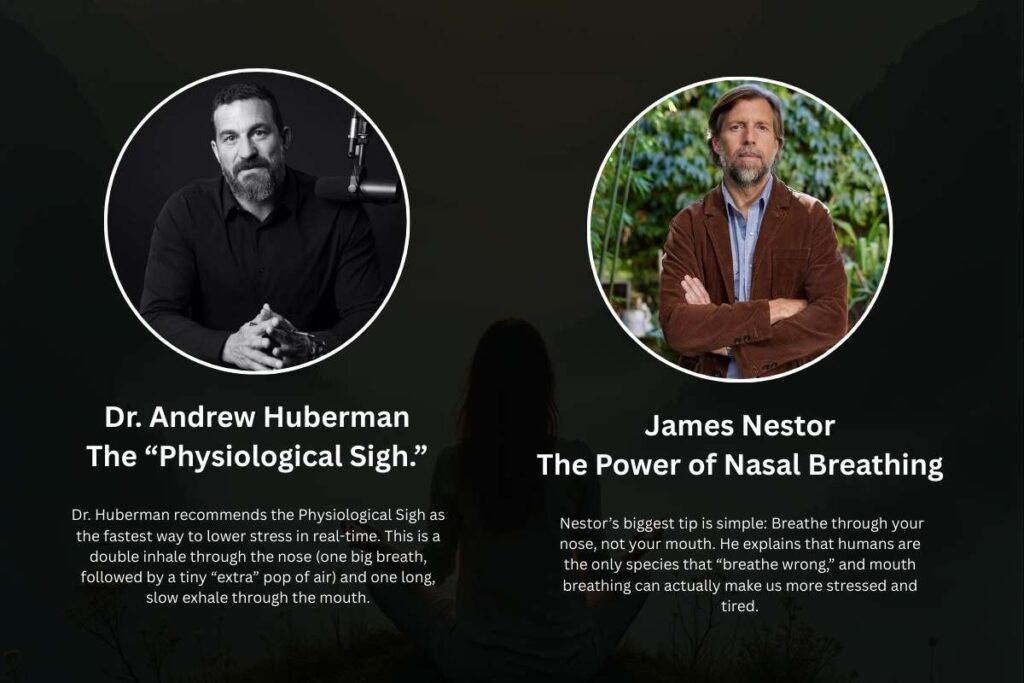
Dr. Andrew Huberman: The “Physiological Sigh.”
➢ Expert Profile: A Neuroscientist and Professor at Stanford University School of Medicine. He is famous for the Huberman Lab podcast. Where he shares science-based tools for health.
➢ The Insight: Dr. Huberman recommends the Physiological Shift as the fastest way to lower stress in real-time. This is a double inhale through the nose (one big breath, followed by a tiny “extra” pop of air) and one long, slow exhale through the mouth.
➢ Why it works: It pops open tiny air sacs in your lungs called alveoli, which helps your body get rid of extra carbon dioxide (CO2) and signals your brain to calm down immediately.
James Nestor: The Power of Nasal Breathing
➢ Expert Profile: A science journalist and author of the New York Times bestseller, Breath: The New Science of a Lost Art.
➢ The Insight: Nestor’s biggest tip is simple: Breathe through your nose, not your mouth. He explains that humans are the only species that “breathe wrong,” and mouth breathing can actually make us more stressed and tired.
➢ Why it works: Nasal breathing filters and warms the air. It also releases nitric oxide, which helps your blood flow better and tells your nervous system to stay in “rest and digest” mode.
Case Study: How Brief Breathing Exercises for Relaxation Improve Mood and Calm the Body
The peer-reviewed study titled “Brief Structured Respiration Practices Enhance Mood and Reduce Physiological Arousal.” This examined whether short, guided breathing interventions could produce measurable psychological and physiological benefits. Researchers evaluated multiple structured breathing patterns and assessed their effects on mood, heart rate, and indicators of autonomic nervous system activation.
Results showed that even brief sessions of paced breathing led to statistically significant improvements in mood. And reductions in physiological arousal. Participants demonstrated lower heart rate activation and reported decreased tension following the exercises. The findings suggest that slow, intentional respiration enhances parasympathetic activity. It is the body’s primary relaxation mechanism. Thereby reducing stress-related sympathetic dominance.
Importantly, the study confirms that structured breathwork is not just subjective or placebo-driven. It produces observable changes in both emotional state and autonomic regulation within minutes. These findings strengthen the evidence base supporting Breathing Exercises for Relaxation as a low-risk, accessible intervention for acute stress management and emotional stabilization.
Source: https://pmc.ncbi.nlm.nih.gov/articles/PMC9873947/
Conclusion:
You now possess a strong toolkit to manage stress when it arises. You are taking charge of your body and mind. By using these breathing exercises for relaxation. Remember that all you need to do is breathe. Perfection is not necessary. Every breath is a step toward a calmer, happier you. Whether you use 4-7-8 breathing to help you fall asleep or Box Breathing before a significant event. Observe how much better you feel as you continue to practice a little each day. All you need to do is take a deep breath to activate your “calm button.” It was always present!
FAQ:
1. How do breathing exercises for relaxation actually reduce stress?
Breathing exercises for relaxation work by activating the parasympathetic nervous system. It is often called the “rest and digest” system. Slow, controlled breathing lowers heart rate and reduces cortisol (the stress hormone). It then signals the brain that it is safe to relax. Over time, consistent practice can improve emotional regulation. And also provide resilience to daily stressors.
2. Are breathing exercises safe for everyone?
Breathing exercises are generally safe for most healthy adults. However, individuals with respiratory conditions (such as asthma or COPD), cardiovascular disorders, or a history of panic disorder should consult a healthcare professional before starting intensive breathwork techniques. Gentle diaphragmatic breathing is usually well tolerated.
3. What is the best breathing technique for anxiety?
Techniques that extend the exhale. Such as 4-7-8 breathing or slow diaphragmatic breathing. They are particularly helpful for anxiety. Longer exhalations stimulate the vagus nerve. This promotes calmness. The “best” technique varies by individual, so experimenting with a few methods is recommended.