
Almost 95% of business leaders know a major crisis will hit their company eventually. Yet, only 23% have a plan ready to survive it. When disaster strikes, standard management routines fall apart fast.
Knowing how to lead through a disaster is what keeps your business alive while competitors crumble. Learning from leaders who survived worst-case scenarios gives you a practical playbook for your own team.
Here are seven real crisis leadership examples from global brands. You will see the exact decisions, cash moves, and real-world results that saved these companies when everything went wrong.
How is crisis leadership different from PR damage control?
When severe trouble hits a business, crisis leadership means making real changes to operations, keeping people safe, and moving money where it is needed most.
PR damage control, on the other hand, is just an attempt to protect a company’s short-term image through public statements.
Surface-level public relations strategies rarely work when serious trouble strikes. Investors, employees, and customers can easily tell when a company is using a scripted apology to hide deeper operational issues.
| Focus Area | Crisis Leadership | PR Damage Control |
| Primary Goal | Fix underlying business problems and protect people | Guard short-term public reputation |
| Action Taken | Shift business models and reallocate money | Issue public statements and press releases |
| Communication Style | Open, honest, and direct | Vetted, cautious, and defensive |
| Primary Beneficiary | Customers, workers, and long-term investors | Immediate media perception |
Leading through major trouble requires three basic things: steady nerves, total honesty, and the courage to shift funds fast. Leaders must balance keeping the company solvent with looking after frontline staff, clients, and regulators.
Top 7 crisis leadership examples in modern business history
This summary table outlines seven memorable crisis leadership examples, showing the business challenge, the strategy used, and the bottom-line result.
| Leader & Company | Crisis Event | Strategy | Result |
| Arne Sorenson (Marriott) | Global Travel Shutdown | Gave up personal salary and spoke openly on video | Restructured company debt and brought stock to new highs |
| Mary Barra (General Motors) | Fatal Ignition Switch Defect | Oversaw massive recall and created an internal whistleblower safety program | Rebuilt customer trust and launched record-breaking sales years |
| Risto Siilasmaa (Nokia) | Phone Business Collapse | Sold failing phone division and switched to network gear | Built over $25 billion in telecom infrastructure revenue |
| Patrick Doyle (Domino’s Pizza) | Public Quality & Product Backlash | Launched honest ad campaign admitting bad quality and overhauled recipe | U.S. same-store sales grew 9.7% at company-owned stores and 10.0% at franchise stores in 2010 |
| Alan Mulally (Ford) | Impending Cash Collapse & Recession | Mortgaged assets for $23.6B cash early and united under “One Ford” | Only Detroit automaker to avoid bankruptcy and a government bailout |
| Jørgen Vig Knudstorp (Lego) | Impending Bankruptcy | Cut 30% of non-core products and refocused on main bricks | Became the most profitable toy company in the world |
| Brian Chesky (Airbnb) | Overnight Revenue Shock | Shifted focus to local stays, cut costs, and restructured operations | Rebounded to complete a record-setting IPO the same year |
1. Arne Sorenson (Marriott international): transparent human connection

When global travel came to a sudden halt, Marriott saw its revenue drop by roughly 90% in key markets within weeks. CEO Arne Sorenson faced an immediate threat to the world’s largest hotel chain.
Instead of hiding behind press releases, Sorenson recorded a plain-spoken video message to all global employees detailing the company’s financial realities. He shared his own fight with pancreatic cancer, gave up his salary for the year, and explained the pauses needed to keep the company alive.
By choosing simple honesty over polished rhetoric, Sorenson kept the trust of his workforce. Marriott successfully rearranged its debt and saw its market value climb to record highs as travel returned.
2. Mary Barra (general motors): fixing operational failure
Shortly after Mary Barra became CEO of General Motors, she faced a deadly ignition-switch defect that had gone unaddressed for years. The problem led to crashes, deaths, recalls, and major questions about GM’s safety culture.
Barra responded by launching an internal investigation, addressing the issue publicly, and pushing the company to make safety concerns easier to report. In April 2014, GM introduced its “Speak Up for Safety” program, encouraging employees to raise safety concerns quickly and directly.
Barra made the goal clear when she told employees: “GM must embrace a culture where safety and quality come first.”
She also told employees that they should raise safety concerns “quickly and forcefully” and be recognized for doing so.
This was an important shift because the investigation found that GM’s problem was not simply one bad decision. The Conference Board noted that employees had failed to bring critical information to senior leaders, pointing to deeper problems in how the company handled bad news.
Barra’s response therefore went beyond managing the immediate crisis. It focused on changing how employees reported problems before they could become bigger safety failures.
3.Risto Siilasmaa (Nokia): facing hard realities

Between 2007 and 2012, Nokia lost about 90% of its phone market value as smartphones quickly dominated the market.
Board Chairman Risto Siilasmaa forced the leadership team to face reality rather than defend declining phone sales. He led the deal to sell Nokia’s struggling phone business to Microsoft for $7.2 billion while buying full control of Nokia Siemens Networks.
| Old Business Focus | Strategic Change | Revenue Outcome |
| Mobile Handset Division | Sold to Microsoft for $7.2 billion | Reallocated capital into infrastructure |
| Network Infrastructure | Purchased full control of Siemens unit | Created $25B+ in annual infrastructure sales |
This bold shift turned Nokia into a network infrastructure powerhouse. According to Nokia’s annual reports, changing direction rebuilt the firm’s value, creating over $25 billion in yearly network sales.
4. Patrick Doyle (Domino’s pizza): leading a product turnaround
By 2009, Domino’s was under pressure to improve its core pizza business, with domestic same-store sales declining during the first half of the year. The company responded with its “Pizza Turnaround” campaign, openly admitting that its pizza needed improvement and introducing a completely new recipe.
Patrick Doyle played an important role in carrying that turnaround forward. He became Domino’s president and CEO in March 2010, shortly after the new pizza and campaign were launched. Under his leadership, the company continued to build on the turnaround by investing in the product, technology, digital ordering, and the customer experience.
Rather than treating the campaign as a one-time marketing move, Doyle helped turn it into a broader business strategy. Domino’s 2010 results showed 9.7% growth in U.S. company-owned same-store sales and 10.0% growth at franchise stores, showing that the turnaround was gaining traction.
His leadership lesson is useful: admitting a problem only matters when leaders are willing to support that message with real changes to the business.
| Crisis | Doyle’s Leadership Role | Result |
| Falling sales and a weak product reputation | Continued the pizza turnaround, backed product improvements, and invested in technology and customer experience | U.S. same-store sales grew 9.7% at company-owned stores and 10.0% at franchise stores in 2010 |
5. Alan Mulally (ford motor company): spotting the storm early

Alan Mulally’s story is one of the clearest crisis leadership examples because he acted before Ford’s financial crisis became impossible to manage.
In 2006, Ford was losing billions of dollars and bleeding cash fast. Newly appointed CEO Alan Mulally recognized that Ford suffered from internal silos, hidden operational problems, and an impending industry cash crunch long before others saw it.
Mulally took immediate action two years before the 2008 financial crisis hit. He mortgaged all of Ford’s assets, including the iconic blue oval logo, to raise $23.6 billion in cash reserves before credit markets froze.
He also launched the “One Ford” plan, cutting duplicate vehicle platforms and forcing senior managers to share honest, color-coded updates on operational bottlenecks.
| Initial Threat | Strategic Response | Business Outcome |
| Massive cash burn & hidden operational flaws | Raised $23.6B in cash early & created “One Ford” plan | Only major U.S. automaker to avoid bankruptcy and a government bailout |
When the Great Recession arrived, Ford was the only major American automaker that did not need a taxpayer bailout or bankruptcy protection.
Mulally’s early foresight protected the brand’s independence, restored profitability, and allowed Ford to repay its debt in full.
6. Jørgen Vig Knudstorp (LEGO): cutting costs to save the business
In 2004, Lego was facing serious financial trouble after reporting a DKK 1.688 billion loss. The company had expanded into areas beyond its core toy business, while declining sales and high costs put further pressure on the company.
New CEO Jørgen Vig Knudstorp moved to simplify the business and cut costs. LEGO reduced non-core activities, introduced major cost-saving measures, and sold its LEGOLAND Parks in 2005 to focus more closely on its core business.
| Root Cause of Crisis | Management Fix | Outcome |
| Heavy losses, high costs and non-core activities | Cut costs, reduced non-core activities and sold LEGOLAND Parks | Profit before tax improved from a DKK 1.688B loss in 2004 to a DKK 702M profit in 2005 |
By cutting costs and focusing more closely on its core toy business, Knudstorp helped put LEGO back on a stronger financial path. LEGO’s operating results improved sharply in 2005, with profit before tax reaching DKK 702 million.
7. Brian Chesky (Airbnb): pivoting during a sudden market collapse

When global travel came to a halt in early 2020, Airbnb lost 80% of its bookings almost overnight. The company was prepping for an initial public offering (IPO) that suddenly looked impossible.
CEO Brian Chesky acted fast. He paused non-core projects, cut operating costs, and raised emergency financing. He then noticed a new trend: people wanted short travel stays closer to home. He quickly redesigned the app to promote local stays and remote-work rentals.
| Initial Shock | Operational Shift | Result |
| 80% drop in bookings overnight | Refocused app on local stays & long-term rentals | Completed a historic $100B+ IPO late in 2020 |
This fast pivot saved the business model. Airbnb rebounded so strongly that it went public later that year in one of the tech industry’s largest IPOs.
Success vs. Failure: how leaders respond to a crisis
The table below shows the differences between strong leadership choices and poor organizational responses across key areas.
| Key Area | Strong Crisis Response | Poor Crisis Response |
| Communication | Responds within hours with clear, simple messages | Waits days or weeks and uses formal statements |
| Use of Money | Quickly spends money to protect people and fix key problems | Holds back money to protect short-term profits |
| Leadership | Takes responsibility and stays visible | Blames others and stays out of sight |
| Long-Term Plan | Makes real changes to prevent future problems | Focuses only on getting through the current crisis |
4 steps leaders can learn from crisis leadership examples
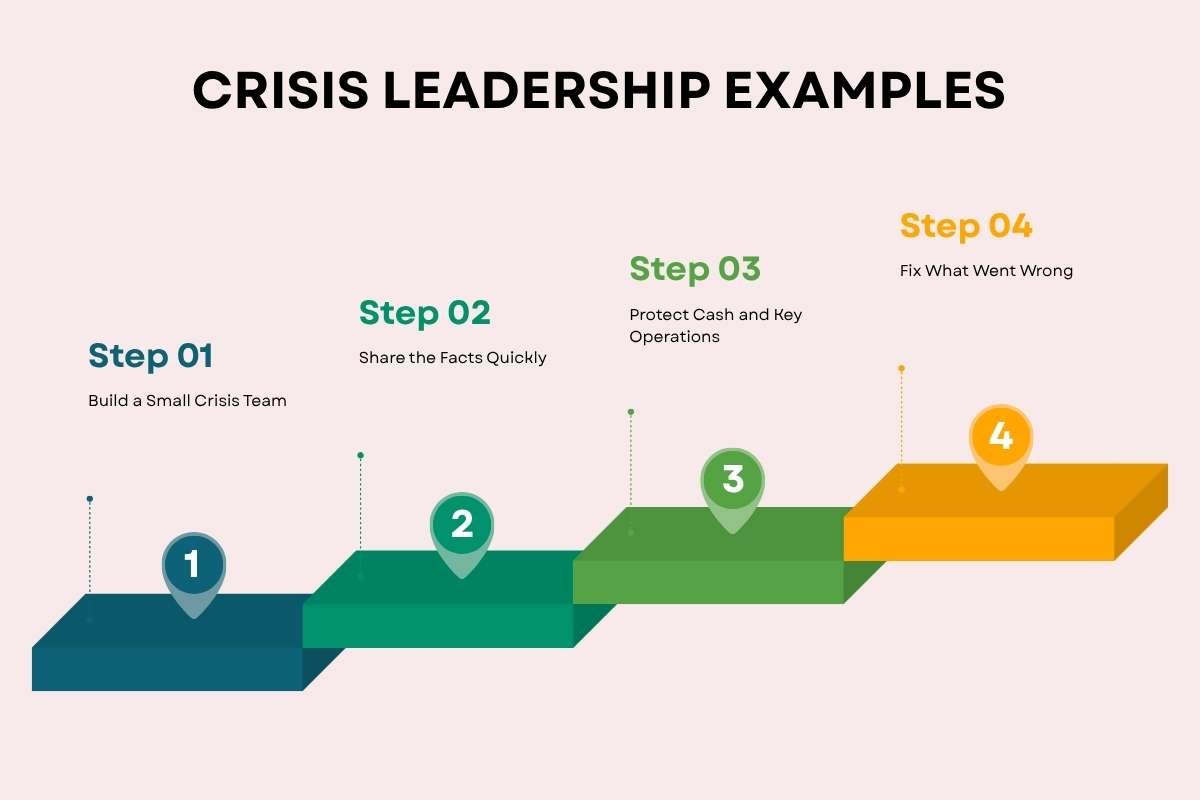
The crisis leadership examples in this article show that strong responses often start with a few basic actions. When a major crisis hits, leaders need to act quickly and stay focused. These four steps can help protect the business and guide the team.
1. Build a small crisis team
- Keep the crisis team separate from daily business work.
- Give a small group the power to make quick decisions.
- Keep roles clear so everyone knows what they need to do.
2. Share the facts quickly
- Speak to employees, customers, and investors within hours.
- Be clear and honest about what happened.
- Share what you know instead of hiding behind carefully written PR statements.
3. Protect cash and key operations
- Stop spending on things the business does not need right now.
- Move money toward critical areas that keep the business running.
- Focus spending on safety, customers, employees, and core operations.
4. Fix What Went Wrong
- Review what happened once the crisis is under control.
- Find the gaps that made the problem worse.
- Update processes and rules to help the team handle a similar crisis better next time.
How business leaders measure crisis preparedness?
The best crisis leadership examples show that strong preparation starts before trouble hits. Business leaders can track a few simple metrics to see how ready their teams are.
- Simulation Frequency: How often senior managers run practical crisis drills (a minimum of twice per year is best).
- Mean Time to Alignment (MTA): The total hours needed for top managers to meet, pick a strategy, and give public guidance after trouble starts.
- Sentiment Tracking: Real-time monitoring of employee morale and customer trust scores during a disruption.
- Cash Runway: The total number of days a business can operate if normal revenue stops completely.
Conclusion
A crisis can test every part of a business, but strong leadership can shape what happens next. These crisis leadership examples show that clear decisions, honest communication, and the ability to act early can help companies recover and come back stronger.
The real lesson is simple: prepare before the crisis, stay calm when it hits, and be ready to change course when needed.
Frequently asked questions
1. Who should be part of a crisis leadership team?
It should include senior leaders from key areas such as operations, finance, legal, communications, and human resources.
2. How can leaders make better decisions when facts are unclear?
Use the best information available, separate facts from assumptions, and update decisions as new information comes in.
3. When should a company involve legal or regulatory teams during a crisis?
As soon as the crisis may involve safety, legal duties, reporting rules, contracts, or possible regulatory action.
4. How should companies handle a crisis involving suppliers or partners?
Identify critical suppliers early, check backup options, and agree on how information and responsibilities will be shared.
5. What are some useful Crisis Leadership Examples for smaller businesses?
Small businesses can learn from how larger firms make decisions, manage risk, protect trust, and adjust when conditions change.