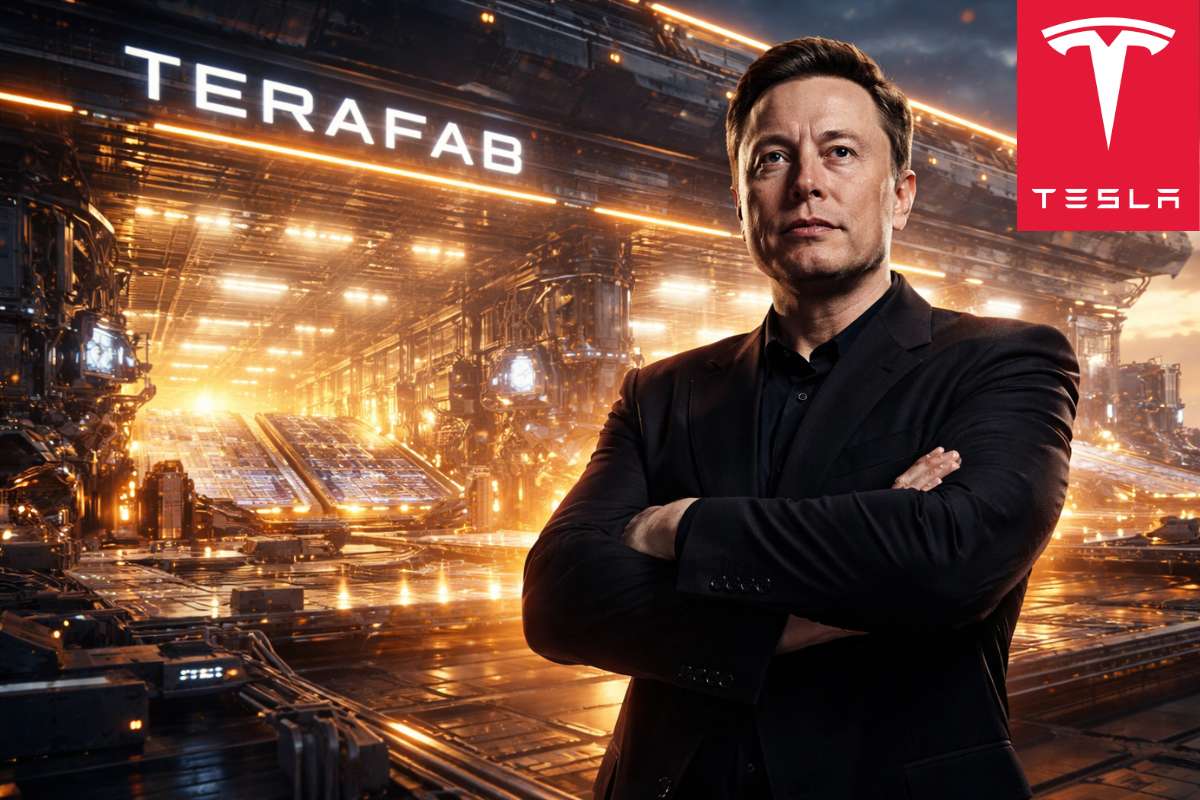
Tesla is preparing to launch a new project, Tesla Terafab, aimed at producing advanced artificial intelligence chips, a move that signals the company’s growing focus on AI infrastructure and next-generation computing. The initiative, known as “Terafab,” is expected to begin within a week, according to comments from Tesla CEO Elon Musk.
The project is designed to support Tesla’s rapidly expanding AI ambitions, particularly in areas such as autonomous driving, robotics, and high-performance data processing. As Tesla vehicles increasingly rely on sophisticated software and machine learning systems, the need for powerful computing chips has become central to the company’s long-term strategy.
At present, Tesla depends largely on external semiconductor manufacturers for chip fabrication. However, the increasing demand for advanced processors used in AI systems and electric vehicles has exposed supply-chain risks across the global semiconductor industry. By moving toward in-house chip production, Tesla aims to secure a more reliable supply of critical components while accelerating innovation in its technology stack.
The Tesla Terafab project is expected to focus on the production of next-generation AI processors designed specifically for Tesla’s ecosystem, enabling faster data processing and improved performance for future vehicles and AI-driven systems.
Massive Investment Reflects Tesla’s Long-Term AI Vision
The scale of the Tesla Terafab initiative underscores the magnitude of Tesla’s ambitions. Industry estimates suggest that a full-scale semiconductor fabrication facility could require an investment of $20 billion to $30 billion, depending on location and technological scope.
Such a facility would represent one of the most significant capital projects undertaken by the company outside its electric vehicle manufacturing plants. If completed, it could allow Tesla to control the entire lifecycle of its AI hardware from chip design to production, strengthening its vertical integration strategy.
Tesla already designs specialized processors used in its autonomous driving systems. However, the actual manufacturing of these chips has traditionally been carried out by external foundries. Establishing a dedicated fabrication facility would mark a major shift in how the company develops and deploys its computing technology.
The investment also reflects the broader industry race to build advanced semiconductor capacity, particularly as demand for AI chips continues to surge across sectors such as automotive technology, cloud computing, and robotics. For Tesla, the ability to produce its own processors could reduce reliance on global chip suppliers and offer greater flexibility in scaling AI capabilities.
AI Hardware Seen as Key to Tesla’s Future Technologies
Artificial intelligence has become a cornerstone of Tesla’s long-term roadmap. The company’s vehicles already rely on powerful onboard computers to process massive amounts of real-time data from cameras and sensors, enabling driver-assistance systems and autonomous driving features.
More advanced AI chips could significantly expand these capabilities. Faster processors allow neural networks to analyze complex driving environments more quickly, improving safety, navigation, and automation in Tesla vehicles.
Beyond automobiles, Tesla is also investing heavily in robotics and AI infrastructure. Projects such as humanoid robots and large-scale AI training systems require enormous computing power, further increasing the importance of specialized processors.
If Tesla Terafab succeeds, Tesla could emerge as a more influential player not only in the electric vehicle industry but also in the rapidly evolving semiconductor and artificial intelligence sectors. Producing chips internally would enable tighter integration between hardware and software, an approach that has historically helped technology companies accelerate innovation.
However, semiconductor fabrication is among the most complex and capital-intensive manufacturing processes in the world. Building and scaling such facilities often takes years and requires cutting-edge engineering expertise. As a result, while Tesla’s announcement highlights its aggressive push into AI hardware, the project’s full impact will likely unfold over a longer timeline.
Still, the planned launch of Terafab reflects Tesla’s determination to expand beyond electric vehicles and position itself at the center of the global AI revolution.