Key Points:
- Van Allen Probe A reentered after 14 years in orbit.
- It revealed new insights, including a temporary third radiation belt.
- Its data continues to guide space science today.
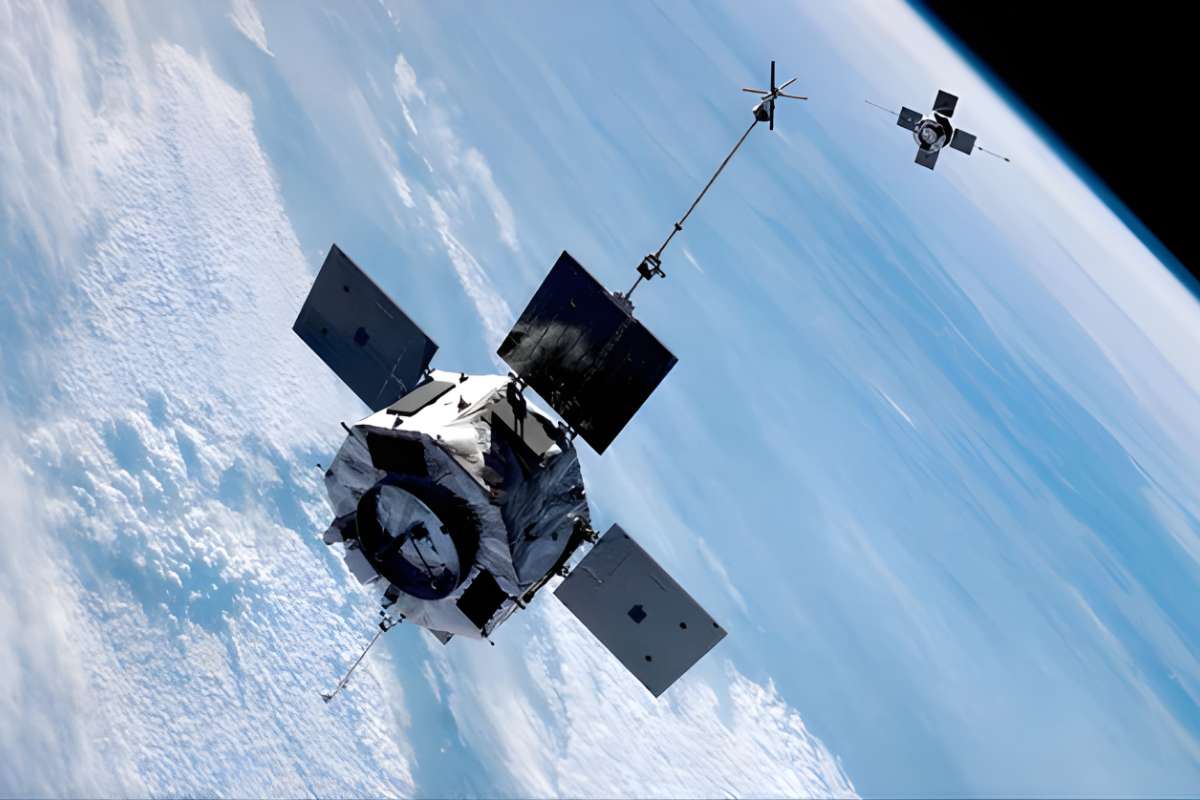
A long-retired NASA spacecraft that once played a crucial role in studying Earth’s radiation environment has reentered the planet’s atmosphere, concluding a mission that significantly advanced space science. The satellite, known as Van Allen Probe A, made its final descent over the eastern Pacific Ocean after spending more than a decade orbiting Earth.
Launched in August 2012, the spacecraft was part of NASA’s effort to better understand the radiation belts surrounding the planet. Weighing roughly 1,300 pounds (about 600 kilograms), the probe remained in orbit for nearly 14 years before atmospheric drag gradually pulled it back toward Earth.
Originally, scientists had predicted that the satellite would stay in orbit until the mid-2030s. However, stronger solar activity associated with the current solar cycle caused Earth’s upper atmosphere to expand slightly, increasing drag on the spacecraft and accelerating its orbital decay.
Tracking systems monitored the probe closely as it approached reentry. While the exact timing of such events is difficult to predict due to changing atmospheric conditions, experts were able to estimate the general window in which the satellite would fall back to Earth. As it plunged through the atmosphere, most of the spacecraft burned up due to the extreme heat generated during reentry.
Extremely Low Risk to People on the Ground
Despite the dramatic nature of satellite reentries, space agencies emphasized that the event posed minimal risk to the public. The vast majority of spacecraft components disintegrate during atmospheric reentry because of temperatures that can reach thousands of degrees Celsius.
While small fragments can occasionally survive and reach the ground, the chances of them hitting populated areas are extremely low. Experts estimate that the probability of debris causing injury is incredibly small compared to everyday risks.
One reason for this low danger is the geography of the planet. Around 71% of Earth’s surface is covered by oceans, and much of the remaining land area consists of sparsely populated regions. As a result, most pieces from falling satellites end up in remote areas or open water.
Satellite reentries are not unusual. Over the past several decades, numerous defunct spacecraft and rocket stages have naturally fallen back to Earth after completing their missions. Historically, these events have rarely resulted in any damage or injuries.
Van Allen Probe A had actually completed its operational mission several years earlier. NASA shut down the spacecraft in 2019 after it exhausted its fuel supply, leaving it unable to maintain its orientation toward the Sun to generate power. From that point onward, the inactive satellite slowly descended in orbit until it finally reentered the atmosphere.
A Mission That Transformed Understanding of Space Radiation
Although its final return marked the end of the spacecraft’s journey, the mission itself is widely considered a major scientific achievement. Van Allen Probe A was launched alongside its twin spacecraft as part of NASA’s “Living With a Star” program, which focuses on understanding how solar activity influences Earth and its surrounding space environment.
The probes were designed to study the Van Allen radiation belts, two massive zones of high-energy charged particles trapped by Earth’s magnetic field. These radiation belts play a crucial role in shielding the planet from harmful solar radiation but can also disrupt satellites, communication systems, and even astronauts traveling through space.
During its years of operation, the spacecraft delivered groundbreaking insights into how these radiation belts behave. Among its most notable discoveries was the identification of a temporary third radiation belt that can form during periods of intense solar activity, something scientists had never observed before.
The mission also helped researchers better understand how energetic particles move through Earth’s magnetic field and how solar storms influence the space environment around the planet. These findings are critical for improving satellite design, protecting astronauts, and forecasting space weather that could affect modern technology on Earth.
Even though Van Allen Probe A has now burned up in the atmosphere, the data it collected continues to shape scientific research. Together with its twin spacecraft, the mission provided one of the most detailed looks ever at the dynamic radiation environment surrounding Earth, leaving behind a legacy that will guide future space exploration for years to come.