Key Points:
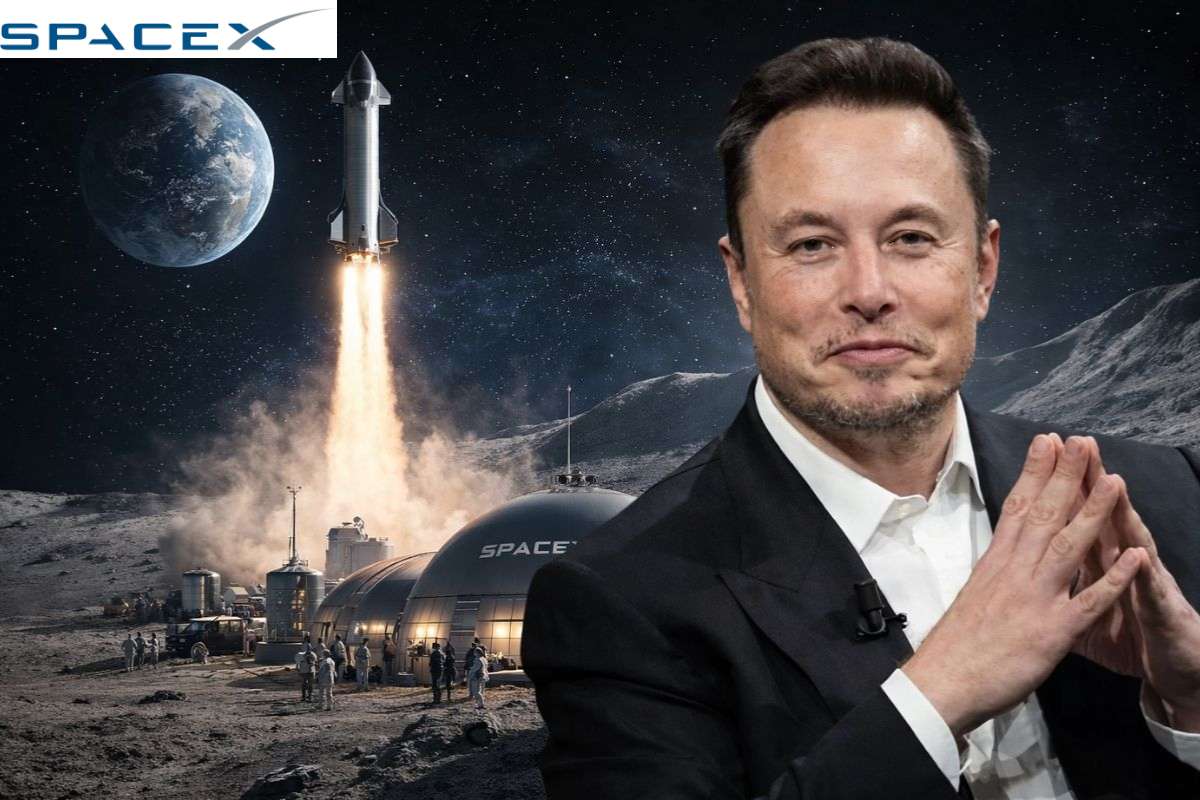
- SpaceX is shifting focus from Mars to building a sustainable human presence on the Moon, with Elon Musk’s Moon mission emphasising a self-sustaining lunar city first.
- This pivot intensifies competition with Blue Origin and aligns with NASA’s lunar ambitions.
- Mars remains a long-term goal, with lunar development serving as a stepping stone.
SpaceX appears to be recalibrating its long-term space ambitions, shifting its primary focus from Mars colonisation to establishing a sustainable human presence on the Moon. Elon Musk, the company’s founder and CEO, has recently emphasised the practicality of building what he describes as a “self-sustaining city” on the lunar surface before attempting deeper interplanetary missions.
For years, Mars has been central to Elon Musk’s Moon mission vision of making humanity a multiplanetary species. However, the logistical and technological challenges of sending humans to Mars, including long-duration space travel, life-support sustainability, and safe return strategies, remain formidable. By contrast, the Moon offers a significantly shorter travel time, more frequent launch windows, and the possibility of faster infrastructure development.
Industry analysts view this pivot as both pragmatic and strategic. A lunar settlement could serve as a testing ground for life-support systems, habitat construction, and in-situ resource utilisation, all of which would be essential for eventual Mars missions. Additionally, near-term lunar milestones may be easier to demonstrate, providing measurable progress toward broader exploration goals. The shift also positions SpaceX more closely alongside current international lunar initiatives, where public and private collaboration is intensifying.
Renewed Rivalry in the Commercial Space Race
The renewed emphasis on the Moon has intensified competition within the private aerospace sector. SpaceX now finds itself in more direct alignment and rivalry with Blue Origin, which has consistently prioritised lunar exploration through its lander programs and heavy-lift rocket development.
Blue Origin’s strategy has centred on steady, methodical progress toward supporting lunar infrastructure and cargo transport. In recent months, the company has redirected resources away from suborbital tourism projects to focus more aggressively on its Moon-focused systems. This recalibration signals a broader industry trend: commercial players are increasingly targeting lunar contracts, infrastructure partnerships, and technology demonstrations that support long-term habitation.
NASA’s lunar ambitions have further amplified the stakes. With the agency aiming to establish a sustained human presence on the Moon, private companies are under mounting pressure to deliver reliable lander systems and launch capabilities. The competition is no longer symbolic; it carries substantial financial implications and could determine leadership in the next era of space exploration.
Elon Musk’s Moon mission observers Market & also note that SpaceX’s evolving strategy comes amid speculation about future financial milestones for the company. Achievable lunar objectives may resonate more strongly with investors than distant, high-risk Mars timelines, strengthening SpaceX’s near-term positioning in the commercial space economy.
Mars Remains a Vision, But a Longer-Term One
Despite the strategic pivot, Mars has not disappeared from SpaceX’s roadmap. Elon Musk’s Moon mission continues to describe the Red Planet as the ultimate objective, framing lunar development as a stepping stone rather than a replacement. The technologies required for a Moon settlement, advanced propulsion, reusable launch systems, habitat engineering, and resource extraction, would directly inform future Mars missions.
However, experts caution that even lunar settlement remains an immense technical undertaking. Sustaining human life on the Moon will demand reliable energy generation, radiation protection, and supply chain resilience. Building a “self-growing” lunar city represents a bold ambition that will require breakthroughs in autonomy, robotics, and closed-loop life-support systems.
Still, the shift signals a maturing phase in commercial space strategy. Rather than leap immediately toward Mars, SpaceX appears to be embracing a phased approach, consolidating capabilities closer to Earth before venturing farther into deep space.
As the commercial space race accelerates, the Moon is once again becoming the proving ground for humanity’s next giant leap. Whether it ultimately becomes a permanent settlement or a staging point for Mars, the direction of private space exploration has unmistakably changed.
Visit Visionary CIOs Magazine for the latest information.