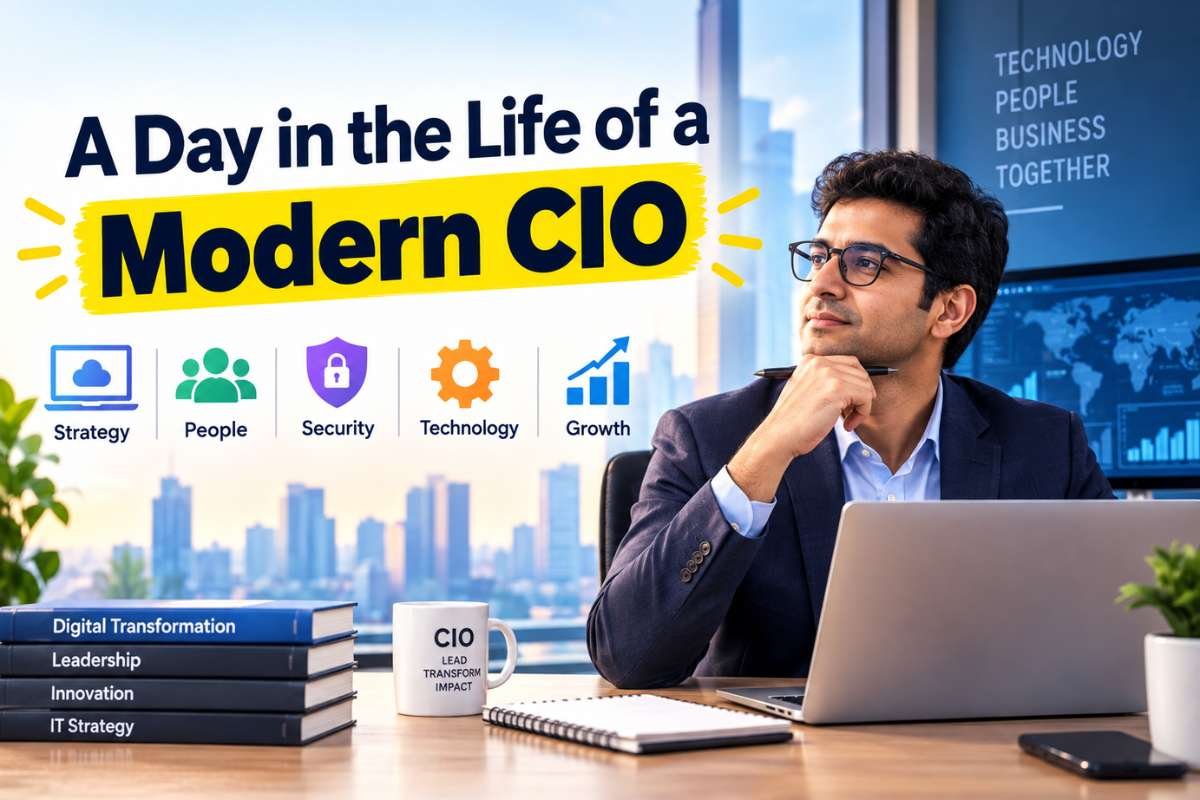
How much of a CIO’s day is actually spent managing IT?
The answer has changed as technology has become more closely tied to business strategy. Today, a CIO may balance AI, cybersecurity, data, digital transformation, technology spending, and daily IT operations.
A day in the life of a modern CIO can include reviewing overnight issues, meeting with the CFO about technology spending, evaluating an AI project, discussing cybersecurity risks, and working with technology teams on key priorities.
To understand what fills that calendar, it helps to first look at how the CIO role itself has changed.
How has the CIO role changed from it operator to business strategist?

The traditional CIO job centered heavily on keeping technology systems available, supporting employees, managing infrastructure, and delivering IT projects. Those responsibilities remain important, but they no longer describe the full scope of the role.
Cloud computing, cybersecurity, data, automation, and AI have changed how technology affects the business. This makes the modern CIO increasingly responsible for turning technology into business value rather than serving only as the organization’s technology expert.
The shift can be seen in the areas that now compete for a CIO’s attention:
- Business strategy: Connecting technology investments with growth, productivity, customer experience, and operating goals.
- AI adoption: Selecting useful AI use cases, setting governance standards, and moving projects beyond experimentation.
- Cybersecurity: Managing technology risk, resilience, data protection, and business continuity.
- Data strategy: Making sure data can support decisions, automation, analytics, and AI.
- Digital transformation: Modernizing processes, applications, and operating models.
- Technology investment: Deciding where limited budgets should create the most business value.
- Talent: Building the skills and leadership structure needed to execute the technology strategy.
This does not mean CIOs have stopped focusing on uptime, infrastructure, applications, or service delivery. They now also need to connect reliable IT operations to wider business goals.
CIOs must explain technology decisions in business terms that other executives can understand. For example, a cybersecurity investment can help reduce business disruptions, meet regulations, protect customer trust, and keep operations running.
What does a day in the life of a modern CIO look like?
There is no typical CIO schedule. A day in the life of a modern CIO can vary based on company size, industry, and current business priorities.
| Time | Typical CIO Focus | Business Purpose |
| 8:30–9:00 AM | IT health, security alerts, and overnight issues | Identify urgent risks before they affect operations |
| 9:00–10:30 AM | Leadership and executive meetings | Align technology priorities with business needs |
| 10:30 AM–12:30 PM | AI, transformation, and technology decisions | Direct investment toward strategic priorities |
| 12:30–1:30 PM | Business and team discussions | Resolve dependencies and support execution |
| 1:30–3:30 PM | Cybersecurity, vendors, budgets, or operations | Manage risk, costs, and delivery |
| 3:30–5:00 PM | Technology leadership and project reviews | Track execution and address major blockers |
| 5:00–6:00 PM | Strategy and planning | Protect time for longer-term priorities |
| After hours | Global teams, escalations, or next-day planning | Maintain continuity when needed |
The exact hours are less important than the mix of responsibilities.
For example, the day may begin with an operational issue that needs attention but quickly move into a discussion about an AI investment. Later, the CIO may review a cybersecurity risk with the CISO, discuss project funding with the CFO, and then spend time with the technology leadership team.
The unpredictability is part of the job. A CIO needs to stay aware of IT operations while delegating routine issues so they can focus on bigger business and technology decisions.
Which meetings take up a CIO’s day and why do they matter?
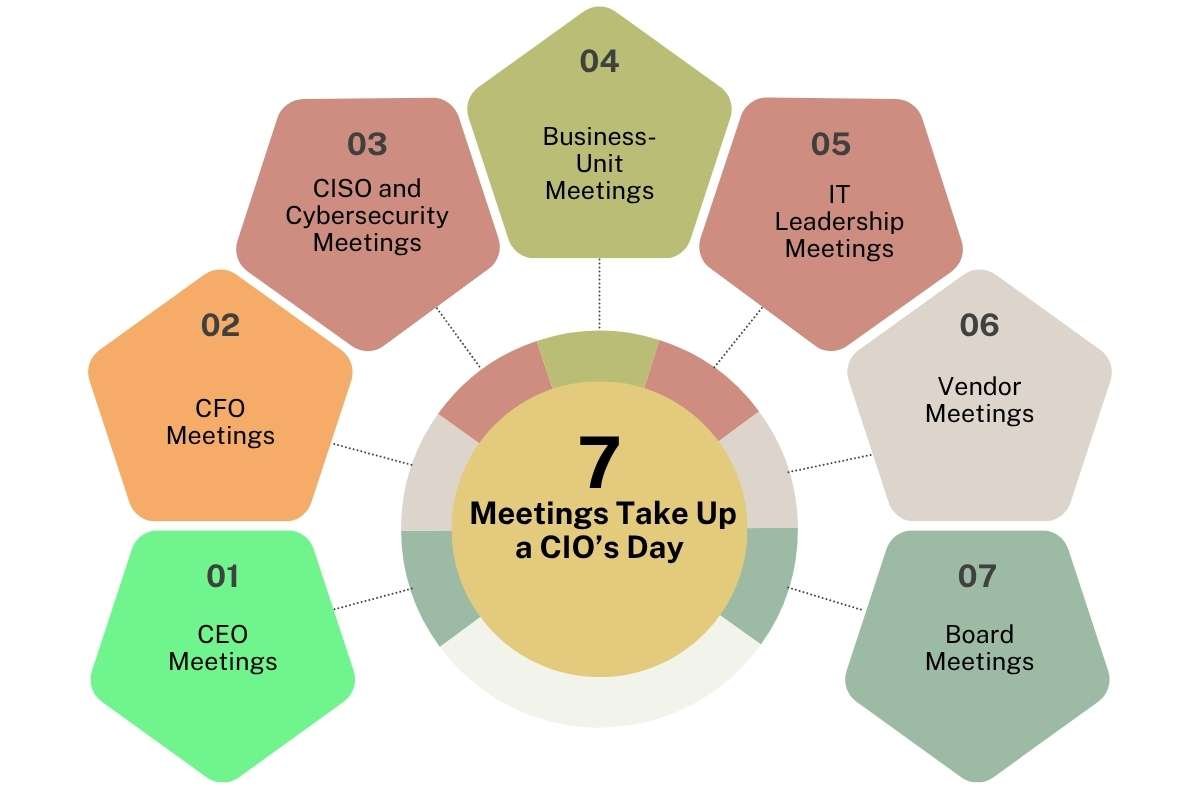
A CIO’s calendar can look meeting-heavy, but the meetings serve different purposes.The important question is what decisions those meetings enable during a day in the life of a modern CIO.
- CEO Meetings
The CEO discussion is often about where technology can support company strategy.
The CIO may discuss growth plans, customer experience, new products, operating models, major technology investments, or risks that could affect business performance.
- CFO Meetings
The CFO helps connect technology spending with the company’s financial goals. A CIO may discuss major technology investments, cloud costs, budgets, or whether an AI project is delivering real value.
- CISO and Cybersecurity Meetings
Cybersecurity is now a key business concern for CIOs.
Gartner’s 2026 guidance reports that 93% of boards see cybersecurity as a threat to business value, while 61% of CIOs see it as a business outcome.
So, a CIO’s security meetings can cover more than security alerts. They may discuss business risk, critical systems, data protection, third-party risk, regulatory needs, incident response, and business continuity.
- Business-Unit Meetings
A CIO cannot build an effective technology strategy from the IT department alone.
Meetings with sales, finance, operations, marketing, HR, or product teams help reveal where technology is slowing work down, where data is creating problems, and where new technology could support growth.
- IT Leadership Meetings
These meetings help the CIO stay informed without taking over every operational task.
Topics can include service performance, staffing, infrastructure, applications, project delivery, architecture, cybersecurity, and major incidents.
- Vendor Meetings
Technology vendors can take up significant executive time, particularly in large organizations.
A CIO may review contract performance, pricing, product roadmaps, service levels, security requirements, or whether an existing platform still fits the company’s needs.
- Board Meetings
At the board level, technology usually needs to be translated into business terms.
The discussion may focus on cybersecurity risk, technology investment, AI governance, resilience, regulatory exposure, or the role of technology in the company’s broader strategy.
The CIO is often translating technology into business decisions.
What technology decisions does a CIO make during the day?
A CIO makes technology decisions based on business needs, cost, risk, and expected value. Key decisions often include:
- AI and automation: Which AI use cases to fund, how to measure ROI, and what governance is needed.
- Cybersecurity: Where to increase security investment, which risks need attention, and whether systems can recover after an incident.
- Cloud and infrastructure: Which systems to move, modernize, or replace based on cost, performance, security, and resilience.
- Technology spending: Where to allocate the IT budget across AI, cybersecurity, data, infrastructure, and business systems.
- Data and digital transformation: How to improve data quality and governance and which transformation projects should move forward.
These decisions show why a day in the life of a modern CIO extends beyond traditional IT management.
What does a CIO do at small and large companies?

Company size can change the CIO role as much as industry does.
At a smaller company, the CIO may work directly with the CEO, manage a smaller technology team, oversee vendors personally, and stay close to operational issues. At a larger company, the CIO is more likely to work through specialized leaders and governance structures.
| Area | 50-Person Company | 5,000-Person Company |
| IT operations | More direct involvement | Specialized teams manage daily operations |
| Cybersecurity | Smaller internal team or external support | Dedicated security teams and leadership |
| Technology strategy | Broad and hands-on | Larger portfolio with formal governance |
| AI adoption | A smaller number of focused use cases | Multiple use cases across business functions |
| Vendors | Smaller vendor portfolio | Complex contracts and relationships |
| Talent | Direct hiring and team management | Multiple management layers and specialist roles |
| Budget | Fewer major investment decisions | More complex allocation across portfolios |
| Decision-making | Fewer layers and faster coordination | More stakeholders and governance |
The smaller company does not necessarily mean an easier CIO role. The CIO may have fewer layers between the technology function and the business, but that can also mean more direct responsibility.
In a 5,000-person organization, the CIO may spend less time solving individual technical problems and more time coordinating architecture, security, business units, budgets, vendors, and technology leaders.
What does a CIO measure at the end of the day?
The modern CIO needs more than a list of completed IT tasks. The useful measures connect technology performance to business outcomes:
| Area | What the CIO may review |
| IT operations | Availability, incidents, service performance |
| Cybersecurity | Risk exposure, incidents, recovery readiness |
| Technology spending | Budget performance, cost efficiency, investment value |
| AI | Adoption, use-case performance, measurable ROI |
| Digital transformation | Delivery progress, process improvements, business impact |
| Projects | Milestones, risks, dependencies, expected outcomes |
| Talent | Skills, hiring needs, leadership capacity |
| Business impact | Revenue support, productivity, customer experience, resilience |
Conclusion:
A day in the life of a modern CIO is not a fixed sequence of meetings or technical tasks. It is a constant balance between keeping today’s business running and deciding how technology should support tomorrow’s business.
As companies depend more on technology, the CIO’s role continues to grow. The job still involves keeping IT reliable, but it now also covers strategy, growth, resilience, and business goals.
FAQs
1. What skills does a CIO need to succeed?
A CIO needs skills in business strategy, cybersecurity, financial planning, communication, data, AI adoption, and technology leadership.
2. What does a CIO need to know about AI governance?
A CIO should understand data privacy, security, responsible use, regulatory requirements, human oversight, and how AI results will be measured.
3. How can someone prepare for a CIO career?
Experience across IT, business strategy, budgeting, leadership, and major technology projects can help build the skills needed for a CIO role.
4. What does a CIO need to report to the board?
A CIO may report on technology risks, major investments, cybersecurity, compliance, and how technology supports business priorities. This is one important part of a day in the life of a modern CIO.