Big empires rarely begin with their most famous product. When Jio launched in September 2016, millions of Indians signed up within weeks, and the company called it a major digital milestone. Yet the Reliance Industries digital empire was not built in a single day. A family known for textiles, petrochemicals and energy had been preparing for years.
This article traces that story across three generations of Ambanis. Dhirubhai laid the entrepreneurial and capital foundation. Mukesh inherited it and steered the group toward technology and consumer access. Akash, Isha, and Anant now step into formal leadership roles.
Three Generations:
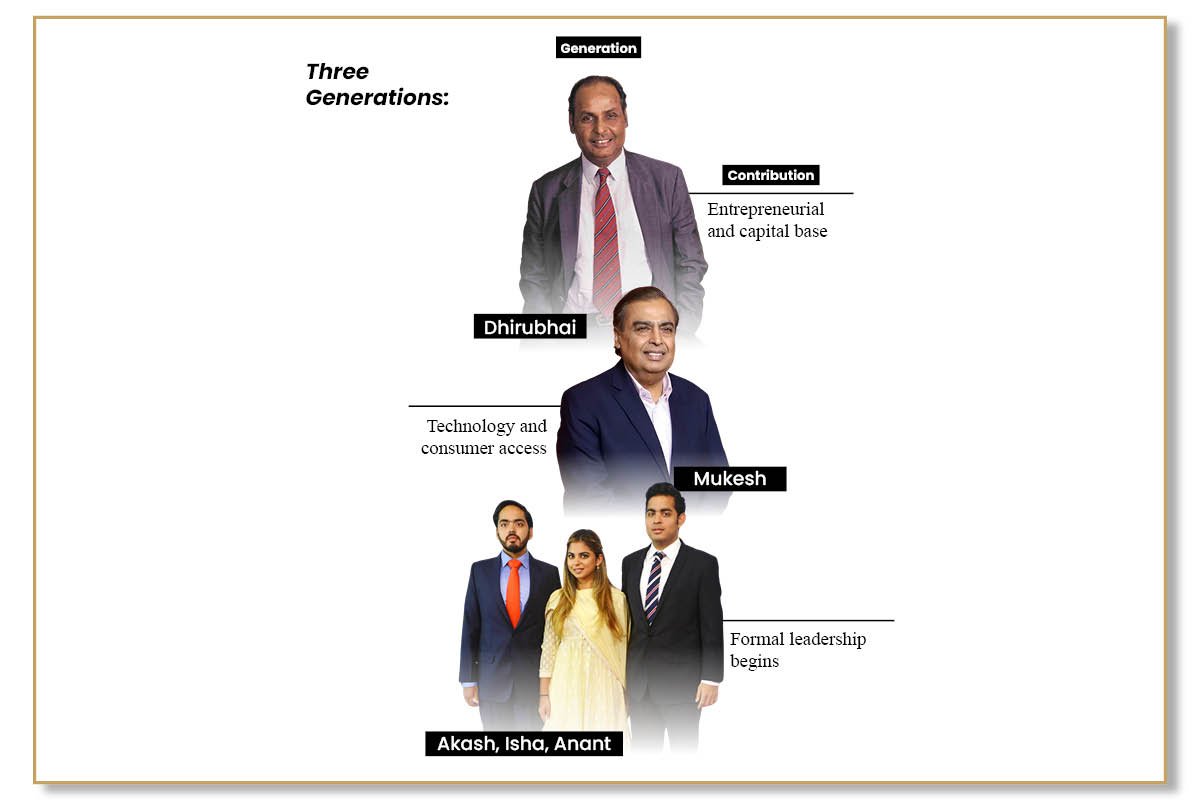
| Generation | Contribution |
| Dhirubhai | Entrepreneurial and capital base |
| Mukesh | Technology and consumer access |
| Akash, Isha, Anant | Formal leadership begins |
Jio’s launch was the visible result. The real explanation lies with one trader and the bold decisions he made decades earlier.
Dhirubhai Ambani built more than a company
Dhirubhai Ambani saw a business as a system he could own completely. Three decisions show his thinking.
- Control the Chain: He entered manufacturing so the company managed more of its own production, which protected margins and supply.
- Use the Capital Markets: The 1977 IPO of Reliance Textile Industries was oversubscribed seven times, the group says. Ordinary investors funded expansion and became lasting partners. Their trust gave the family capital whenever a new project needed it.
- Build a Brand: Vimal put the family name in front of shoppers and gave the business a consumer identity. Buyers could ask for the fabric by name.
These habits formed the base of the Mukesh Ambani business strategy, which the second generation later applied to a very different industry, digital services.
Industrial cash flow that funded a digital bet

Every part of the Reliance Industries digital empire traces back to an industrial cause. The table below shows how each asset created room for the next move.
| What the group had | What it allowed |
| Jamnagar refining complex | Steady cash flow for new bets |
| Energy and petrochemical operations | Balance sheet strong enough to borrow at scale |
| Decades of giant projects | Skill at building infrastructure on time |
Dhirubhai Ambani taught the group to build ahead of demand. The Mukesh Ambani business strategy applied that habit to telecom, where a network costing billions looked reckless to anyone without an industrial cushion. Jio was possible because the family had already built a company capable of making very large, long-term bets.
The family crisis that changed Reliance’s future
Dhirubhai Ambani died in 2002 with no formal succession plan. A bitter public dispute followed between his sons, Mukesh and Anil. In 2005, their mother, Kokilaben Ambani, brokered a settlement that divided the major family businesses and set the course for Mukesh Ambani business strategy.
Case File:
- Mukesh’s Share: Oil refining and petrochemicals.
- Cash Position: Steady earnings at a very large scale.
- Leadership: One clear owner of the group’s core.
- Timing: More than ten years before Jio launched.
What did Mukesh gain that allowed him to make the conglomerate’s next major bet? A capital base and large industrial assets, which later supported Jio and the Reliance Industries digital empire. That base gave him the freedom to borrow, build, and wait for returns.
Mukesh Ambani’s big bet was about India’s digital future
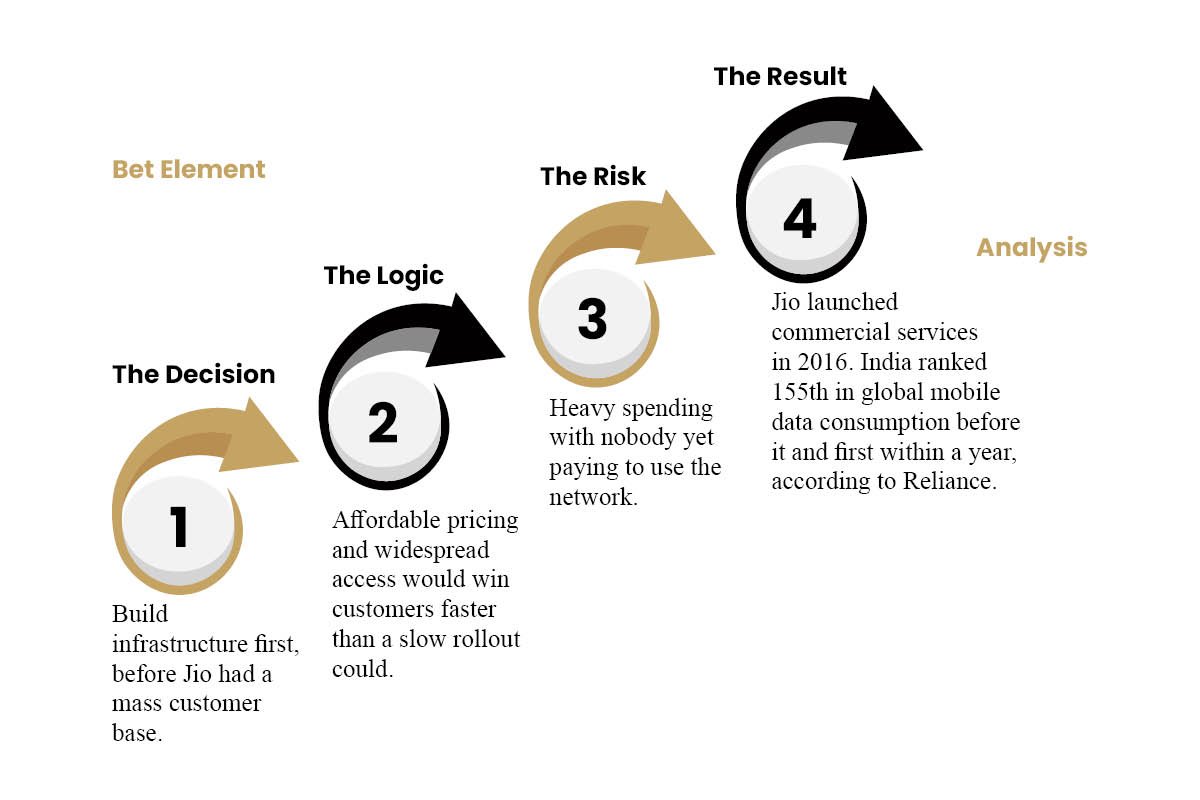
The Bet
Mukesh Ambani did not chase telecom because it paid well. He wanted connectivity at national scale, with digital services built on top of it. Revenue would follow once people were connected. The whole plan demanded patience, discipline, and very deep pockets.
| Bet Element | Analysis |
| The Decision | Build infrastructure first, before Jio had a mass customer base. |
| The Logic | Affordable pricing and widespread access would win customers faster than a slow rollout could. |
| The Risk | Heavy spending with nobody yet paying to use the network. |
| The Result | Jio launched commercial services in 2016. India ranked 155th in global mobile data consumption before it and first within a year, according to Reliance. |
Key insight: Commerce, entertainment, and payments could reach a ready and enormous audience of subscribers.
This Mukesh Ambani business strategy made connectivity the foundation for a much larger consumer platform and gave the family access to daily life.
Jio changed what Reliance could be
Jio gave the group a new public face, and Mukesh Ambani business strategy reshaped the conglomerate in three visible ways.
1. Identity: Energy, refining, and petrochemicals once defined the business. Technology and data now lead its plans.
2. Customers: Households were once reached indirectly. Jio now gives the group a direct relationship with millions of consumers.
3. Investors: Steady cash flows from industrial assets once anchored the pitch. Growth in digital services now carries it. In 2020, Meta, Google, Intel and Qualcomm backed Jio Platforms, and Reliance identifies these collaborations as part of its digital expansion. Their arrival as shareholders showed outside players accepted the new positioning.
The company’s centre of gravity now sits inside a Reliance Industries digital empire, and that shift defines the group’s direction today.
The Ambani made succession a business decision

How can a founding family pass control of its enterprise without repeating the previous generation’s disruption?
Q. What separated the two transitions?
The first ended with control divided between two brothers. The current one keeps the next generation inside a unified company, working toward one shared vision.
Q. Who steps in today?
Isha, Akash, and Anant Ambani joined the RIL board in 2023, each stepping into formal responsibilities inside the group.
Q. Why plan so early?
Shareholders, employees, and partners then know who will lead, and the company avoids a sudden leadership reset. Clear planning protects long-term business continuity, a principle central to Mukesh Ambani business strategy.
The years ahead will show how well this arrangement holds up as the group takes on its largest bets yet.
The real Ambani blueprint: think generations ahead
The family story leaves five principles behind. Together, these decisions built the Reliance Industries digital empire, and Jio is only its most visible result.
1. Build capital first. The largest bet needs funding secured well in advance.
2. Use scale as an advantage. Size lowers costs and gives pricing power.
3. Invest before the market matures. Early entry secures ground that latecomers cannot copy.
4. Own the customer relationship. Direct contact creates data, trust, and loyalty.
5. Prepare the next generation first. Training must finish before control changes hands.
This sequence defines Mukesh Ambani business strategy: patience first, ambition second.
Closing: Jio was the result, not the beginning
The Reliance Industries digital empire took decades to assemble, and every layer came from a choice made long before its payoff was visible. A trader’s ambition, a painful family settlement, and a costly network bet each played a part. Business builders can take a simple lesson from this record: lay foundations while the opportunity still has no name.
Thank You For Reading!
Know More
Inside The Top 20 Richest Men in the World and Their Business Strategies