Who owns technology strategy when a company has both a CIO and a CTO?
It sounds like a simple question, but the answer is not just that one manages IT while the other manages technology. As technology becomes more closely tied to how a business operates and competes, the two roles can overlap.
That makes the CIO vs CTO question important for CEOs, founders, and boards. Knowing who owns what can help avoid overlapping responsibilities, competing priorities, and slow technology decisions.
So, what actually separates these two roles? And when should a company have one technology leader rather than two?
What is the difference in CIO vs CTO roles?
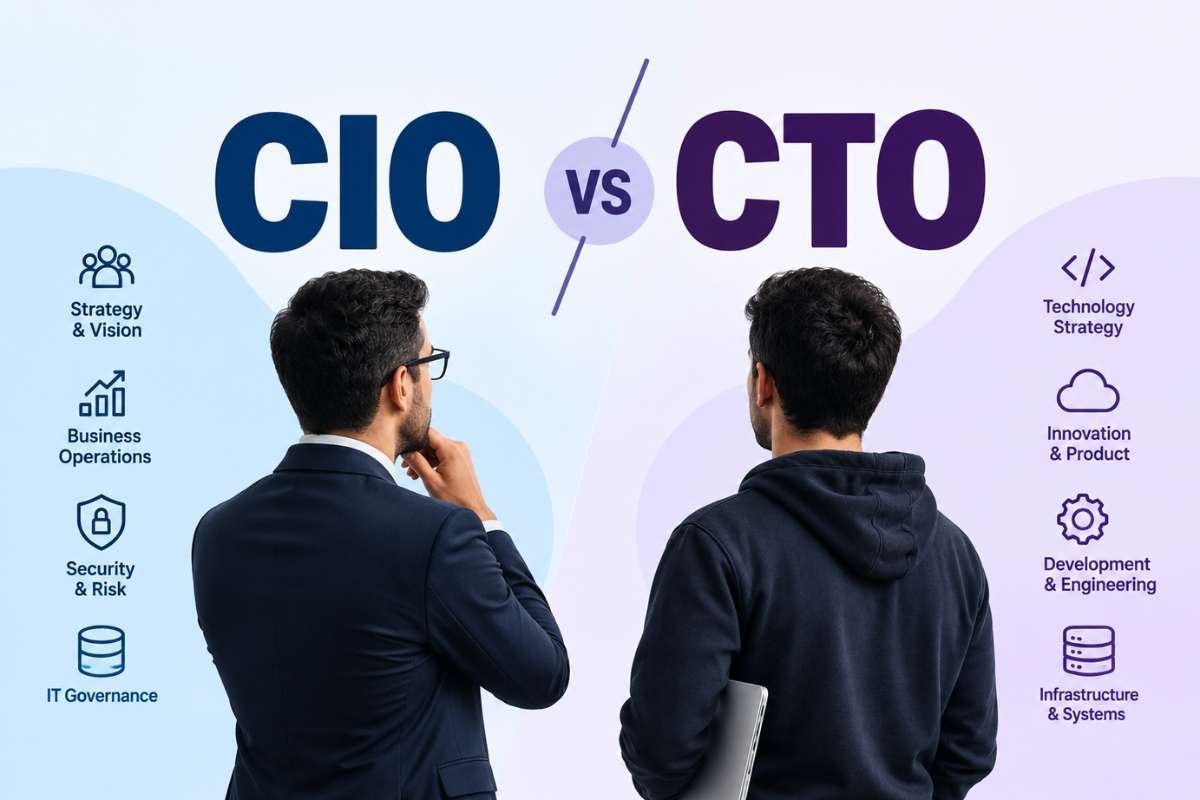
The key difference between a Chief Information Officer (CIO) and a Chief Technology Officer (CTO) is where they apply technology. The CIO typically oversees technology used across the business, while the CTO focuses on technology that supports products, services, and innovation.
However, the boundary is not fixed. Responsibilities vary by industry, company size, business model, and the role technology plays in creating revenue.
| CIO | Area | CTO |
| Internal technology and business operations | Primary focus | Technology, products, and innovation |
| Make the business more efficient, secure, and connected | Main objective | Use technology to improve products and competitive position |
| CEO, CFO, COO, employees and business units | Typical stakeholders | CEO, product teams, engineering, customers and partners |
| Enterprise IT, systems, data, infrastructure | Core technology | Product platforms, engineering, architecture and emerging technology |
| Cybersecurity, technology costs, resilience and operational disruption | Major risks | Technical debt, product risk, scalability and innovation risk |
| Efficiency, reliability, security, transformation and technology ROI | Success measures | Product performance, innovation, engineering delivery and technology-enabled growth |
There is overlap by design. A cloud platform, for example, can support internal operations while also powering a customer-facing product. Understanding the CIO vs CTO distinction is especially useful when CEOs assign accountability for large technology investments.
That distinction becomes especially useful when CEOs assign accountability for large technology investments.
What does a CIO manage in the CIO vs CTO structure?

A CIO is usually responsible for the technology that keeps the business running. This includes enterprise IT, infrastructure, information systems, technology budgets, cybersecurity, governance, and digital transformation.
The role also involves making sure technology investments support business goals. That means looking at whether a new system improves efficiency, reduces risk, supports growth, or solves a real business problem.
This becomes especially important when technology spending is spread across different teams. Without a clear enterprise view, departments can adopt separate tools, cloud services, or automation projects that do not work well together.
For example, during an ERP replacement, the CIO may need to balance cost, cybersecurity, integration, and long-term business needs. The goal is to make sure the company’s technology works as one connected system.
What does a CTO own?
The CTO usually leads the technology behind a company’s products, services, and technical innovation.
That can include product engineering, technology architecture, R&D, AI, platform scalability, and engineering teams. The exact scope depends on the business.
For example, in a software company, the CTO may oversee the product architecture, engineering roadmap, AI capabilities, and platform performance. The CIO may handle internal systems, enterprise applications, data governance, and IT security.
In manufacturing, the CTO may focus on automation, product technology, and R&D, while the CIO manages enterprise systems and internal IT.
CTO responsibilities vary by organization, and some companies give the role responsibilities that overlap with the CIO. The roles can overlap, but their main business priorities are different.
A simple way to look at it:
- CTO: How can technology make our products or services better?
- CIO: How can technology help the business operate better?
CIO vs CTO: who owns which technology decisions?
AI, cloud, data, and cybersecurity can involve both the CIO and CTO. The key is what the technology is being used for.
For example, a CIO may lead AI used to automate internal finance or HR processes. A CTO may lead AI built into the company’s product.
| Technology decision | Usually led by | Main focus |
| Internal AI tools | CIO | Productivity and governance |
| AI-powered products | CTO | Product value and innovation |
| Corporate cybersecurity | CIO + CISO | Protecting business systems and data |
| Product security | CTO + CISO | Protecting customer-facing technology |
| ERP and CRM | CIO | Business operations |
| Product architecture | CTO | Product performance and scale |
| Cloud infrastructure | CIO + CTO | Enterprise and product platforms |
| Internal automation | CIO | Process efficiency |
| Customer-facing platforms | CTO | Product experience |
| Enterprise data governance | CIO | Data standards and controls |
The CIO does not automatically own every technology decision. Responsibility should follow the business purpose.
If AI is being used to improve internal operations, the CIO will usually lead it. If it is becoming part of the product, the CTO is more likely to take the lead.
That does not mean they work separately. CIOs and CTOs often need to coordinate with the CISO, CFO, COO, and business leaders when a technology decision affects security, spending, operations, or growth.
When does a company need both a CIO and a CTO?

Not every company needs both roles. A smaller business may have one technology leader handling internal IT, product engineering, and technology strategy.
As the CIO vs CTO roles become more distinct, having both makes sense when internal technology needs and product innovation are growing at the same time.
One technology leader may be enough when:
- The business is small: IT operations, security, and technology planning can sit with one leader.
- Technology mainly supports operations: A traditional enterprise may need stronger focus on systems, transformation, and risk.
- The company is product-led: A SaaS or R&D-heavy business may place most technology responsibility under a CTO.
Both roles make sense when:
- Internal IT is becoming complex: The company has large-scale systems, cloud platforms, security requirements, and multiple business units.
- Technology is also driving the product: Product engineering, technical architecture, and innovation need dedicated leadership.
- The company operates globally: Different business units may create technology needs that are too broad for one executive to manage effectively.
- Regulation and innovation are both priorities: Enterprise governance and risk need strong oversight while product teams continue to move quickly.
CIO vs CTO: who should be accountable for what?

CEOs should measure CIOs and CTOs on the business value of their technology decisions, not just uptime, project delivery, or IT spending.
The difference is what each leader is accountable for:
CIO performance:
- IT efficiency: Better return on enterprise technology spending
- Operational resilience: Reliable systems with less disruption
- Cybersecurity: Lower enterprise risk and stronger protection
- Digital transformation: Technology initiatives that deliver their intended business outcomes
- Employee technology experience: Tools and systems that support workforce productivity
CTO performance
- Product development speed: Faster, more effective releases
- Platform reliability: Stable products and better customer experience
- Engineering productivity: Stronger output from development teams
- Product adoption: Technology that customers actually use
- Technology-driven revenue: Clear contribution to growth
The same metric can also mean different things. A CIO reducing cloud costs may be improving enterprise IT efficiency, while a CTO reducing cloud costs may be improving product economics. Cost reduction only matters if it does not weaken the capabilities the business needs.
Who should report to the CEO?
There is no fixed answer. The reporting structure should reflect where technology creates the most business value and where its biggest risks sit.
A CIO may need direct access to the CEO when enterprise systems, cybersecurity, data, and large-scale transformation are critical. A CTO may need the same access when product technology, engineering, and technical innovation directly drive revenue.
In larger companies, both can report to the CEO if their responsibilities are clearly separated. In other organizations, the CTO may report to the CIO when product technology is not a major part of the business.
Before setting the reporting structure, CEOs should clearly assign ownership for enterprise IT, product technology, AI, cybersecurity, cloud investment, data governance, technology budgets, and digital transformation.
The goal is that every major technology decision should have one clear owner, even when both executives are involved.
Conclusion:
The CIO vs CTO distinction comes down to business responsibility. CIOs typically focus on enterprise technology, while CTOs focus on product technology, innovation, and competitive advantage.
The strongest structure is not about choosing one over the other. It is about giving each leader clear ownership while aligning both with the company’s business goals.
FAQ
1. Is a CTO higher than a CIO?
Neither role is automatically higher. Their seniority depends on the company’s structure, technology strategy, and reporting lines.
2. What does CIO vs CTO look like in a startup?
A startup building a technology-driven product will usually prioritize a CTO, while a growing business with complex internal systems may eventually need CIO leadership.
3. Can one person be both CIO and CTO?
Yes. Smaller companies may combine the roles when the technology organization is not large enough to require separate enterprise and product leadership.
4. What skills are important for a CIO but not a CTO?
CIOs typically need stronger expertise in enterprise operations, technology governance, vendor management, and aligning IT with business functions.