What matters more to your business: fewer process defects or faster responses to change? The answer depends on the problem your team needs to solve, the risks involved, and how quickly your business must respond to customer needs.
When comparing Six Sigma vs Agile, the difference is their primary purpose. Six Sigma uses data and statistical analysis to reduce defects and improve process consistency. Agile supports iterative delivery, customer feedback, and changing requirements.
Understanding the differences between Six Sigma vs Agile helps CIOs, project managers, and operations leaders allocate resources, choose relevant performance measures, and improve business outcomes. First, it helps to understand what each methodology is designed to achieve.
What are Six Sigma and Agile designed to improve?
Six Sigma and Agile both support better business performance, but they approach improvement differently.
What is Six Sigma?
In the Six Sigma vs Agile comparison, Six Sigma is a method that helps businesses reduce defects, control process variation, and improve quality. Teams use data to find the causes of problems, test solutions, and maintain improvements over time.
The American Society for Quality (ASQ) explains DMAIC as a five-step method to improve existing processes.
- Define: Identify the problem and set clear goals.
- Measure: Collect data to understand current results.
- Analyze: Find the main causes of the problem.
- Improve: Test solutions to fix the problem.
- Control: Track results to keep the improvements in place.
ASQ explains that DMAIC works best when a process fails to meet quality standards or customer needs.
For example, a manufacturer may face repeated product defects. Six Sigma helps the team find the cause, such as faulty equipment, poor raw materials, or incorrect production settings. The team then uses data to fix the problem and prevent it from happening again.
What is agile?

When comparing Six Sigma vs Agile, Agile helps teams deliver products and projects in small steps. It focuses on teamwork, customer feedback, and quick changes. Instead of waiting until a project is complete, teams release parts of the work, learn from feedback, and make improvements.
The Agile Manifesto supports early delivery, regular updates, and quick responses to changing needs.
Agile teams often use methods such as Scrum and Kanban. Scrum divides work into short periods called sprints. Kanban helps teams track tasks and manage the flow of work.
For example, a software team building a customer portal may release the account management feature first. The team can then gather user feedback and improve other features based on what customers need.
How does Six Sigma vs agile compare?
The differences become clearer when you compare how each approach handles planning, change, measurement, and delivery.
| Comparison factor | Six Sigma | Agile |
| Primary goal | Reduce defects and process variation | Deliver value incrementally |
| Core approach | Measure, analyze, improve, and control | Build, test, review, and adapt |
| Planning | Structured problem definition and analysis | Short-term planning and flexible priorities |
| Response to change | Evaluates changes through data and process controls | Welcomes changing requirements |
| Customer involvement | Defines requirements and evaluates improvements | Collects feedback throughout delivery |
| Typical measures | Defect rate, rework, process variation, cost of poor quality | Lead time, delivery frequency, customer feedback |
| Best-fit work | Repeatable processes with measurable problems | Projects with evolving requirements |
| Common applications | Manufacturing, service operations, quality management | Software development, product management, digital projects |
| Main challenge | Requires reliable data and disciplined analysis | Requires collaboration and clear priorities |
The Six Sigma vs Agile comparison highlights the strengths and limitations of both approaches. Six Sigma may be too complex for small projects that need quick testing, while Agile may fall short when a business needs to find the root cause of a recurring problem.
The choice should follow the business problem rather than a company’s preferred methodology.
Which method best fits each business goal?

When comparing Six Sigma vs Agile for business improvement, the best choice depends on what your business needs to fix, improve, or achieve.
- Choose Six Sigma to reduce errors and waste. It works well when a process has repeated defects, high costs, or uneven results. For example, a team can track billing errors, find their causes, and test whether a fix works.
- Choose Agile to adapt to changing needs. It suits software projects, digital products, and new features that need regular testing. Teams release smaller updates, collect feedback, and adjust plans before spending more time and money.
- Combine both when you need faster delivery and fewer defects. A software team can use Agile to release features in short cycles and Six Sigma to find and prevent repeated bugs.
Keep the approach focused. Using both methods does not mean every project needs every tool. Choose only the steps that help your team reach its goal without adding needless work.
What business metrics should you track with each method?
Six Sigma measures process quality, while Agile measures delivery and product results. Both should help your business cut costs, serve customers better, and improve results.
Before choosing metrics, record current performance. Then track the measures that match your goal.
| Area | Six Sigma metrics | Agile metrics |
| Quality | Error rate, defects, work done right the first time | Bugs found after release, production issues |
| Speed | Process time, rework hours | Time to deliver changes, release frequency |
| Cost | Cost of errors, verified savings | Delivery costs, value gained from new features |
| Customer results | Complaints, service errors, satisfaction | Customer feedback, product use, satisfaction |
| Long-term results | Process consistency, control-chart results | Failed changes, recovery time, repeat fixes |
How should leaders use these metrics?
Track speed and quality together. Faster work does not always mean better results. A team may release features more often but also cause more production issues. A process may become faster while errors increase.
Set a starting point, choose a review period, and define what success looks like before making changes. Then compare the results with the baseline to see whether performance has improved.
Can Six Sigma and agile work together?
Yes. Six Sigma and Agile work well together when a business needs to improve quality and deliver work faster. The team can combine both methods to fix the issue:
- Find the problem: Use customer feedback and support tickets to identify common errors.
- Find the cause: Use Six Sigma tools to understand why the errors keep happening.
- Test a fix: Use Agile sprints to develop and test changes.
- Check the results: Track error rates after release to confirm that the fix works.
This approach helps teams keep delivering updates while reducing recurring errors.
Keep the process simple. Use only the tools each project needs, and make sure everyone knows who is responsible for delivery and quality.
How should leaders choose between six sigma vs agile?
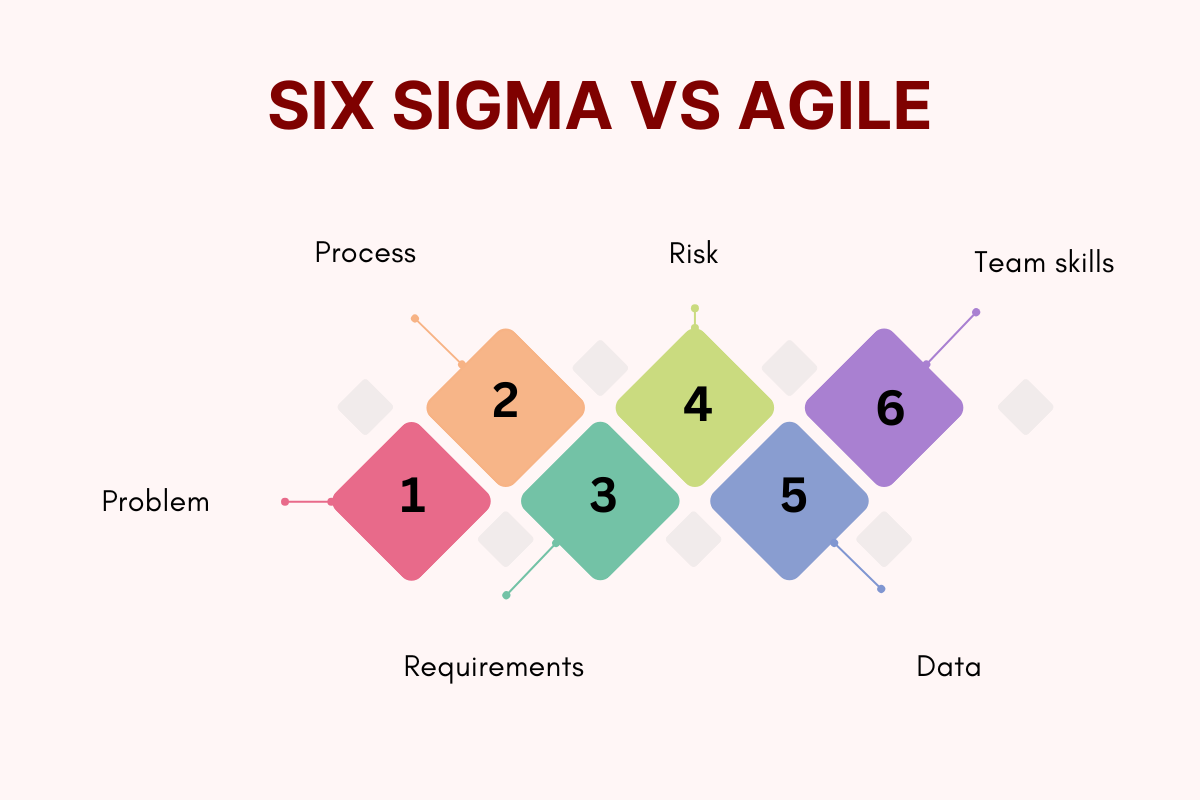
Choose a method based on the problem your business needs to solve. Use these six factors to guide your decision.
- Problem: Choose Six Sigma to fix recurring errors. Choose Agile when the solution needs testing and feedback.
- Process: Use Six Sigma to improve a stable but underperforming process. Use Agile when the work changes as teams learn.
- Requirements: Choose Six Sigma when quality standards are clear. Choose Agile when customer needs change often.
- Risk: Use Six Sigma when defects raise costs or disrupt operations. Use Agile to test changes early and catch issues sooner.
- Data: Choose Six Sigma when you can measure errors and process performance. Use Agile when customer feedback and delivery results guide decisions.
- Team skills: Six Sigma needs people who can analyze data and track process quality. Agile needs teams that can work closely, review progress, and adjust plans.
Conclusion:
The choice between Six Sigma vs Agile depends on your business goal. Use Six Sigma to reduce errors, cut waste, and improve process quality. Choose Agile to respond to changing needs and deliver work faster. If you need both, combine the methods with clear goals and measures of success. Start with one business problem, track the results, and expand the approach only when it proves its value.
Frequently asked questions
1. What training is needed for Six Sigma and Agile?
Six Sigma training covers process analysis and quality tools. Agile training focuses on teamwork, planning, and regular delivery.
2. Can a company switch from Agile to Six Sigma?
Yes. A company can adopt Six Sigma when it needs a structured way to fix recurring process problems.
3. How long does it take to see results?
Results depend on the project and team. Agile may show progress within a few delivery cycles, while Six Sigma may need more time to find causes and verify improvements.
4. How do you decide between Six Sigma vs Agile?
Compare Six Sigma vs Agile based on your main goal, available data, team skills, and need for flexibility. Choose the method that best fits the problem you want to solve.