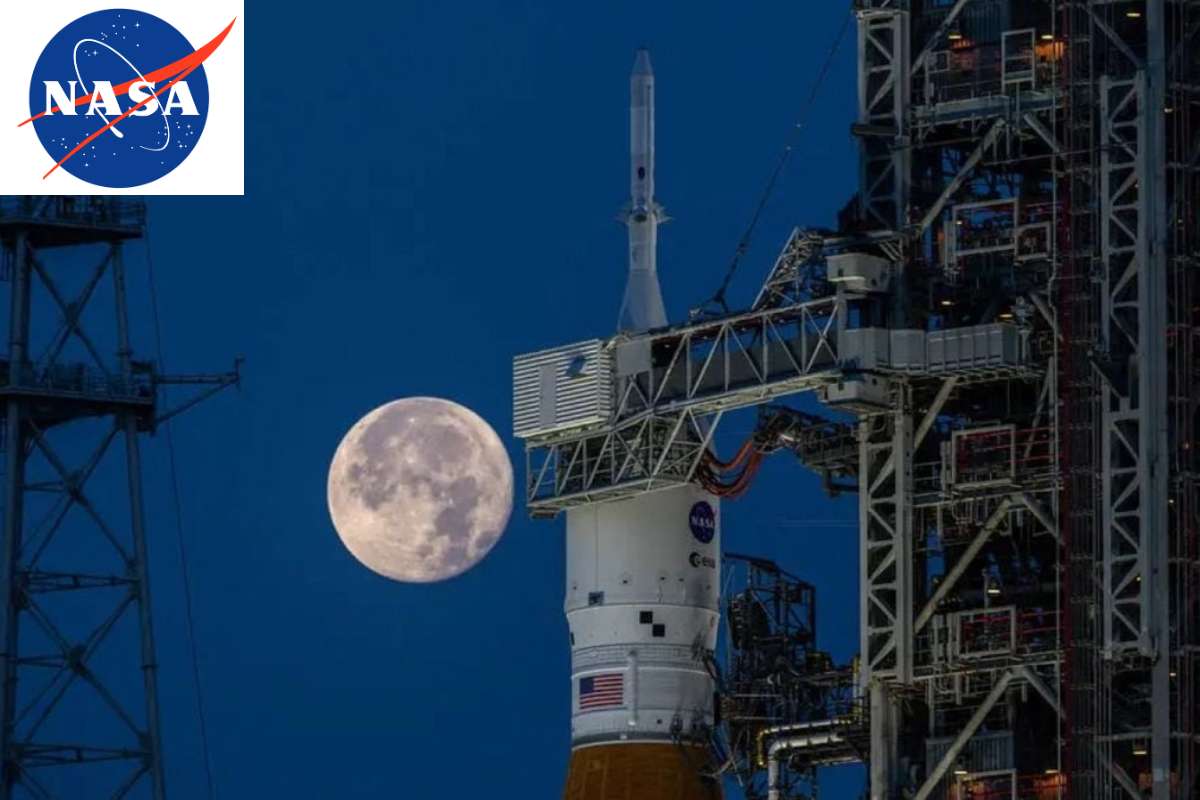
Key Points:
- NASA completed a full countdown “wet dress rehearsal” for the Artemis II mission, simulating launch-day fueling and systems checks.
- The mission will send four astronauts on a 10-day journey around the Moon, the first crewed deep-space flight since Apollo.
- Artemis II is a critical step toward future lunar landings and sustained human presence, paving the way for Artemis III.
NASA has entered a decisive phase in its Artemis program, conducting a full countdown rehearsal for the highly anticipated Artemis II mission, the first crewed journey toward the Moon in more than five decades. The exercise, taking place at Kennedy Space Center in Florida, is designed to simulate launch-day conditions and ensure the Space Launch System (SLS) rocket and Orion spacecraft are fully prepared for human spaceflight.
The rehearsal, known as a “wet dress rehearsal,” involves loading the rocket with super-cold liquid hydrogen and liquid oxygen propellants and running the countdown sequence to just seconds before liftoff. Engineers halt the test before engine ignition, allowing teams to evaluate performance without committing to launch. This process serves as a final systems check before NASA confirms an official launch date.
The Artemis II mission is currently targeting an early launch window, pending successful completion of these tests. The mission will carry four astronauts on a 10-day journey around the Moon, marking humanity’s first crewed deep-space voyage since the Apollo era.
Addressing Technical Challenges Before Liftoff
The current rehearsal follows earlier technical setbacks that forced NASA to delay its timeline. Previous fueling attempts revealed hydrogen leaks and hardware concerns within the rocket’s propellant system, which required seal replacements, filter inspections, and additional engineering reviews. While such challenges are not uncommon in complex spaceflight operations, the agency has emphasized that crew safety remains the top priority.
Liquid hydrogen, one of the rocket’s primary fuels, must be handled at extremely low temperatures, making it especially sensitive to pressure changes and structural stress. Engineers have since reinforced components and conducted extensive diagnostic checks to prevent recurrence of earlier leaks.
During this rehearsal, mission controllers are evaluating not only fueling procedures but also communication networks, ground support equipment, launch pad infrastructure, and emergency response systems. The integrated testing ensures that all operational elements from countdown sequencing to spacecraft systems function seamlessly under real-world conditions.
If the simulation concludes without major issues, NASA will proceed toward establishing a confirmed launch date. Officials have indicated that a successful rehearsal is critical to maintaining momentum for the broader Artemis timeline.
A Critical Step Toward Sustained Lunar Exploration
Unlike its predecessor, Artemis I, which flew uncrewed in 2022, Artemis II will place astronauts aboard the Orion capsule for the first time. The mission will not include a lunar landing; instead, the crew will orbit the Moon and return to Earth, validating life-support systems, navigation capabilities, and deep-space operations in preparation for future surface missions.
The Artemis II mission is widely viewed as a foundational mission. Its success will pave the way for Artemis III, which aims to land astronauts,s including the first woman and first person of color, on the lunar surface. Beyond symbolic milestones, the Artemis program seeks to establish a sustainable human presence on and around the Moon, serving as a stepping stone for eventual crewed missions to Mars.
The mission also reflects growing international collaboration in space exploration. The four-person crew includes representatives from both NASA and the Canadian Space Agency, underscoring a cooperative approach to deep-space exploration.
As NASA advances through its final pre-launch preparations, Artemis II represents more than a technical achievement. It signals a renewed commitment to human exploration beyond Earth orbit and the beginning of a new chapter in lunar exploration history.
Visit Visionary CIOs Magazine for the latest information.