
Business process reengineering completely redesigns broken workflows to slash costs and speed up operations. Unlike small continuous updates, BPR throws out old habits to build faster systems from scratch. Success requires clear executive goals, mapping manual bottlenecks, and guiding your team through the shift. Read the complete guide to start your workflow redesign.
Most companies try to fix slow workflows by adding another piece of software or tweaking an old spreadsheet. But it rarely works.
When daily operations get bogged down in messy paperwork and outdated habits, minor patches just waste time. That is why smart leaders throw out the old playbook. Instead of tweaking what is broken, business process reengineering tears down messy routines to build clean, fast workflows from scratch.
So let’s look closer at what this radical shift actually means.
Defining Business Process Reengineering: How to Fix Broken Systems?
BPR means wiping the slate clean instead of patching broken steps.
Instead of asking how to make a slow approval process 10 percent faster, you ask why that manual approval step exists at all.
For example, a traditional retail supply chain might use four separate teams to manually check inventory spreadsheets. A proper reengineering project removes those spreadsheets entirely and replaces them with an automated IoT database that syncs stock levels in real time.
This fixes broken systems by cutting extra approvals, replacing manual data entry with software, and clearing out slow habits. Companies get rid of wasted time and create smooth paths for their teams to work.
How to Apply a Business Process Reengineering Framework?
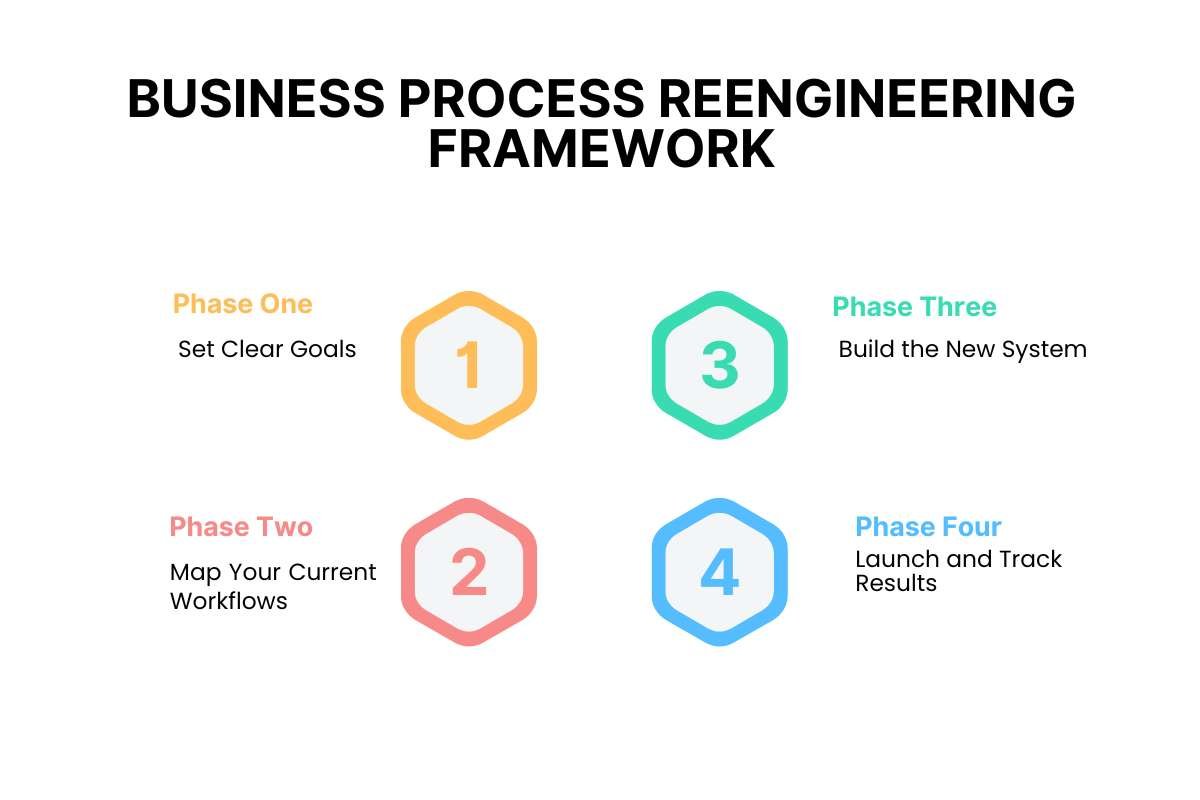
Redesigning a core workflow follows a straightforward, four-step process:
Phase 1: Set Clear Goals
Your leaders must agree on what you want to fix before you touch any software. Instead of a vague goal like be faster, pick an exact target. For example, aim to cut customer onboarding time in half or handle twice as many orders without hiring extra staff.
Phase 2: Map Your Current Workflows
Follow a real order or customer request through every department. Write down every handoff, approval check, and spreadsheet you use. Look for hidden delays, like waiting days for a manager’s signature or typing the same data into three different programs.
Phase 3: Build the New System
Design the ideal process from scratch. Cut out extra approval layers and swap manual typing for automated software. Build the new setup around speed and direct work instead of old office habits.
Phase 4: Launch and Track Results
Roll out the new system carefully, starting with one team to catch any early bugs. Train your staff well, and set up simple dashboards to track error rates, time saved, and costs week by week.
How Do BPR and Continuous Process Improvement Differ?
People often mix up business process reengineering with continuous improvement. While both try to make work better, they use completely different methods.
Continuous improvement focuses on small, steady changes over time. It keeps your current system in place and makes minor fixes to help things run smoother. For example, a customer service team might update their email templates once a month to answer common questions a bit faster.
Business process reengineering throws out the old system entirely. It builds a brand new process from the ground up, targeting massive jumps in speed and efficiency.
A classic example is how Mutual Benefit Life handled insurance applications. Under its old system, approving a single policy required 30 separate steps across five different departments, taking up to 25 days.
Instead of tweaking individual steps, the company replaced the entire handoff chain with a single case manager backed by automated software. This radical redesign cut approval times down to just two to five days.
Here is a quick look at how the two strategies compare side by side:
| Continuous Improvement | Feature | Business Process Reengineering |
| Small tweaks to current steps | Scope | Total redesign of the whole workflow |
| Low risk, steady gains | Risk Level | Higher risk, major structural leaps |
| Ongoing, day-to-day updates | Timeline | Done in a set project window |
| Smooth out small bumps | Main Goal | Fix deep, broken systems |
What Are the Core Benefits of Business Process Reengineering?

Redesigning your workflows is not just about changing how work looks on paper. It unlocks real financial and operational gains.
The global business process reengineering market is valued at $3.15 billion in 2026, according to Business Research Insights. Companies shifting to structured workflow redesign see clear financial returns.
Organizations can recover up to 35 percent of their operational spend through big structural changes. Investments in automated workflows typically pay for themselves within 12 to 15 months.
Here is what you actually gain:
- Lower costs: Cutting out duplicate steps and wasted effort can drop your overhead expenses by 20 to 40 percent.
- Faster delivery: Getting rid of paperwork bottlenecks helps your team ship products and answer customer questions much quicker.
- Better team visibility: Tearing down walls between departments connects all your data so every team sees the same information.
- Real flexibility: Fixing your core systems helps your business shift fast when market trends or customer needs change.
How to Manage Employee Resistance During Business Process Reengineering?
Workers often push back during a structural overhaul because they fear losing their routines, feel left out of top-down decisions, or worry new tools will complicate their day. When staff does not trust the new system, adoption drops and the project stalls.
To fix this, use these practical steps:
1. Bring frontline staff into the mapping phase:
Employees who run daily tasks know where the real friction hides. Ask for their input early so they help design the fix instead of having it forced on them.
2. Run hands-on practice sessions:
Do not just hand your team a software manual. Host guided practice sessions so workers build confidence and muscle memory before launch day.
3. Show how the change removes daily frustration:
Be clear about why the old system is gone. Show staff how automated workflows remove tedious paperwork, giving them more time for actual work.
Common Pitfalls to Avoid in Business Process Reengineering

BPR projects often fail because of two major execution traps. Here is how to spot and fix them before they derail your timeline:
1: Executive Misalignment
The Problem: If top leaders do not agree on the exact goal, cross-functional teams lose momentum and projects stall out.
How to Fix It: Form a small steering committee with one decision-maker from each affected department. Require all executive sponsors to sign off on specific financial and time metrics in writing before work begins. If leaders cannot agree on the end goal, do not start the project.
2: Automating Broken Steps
The Problem: Slapping new software or digital tools onto a flawed workflow only helps you make mistakes faster.
How to Fix It: Map the workflow completely on paper or a whiteboard first. Erase redundant approvals and manual data checks before you shop for software. Only after the manual process makes logical sense should you select tools to automate it.
Also Read: What is Process Improvement and How To Use It In Your Business?
Conclusion:
Business process reengineering is a commitment to tearing down broken workflows and building faster, smarter systems from the ground up.
Success comes down to discipline. Set clear targets, map your exact bottlenecks, fix your manual logic before buying software, and bring your frontline team along for the ride. When done right, BPR transforms how your company operates, cutting costs and giving your business the speed it needs to grow.
Frequently Asked Questions
1. How long does a typical business process reengineering project take?
Most large-scale enterprise reengineering projects take anywhere from six to eighteen months to fully plan, test, and deploy, depending on the complexity of the legacy systems involved.
2. What role does artificial intelligence play in modern redesign efforts?
Artificial intelligence acts as an intelligent diagnostic engine that helps map existing workflows, automate repetitive manual tasks, and process unstructured data at scale.
3. How do you measure the financial return on investment of a workflow overhaul?
Executives measure ROI by tracking reductions in operational costs, decreases in cycle times, and the elimination of labor hours spent on manual data correction.
4. What is the primary difference between departmental automation and full enterprise reengineering?
Departmental automation fixes localized bottlenecks within a single team, whereas enterprise reengineering completely redesigns end-to-end workflows across multiple business units.