
What would happen to your business if a cyberattack stopped critical systems for days? The global average cost of a data breach reached $4.44 million in 2025, making the financial impact of a cyber incident hard to ignore.
Cyber insurance for businesses can help cover certain financial losses from cyber incidents, including data breaches, ransomware, business interruption, and some third-party claims. However, coverage depends on the policy’s limits, exclusions, conditions, and the risks your business faces.
This article explains what cyber insurance covers, which risks you can transfer, how insurers assess your risk, what affects costs, what policies exclude, and what to review before buying or renewing coverage.
What does cyber insurance for businesses actually cover?
Cyber insurance generally covers financial losses and response costs linked to certain cyber incidents. Policies can include both first-party coverage, which addresses the insured business’s own losses, and third-party coverage, which addresses claims or legal costs arising from harm to customers, partners, or other outside parties.
| Coverage type | What it may address | Business impact |
| First-party | Forensics, data restoration, incident response | Direct recovery costs |
| Business interruption | Lost income and extra operating expenses | Revenue disruption |
| Cyber extortion | Negotiation and certain ransom-related expenses | Ransomware response |
| Third-party liability | Legal defense, settlements, judgments | Claims from affected parties |
| Breach response | Notification, credit monitoring, communications | Customer and regulatory response |
| Cyber crime | Certain computer, funds-transfer, or social-engineering losses | Direct financial loss |
Coverage varies by insurer and policy. Limits, deductibles, sublimits, exclusions, waiting periods, and policy conditions can significantly affect what the business can actually recover.
Which cyber risks can insurance help transfer?
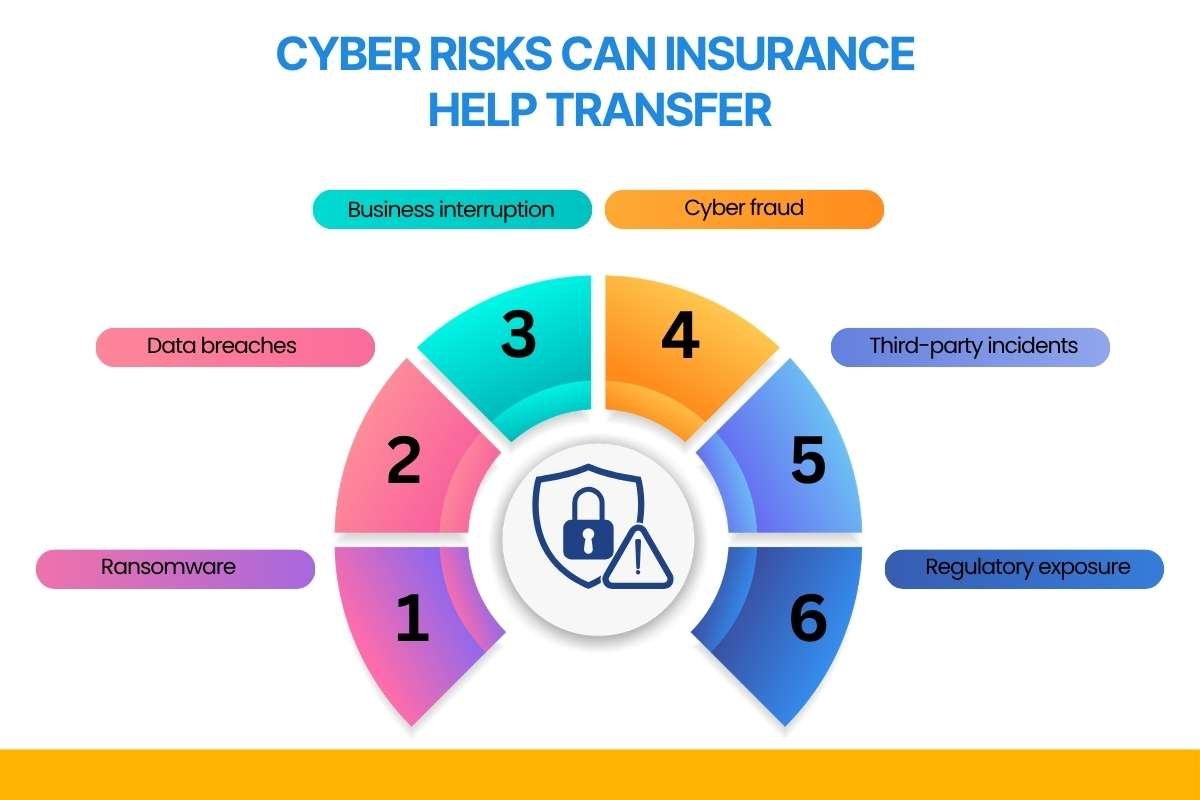
The main risks cyber insurance for businesses may help transfer include:
- Ransomware: Financial exposure from extortion and the disruption caused by a ransomware incident.
- Data breaches: Costs and liabilities associated with unauthorized access to sensitive business, customer, or employee data.
- Business interruption: Financial losses when a covered cyber incident prevents critical systems or operations from functioning.
- Cyber fraud: Certain losses involving social engineering, phishing, or fraudulent fund transfers.
- Third-party incidents: Claims or financial liabilities that arise when a cyber incident affects customers, vendors, partners, or other third parties.
- Regulatory exposure: Certain legal and regulatory costs that follow a covered cyber incident.
Insurance can therefore transfer part of the financial impact of a cyber event, but it does not transfer the underlying operational risk. Security controls, backups, access management, monitoring, and incident response remain essential to reducing the chance and severity of an attack.
How much does cyber insurance for businesses cost?
Premiums depend on the business’s risk profile, the amount and type of coverage purchased, its security controls, claims history, industry, revenue, data exposure, and other underwriting factors.
The market itself can also affect pricing. Marsh reported that U.S. cyber insurance rates declined by an average of 5% in the fourth quarter of 2024, while insurers continued to favor organizations that strengthened their cybersecurity controls.
That means executives should avoid treating a quoted premium as a fixed market price. Two businesses with similar revenue can receive different terms because their security maturity, exposure, and claims history differ.
| Cost factor | Why insurers consider it |
| Annual revenue | Indicates the scale of potential business interruption and financial exposure |
| Industry | Certain sectors handle more sensitive data or face greater regulatory exposure |
| Data volume and sensitivity | More valuable or regulated information can increase potential losses |
| Security controls | Stronger controls can influence the insurer’s assessment of risk |
| Claims history | Previous incidents can affect underwriting and pricing |
| Coverage limits | Higher limits generally increase the amount of risk transferred |
| Deductible or retention | Determines how much loss the business retains before coverage responds |
| Third-party exposure | Vendors and technology dependencies can create additional loss scenarios |
The better question for an executive team is therefore not “What is the cheapest policy?” It is “What level of financial exposure can the company reasonably retain, and what risk should it transfer?”
What factors affect cyber insurance for businesses?

Before an insurer sets terms, it evaluates how likely a business is to experience a covered loss and how severe that loss could be.
Underwriters consider factors such as industry, the types of data held, cybersecurity controls, and previous cyber incidents and claims. These inputs can affect the policy’s price, deductible, limits, and conditions.
The assessment typically extends beyond the IT department. An insurer may need to understand the company’s revenue, critical systems, sensitive data, technology providers, incident history, and ability to recover from an outage.
This makes the insurance application an important exercise in risk documentation. If the organization cannot clearly show how its controls work, the underwriting process can expose gaps that should already be addressed.
Which security controls affect cyber insurance for businesses?
Security controls do not guarantee lower premiums, but they can influence how insurers assess risk and structure coverage.
Common controls include:
- Multifactor authentication (MFA) for privileged and remote access
- Endpoint protection across laptops, servers, and other connected devices
- Regular patching and vulnerability management
- Tested and protected backups
- Strong privileged-access management
- Employee security awareness and phishing controls
- Network monitoring and logging
- A documented and tested incident response plan
- Vendor and third-party risk management
Security controls should be treated as both defensive measures and evidence of risk maturity.
What does cyber insurance for businesses not cover?
Cyber policies can exclude or limit intentional or fraudulent acts, known prior incidents, certain regulatory penalties, contractual liabilities, sanctions, and losses linked to required security controls.
Policies may also limit social engineering, funds-transfer fraud, ransomware, or other losses. War and nation-state-related events may have specific exclusions too.
Coverage varies by insurer, policy, and jurisdiction, so check the exclusions, limits, and sublimits before buying.
Why do cyber insurance for businesses claims get denied?

A claim can face problems when the loss falls outside the policy terms or when required conditions are not met.
Common issues include:
- The incident is excluded by the policy.
- The business failed to disclose material information during underwriting.
- Required security controls were not maintained.
- The company missed a policy’s incident-notification deadline.
- The claimed loss exceeds a policy limit or sublimit.
- The event involves a known prior incident or circumstance.
- The specific type of fraud or social engineering loss was not covered.
These are not universal denial rules. The actual outcome depends on the policy wording, facts of the incident, applicable law, and the insurer’s claims assessment.
That is why you should treat the insurance application and renewal process with the same accuracy you would apply to a security audit. If the organization says it has MFA, backups, or response controls, those controls need to exist and operate as represented.
How should businesses decide how much coverage they need?
Set your coverage limits based on the financial impact a cyber incident could have on your business. Focus on these areas:
- Critical systems: Estimate the cost of downtime for systems that support essential operations or revenue.
- Sensitive data: Consider data recovery, forensics, legal support, and breach notification costs.
- Third-party exposure: Account for vendor disruptions and claims linked to partners or suppliers.
- Major cyber events: Include ransomware, business interruption, regulatory response, and cyber fraud.
- Policy terms: Review coverage limits, deductibles, sublimits, exclusions, and the losses your business can afford to absorb.
The size of these costs can vary widely. IBM’s 2025 research found that the average global cost of a data breach was $4.44 million, compared with $10.22 million for U.S. organizations.
Which businesses face the greatest cyber insurance exposure?
Your cyber insurance risk depends on more than your industry. The type of data you handle, your technology, security controls, and claims history also matter.
However, several exposure patterns consistently matter when evaluating cyber risk.
| Exposure factor | Why it matters | Examples |
| Sensitive customer data | Breaches can trigger notification, legal, and regulatory costs | Healthcare, finance, retail |
| High digital dependency | System outages can quickly affect revenue | SaaS, e-commerce, technology |
| Large third-party ecosystem | Vendors can introduce additional attack paths | Enterprises, manufacturers |
| High-value transactions | Fraud can create direct financial losses | Finance, professional services |
| Regulatory obligations | Incidents may create reporting and legal requirements | Healthcare, financial services |
Verizon’s 2025 DBIR shows the growing role of third parties. Third-party involvement in breaches doubled to 30% in its dataset.
This means you also need to look at risks outside your own network. Cloud providers, managed service providers, software vendors, and other partners can all affect your cyber risk and insurance needs.
What should leaders check before buying a cyber insurance policy?

A cyber insurance policy for businesses should be evaluated by its actual terms, not simply by its premium. Before signing, review:
- Coverage limits: How much can the insurer pay?
- Deductibles or retention: What loss does the company retain?
- Sublimits: Are important coverages capped below the overall policy limit?
- Business interruption: What triggers coverage and how is the loss calculated?
- Ransomware coverage: What expenses are covered and what conditions apply?
- Third-party coverage: Are customer, partner, and regulatory claims included?
- Vendor exposure: Does the policy address losses involving critical suppliers?
- Security requirements: Which controls must the company maintain?
- Reporting requirements: How quickly must an incident be reported?
- Panel providers: Must the company use insurer-approved legal, forensic, or response firms?
The premium is only one number in the policy. The definitions, conditions, and exclusions can be just as important when a claim occurs.
What should you review before renewing cyber insurance?
Before renewal, check whether your policy still matches your current cyber risk. Focus on these areas:
- Business changes: New cloud services, acquisitions, markets, digital operations, or critical vendors.
- Security controls: Privileged access, backups, critical vulnerabilities, asset inventory, and incident response.
- Coverage: Limits, deductibles, ransomware protection, business interruption, and third-party coverage.
- Policy terms: Exclusions, sublimits, conditions, and any changes from the previous policy.
- Risk history: Recent incidents, claims, or security changes that could affect your risk profile.
- Underwriting: Information your insurer needs and security improvements that could affect your terms or pricing.
- Incident response: Who to contact first if a covered cyber incident occurs.
Bring together your CIO, CISO, risk, legal, finance, and procurement teams so the renewal reflects your current exposure.
Conclusion
Cyber Insurance for businesses can help transfer the financial impact of certain cyber incidents, but it works best alongside strong security controls and recovery plans. Review your key systems, data, vendors, coverage limits, and exclusions to make sure the policy matches your actual risks.
Know which losses you can absorb and which risks you want to transfer.
FAQ
1. Does cyber insurance cover cloud provider outages?
Some policies cover cloud provider outages through contingent business interruption or related coverage. What is covered depends on the policy’s terms, limits, and exclusions.
2. Does Cyber Insurance for Businesses cover insider threats?
It depends on the policy and the incident. Intentional, criminal, or fraudulent acts may be excluded, while some accidental insider incidents may be covered.
3. Can a business change cyber insurance coverage after a breach?
Changes after an incident depend on the insurer, policy period, underwriting assessment, and circumstances involved. A known incident can also affect the availability or scope of new coverage.
4. Does cyber insurance cover regulatory fines?
Some cyber insurance policies may cover certain regulatory fines or penalties where legally allowed. Check your policy and local laws because coverage varies by jurisdiction.