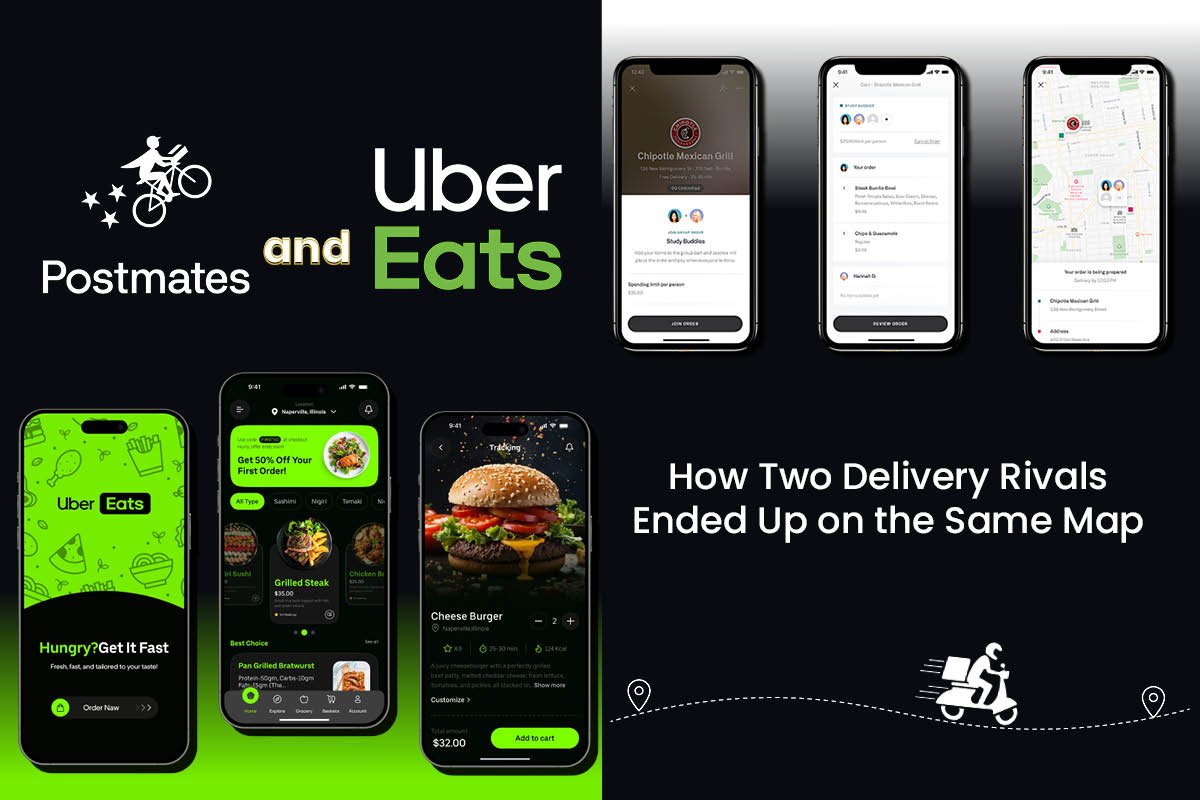
Picture a city seen from above: restaurants scattered across the blocks, homes clustered around them, and delivery routes threading through the streets. A customer opens an app, picks a restaurant, and taps order. That routine tap sits inside a much larger contest, and Postmates and Uber EATS were two of its best-known names in the U.S. market.
Business of Apps notes that consolidation in 2018 left DoorDash, Uber Eats, and Grubhub as the three main services. Second Measure’s March 2020 data showed DoorDash at 42% of sales, Grubhub at 28%, Uber Eats at 20%, and Postmates at 9%. Together, those four names held about 98% of meal delivery sales.
Command centers: two business models
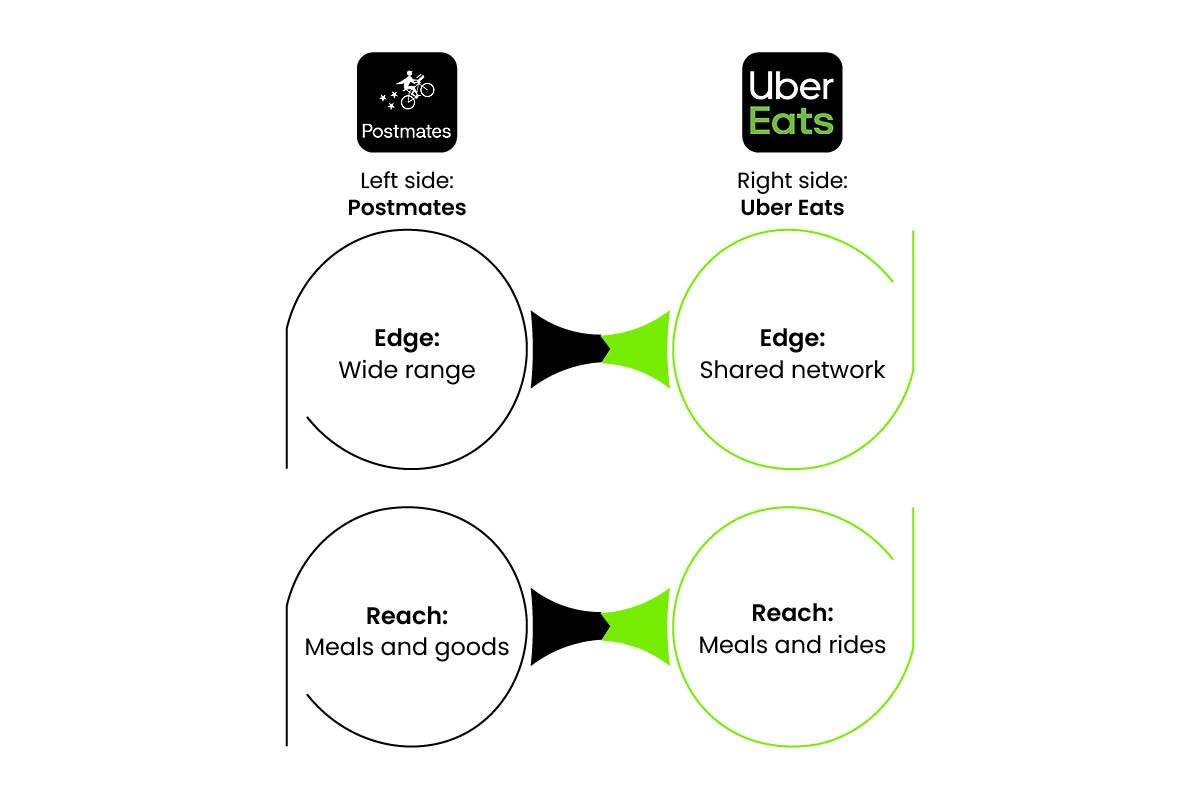
Two headquarters sit on opposite sides of the map, and each one runs on a different plan.
| Left side: Postmates | Right side: Uber Eats |
| Edge: Wide range | Edge: Shared network |
| Reach: Meals and goods | Reach: Meals and rides |
Left side: range
Postmates built its reputation on breadth. Couriers carried restaurant meals, groceries, pharmacy items, and retail goods, so a customer could order dinner and a phone charger in one app. Comparison reviews pointed to its wide merchant list and the Unlimited plan, which waived delivery fees above a set order size. Small independent businesses could join without building delivery teams of their own.
Right side: scale
Uber Eats began with assets already in place. It used Uber’s drivers, mapping technology, and payment system, and it could promote meals to riders who already had the app on their phones. That shared network cut setup costs and sped up expansion. Postmates and Uber EATS therefore entered the contest with different strengths: one offered range, the other offered scale.
Zone three: the customer zone
Fighting for the Order
Restaurant selected → Order placed → Courier assigned → Food delivered
Each stop on this route hides a choice. Restaurant availability comes first, because a favorite kitchen may list on one app only. Delivery fees, promotions, and estimated arrival times follow. App usability, membership benefits, and convenience often settle a close call.
Comparison sources show how small the gaps are. Kiplinger listed Postmates delivery fees between $0.99 and $3.99 at partner merchants, and $5.99 and $9.99 elsewhere. WMTips notes Uber One removes delivery fees on eligible orders. Postmates and Uber EATS each won or lost the order on details like these.
Nobody reads market-share charts at dinner time. They see a restaurant list, a price, a delivery estimate, and one app screen.
The restaurant district: winning the supply side
Map view: each eatery sits between two competing delivery routes.
Selection
An app with thin menus loses shoppers quickly. Every kitchen that signs up gives a platform another reason to be opened first.
Partnerships
Exclusive deals and chain agreements secured popular names, while independent kitchens often listed on several apps at once. Signing a well-known name could pull nearby diners into the app.
Commissions and reach
Eateries paid a share of each order in exchange for exposure beyond their own dining rooms. Neither fee model suited every owner, since small venues and large chains weighed the same percentage differently.
Ordering infrastructure
Tablets, menu syncing, and courier dispatch tools decided how smoothly orders reached the counter. Postmates and Uber EATS each offered these systems, and a kitchen’s daily workload shaped which one felt easier to use.
The side that signed the most venues held the largest claim on this district.
The courier zone: the people moving the map
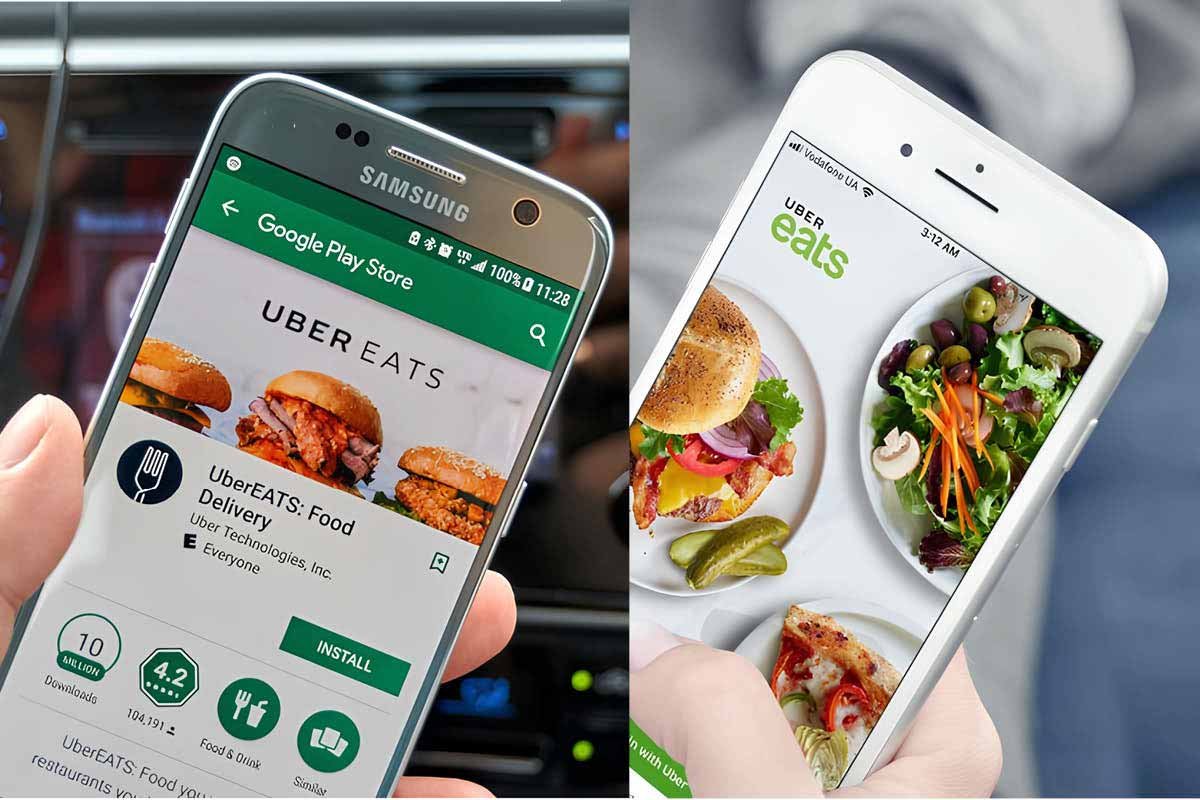
Every digital order needs a person with a bag and a route. Couriers decide how well the map works.
- Availability: Uber Eats has no shift scheduling. Couriers log in and start.
- Flexibility: Drivers can slot orders between rides.
- Incentives: Uber Eats trips count toward Quest bonuses.
- Earnings: Waiting for food goes unpaid on Uber Eats, while Postmates paid for that time.
- Distance: Pay follows mileage, so longer trips bring larger fares.
- Order volume: Slow nights cut income because payouts are not guaranteed.
Postmates and Uber EATS competed for customer orders while relying on the same workers to complete them, which made worker satisfaction a hidden battleground.
The arsenal: technology, pricing, and promotions
- Technology: App features, order flow, live tracking, and platform infrastructure shaped how smooth each service felt, and comparisons on WMTips and Slashdot cover these differences.
- Pricing: Delivery fees, service charges, memberships, and promotions changed what each order cost. Kiplinger and The Zebra treat these costs as central for shoppers.
- Reach: Restaurant availability and city coverage decided which app could serve a given street, a point Business of Apps highlights.
- Convenience: Discovering a restaurant, placing an order, and tracking the courier had to feel effortless, since a clumsy screen could lose a customer before checkout.
Postmates and Uber EATS held different mixes of these tools, so no single one settled the contest. Price mattered, yet customers also weighed the interface, the menu choices, availability, and the wait. Whichever platform’s full kit fit that moment took the order.
The turning point: when the battle changed
July 2020: Uber agrees to acquire Postmates in an all-stock deal worth about $2.65 billion. The sale closes in December.
- Before: two independent platforms compete for every order.
- After: Postmates becomes a unit inside a larger Uber operation.
For Postmates and Uber EATS, the relationship changes completely. Former rivals now answer to one owner, and the contest for customers becomes an internal matter. Uber gets extra reach in US cities, and Postmates gets the backing of a global parent.
Why Uber bought Postmates?
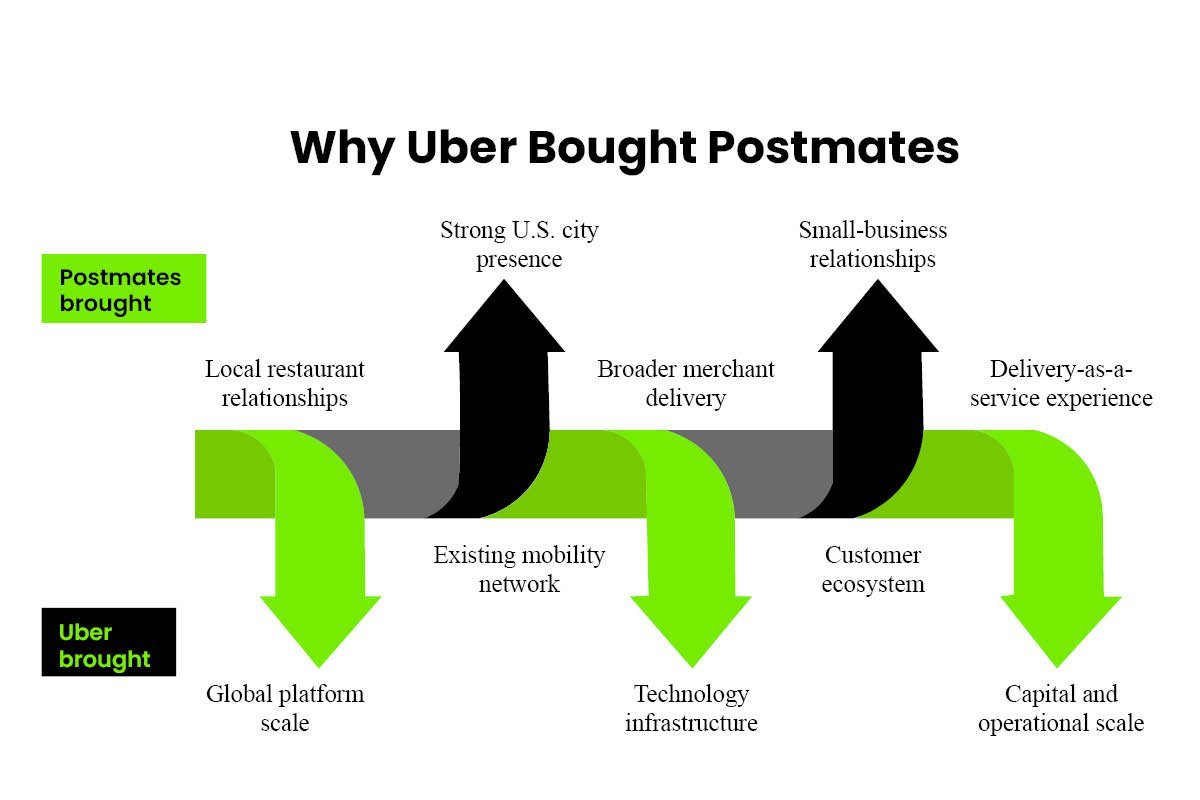
| Postmates brought | Uber brought |
| Local restaurant relationships | Global platform scale |
| Strong U.S. city presence | Existing mobility network |
| Broader merchant delivery | Technology infrastructure |
| Small-business relationships | Customer ecosystem |
| Delivery-as-a-service experience | Capital and operational scale |
July 2020: Acquisition announced
December 2020: Deal completed
2021: Postmates users, couriers, and merchants increasingly migrated into Uber Eats
The aftermath: a redrawn market
The acquisition did not immediately erase the Postmates brand. Uber initially kept the Postmates and Uber Eats consumer apps operating separately while combining parts of their underlying merchant and delivery infrastructure. This allowed Uber to bring Postmates’ network into its larger delivery operation without requiring an immediate shutdown of the Postmates app.
The integration became more visible in 2021. By the second quarter, Uber reported that nearly 5 million consumers, 160,000 couriers, and more than 25,000 merchants had migrated from Postmates to Uber Eats.
What changed after the deal?
- Customers: Postmates users were increasingly moved into the Uber Eats ecosystem.
- Couriers: The combined network gave Uber access to a larger pool of delivery workers.
- Restaurants: More than 25,000 Postmates merchants were brought into Uber Eats.
- Technology: Uber could combine Postmates’ delivery capabilities with its existing platform and infrastructure.
- Market Structure: A once-independent rival became part of Uber’s larger delivery business.
The acquisition therefore changed more than ownership. It brought Postmates’ customers, merchants, couriers, and delivery capabilities into Uber’s network. What had once been two competing platforms increasingly became one operating ecosystem.
Final map: the doorstep is the destination
Pull back from one customer’s doorstep, the place where every order ends. The view widens to reveal restaurants, couriers, pricing offers, software tools, and market reach across every city. Postmates and Uber EATS contested each of those points. Then the 2020 acquisition redrew the final border, while a customer somewhere still taps to place an order.