AI Implementation for Leaders is no longer just a side IT project. It is the main way to change how decisions are made and how businesses compete. The server room is no longer in charge. Now it’s the boardroom that is in charge as AI-powered companies start to take over the world market.
Even though there has been record-breaking investment. There is still a big gap in leadership: many organizations have the technology but not the plan to use it. This guide fills that gap by changing the focus from new technology to changing the way businesses work. You will go beyond pilot programs and add smart systems to the main parts of your business. If you change your way of thinking about AI. It will go from being a cost center to a key driver of growth and long-term value.
Why is an AI strategy no longer optional for business leaders?
AI implementation for leaders demands bold action now. Ignore it, and your business falls behind.
The global AI adoption reality
AI forms a competitive infrastructure that top firms build first. JPMorgan Chase uses AI to analyze 300 million customer interactions daily. This is cutting fraud by 20% and boosting revenue. In healthcare, Siemens Healthineers deploys AI for faster diagnostics. It also speeds up scans by 30%. Retailers like Walmart leverage it for inventory predictions, slashing waste 15%. Manufacturers such as GE deploy AI on factory floors, lifting productivity 25%. These wins show AI drives core innovation everywhere.
The leadership risk of waiting too long
Delay, and competitors pull ahead. Netflix outpaced Blockbuster by mastering AI recommendations early, capturing 80% of streaming. Talent flees to AI-ready firms. Google hired 10,000 AI experts last year while laggards struggle. Data edges compound: Amazon’s flywheel grows stronger yearly, widening gaps for late entrants like traditional retailers.
AI is a business strategy — not a technology strategy
Shift AI ownership from CIOs to CEOs and leadership teams. At Salesforce, CEO Marc Benioff made AI central to revenue via Einstein tools, adding $1B+ annually. It reshapes efficiency (Unilever cut supply chain costs 10% with AI forecasting). And customer experience (Starbucks personalizes orders, lifting sales 9%). AI implementation for leaders means strategy at the top.
Where should leaders invest in AI for the highest returns?
AI implementation for leaders targets 3-5x ROI when tied to business pain points. Focus here for fastest wins.
High-ROI AI implementation areas
- Customer experience & personalization: Starbucks’ AI app upsells via preferences, lifting sales 9%. Start with recommendation engines.
- Operational efficiency & automation: UPS ORION routes save 100M miles yearly, cutting fuel 10M gallons, and automating workflows first.
- Predictive analytics & forecasting: Coca-Cola predicts demand with 95% accuracy, reducing stockouts 20%. It builds sales models.
- Supply chain intelligence: Zara uses AI for real-time visibility, speeding restocks 50%. This track disrupts proactively.
- Knowledge workforce augmentation: Deloitte’s AI co-pilots boost consultant output 25%. It enhances research and insights.
Quick wins vs long-term AI transformation
| Aspect | Quick Wins (Pilots) | Long-Term Transformation (Platforms) |
| Timeline | 3-6 months | 12-24 months |
| Investment | $100K-$1M per use case | $10M+ enterprise-wide |
| ROI Example | 20% efficiency gain (e.g., chatbots) | 40% revenue lift (e.g., Salesforce Einstein) |
| Risk | Low, scalable proof | High, needs C-suite buy-in |
| Best For | Test CX or ops | Full org redesign |
Avoiding the “Shiny tool” trap
Skip tech without a business case. This proves ROI via pilots first. Reject vendor-driven hype; demand case studies matching your industry. Set measurable KPIs upfront, like 15% cost cuts or 10% revenue growth, as laggards waste 70% of budgets without them (Gartner).
How smart leaders are staying ahead with AI?

AI implementation for leaders builds unbeatable edges.
The leadership mindset shift
“Velocity and empathy can—and must—coexist.” — Sarah Wang, Founder & CEO of BlissBot.AI
Swap automation for intelligence, treat AI as a strategic brain. Cultivate experimentation: Intuit’s 1,000+ tests sped launches 20%. Augment decisions: Use AI dashboards to spot shifts early.
Organizational capabilities that successful leaders build
- Data readiness: P&G unified data for 15% supply chain wins.
- Cross-functional AI teams: Microsoft’s blend drove Azure growth.
- Governance and ethics frameworks: IBM’s board scaled safely.
- Continuous learning culture: Accenture upskilled 700K for advantage.
Global examples of AI leadership success
Productivity soars: Maersk cut logistics 30%. Personalization scales: Nike boosted loyalty 40%. Predictions empower: Delta reduced delays 25%.
Where should leaders invest in AI for the highest returns?
AI implementation for leaders yields 3-5x ROI on business priorities. Invest smart.
High-ROI AI implementation areas
- Customer experience & personalization: Starbucks lifts sales 9% with app recs.
- Operational efficiency & automation: UPS saves 10M gallons of fuel via routes.
- Predictive analytics & forecasting: Coke cuts stockouts 20%.
- Supply chain intelligence: Zara speeds restocks 50%.
- Knowledge workforce augmentation: Deloitte boosts output 25%.
Quick wins vs long-term AI transformation
| Focus | Quick Wins (Pilots) | Long-Term (Platforms) |
| Time | 3-6 months | 12-24 months |
| Cost | $100K-$1M | $10M+ |
| ROI | 20% ops gain | 40% revenue |
| Example | Chatbots | Salesforce Einstein |
Avoiding the “Shiny tool” trap
Demand business cases first, no tech for tech’s sake. Ignore vendor hype without your industry proof. Lock in KPIs like 15% cuts or 10% growth (Gartner: 70% waste without).
What’s the right AI roadmap based on your business maturity?
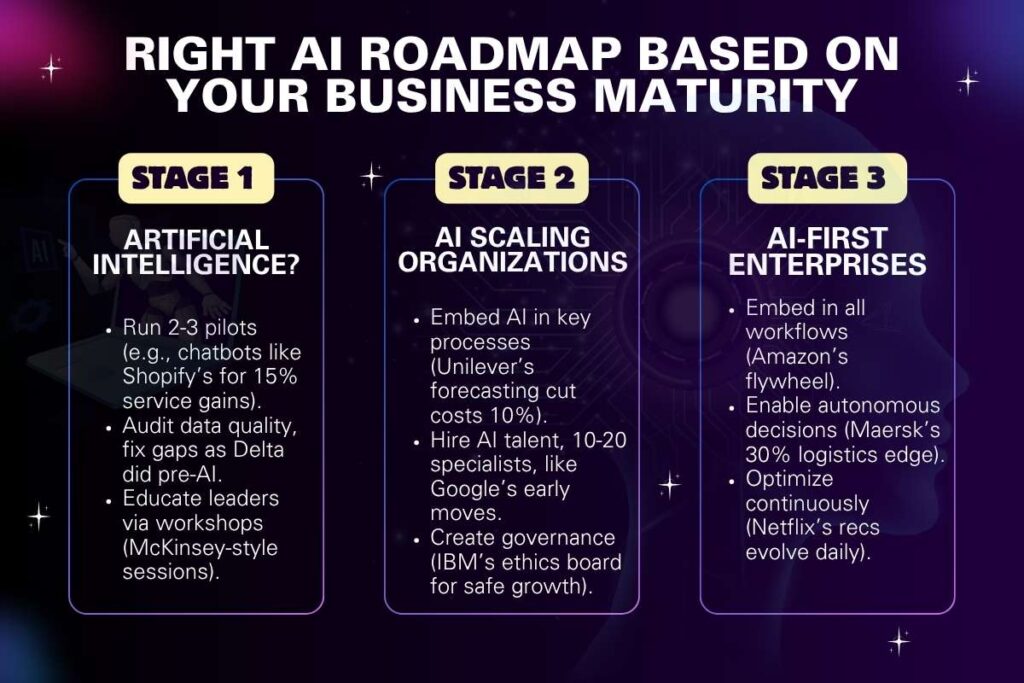
AI implementation for leaders matches your stage. Follow this proven path to scale.
Stage 1 — AI curious organizations
Start small to build wins.
- Run 2-3 pilots (e.g., chatbots like Shopify’s for 15% service gains).
- Audit data quality, fix gaps as Delta did pre-AI.
- Educate leaders via workshops (McKinsey-style sessions).
Stage 2 — AI scaling organizations
Integrate for momentum.
- Embed AI in key processes (Unilever’s forecasting cut costs 10%).
- Hire AI talent, 10-20 specialists, like Google’s early moves.
- Create governance (IBM’s ethics board for safe growth).
Stage 3 — AI-first enterprises
Dominate with the AI core.
- Embed in all workflows (Amazon’s flywheel).
- Enable autonomous decisions (Maersk’s 30% logistics edge).
- Optimize continuously (Netflix’s recs evolve daily).
Step-by-step roadmap
- Assess maturity (survey teams, audit data).
- Pick 1-2 pilots from Stage 1; measure ROI.
- Scale winners to processes (Stage 2 hires/governance).
- Go enterprise-wide (Stage 3 embedding).
- Review quarterly; iterate with new AI advances.
Inside a CEO’s playbook: implementing AI successfully across functions
Successful AI Implementation for Leaders is less about the software and more about the orchestration of talent, data, and purpose. The most effective CEOs follow a disciplined framework to move from pilot to profit.
Step 1 — define business outcomes first
Avoid “tech-first” thinking. Start by identifying which lever you intend to pull:
- Revenue Growth: Identifying new market segments through predictive demand sensing.
- Cost Efficiency: Using agentic systems to automate complex, multi-step back-office workflows.
- Risk Reduction: Implementing real-time monitoring to detect compliance anomalies before they escalate.
Step 2 — build cross-functional leadership ownership
AI is too impactful to be siloed in the IT department. It requires a unified front:
- CEO Vision: Setting the “North Star” and ensuring AI aligns with the long-term mission.
- COO Alignment: Integrating intelligent systems into the daily “rhythm of business” to ensure operational adoption.
- CTO/CIO Execution: Building the secure, scalable infrastructure that allows data to flow safely across the enterprise.
Step 3 — invest in people before platforms
The highest-performing organizations in 2026 prioritize “human-in-the-loop” strategies.
- Workforce Upskilling: Moving employees from “doing” to “prompting” and “editing.”
- Change Management: Addressing the “fear of replacement” by highlighting how AI removes drudgery.
- AI Literacy Programs: Ensuring every manager understands the limitations and strengths of generative systems.
Step 4 — Establish responsible AI governance
Trust is your most valuable asset. Leaders must ensure:
- Ethics: Auditing models for bias to protect brand reputation.
- Transparency: Clearly communicating when and how AI is used in decision-making.
- Global Compliance: Navigating the complex web of international AI regulations.
Step 5 — measure impact relentlessly
To sustain momentum, track these core metrics:
- ROI: Hard dollar savings or revenue generated per AI project.
- Productivity Gains: Measuring “time-to-completion” for high-value tasks.
- Customer Satisfaction: Monitoring how AI-driven personalization impacts Net Promoter Scores.
- Innovation Velocity: Tracking the speed at which new products move from concept to market.
The future of leadership in the age of AI:

AI implementation for leaders evolves you into an augmented force—smarter, faster, unstoppable.
The rise of the AI-augmented leader
Embrace decision intelligence: Nadella at Microsoft uses AI for 20% sharper calls. Master human + machine collaboration: Pair intuition with AI scale, as Maersk CEOs do for logistics dominance.
Skills tomorrow’s leaders need
- Data literacy: Read AI outputs like P&G execs for supply wins.
- Strategic thinking: Align AI to vision, Netflix-style.
- Ethical leadership: Guide responsibly, the IBM board model.
- Adaptability: Pivot fast in AI shifts, like Ambani at Reliance Jio.
AI doesn’t replace leaders. It elevates them.
Conclusion:
The future is for businesses that go beyond testing and start doing. AI Implementation for leaders isn’t about following the latest trends in technology; it’s about making systems that are smarter and help teams make better decisions, grow in a way that lasts, and make decisions that are better. Leaders who use AI to reach specific business goals will do better than those who see it as a way to improve technology.
Leadership courage, a willingness to learn, and responsible adoption are all important for success now. Start with small steps, build on what works, and make intelligence a part of daily operations. AI becomes more than just automation when strategy, people, and data all work together. It becomes a long-term competitive edge.
The question is no longer if we should use AI. The real question is how quickly leaders can use smart technology to make real changes in their businesses.
People also ask:
1. What is AI implementation for leaders
AI implementation for leaders refers to the strategic adoption of artificial intelligence to improve decision-making, operational efficiency, customer experience, and long-term business growth. It focuses on leadership vision, governance, and organizational transformation rather than just deploying technology tools.
Why is AI implementation now a leadership responsibility?
AI affects revenue models, workforce productivity, risk management, and competitive positioning. Because these outcomes shape business strategy, CEOs and executive teams, not only IT departments, must lead AI initiatives.
Do leaders need technical expertise to implement AI successfully?
No. Leaders do not need to become data scientists. However, they must develop AI literacy, which is an understanding of capabilities, risks, ethics, and strategic applications. This helps to make informed decisions and guide teams effectively.