Growth brings opportunities but can increase costs and operational complexity. A scalable business model helps businesses turn growing demand into sustainable expansion without increasing operating costs at the same rate as revenue.
Businesses scale through technology, repeatable systems, and partnerships across SaaS, marketplaces, franchising, and online education. Understanding how these models work can help entrepreneurs choose the right approach, improve efficiency, and prepare for long-term growth.
Table of content
- What Is a Scalable Business Model?
- How to Build a Scalable Business Model: Six Practical Steps
- What Are the Types of Scalable Business Models?
- How Is AI Changing Business Scalability in 2026?
- How Do You Measure Business Scalability?
- Challenges that Limit Scalability
- Conclusion
- FAQs
What is a scalable business model?
A scalable business model allows a company to increase revenue faster than its operating costs by using automation, technology, and repeatable processes to serve more customers efficiently.
It helps businesses improve productivity, control costs, expand market reach, and achieve sustainable long-term growth.
How to build a scalable business model: six simple steps
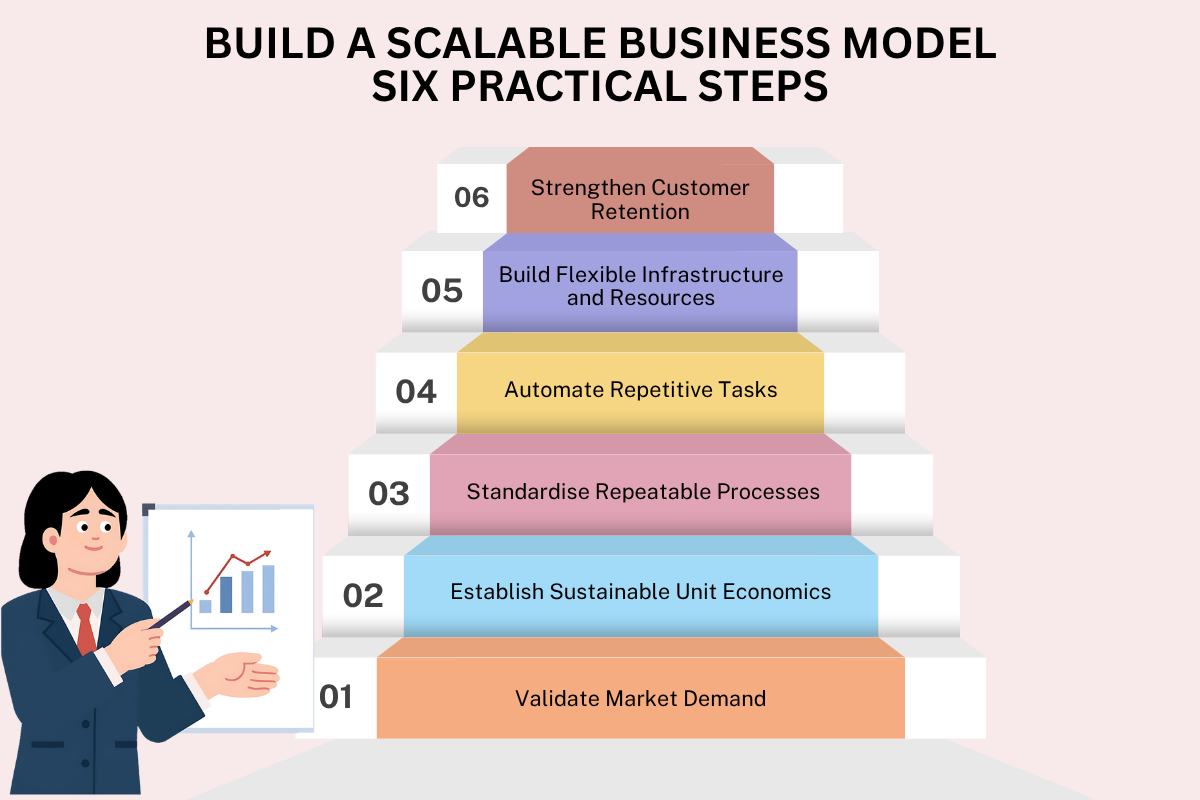
Step 1: validate market demand
Identify your target audience and understand the problem your product solves. Use customer interviews, surveys, pilot launches, or pre-orders to test demand before committing significant resources.
Implementation: A skincare startup can launch a small product range and collect customer feedback before expanding its inventory. This helps the business understand demand and product preferences.
Step 2: Establish sustainable unit economics
Calculate customer acquisition cost (CAC), gross margin, delivery expenses, and customer lifetime value (CLV). These metrics help determine whether acquiring additional customers can support profitable growth.
Implementation: If a business spends more to acquire and serve a customer than it earns from that relationship, increasing sales may deepen its losses. Review pricing, acquisition channels, and delivery costs before expanding.
Step 3: Standardise repeatable processes
Document standard operating procedures (SOPs) for sales, onboarding, fulfilment, customer support, and quality checks. Clear workflows reduce avoidable errors and make delegation easier.
Implementation: An online clothing store can create a standard order-processing checklist for payment verification, packing, shipping, and returns. The same workflow can guide new employees as order volumes increase.
Step 4: Automate repetitive tasks
Use technology to automate stable, repetitive activities such as invoicing, appointment scheduling, email notifications, and routine customer queries. Begin with tasks that consume time but require limited human judgement.
Implementation: A digital course business can automate payment confirmation, student enrolment, and access emails. This allows the team to spend more time improving lessons and supporting learners.
Step 5: Build flexible infrastructure and resources
Choose systems that can accommodate changing demand without unnecessary fixed expenses. Cloud services, specialist contractors, and reliable third-party partners can provide flexibility when managed carefully.
Implementation: An online store can use cloud-based tools and a fulfilment partner to handle seasonal demand. It should still monitor service levels, data security, and the costs of additional capacity.
Step 6: Strengthen customer retention
Improve product reliability, onboarding, customer support, and the overall customer experience. Satisfied customers may return, renew subscriptions, or recommend the business to others.
Implementation: A SaaS company can introduce guided onboarding, product tutorials, and timely customer support. Tracking renewal rates and customer feedback helps identify opportunities to improve retention.
What are the types of scalable business models?
1. Software-as-a-Service (SaaS): Provides subscription-based or usage-based software through a shared platform that serves multiple customers.
2. Digital Marketplace Model: Connects buyers and sellers through a platform, expanding transactions without owning the products listed.
3. Digital Products and Online Education: Sells e-books, courses, and templates that can reach more customers without repeating production.
4. Subscription-Based Business Model: Generates recurring revenue through regular payments for continued access to products or services.
5. E-commerce and Third-Party Fulfilment: Uses online stores, automation, and external logistics partners to handle increasing orders efficiently.
Real-world example
1. Shopify: SaaS business model

Shopify helps businesses create and manage online stores through its shared software platform.
How it works: Shopify uses standardised tools, automation, and third-party integrations to help merchants manage their operations. Its app ecosystem and flexible plans support businesses as they grow.
Business growth in numbers: In 2025, Shopify facilitated $378.4 billion in gross merchandise volume (GMV), up 29% year over year. Its annual revenue reached $11.6 billion, increasing 30%.
Why this model is scalable: Shopify can serve more merchants through its existing platform without developing separate software for each business, making expansion more efficient.
2. Airbnb: digital marketplace business model
Airbnb connects travellers with hosts offering accommodation through its online platform, facilitating bookings, payments, and communication without owning every listed property.
How it works: Airbnb uses a shared booking system, automated tools, reviews, and ratings to manage transactions, build trust, and attract more hosts and travellers.
Business growth in numbers: In 2025, Airbnb recorded 533 million nights and seats booked, up 8% year over year. Its gross booking value reached $91.3 billion, increasing 12%.
Why this model is scalable: Airbnb can expand its listings and customer base without purchasing every property, making growth more flexible and efficient.
How is AI changing business scalability in 2026?

AI helps businesses manage growing demand through automation, data analysis, and faster customer support. It can improve efficiency without requiring proportional workforce growth.
AI helps businesses innovate and scale efficiently. IBM CEO Arvind Krishna stated,
“AI is the only way to scale innovation, insight, and expertise.”
This highlights AI’s potential to support business expansion when implemented strategically.
According to the 2026 OECD D4SME Survey, 61% of surveyed SMEs reported using AI, while 76% of AI-using SMEs were AI novices, mainly using off-the-shelf tools for individual tasks. The survey covered over 2,000 SMEs across 12 OECD countries, using a non-representative sample.
Practical uses of AI:
- Customer support: Answer routine queries.
- Marketing: Assist with content and campaign analysis.
- Inventory: Identify demand patterns.
- Operations: Automate repetitive tasks.
How do you measure business scalability?
| Metric | How to Measure | What It Indicates |
| Revenue growth | [(Current revenue − Previous revenue) ÷ Previous revenue] × 100 | Whether sales are increasing |
| Operating cost ratio | (Operating expenses ÷ Revenue) × 100 | Whether costs are growing slower than revenue |
| Customer acquisition cost (CAC) | Total customer acquisition expenses ÷ New customers acquired | How efficiently the business attracts customers |
| Customer retention | [(Customers at end − New customers acquired) ÷ Customers at start] × 100 | How effectively the business retains customers |
| Gross margin | [(Revenue − Cost of Goods Sold) ÷ Revenue] × 100 | How much revenue remains after direct costs |
Tracking these metrics together helps businesses evaluate whether revenue growth is supported by sustainable economics, customer retention, and operational efficiency.
Challenges that limit scalability
- Rising costs: Higher staffing, marketing, and infrastructure expenses.
- Operational bottlenecks: Systems struggling to handle growing demand.
- Inconsistent quality: Difficulty maintaining product and service standards.
- Customer churn: Losing customers due to poor experiences.
- Technology risks: Security issues, downtime, and maintenance costs.
Conclusion
Building a scalable business model starts with validating market demand, establishing sustainable unit economics, standardising processes, and automating repetitive tasks. These steps help businesses prepare for increasing demand while maintaining efficiency.
By investing in flexible infrastructure, strengthening customer retention, and tracking performance, companies can accelerate business expansion, manage costs, and support long-term success.
FAQs
1. What is the difference between growth and scaling?
Growth means increasing a business’s size, revenue, or customer base. Scaling focuses on increasing revenue without a proportional increase in operating costs or resources.
2. Can a small business have a scalable business model?
Yes, a small business can scale through digital products, subscriptions, automation, and standardised services. Its success depends on customer demand, financial viability, and operational capacity.
3. How do you know when your business is ready to scale?
A business may be ready to scale when it has consistent demand, stable cash flow, repeatable processes, and enough operational capacity.
4. What are the biggest risks of scaling a business?
Rapid expansion can increase costs, strain resources, reduce product quality, and create cash flow problems if growth is poorly managed.