Shoppers today expect their online orders to arrive quickly, with little effort and predictable delivery costs. That standard did not always exist. Amazon launched Prime in 2005 with a plain offer: an annual fee for unlimited two-day shipping on eligible products.
Loyalty changed when Amazon tied membership to everyday shopping convenience. Members received a clear benefit immediately after joining, without waiting to earn points or discounts.
Central idea: The Amazon Prime business model works as a loyalty mechanism, not just another subscription. This article examines how paid convenience reshaped shopping habits, and what the results show about long-term customer trust.
The Original Problem: Too Much Friction
Early online retail promised convenience, yet the buying experience asked shoppers to accept several compromises.
| Pain Point | What Shoppers Faced |
| Shipping fees | Extra charges appeared at checkout and often cancelled out the savings. |
| Slow delivery | Orders took days or weeks, so urgent needs went to local stores. |
| Unclear total cost | The final price stayed unknown until the last step. |
ProductRound names shipping cost and delivery speed as key barriers that Prime was designed to address. Loyalty suffered as a result. A shopper could like one retailer yet buy elsewhere when a rival was cheaper or faster. The Amazon Prime business model answered this exact problem.
Delivery became a predictable membership benefit, so shoppers no longer had to weigh fees and timing on every online order.
Paying Upfront Changed the Customer Relationship
The Amazon Prime business model flips the usual loyalty sequence.
1. Pay First: Points programs reward purchases after they happen. A paid membership collects the fee first.
2. Commit and Use: Ebbo calls this a two-way commitment. Members may make extra purchases to justify the cost, and frequent use makes the fee feel worthwhile.
Key Takeaway
Loyalty becomes tied to usage, not reward collection. A points program records what a customer spent, while a membership reflects how often the customer returns. The distinction matters because a points balance can sit unused, whereas a paid fee keeps prompting the member to get value. The effect varies by member, so it describes a tendency, not a rule for every shopper.
Fast Delivery Became a Habit, Not Just a Benefit
Repeated deliveries on a known date turned a one-time perk into a routine that shoppers rarely questioned.
Habit Loop
- Trigger: A need appears, and the customer opens the same app.
- Action: Checkout is quick because the arrival date is already known.
- Result: The parcel arrives on schedule, and the routine repeats.
Why It Sticks
- Certain arrival removes any reason to postpone a purchase.
- Small orders feel reasonable when each one arrives on time.
- Searching other retailers seems like wasted effort.
Market Sidebar
The Conversation reports that shoppers who tried two-day free shipping began expecting it from other online retailers. Speed became part of what shoppers call acceptable service. The Amazon Prime business model set that bar, and rivals had to meet it.
The Membership Became Bigger than Shipping
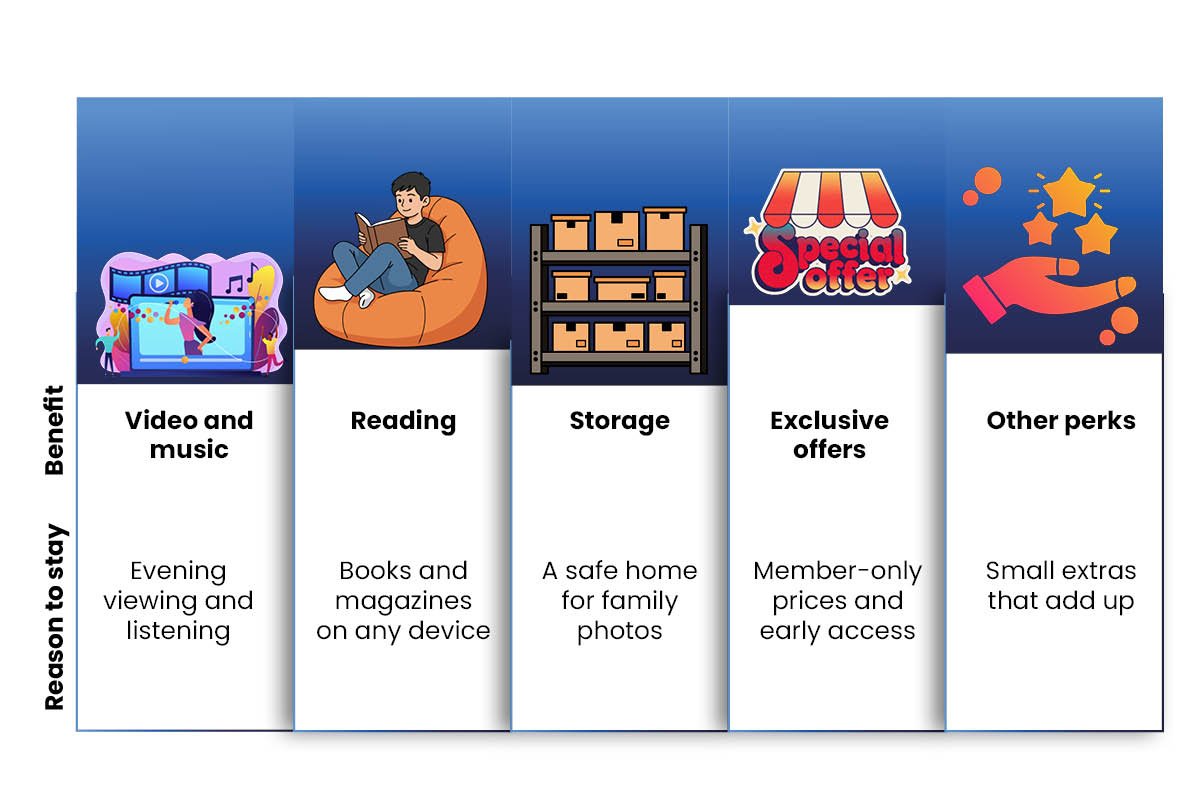
Members who joined for delivery found other reasons to stay. The Amazon Prime business model added services that gave each member more occasions to use the subscription.
| Benefit | Reason to stay |
| Video and music | Evening viewing and listening |
| Reading | Books and magazines on any device |
| Storage | A safe home for family photos |
| Exclusive offers | Member-only prices and early access |
| Other perks | Small extras that add up |
Why it matters
Specific benefits change often, but the strategy stays constant: tie the membership to more useful occasions. A customer may sign up for delivery and renew because a single service, such as music or photo storage, now matters more. Each benefit adds a separate reason to stay.
Prime Changed How Customers Choose Where to Shop
Forrester’s 2018 research gives the clearest look at loyalty behavior inside the Amazon Prime business model. Four questions cover it.
How often did members shop?
Frequently on Amazon.
Did they look elsewhere?
Longer-term members were less likely to research and comparison-shop with other retailers.
How strong was trust?
More than 80% of members with three or more years said they trusted Amazon to treat them as valued customers.
Does every member behave alike?
No. The data dates from 2018, so the point is narrower. Membership can shape where a shopper starts searching and how much effort goes into considering alternatives.
This is the article’s strongest evidence that the program reshapes loyalty behavior in everyday shopping.
Crisis Tested Whether Convenience Could Become Dependence
Stress Log: 2020
- Demand: Online orders surged while physical shopping became difficult.
- Supply: CNBC reported supply-chain pressure, delivery delays, and out-of-stock notices.
- Labor: Scrutiny of Amazon’s workforce added a second challenge.
Why It Matters
Shoppers with an established online routine had an easy option when stores were hard to use. The Amazon Prime business model gained practical value in that moment, since a habit already in place needed no new effort.
Balanced View
The pandemic did not make this a simple success story for the retailer. Each pressure point above showed that convenience creates dependence, and dependence raises expectations the company must meet every day.
The Bigger Change: Customers Began Paying for Convenience
Retailers once gave loyalty away in the form of rewards, but Prime showed that customers would buy it.
Two Loyalty Models
Conventional programs
- Points, coupons, and rewards redeemed later
- Value arrives only after enough purchases add up
Premium loyalty
- Members pay a recurring fee for constant, everyday access
- Benefits are usable throughout the year
Ebbo and Clarus Commerce describe Prime as a leading example of premium loyalty, where customers pay for ongoing benefits instead of collecting rewards for later use.
Beyond One Retailer
The Amazon Prime business model matters because its influence reaches well past the company that built it. Other retailers have since introduced paid memberships built on the same principle: a recurring payment for immediate and continuing value.
What the Prime Model Means for Future Loyalty
Looking ahead, the membership program leaves retailers with five takeaways worth keeping in mind.
Five Lessons
- Convenience: Loyalty can rest on ease instead of points.
- Immediacy: Value received today outweighs rewards promised later.
- Variety: Several useful benefits keep membership relevant.
- Payment: A fee paid upfront changes buying behavior.
- Spread: Customer expectations reach beyond the original company.
Conclusion
Loyalty once meant collecting points and waiting for a reward. Today, many online shoppers expect a retailer to earn their place through everyday usefulness. The Amazon Prime business model worked because it sat inside each order, each delivery and each evening of viewing. Other companies need not copy this approach, and results will differ by business and by shopper. The lasting question for retailers is simple. Which benefits will customers use often enough that paying for membership feels natural to them?
Thank You For Reading!
Read More
How Tesla Changed Public Perception and Made EVs Mainstream?