Venture capital may be flowing again, but raising money is still not easy for every founder. In Q2 2026, U.S. startups on Carta raised $3.19 billion across more than 11,500 pre-seed instruments, compared with $3.22 billion across 14,825 instruments a year earlier.
That means roughly the same amount of money went into fewer deals, suggesting investors are becoming more selective.
A strong idea or polished pitch deck is no longer enough. Founders need to show why they need the money, what it will help them achieve, and why a particular investor is the right fit.
The best fundraising strategies for founders start with the business, not the pitch. The goal is to raise enough capital to reach the next meaningful milestone while choosing the right investors and protecting as much ownership and control as possible
What are the most important fundraising strategies for founders in 2026?
The strongest fundraising approach is not one tactic. It is a system that connects milestones, investor fit, traction, capital structure, and deal terms.
Here are 10 strategies founders can put into practice.
1. Raise around a specific business milestone
Do not begin with, “How much money can we raise?” Begin with, “What must this capital help us achieve?”
Your next round should have a clear purpose. That could be reaching a revenue target, proving retention, launching a product, expanding into a new market, or building the sales team needed for the next stage.
Use this framework: Current position → Next milestone → Cost to reach it → Required runway → Target raise.
For example, if a SaaS company has $2 million in ARR and wants to reach $5 million before its next financing, the founder should model the hiring, sales, product, and operating costs required to reach that goal.
Action: Build a 12–18-month cash plan before deciding the size of the round.
2. Start investor relationships before you urgently need capital

Fundraising should not begin when the bank account is running low. Start building relationships months before the formal raise. This gives investors time to understand the company, and it gives founders time to learn which investors are genuinely interested.
A practical timeline can look like this:
- 6–9 months before the raise: Research and rank potential investors.
- 4–6 months before: Begin introductions and early conversations.
- 2–3 months before: Finalize the pitch deck, financial model, and data room.
- Fundraising window: Run meetings and follow-ups in a focused batch.
Action: Build your investor pipeline before you need a term sheet.
3. Rank investors by fit, not fame
The biggest VC firm is not necessarily the best investor for your company.
Before contacting an investor, score them on stage, sector, check size, geography, portfolio, follow-on capacity, and strategic value. This can quickly eliminate investors who are unlikely to participate.
A simple 1- 5 scoring system works well:
| Investor Factor | What to Check |
| Stage fit | Does the investor fund your current stage? |
| Sector expertise | Do they understand your industry? |
| Check size | Does your target round fit their normal range? |
| Portfolio | Have they backed similar businesses? |
| Follow-on capacity | Can they participate in future rounds? |
| Strategic value | Can they help with hiring, sales, or partnerships? |
| Conflicts | Do they back a direct competitor? |
Action: Rank your investor list before outreach and start with the highest-fit prospects.
4. Make traction the center of the pitch
A pitch should not simply explain what the company hopes to become. It should show evidence of what the business is already proving. As part of effective fundraising strategies for founders, traction should make the connection between current performance and future growth clear.
Instead of spending several slides on a large total addressable market, connect the opportunity to actual customer behavior.
For example: Revenue grew 85% year over year, retention improved, and customer acquisition costs fell. The new capital will fund expansion into two additional markets.
That statement gives an investor a clearer path from traction → capital → growth.
Action: Build a one-page traction summary with the three to five metrics that best prove your company’s progress.
5. Know the story behind every core metric

Investors will look at the numbers, but they will also ask what caused them.
Founders should be prepared to explain revenue growth, gross margin, customer acquisition cost, lifetime value, retention, burn rate, runway, and pipeline.
For every major metric, prepare three answers:
- What is the number today?
- Why did it change?
- What are you doing next?
That third question is often the most important. A weak metric with a credible explanation and improvement plan can be more useful than a strong metric the founder cannot explain.
Action: Create a one-page metric sheet and rehearse the story behind every number before investor meetings.
6. Compare capital options before choosing VC
Venture capital can be powerful, but it is not the only way to finance a company.
Founders should compare the amount of capital available against dilution, repayment obligations, control, speed, and strategic value.
| Funding Option | Equity Dilution | Repayment | Potential Use |
| Venture capital | Yes | No | High-growth businesses |
| Angel funding | Yes | No | Early-stage companies |
| SAFE | Potentially | No | Early-stage fundraising |
| Convertible note | Potentially | Usually converts to equity | Early rounds or bridge financing |
| Venture debt | No immediate equity dilution | Yes | Companies able to support debt |
| Strategic investment | Usually | No | Capital plus industry access |
| Grants | No | No | Eligible projects or businesses |
| Customer-funded growth | No | No | Businesses with early revenue |
The right choice depends on the business model. A company with predictable revenue may have financing options that a pre-revenue startup does not.
For U.S. companies, the SEC says Regulation Crowdfunding allows eligible companies to raise up to $5 million in 12 months, subject to its requirements and disclosures.
Action: Compare at least two or three funding routes before committing to a financing structure.
7. Model dilution before negotiating valuation
A high valuation can reduce immediate dilution, but the headline number does not tell you everything about a deal.
Founders should model the effect of the proposed financing on the cap table before signing. That includes the new investor’s ownership, option-pool changes, and potential future rounds.
A simple starting point is:
Post-money ownership = Investment ÷ Post-money valuation
For example, a $5 million investment at a $25 million post-money valuation gives the new investor 20% ownership, before considering other factors that can affect the cap table.
Carta’s private-market data also shows why dilution deserves close attention. Its Q4 2025 report found median dilution from seed through Series C fell to 16%, down from about 18% at the start of the year.
Action: Model your ownership under base, optimistic, and downside scenarios before negotiating the term sheet.
8. Run the fundraise like a sales pipeline
Fundraising becomes much easier to manage when every investor is at a defined stage.
Track the process from:
Investor identified → Introduction → First meeting → Partner meeting → Due diligence → Term sheet → Closed
Then measure where investors are dropping out.
If 40 investors receive the deck but only five take a second meeting, the problem may be investor targeting or the pitch. If investors reach due diligence but stop before a term sheet, the issue may be valuation, metrics, or another part of the deal.
Action: Review your investor pipeline every week and track conversion at each stage.
9. Protect operating momentum while you raise

A fundraiser can consume a founder’s calendar quickly. That becomes dangerous when customer growth, product development, or hiring begins to suffer.
Where possible, separate responsibilities. The CEO or founder can lead investor conversations while finance handles the model and diligence, and operating leaders continue running the business.
Action: Block specific fundraising time each week and protect the rest of the calendar for customers, product, and operations.
10. Keep investor relationships warm between rounds
A founder should not disappear after the money arrives.
Regular investor updates can keep existing relationships strong and make the next financing conversation easier. Updates can cover key metrics, product milestones, major hires, challenges, and specific requests for help.
This is also where investors can become more than sources of capital. A well-connected investor may help with hiring, customer introductions, partnerships, or future financing.
Action: Create a consistent investor-update schedule before the next round is on the horizon.
A practical 2026 fundraising checklist
Before approaching investors, make sure you can answer:
- What specific milestone will this round fund?
- How much capital is required to reach that milestone?
- How much runway will the raise provide?
- Which investors are the strongest fit?
- What three to five metrics prove traction?
- Can we explain why each major metric changed?
- What dilution will the proposed terms create?
- What happens to founder ownership after a future round?
- Have we compared alternatives to VC?
- How will we track investor outreach and conversion?
If you cannot answer these questions clearly, the company may need more preparation before starting broad investor outreach.
Which fundraising strategy fits your startup stage?
The right fundraising strategies for founders change as a company moves from pre-seed to later-stage funding. A pre-seed founder and a Series B founder are solving different financing problems.
At pre-seed, investors may place greater weight on the team, problem, product, and early validation. At later stages, the conversation moves toward repeatable growth, unit economics, operating efficiency, and market position.
Founders should understand not only how much capital is available at their stage, but what investors are using to distinguish one company from another.
| Startup Stage | Primary Goal | Common Capital Sources | Investor Focus |
| Pre-seed | Validate the problem and product | Angels, accelerators, SAFE | Team, problem, early validation |
| Seed | Prove traction | Angels, seed VC, SAFE, priced equity | Revenue, users, retention |
| Series A | Scale a repeatable model | Venture capital | Growth, unit economics, market |
| Series B+ | Accelerate scale | Growth VC, strategic capital, debt | Revenue, efficiency, market position |
What numbers do investors want to see before writing a check?
The numbers investors care about depend on the company’s stage, but the underlying question is consistent: Is this business showing evidence that more capital can produce more value? That is why strong fundraising strategies for founders should connect financial metrics to the company’s growth story, rather than presenting numbers in isolation.
For an early-stage startup, investors may focus heavily on customer adoption, retention, product usage, and early revenue. As the company grows, revenue growth, gross margin, customer acquisition cost, lifetime value, burn, and operating efficiency become increasingly important.
Founders should know the story behind every major metric:
- Revenue growth: Shows whether demand is increasing.
- Gross margin: Shows the economics of the core business.
- Customer retention: Shows whether customers continue to see value.
- Customer acquisition cost (CAC): Shows what the company spends to acquire customers.
- Lifetime value (LTV): Estimates potential long-term customer value.
- Burn rate: Shows how quickly capital is being used.
- Runway: Shows how long existing cash can support operations.
- Pipeline: Provides a view of potential future revenue.
- Net revenue retention (NRR): Shows whether revenue from existing customers is expanding or shrinking.
Do not present metrics simply because investors expect them. Explain what changed, why it changed, and what you plan to do next.
What are the biggest fundraising mistakes founders make in 2026?
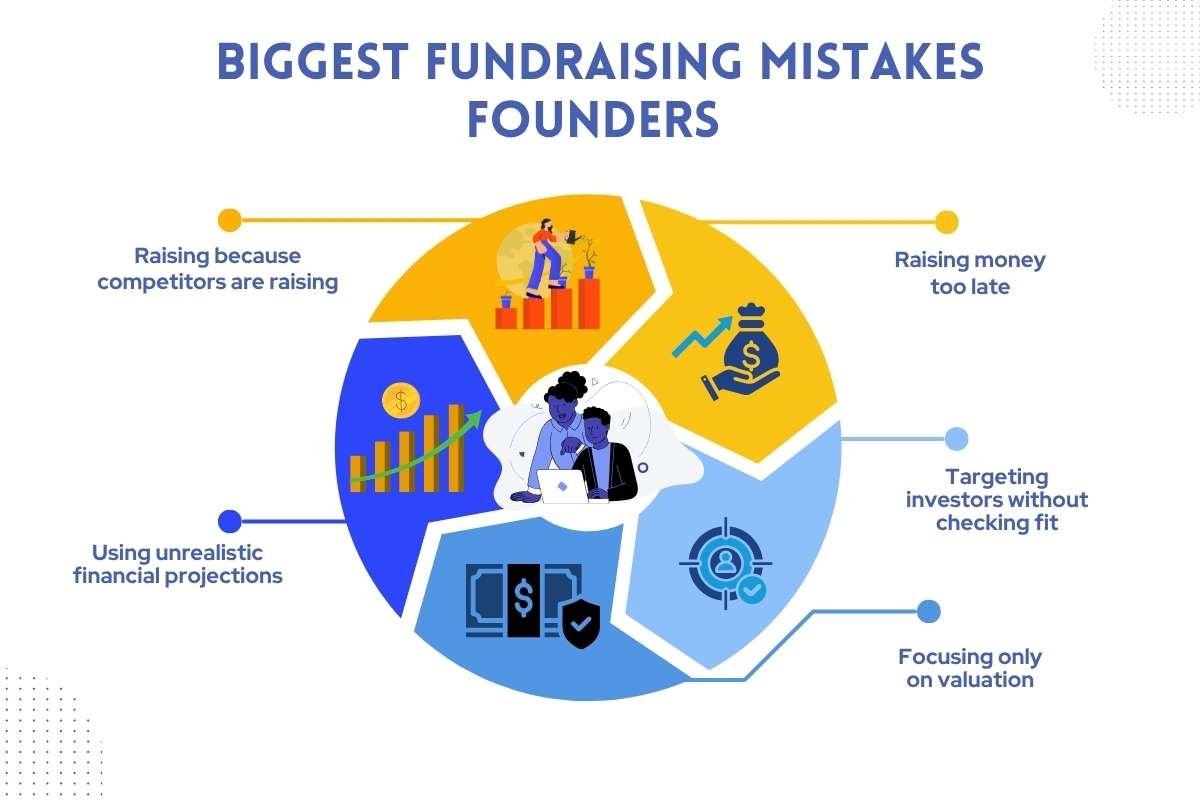
The biggest fundraising mistakes often come from poor planning, weak investor fit, and unclear use of capital. Founders can avoid them by linking every funding decision to a clear business need and milestone.
- Raising money too late: Waiting until cash is running low can weaken your negotiating position. Start fundraising early enough to maintain a healthy runway and tie the raise to clear business milestones.
- Targeting investors without checking fit: Contacting every VC rarely leads to better results. Focus on investors who match your industry, stage, geography, check size, and growth plans.
- Focusing only on valuation: A high valuation can come with higher dilution, investor preferences, or tighter governance terms. Evaluate the full deal, not just the valuation.
- Using unrealistic financial projections: Large revenue targets without strong assumptions can reduce investor confidence. Build projections around realistic customer growth, pricing, costs, and market conditions.
- Raising because competitors are raising: Another company’s funding round does not mean you need the same amount of capital. Raise based on your own cash needs, growth plans, and upcoming milestones.
How should fundraising strategies for founders continue after they close a round?
The funding round is the beginning of the next operating phase.
Translate the fundraising plan into measurable targets. If the capital was raised to reach $5 million ARR, hire 20 salespeople, or launch in two new markets, those goals should become part of the company’s operating plan.
Investor communication should continue as well. Regular updates can cover financial performance, product progress, hiring, customer wins, and challenges.
The next fundraise should not be the first time investors hear from you after the current one closes. Capital creates the opportunity, but execution determines whether the next round is easier to raise.
Conclusion
Fundraising works best when capital is tied to a clear business goal. The strongest fundraising strategies for founders focus on the right investors, proven traction, sensible terms, and disciplined execution. Raise with a clear milestone in mind, use the capital well, and keep investors engaged long after the round closes.
Frequently asked questions
1. How do founders know if their startup is ready to raise funding?
A startup is generally better positioned to raise when it can show a clear market need, evidence of customer demand, a defined growth plan, and a realistic reason for needing outside capital. Readiness also depends on the company’s stage and funding type.
2. How much equity should founders give up when raising capital?
There is no universal percentage. Founders should evaluate valuation, round size, option-pool changes, future financing needs, and other terms together to understand the full effect on ownership.
3. Is venture capital always the best funding option for founders?
No. VC can suit high-growth companies, while angels, bootstrapping, debt, grants, strategic investment, or customer-funded growth may be better for other businesses.
4. Should founders raise funding before reaching product-market fit?
They can, particularly at the pre-seed or seed stage, but the purpose of the funding should be clear. Early capital can help validate the product, test demand, or reach the evidence needed for a larger round.