What does it actually take to become a management consultant?
The U.S. Bureau of Labor Statistics projects management analyst employment to grow 9% between 2024 and 2034, three times the projected growth rate for all occupations. The agency also expects around 98,100 openings a year, pointing to continued demand for professionals who can help organizations solve business problems.
But consulting does not have one standard entry route. You might enter straight from college, use an MBA to switch careers, or bring industry experience into an experienced-hire role.
This article explains how to become a management consultant and what each route involves, including the skills firms value, recruiting process, case interviews, career paths, and compensation.
What does a management consultant do?
A management consultant helps an organization understand a business problem, analyze the options, and decide what to do next.
The work can range from helping a retailer enter a new market to helping a manufacturer cut costs, a technology company improve operations, or a financial-services firm rethink its growth strategy. The common thread is structured problem-solving under a deadline.
A typical project starts with a client question. The consulting team then breaks the problem into smaller parts, gathers data, interviews stakeholders, tests assumptions, and turns the findings into a recommendation.
Consultants move between clients and industries, learn quickly, analyze information, and work with clients to turn recommendations into action.
That is why the role sits between analysis and decision-making. You may spend a morning reviewing market data and an afternoon preparing a presentation for a senior executive.
Management consulting vs. related careers
| Career | Primary focus | Typical work |
| Management consulting | Business problems and strategic decisions | Analysis, recommendations, client work |
| Corporate strategy | Strategy inside one company | Market analysis, growth plans, strategic initiatives |
| Investment banking | Capital raising and transactions | Valuation, M&A, financial modeling |
| Operations consulting | Business performance and processes | Process improvement, cost, supply chain |
| Technology consulting | Technology-enabled business change | Systems, digital transformation, implementation |
The boundaries can overlap. A consulting firm may work on technology, finance, or operations, but its role is usually to help the client solve a defined business challenge, often from an external perspective.
What degree do you need and what are the main paths into consulting?

BLS lists a bachelor’s degree as the typical entry-level education for management analysts, the broader occupation that includes many consulting-related roles.
Business, economics, finance, engineering, mathematics, computer science, and other analytical fields can all build useful foundations. A liberal arts background can also work when paired with strong evidence of analytical ability, leadership, communication, or business interest.
The bigger question is how you use your education to build a consulting profile.
The undergraduate route
For college students, internships are often the most direct bridge into full-time consulting.
Consulting firms recruit from universities for analyst and related entry-level roles. BCG’s U.S. recruiting information, for example, states that undergraduate and non-MBA master’s students from all fields of study and backgrounds can apply for its associate opportunities.
That means students should not assume they need a business degree. Strong academic performance, leadership, problem-solving experience, internships, and evidence that you can work well in teams can matter just as much.
A consulting club or case competition can help because it gives students practice with the type of structured thinking used in interviews. It can also put you in contact with students and alumni who have already gone through recruiting.
The MBA route
An MBA is not universally required to become a management consultant. It is, however, a major recruiting channel for people who want to enter consulting after gaining professional experience.
At business schools, consulting recruitment is often highly organized. GMAC notes that U.S. MBA recruiting commonly includes internships between the first and second years, with recruiting for those internships often beginning months earlier. It also highlights consulting clubs, networking, peer preparation, and case practice as common parts of the process.
For someone changing careers, the MBA can serve two purposes: building business skills and creating access to a structured recruiting pipeline.
The experienced-hire route
You can also move into consulting without returning to school.
A professional working in technology, healthcare, consumer goods, finance, operations, engineering, or another field may have valuable industry knowledge that a consulting firm can use. In that case, the story is less about starting over and more about showing how your experience helps solve client problems. Large firms actively recruit experienced professionals.
Comparing the main entry routes:
| Entry route | Typical starting point | Main advantage | Main challenge |
| Undergraduate | College student | Direct path into analyst recruiting | Highly competitive campus process |
| MBA | Pre-MBA professional | Structured consulting recruitment | Cost and time of business school |
| Experienced hire | Working professional | Industry expertise | Fewer standardized recruiting pathways |
| Boutique or advisory | Existing consulting/advisory role | Relevant project experience | May require repositioning for strategy roles |
The right route depends less on prestige and more on where you are in your career and what gap you need to close.
What management consulting skills do firms look for?

Consulting firms do not simply look for people who are “smart.” They look for people who can turn messy information into a clear business answer.
1. Structured problem-solving
A client may ask, “Why are profits falling?” That is not one problem. It could involve price, volume, costs, customer behavior, competitors, product mix, or several factors at once.
A consultant must know how to break the question down without losing sight of the bigger business issue.
2. Quantitative and analytical ability
Consultants work with financial data, market research, operational metrics, forecasts, and other evidence.
You do not need to be a mathematician, but you do need to be comfortable with numbers and able to explain what they show.
3. Communication
Strong analysis has little value if a client cannot understand it. BCG says its consulting interview process evaluates skills that include problem-solving, analytical ability, communication, and the candidate’s motivation and experience.
4. Fast learning
Consultants regularly move between industries, clients, and business models. GMAC’s interviews with consulting professionals emphasize the need to learn quickly and become useful on unfamiliar problems.
5. Business judgment
Consulting is not an academic exercise. A technically correct recommendation may still fail if it is too expensive, too slow, too risky, or impossible for the client to implement.
Good consultants learn to ask a second question after reaching an answer: What does this mean for the business?
6. Leadership and teamwork
Consultants work in small teams and spend significant time with clients. That requires more than individual performance.
You need to handle disagreement, communicate under pressure, organize work, and help a team move toward a decision.
Skills that matter most:
| Skill | Why it matters | How to demonstrate it |
| Problem-solving | Breaks complex business questions into manageable parts | Case competitions, projects, analytical work |
| Quantitative analysis | Supports evidence-based recommendations | Finance, analytics, research, coursework |
| Communication | Turns analysis into clear decisions | Presentations, client-facing work |
| Leadership | Helps teams execute under pressure | Team leadership, organizations, projects |
| Business judgment | Connects analysis to real-world decisions | Internships, industry experience |
| Fast learning | Supports work across unfamiliar industries | Cross-functional projects, varied experience |
The strongest candidates do not just list these skills on a résumé. They show evidence of them.
How does the consulting recruiting process work?
Consulting recruiting can feel mysterious from the outside because much of it is highly structured.
A typical process can include an application, screening or assessment, behavioral or fit interview, case interview, and final round. The exact sequence varies by firm, role, office, and candidate type.
For example, McKinsey says most client-facing consulting candidates participate in a personal experience interview followed by a problem-solving interview. It may also use a gamified assessment called Solve for certain roles.
BCG’s current process includes a skill interview, a case interview for client-facing roles, and a team interview.
That variation is important. There is no single “consulting interview” that every firm uses.
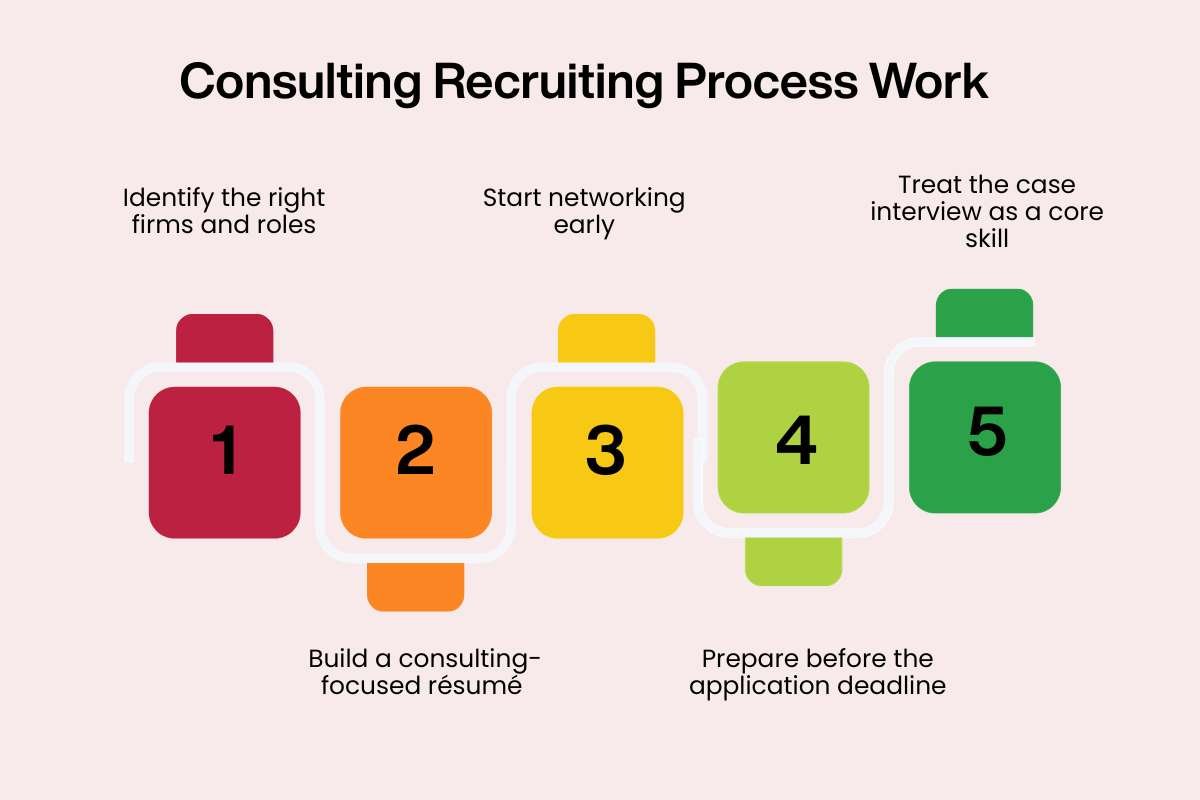
A practical recruiting sequence:
1. Identify the right firms and roles
Do not apply everywhere without a strategy. Decide whether you want strategy consulting, operations, technology consulting, industry-specialist work, or another area.
2. Build a consulting-focused résumé
Your résumé should make analytical and leadership impact easy to find. Quantify results wherever possible.
Instead of saying, “Managed a student organization,” show the business result: increased membership, raised funding, reduced costs, or improved participation.
3. Start networking early
Networking is not just about asking for a referral.
Good conversations help you understand the firm’s work, office culture, recruiting timeline, and what successful candidates tend to do well. Coffee chats, consulting clubs, alumni, and advocates are useful parts of the recruiting process.
4. Prepare before the application deadline
Waiting until the application is submitted to start case preparation is a common mistake.
You want enough time to practice structuring problems, mental math, charts, business judgment, and communication before interviews begin.
5. Treat the case interview as a core skill
For client-facing consulting roles, the case is not a side exercise. It is often central to the process.
McKinsey and BCG both explicitly describe case-style problem-solving as part of their current consulting interviews.
The timing also differs by candidate. Undergraduate and MBA recruiting often follows campus calendars, while experienced hiring can happen throughout the year.
How do you prepare for a consulting case interview?

A case interview gives you a business problem and asks you to work through it with the interviewer. The goal is not to memorize a framework and repeat it. The interviewer wants to see how you think.
The case interview assesses problem-solving and analytical skills. McKinsey describes its problem-solving interview as a discussion of a client scenario designed to evaluate analytical thinking and the approach a candidate takes to solving a complex problem.
Common case types:
| Case type | Example question | Main skill tested |
| Profitability | Why has a company’s profit fallen? | Financial and structured analysis |
| Market entry | Should the company enter a new market? | Market sizing and strategy |
| Growth | How can revenue increase? | Commercial thinking |
| Pricing | What should the company charge? | Quantitative and strategic reasoning |
| M&A | Should the company acquire a competitor? | Strategic and financial analysis |
| Operations | How can the company reduce costs? | Process and operational thinking |
A simple approach is to clarify the objective, structure the problem, analyze the evidence, identify the insight, and recommend an action.
Suppose the client is a consumer company whose profits have fallen. Instead of jumping to “cut costs,” you could break the problem into revenue and cost, then examine price, volume, product mix, fixed costs, and variable costs. That structure gives you a way to test hypotheses rather than guessing.
How much do management consultants make?
Management consulting pay varies widely based on firm, career level, location, bonuses, and educational background.
For the broader U.S. labor market, the Bureau of Labor Statistics (BLS) reports that management analysts earned a median annual wage of $101,190 in May 2024.
- Lowest 10%: Less than $59,720
- Median: $101,190
- Highest 10%: More than $174,140
- Professional, scientific, and technical services: $107,790 median
Management analysts are a broader occupational group than management consultants working at major strategy firms, so these figures provide a general market benchmark rather than a direct measure of consulting-firm pay.
What do top consulting firms pay?
Compensation can be significantly higher at leading strategy firms. According to GMAC’s July 2026 salary reporting, based on Management Consulted’s 2026 Consulting Salary Report, starting MBA consultant base pay reaches:
| Firm | Starting Base Pay | Approx. First-Year Total Compensation |
| McKinsey | $192,000 | $267,000 |
| Bain | $192,000 | $285,000 |
These higher figures include bonuses and other compensation and apply to specific firms and MBA candidate profiles, not the consulting profession as a whole.
A management consultant’s salary can range from around $100,000 in the broader management analyst market to well above $200,000 in first-year total compensation at top consulting firms.
Conclusion:
Learning how to become a management consultant is about building the skills, experience, and recruiting strategy that fit your starting point. Whether you enter through college, an MBA, or industry experience, strong problem-solving, communication, business judgment, and case preparation can help you stand out.
The key is to choose the route that matches your career stage, understand what firms are looking for, and prepare well before recruiting begins.
FAQs
1. Is management consulting stressful?
It can be. Tight deadlines, changing client needs, travel, and long working hours can make the job demanding.
2. Can management consultants work remotely?
Yes. Remote and hybrid work are common for some projects, although client needs may require in-person work.
3. Can consultants specialize in one industry?
Yes. Consultants can develop expertise in areas such as healthcare, financial services, technology, or energy.
4. What is the difference between an internal and external consultant?
External consultants advise different client organizations, while internal consultants work within one company.
5. Can management consulting lead to executive roles?
It can. If you are considering how to become a management consultant as a step toward leadership, consulting experience can provide exposure to strategy, operations, and senior decision-making that supports later executive roles.