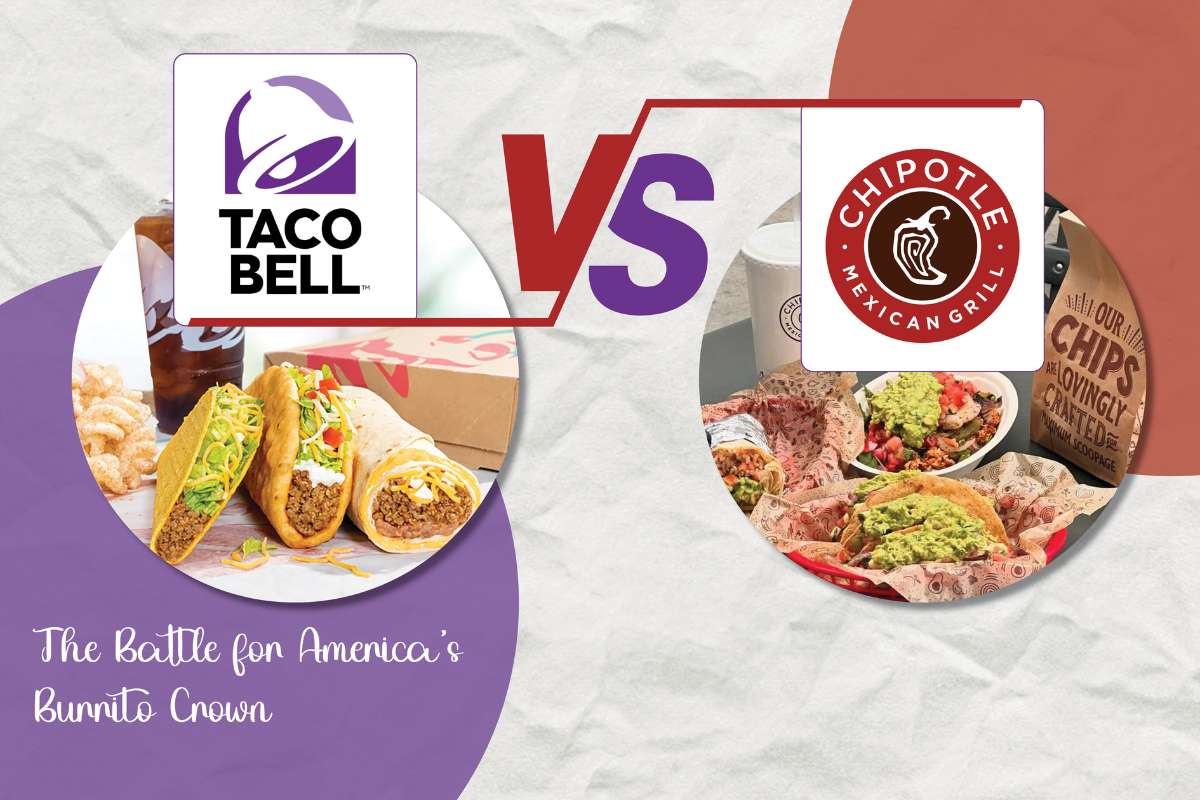
Picture this: You’re hungry, short on time, and a wrapped-in-a-tortilla meal sounds perfect. You pull into a plaza, and there they are. On one side, the vibrant, almost pulsating glow of a purple and orange bell. On the other hand, the austere, industrial-chic font spells out “Chipotle.” Your choice at this moment is about more than just food; it’s a Rorschach test for your mood, your budget, and your values.
Forget world wars. America’s real showdown is Taco Bell vs. Chipotle, unfolding in drive-thrus, digital loyalty apps, and suburban plazas everywhere. But crowning a winner ignores what makes this rivalry remarkable. It isn’t destruction, it’s differentiation. How did two chains, Taco Bell vs. Chipotle, serving nearly identical ingredients, become cultural opposites, business giants, and category leaders in the same space?
The Origin Stories: Fast Food vs. Food With Integrity
Every empire has an origin story, and the philosophies born at its inception still dictate its rule today.
Taco Bell: The Democratizer of the Taco
Founded in 1962 by Glen Bell, a man obsessed with streamlining Mexican food for the American mass market, Taco Bell’s mission was always about one thing: accessibility. Bell figured out how to replicate the taco stand experience with assembly-line efficiency. His innovation wasn’t the recipe, but the system. Taco Bell was born from the classic fast-food playbook that offers consistent, affordable, and craveable food at a speed that beats the competition. It’s a kingdom built on the drive-thru.
Chipotle: The Missionary of the Burrito
Three decades later, in 1993, a classically trained chef named Steve Ells opened the first Chipotle in Denver. His goal wasn’t to feed the masses cheaply, but to prove that fast food didn’t have to be low-quality. The now-famous mantra “Food With Integrity” became the company’s soul. This meant higher-quality ingredients, a focus on fresh preparation in-house, and eventually, a commitment to responsibly sourced meat and produce. Chipotle didn’t just sell burritos; it sold a belief.
The Main Event: A Head-to-Head Breakdown
Let’s get down to the Taco Bell vs Chipotle. What are you actually choosing between?
1. The Menu & Food Philosophy
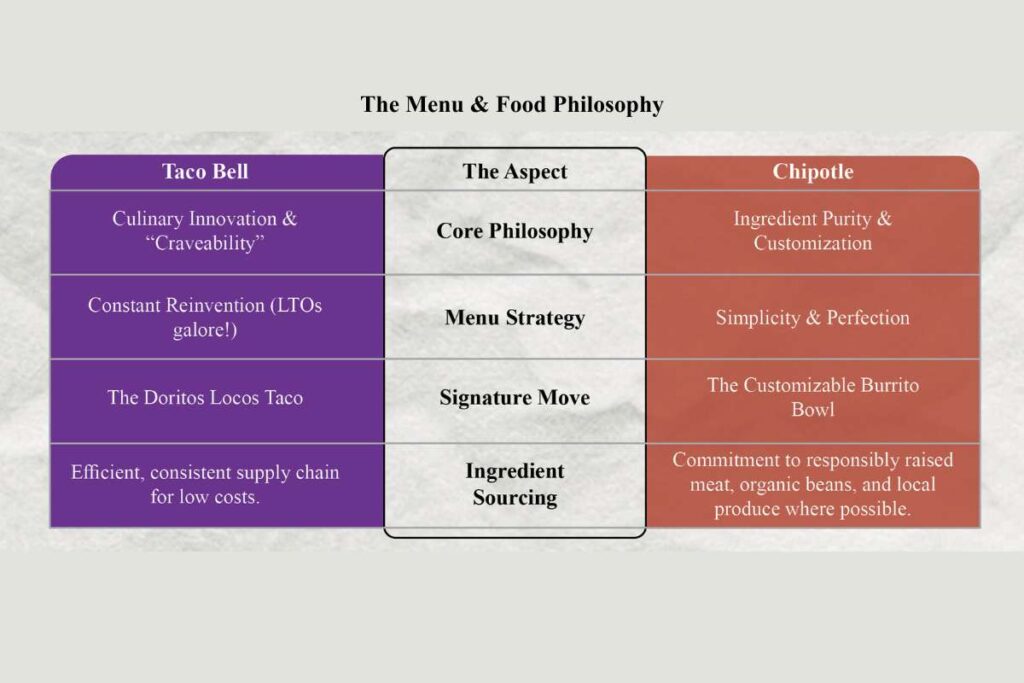
| The Aspect | Taco Bell | Chipotle |
| Core Philosophy | Culinary Innovation & “Craveability” | Ingredient Purity & Customization |
| Menu Strategy | Constant Reinvention (LTOs galore!) | Simplicity & Perfection |
| Signature Move | The Doritos Locos Taco | The Customizable Burrito Bowl |
| Ingredient Sourcing | Efficient, consistent supply chain for low costs. | Commitment to responsibly raised meat, organic beans, and local produce where possible. |
Taco Bell’s Laboratory: Walking into Taco Bell is like entering a food scientist’s playground. The menu is a sprawling, ever-changing landscape of mashups and inventions. The Crunchwrap Supreme, a geometric marvel designed for portability, and the Cheesy Gordita Crunch, a textural masterpiece, are testaments to innovation. Their ingredients are engineered for flavor and shelf-life, and they own it. This is food as fun, an experience that asks, “What will they think of next?”
Chipotle’s Butcher Block: Chipotle’s menu is a study in minimalist confidence. You won’t find 20 new items; you’ll find the same five core vehicles (burrito, bowl, etc.) perfected over time. The “innovation” here happens not in the R&D lab, but in the supply chain sourcing steak from cattle raised without antibiotics, or moving to non-GMO ingredients. The magic is in the customization. You are the architect of your own meal, watching it be assembled from fresh, recognizable ingredients right before your eyes.
So, do you want to be surprised, or do you want to be in control?
2. The Business of Burritos: Taco Bell vs Chipotle.
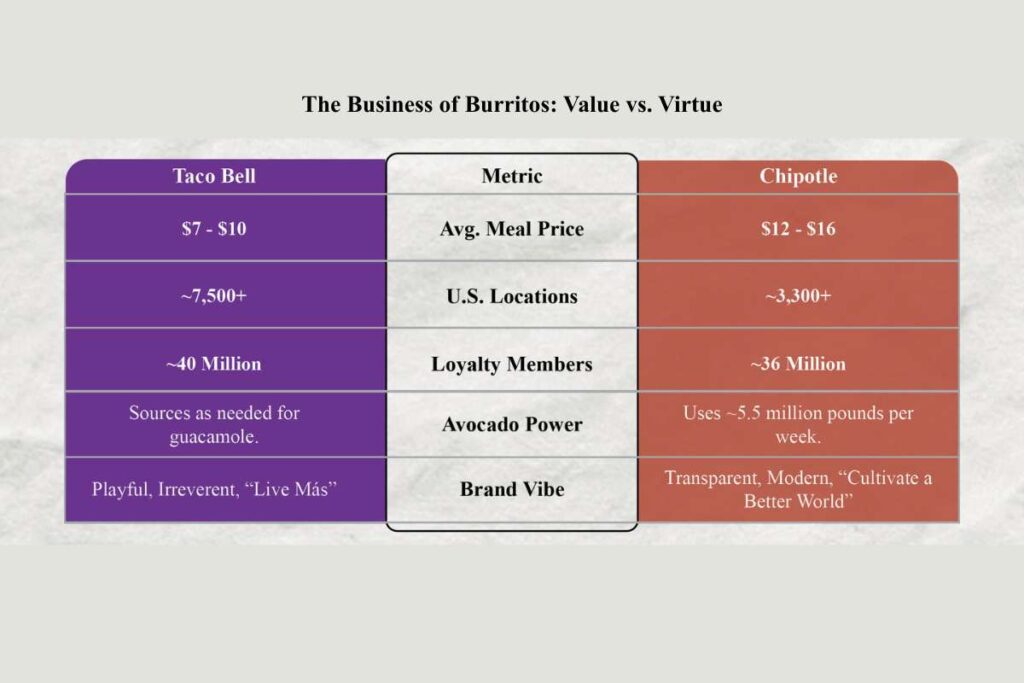
Let’s look at the cold, hard numbers that define their models.
| Metric | Taco Bell | Chipotle |
| Avg. Meal Price | $7 – $10 | $12 – $16 |
| U.S. Locations | ~7,500+ | ~3,300+ |
| Loyalty Members | ~40 Million | ~36 Million |
| Avocado Power | Sources as needed for guacamole. | Uses ~5.5 million pounds per week. |
| Brand Vibe | Playful, Irreverent, “Live Más” | Transparent, Modern, “Cultivate a Better World” |
Taco Bell: The Value King
As a pillar of Yum! Taco Bell’s strength is its colossal scale and aggressive value pricing. Its target is the budget-conscious, often younger, demographic. Its social media presence is legendary, witty, meme-friendly, and deeply engaged with its audience. It’s the official sponsor of your 2 a.m. craving and your “I only have $5” dilemma. The value proposition is clear: maximum flavor for minimum cash.
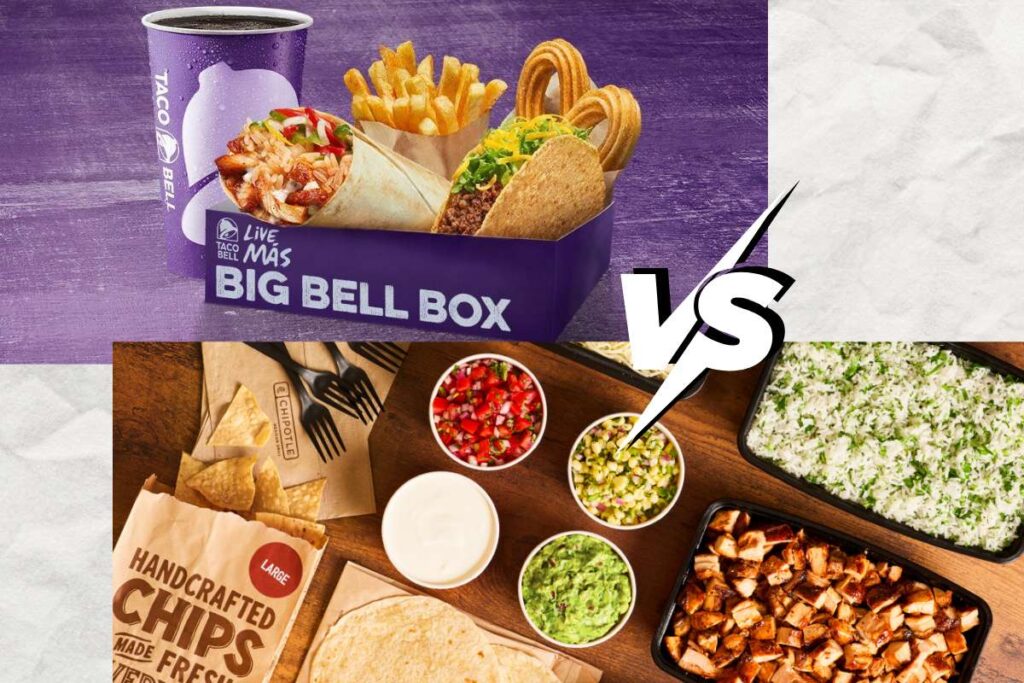
Chipotle: The Premium Proposition
Chipotle’s higher price point is the entire foundation of its model. It’s a tax you pay for its “Food With Integrity” mission. The target customer is the millennial or Gen Z-er who is willing to spend more for what they perceive as a healthier, more ethically sound meal. The atmosphere is clean, efficient, and slightly aspirational. You’re not just buying lunch; you’re buying into a worldview.
So, the question is: Are you paying for a meal, or are you funding a mission?
The Flashpoints: Navigating Crisis
No empire is without its scandals, and how each handled theirs reveals its core identity.
Chipotle’s Food Safety Crisis (2015-2018): For a brand built on “fresh” and “wholesome,” the E. coli and norovirus outbreaks were an existential threat. The very thing that made it premium, fresh ingredients prepared in-store, became its vulnerability. Chipotle’s recovery was a painful, expensive return to its roots, doubling down on food safety protocols and transparency to rebuild the trust it had lost.
Taco Bell’s “Where’s the Beef?” (2011): A lawsuit alleged that Taco Bell’s beef filling didn’t contain enough beef to be called “beef.” While a potential PR disaster, Taco Bell launched a surprisingly effective defensive campaign, openly discussing its recipe and eventually having the suit dropped. For its customers, this wasn’t a deal-breaker; they weren’t there for gourmet beef, they were there for the unique Taco Bell *flavor*.
One brand faced a crisis of safety; the other, a crisis of perception. Their survival proves their understanding of what their customers truly value.
Quirky & Fun Facts for Pull-Out Boxes
- The Avocado Scale: Chipotle uses approximately 400,000 pounds of avocados every day to make its guacamole. That’s the weight of about 100 mid-size sedans.
- Hot Sauce Heaven: Taco Bell serves about 8.2 billion packets of hot sauce per year. If laid end-to-end, they could wrap around the Earth X times.
- The Tortilla Press: Chipotle uses a custom-made press called the “TortillaBot” that can cook and roll 800 tortillas per hour.
- Doritos Dynasty: The Doritos Locos Taco was the most successful product launch in Taco Bell history, selling over 1 billion units in its first year.
- Career Longevity: Chipotle’s first-ever employee, Crystal Pepper, still works for the company today.
The Verdict: Coexistence, Not Conquest
So, who wins? The answer is deceptively simple: we do.
Declaring a winner between Taco Bell vs. Chipotle is a fool’s errand, because they aren’t actually competing for the same title.
Taco Bell is the king of fast food, a realm of affordable, ingenious, and unapologetic indulgence. It’s for the late-night cravings and the “why not?” moments. Chipotle is the champion of fast casual, a temple to premium ingredients and ethical sourcing. It’s for the virtuous lunch and the “I’m making a good choice” feeling.
The truth is, they both, Taco Bell vs Chipotle, win by mastering their domain. Our modern appetites are contradictory; we want both guilt and virtue. The same person who devours a Crunchwrap Supreme on Friday likely orders a responsibly-sourced burrito bowl on Monday.
The market hasn’t forced a choice. It has brilliantly given us two different answers to the same question: “What are you in the mood for today?”