Key Takeaways:
- Musk revealed satellite designs to support orbital artificial intelligence computing infrastructure.
- SpaceX plans massive expansions at its Texas facilities to manufacture AI satellite hardware.
- The orbital project bolsters the company’s strategy ahead of its record-breaking IPO.
SpaceX CEO Elon Musk has revealed detailed designs for a new AI-focused satellite, marking a major strategic move to establish a massive orbital network for complex artificial intelligence computing.
Developing Orbital Computing Infrastructure
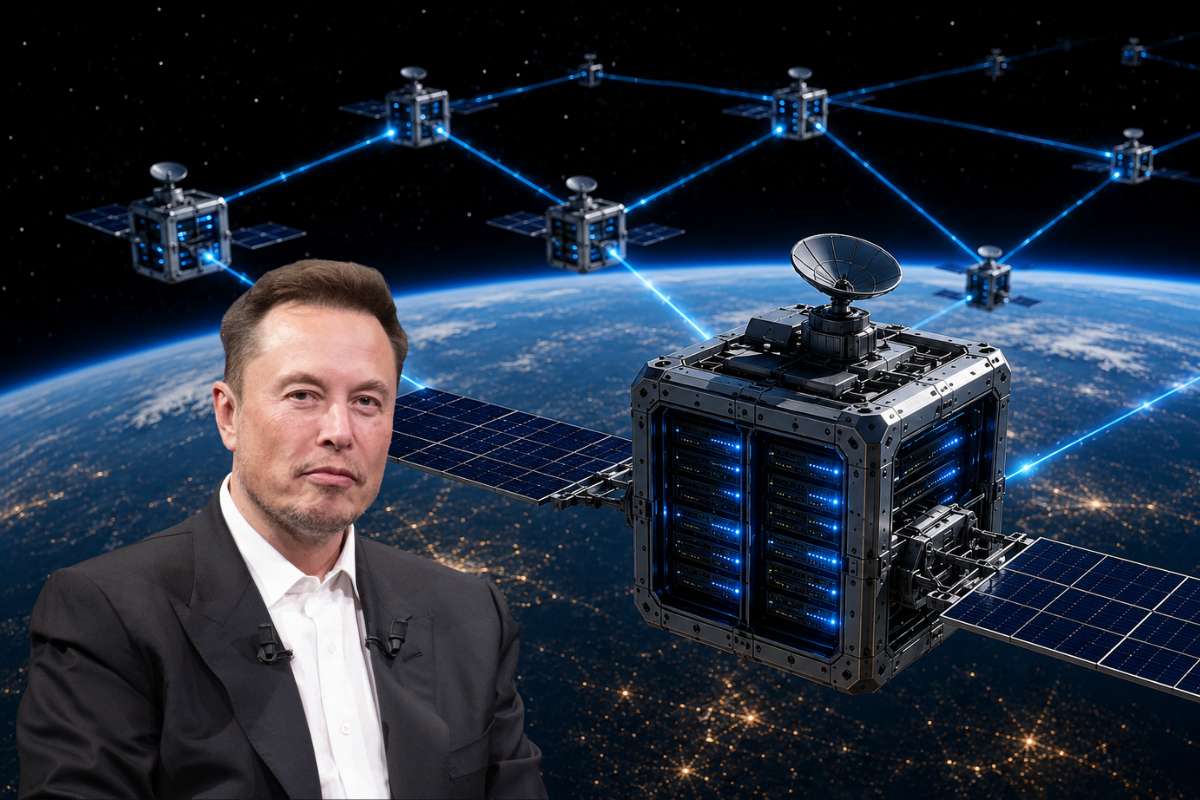
Elon Musk revealed the “AI1” satellite design during a video presentation on his social media platform, X. The spacecraft features solar panels spanning 230 feet and is designed to support a compute payload between 120 and 150 kilowatts.
The company plans to deploy a network of nearly 1 million satellites to process AI tasks from space. Elon Musk noted that while these satellites must be larger than existing Starlink hardware, they are simpler to construct because they lack the complex antennas required for satellite internet.
SpaceX Chief Financial Officer Bret Johnsen confirmed that initial AI satellites will utilize Nvidia chips. The company is already pursuing partnerships, including deals with Anthropic and Google to provide access to its data center and computing resources.
Expanding Massive Manufacturing Facilities
To support this ambition, SpaceX is planning a significant expansion of its Bastrop, Texas, site. The project, referred to as “Gigasat,” will encompass 11 million square feet across 1,000 acres to manufacture the massive solar arrays required for the orbital fleet.
Beyond Gigasat, Elon Musk teased an even larger facility known as “Terafab.” This proposed site would span 100 million square miles, ten times the size of Tesla’s Austin Gigafactory, and is intended to function as a major hub for chip manufacturing and related infrastructure.
“Elon felt the constraint was going to be compute and power,” Johnsen explained in a separate interview with analyst Gavin Baker. “We are already seeing that.”
Strategic Pivot Amid Public Offering
The initiative serves as a core component of SpaceX’s broader AI ambitions as the firm prepares for what analysts anticipate will be the largest initial public offering in history. By focusing on hardware infrastructure rather than consumer-facing chatbots, Musk aims to dominate the foundational layer of the AI industry.
SpaceX also continues to explore internal ventures, including its own Grok chatbot, while simultaneously monetizing its excess compute capacity. The company recently collaborated with AI startup Cursor on coding tools, signaling an intent to remain flexible as it navigates the competitive technology landscape.
As the company scales its manufacturing capabilities, the success of the AI1 satellite project remains tied to SpaceX’s ability to solve critical power and compute constraints. The firm’s rapid hardware development cycle is driven by its extensive experience building the Starlink internet network.
Check out Visionary CIOs Magazine for the latest updates in business, technology, and innovation.