Kaizen, continuous improvement, uses small daily changes instead of big company overhauls. By helping workers cut daily waste, companies save money and work better. To start, build a safe space for worker ideas, test simple fixes, and track your time savings. Read this guide to learn simple ways to improve your business today.
Every business leader knows the quiet frustration of watching resources slip away through a thousand tiny operational leaks. Your team spends hours wrestling with slow habits and everyday friction that drains productivity. That is where the Japanese concept of kaizen comes into play.
While the literal translation means change for the better, its true value lies in how it rescues companies from routine stagnation.
Connecting with this mindset helps you stop treating inefficiency as just another cost of doing business. Let’s break down exactly what this concept means and how it operates behind the scenes.
What Kaizen Actually Is and How It Helps Your Business?

The word comes from two Japanese terms: kai meaning change, and zen meaning good. Together, they form a philosophy focused on continuous, incremental progress. It is a practical system for improving daily business operations through small, consistent changes rather than massive, expensive overhauls.
Instead of waiting for top-down restructuring, it relies on the people doing the actual work to spot and fix everyday friction.
It works by turning problem-solving into a daily habit rather than a rare corporate event. When a team member notices a slow approval loop, an extra data entry step, or a redundant handoff, they fix it right away instead of just working around it.
This direct approach helps your company cut operational costs, reduce employee burnout, and eliminate wasted hours. Over time, those tiny daily adjustments compound into massive efficiency gains that keep your business running smoothly without disrupting daily revenue.
What Are the Core Benefits and Financial Returns of Kaizen?
Redesigning daily workflows unlocks real financial gains. According to market research, the global continuous improvement tools market is valued at $9.88 billion. Companies that adopt these structured practices see clear returns on their invested time and capital.
Here is a breakdown of key operational metrics tracked by continuous improvement teams:
| Goal | What It Does | Main Benefit |
| Saving Time | Reclaiming lost hours | Frees up your team by removing slow approval loops and daily busywork. |
| Saving Money | Cutting waste | Lowers expenses by stopping waste in materials, waiting, and extra movement. |
| Boosting Speed | Increasing output | Speeds up work delivery across both factory floors and office desks. |
How the 5S Framework and PDCA Cycle Power Everyday Operations?

Turning big efficiency goals into daily reality requires practical tools. But before fixing a process, you need to know what you are fighting. Kaizen focuses on clearing out three main types of waste:
- Muda (Waste): Unnecessary steps or tasks that waste time and add zero value for the customer.
- Mura (Unevenness): Wild spikes and drops in workflow speed that cause sudden rush jobs and bottlenecks.
- Muri (Overburden): Pushing workers or machines past safe limits, which leads to burnout and equipment breakdowns.
Now you need practical tools that actually work. The first one is the 5S framework, which cleans up everything from a messy desk to a cluttered computer folder. It breaks down into five simple steps:
- Sort: Clear out tools, files, and paperwork you do not actively use.
- Set in Order: Arrange remaining items so everything has an obvious, labeled home.
- Shine: Clean workspaces regularly to spot equipment wear or maintenance issues early.
- Standardize: Create visual checklists and clear rules so daily habits stick.
- Sustain: Build routine reviews to ensure these clean habits do not fade away.
This simple routine stops workers from wasting twenty minutes hunting down lost documents or buried software links.
The second core tool is the PDCA cycle, which gives your team a clear rhythm for solving stubborn operational problems:
- Plan: Pinpoint a specific workflow bottleneck and measure its exact cost in time or money.
- Do: Test a simple fix on a small scale with just one team.
- Check: Compare your test results against your original baseline data to see if the change worked.
- Act: Make the successful fix a permanent company standard, turning a temporary test into a lasting operational gain.
Also Read: What is Process Improvement and How To Use It In Your Business?
How Does Kaizen Compare to Traditional Management and Radical Restructuring?
Many leaders wonder whether they should fix a broken process with tiny daily tweaks or a massive corporate overhaul. Traditional management often relies on those big, disruptive changes. They try to rewrite the whole playbook at once, which usually panics employees, costs a fortune, and temporarily halts daily work.
On the other hand, daily improvement focuses on steady, small steps. Instead of tearing down an entire house because a door is squeaking, you simply oil the hinges. This keeps your team calm and keeps business moving forward while you quietly fix the leaks.
Here is a quick snapshot of how daily improvement stacks up against a full corporate restructuring:
| Kaizen (Incremental) | Feature | Radical Restructuring (Overhaul) |
| Small, everyday workflow tweaks | Scope | A massive, company-wide redesign |
| Low risk; easy for teams to accept | Risk Level | High risk; can disrupt daily business |
| Continuous, ongoing daily habits | Timeline | Set project window (6 to 18 months) |
| Clear out minor daily annoyances | Primary Goal | Fix major, broken systems from scratch |
How Can Kaizen Be Applied Across Different Sectors?
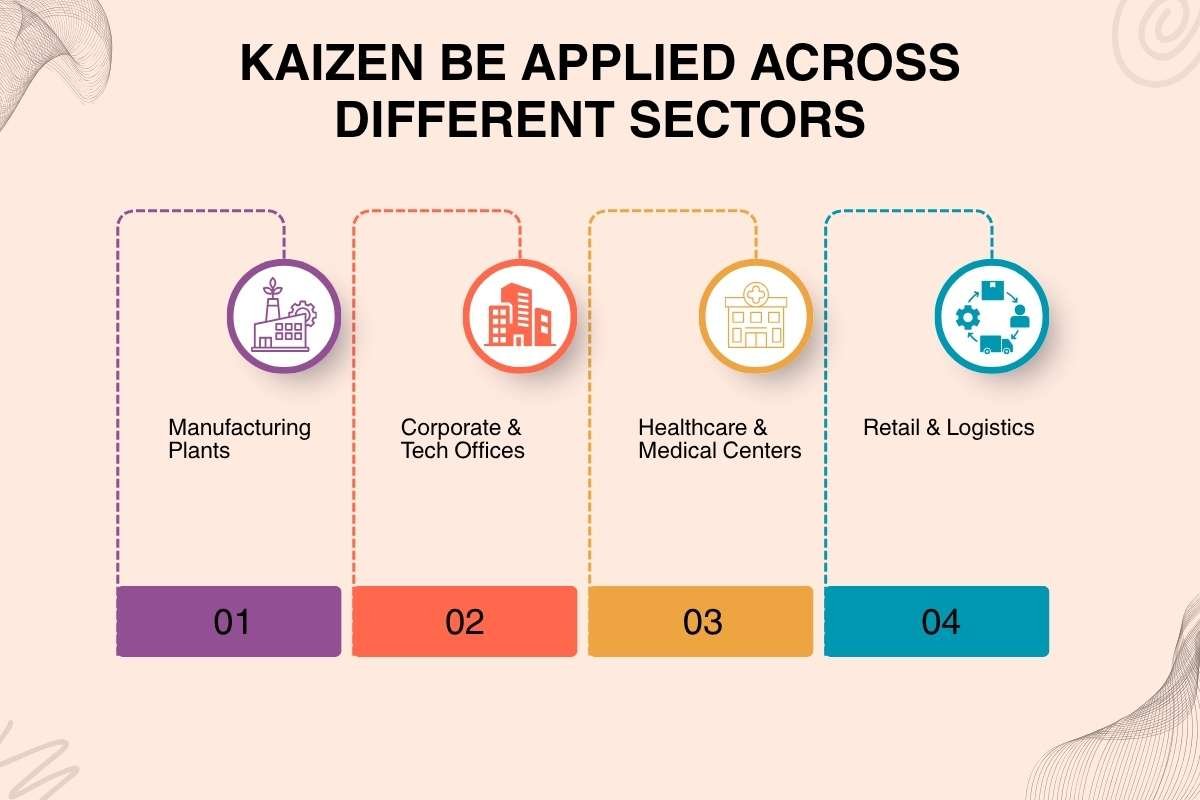
Although this method started on car assembly lines, it works just as well in a tech office, a busy hospital, or a retail store. The core goal is to find where people get stuck and fix the routine.
Here is how different industries apply these daily habits:
1. Manufacturing Plants:
Factory workers used to waste precious minutes hunting for lost tools, while small machine hiccups often turned into expensive assembly line shutdowns.
By introducing visual tool boards and daily micro-logs, teams caught issues early. For instance, catching a loose conveyor belt on Monday morning stopped a full factory breakdown by Tuesday afternoon, saving thousands of dollars in repairs.
2. Corporate & Tech Offices:
Office projects often slow down because of too many approval steps and messy computer folders.
Teams fix this by cleaning up digital steps. Instead of waiting on three managers to clear a small bill, a team sets a quick rule for low-cost buys, which stops days of wasted emails.
3. Healthcare & Medical Centers:
Medical teams use small daily adjustments to organize supply carts, map clear floor paths, and speed up medication delivery. Doctors and nurses collaborate to remove routine paperwork hurdles, which cuts patient wait times and reduces errors.
Also Read: Healthcare Operations Management: A Comprehensive Guide
4. Retail & Logistics:
Warehouse staff used to walk miles just to pack common items. That slowed down order shipping. By tracking walking paths, teams changed where they store items. Moving best-selling products right next to packing desks gets boxes out the door much faster
How Do You Implement a Kaizen Program?
Workers often push back against change if they feel left out of big decisions made by executives. To stop this pushback, you need to build a safe space. Staff must feel comfortable pointing out workplace flaws without fear of blame or punishment.
Once your team feels safe speaking up, follow these four clear steps to get started:
1. Form a small launch team:
Bring together staff from different departments. Write down your current baseline costs and project times so you have clear data to track.
2. Make it easy to share ideas:
Give frontline workers a simple way to log daily workflow blocks. A basic digital form or shared board works better than complicated software.
3. Test small fixes:
Pick one minor annoyance. Run a quick test using a simple fix with just one group, then check if it actually saved time or money.
4. Prove the value and scale up:
Measure your real savings. Once you show that the new habit works, roll it out across the rest of the company.
Conclusion:
Kaizen is about trusting your team to fix small daily annoyances every single day.
We looked at how tools like the 5S framework and the PDCA cycle keep teams organized and focused. We also saw how factories, offices, hospitals, and warehouses use these exact steps to cut waste and save time.
When you give workers a safe space to share ideas and test simple fixes, continuous improvement becomes a daily habit.
Frequently Asked Questions
1. What is the difference between daily Kaizen and a Kaizen event?
Daily Kaizen involves small, ongoing adjustments made by regular workers during normal shifts. A Kaizen event is a focused, workshop-style project where a cross-functional team gathers for a few days to fix a specific, major workflow bottleneck.
2. How do you maintain long-term employee engagement in continuous improvement?
Engagement stays high when workers see their ideas acted upon quickly. If suggestions sit in a queue for months without feedback, participation drops. Transparent tracking and public recognition keep teams motivated.
3. Who is responsible for leading Kaizen improvements?
Everyone on the team! While managers help set up the program, the best ideas come from frontline workers who do the daily tasks. Kaizen works best when every staff member feels empowered to fix small problems in their own workspace.