Who owns the data that your team depends on every day? If the answer changes depending on who you ask, your business may already have a governance problem.
An enterprise data governance strategy fixes this by defining who owns data, what quality and access standards apply, and how teams manage, protect, and measure it. It is important to make trusted data easier to use for business decisions, analytics, compliance, and AI.
In this article, we’ll break down what governance should cover, who should own it, how to set standards, measure maturity, support AI, and build a strategy that can scale.
What does an enterprise data governance strategy actually cover?
Data governance is the system of authority, accountability, policies, standards, and decision-making processes used to manage enterprise data.
In practice, an enterprise data governance strategy defines who owns data, what good data looks like, who can access it, how it should be protected, and how issues are handled. NIST’s Data Governance and Management Profile also addresses roles, data quality, access, metadata, provenance, lineage, sharing, and lifecycle management.
A practical strategy can be organized around seven connected pillars:
- Ownership and accountability: Define who makes decisions and resolves data issues.
- Data quality: Set standards for accuracy, completeness, consistency, timeliness, and validity.
- Security and access: Control who can use data and under what conditions.
- Metadata and lineage: Document what data means, where it comes from, and how it moves.
- Policies and standards: Create common rules for how data is defined, managed, and used.
- Compliance and lifecycle: Address privacy, regulatory requirements, retention, and disposition.
- Measurement and reporting: Track governance performance, data issues, compliance, and maturity.
These pillars work together. Ownership makes standards enforceable, classification informs access controls, and lineage helps teams understand the impact of data changes. The goal is not to govern every data task, but to create clear rules around the data that matters most to the business.
How can you build an enterprise data governance strategy?
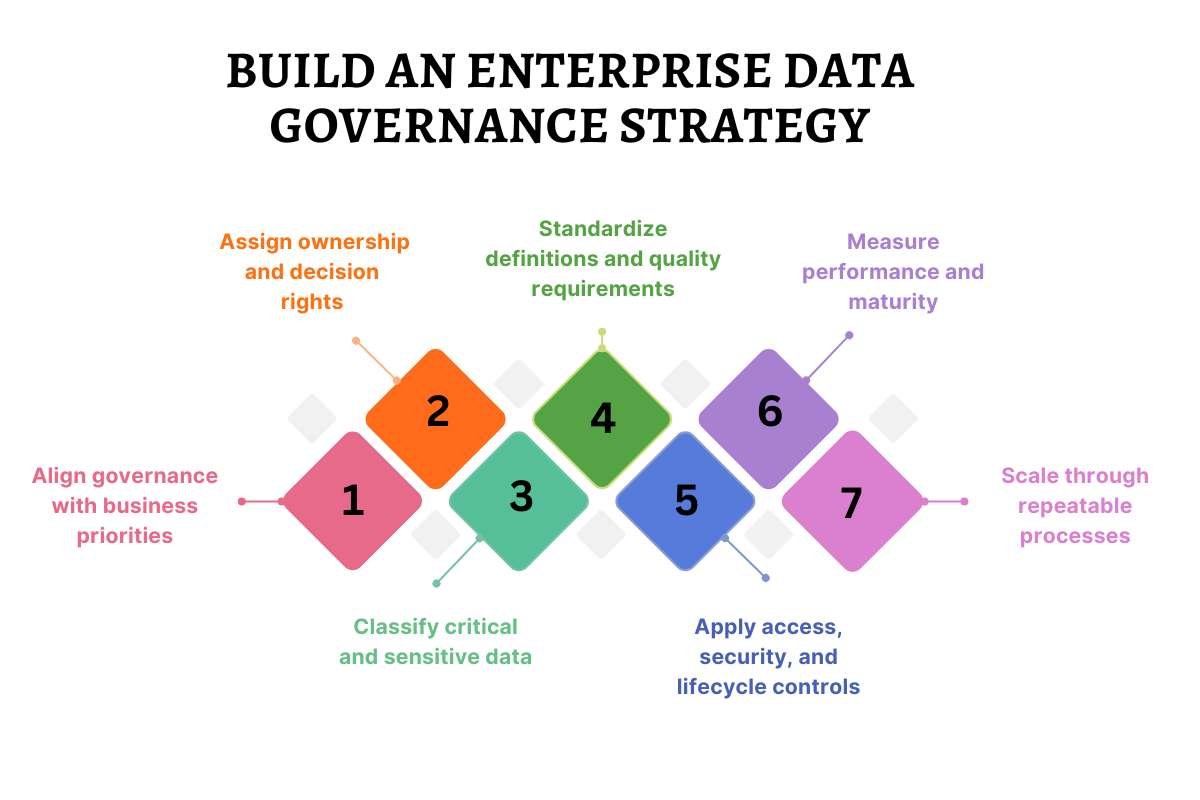
A scalable strategy should start small enough to prove value but be designed for enterprise growth. You can use a seven-step sequence.
1. Align governance with business priorities
Start with business outcomes rather than technology. Identify which data is critical to revenue, customer experience, regulatory obligations, operational performance, or strategic decisions.
2. Assign ownership and decision rights
Identify owners for critical data domains and define the responsibilities of stewards and the governance council. Make escalation paths clear before conflicts occur.
3. Classify critical and sensitive data
Create a practical inventory of important data assets. Identify sensitive, regulated, confidential, and business-critical information so that controls can be applied according to risk.
4. Standardize definitions and quality requirements
Create shared business terms and measurable quality standards for priority data. Avoid trying to standardize every dataset at once.
5. Apply access, security, and lifecycle controls
Connect governance policies to access management, privacy, retention, and data-disposition processes. The objective is to make governance part of normal data operations rather than a separate approval exercise.
6. Measure performance and maturity
Track quality, ownership, lineage, policy compliance, access reviews, and issue resolution. Use the results to identify where governance is working and where controls need improvement.
7. Scale through repeatable processes
Once the model works for priority domains, extend it to additional business units, data products, cloud environments, and AI workflows. Scale the operating model, not bureaucracy.
Who should be responsible for data governance?
Data governance needs executive support, but it should not sit with IT alone. The teams that create and use data should also help set standards, manage quality, and resolve data issues.
Three roles are central to the process:
- Data owners: Take responsibility for specific data domains. They set expectations for data quality, definitions, access, and appropriate use.
- Data stewards: Manage governance on a day-to-day basis. They monitor data quality, maintain definitions, resolve issues, and work with teams that create or use the data.
- Data governance council: Sets the overall direction. It creates priorities, approves standards, resolves conflicts between teams, and checks whether governance is meeting business needs.
Other leaders, including the CIO, CDO, CTO, security, legal, and business-unit executives, may also play a role depending on the company’s structure.
Everyone should know who owns each data domain, who makes decisions, and who handles problems.
What data governance model should you use?
Companies typically use three governance structures: centralized, federated, or hybrid. The right choice depends on the company’s size, regulatory needs, business structure, and how much control individual business units need.
- A centralized model puts most governance decisions under one enterprise function. It works well when you need consistent rules across business units, but it gives individual teams less freedom to set their own standards.
- A federated model gives business units or data domains more control while following shared enterprise principles. This approach can work well for large organizations with different business needs, but it requires strong coordination.
- A hybrid model combines central standards with local ownership. Enterprise leaders set the core rules, while business units manage data within those boundaries. This can help larger organizations balance consistency with flexibility.
How should an enterprise data governance strategy set data standards?

Set standards first for data that affects revenue, customers, operations, compliance, or key decisions.
For data quality, define clear measures for accuracy, completeness, consistency, timeliness, validity, and uniqueness. IBM recommends using data-quality metrics to check whether data meets set standards.
For access, define:
- Who can access the data
- What access they need
- Which data is sensitive
- When access must be reviewed
- What approvals are required
- When access should be removed
Classify data as sensitive, confidential, regulated, or public and apply controls based on its risk.
Keep policies clear and practical. Define exceptions, approval steps, and escalation paths so teams know what to do when standard rules do not apply.
How to measure enterprise data governance strategy?
A governance program needs clear metrics to show if its controls are working. Counting policies or meetings is easy, but these numbers do not show whether the data has actually become more reliable.
Useful governance KPIs include:
| KPI | What to Check | What It Tells Leaders |
| Critical-data coverage | Percentage of priority data assets governed | How much critical data is covered by the governance program |
| Data-quality issue rate | Frequency of data-quality problems | How reliable the organization’s data is |
| Issue-resolution time | Average time to resolve data-quality issues | How quickly teams can fix data problems |
| Ownership coverage | Percentage of critical data assets with assigned owners | Whether accountability is clearly assigned |
| Lineage coverage | Percentage of important data with traceable lineage | How well the organization can trace data sources and movement |
| Policy compliance | Percentage of data assets or processes meeting governance policies | Whether governance rules are being followed |
| Access-review completion | Percentage of required access reviews completed | Whether data access is being reviewed and controlled properly |
The next step is to measure how mature your governance program is. A mature program is not about having more policies. It means the company has clear ownership, repeatable processes, measurable results, and controls that work consistently.
The National Academies’ 2024 data governance and management maturity model uses a structured assessment to help you understand where you stand and what you need to improve.
A simple maturity path looks like this:
| Maturity Stage | What It Looks Like |
| Initial | Ownership is unclear, and problems are handled as they arise |
| Developing | Roles and basic policies are in place |
| Established | Standards, controls, and KPIs are used consistently |
| Advanced | Governance covers more data areas and uses more automation |
| Optimized | Teams measure results and improve governance continuously |
These stages are a roadmap, not a fixed scoring system. Every organization will have different goals, so leaders should focus on whether governance is improving in ways that support their business needs.
What tools support data governance at scale?
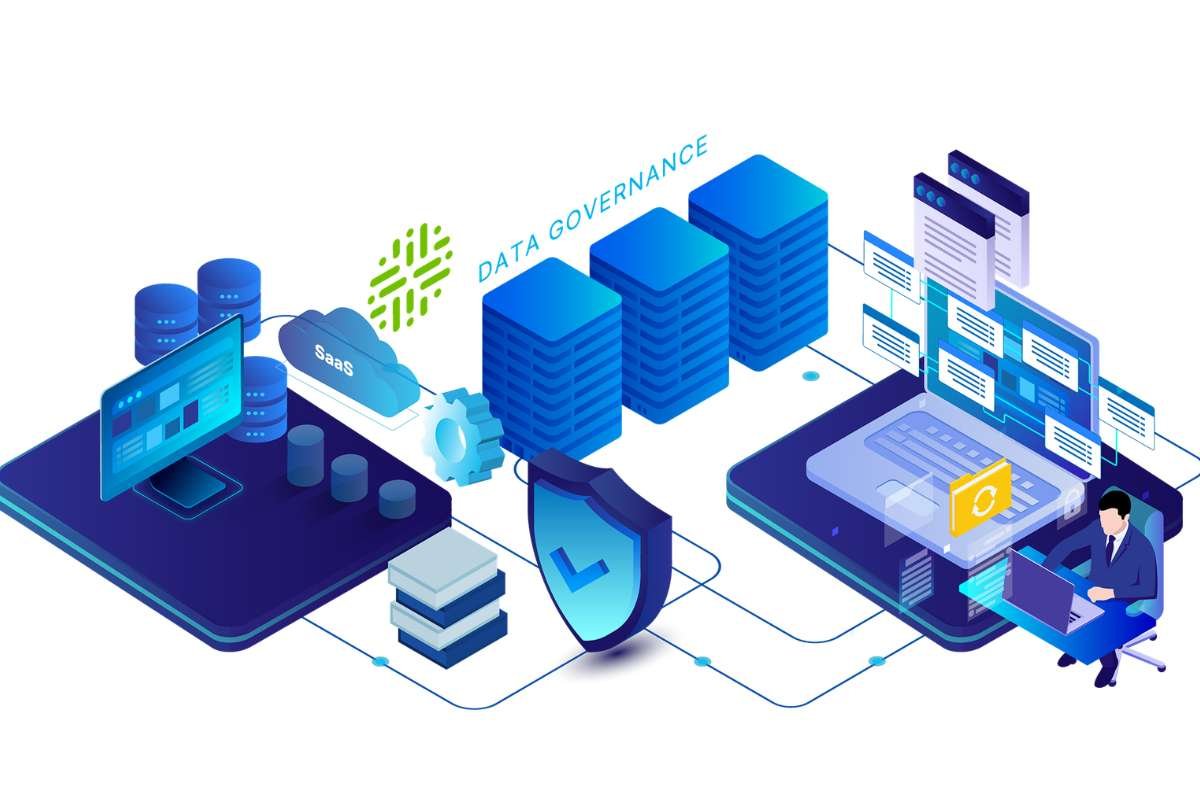
The right tools help teams manage data, track quality, control access, and keep governance processes consistent as the business grows.
Common tools include:
- Data catalogs to help teams find and understand data
- Metadata tools to manage information about data
- Data lineage tools to track where data comes from and where it goes
- Data-quality tools to find and monitor data problems
- Master data management tools to keep key business data consistent
- Access-control tools to manage who can use data
- Governance workflow tools to manage approvals and governance tasks
Choose tools based on your actual governance needs. Start by identifying the problems you need to solve, then choose technology that supports those needs.
How does enterprise data governance strategy support AI and analytics?
AI depends on reliable, well-managed data. If training data has poor quality, unclear ownership, or weak access controls, those issues can affect AI outputs and increase data risk.
For AI training data, governance should cover: Data source and ownership, Quality checks, Data transformations, Sensitive information, Access controls, and data lineage.
Lineage helps teams trace AI data back to its source and see how it was changed before use. This makes it easier to check data quality, investigate issues, and meet compliance needs.
The need is clear in recent industry research. dbt Labs found that 71% of respondents were concerned about incorrect data reaching stakeholders, while 41% cited unclear data ownership as an ongoing challenge.
Strong data governance gives AI teams a clear foundation for using trusted data while keeping access, quality, and accountability under control.
What challenges can slow an enterprise data governance strategy?

Several issues can weaken governance even when the framework is well designed:
- Unclear ownership: No clear decision-maker can lead to slow decisions, unresolved data-quality issues, and accountability gaps.
- Siloed data: Different teams may use different definitions, identifiers, or data sources, which can make enterprise reporting harder to trust.
- Weak executive support: Without leadership backing, teams may struggle to adopt common standards.
- Too many policies: Complex rules can slow data use when teams do not know which requirements matter most.
- One-time implementation: Governance needs regular updates as applications, cloud environments, regulations, data sources, and AI use cases change.
Conclusion:
A strong enterprise data governance strategy gives a clearer view of what data can be trusted, who is responsible for it, and how it should be used. When ownership, standards, controls, and measurement work together, governance becomes part of better business decisions rather than another layer of process.
FAQ
1. How often should an enterprise data governance strategy be reviewed?
Review it at least annually and whenever major changes occur in regulations, business strategy, technology architecture, or AI use. Governance should evolve with the enterprise.
2. What happens when a data owner leaves the company?
The company should quickly assign a new owner. The governance council or relevant leader should ensure there is no gap in accountability.
3. Can data governance work across cloud and on-premises environments?
Yes. The policies and decision rights should apply across environments, while the technical controls can differ by platform.
4. How can leaders show the business value of data governance?
Connect governance metrics to measurable outcomes such as fewer data-quality incidents, faster issue resolution, better compliance, reduced duplication, or improved availability of trusted data.