
“Entrepreneurship is neither a science nor an art. It is a practice.”
Peter Drucker
Many people dream of building something of their own, but few know where to begin. The idea of leaving a stable path to start a business can feel exciting and uncertain at the same time. Questions about skills, risk, and direction often come up early in the journey.
Learning how to become an entrepreneur starts with understanding mindset, planning, and action. Entrepreneurship is about ideas, solving problems, making decisions, and adapting when things do not go as expected. Small steps taken with clarity often matter more than perfect plans.
In this article, we explain how to become an entrepreneur, covering the key skills, habits, and practical steps that help turn ideas into sustainable businesses.
What is an Entrepreneur?
An entrepreneur is a person who identifies a clear market gap and builds a business to address it. They create value by offering a product or service that people are willing to pay for. This often requires personal financial risk and long working hours. The goal is to turn uncertainty into opportunity.
Entrepreneurs move ideas from concept to execution. They test assumptions, learn from failures, and adjust their approach based on real results. Many start with limited resources and rely on creativity to move forward. Progress depends on action, not just planning. Understanding this role is essential when learning how to become an entrepreneur in a practical, sustainable way.
How to Become an Entrepreneur?: A 10 Step Guide
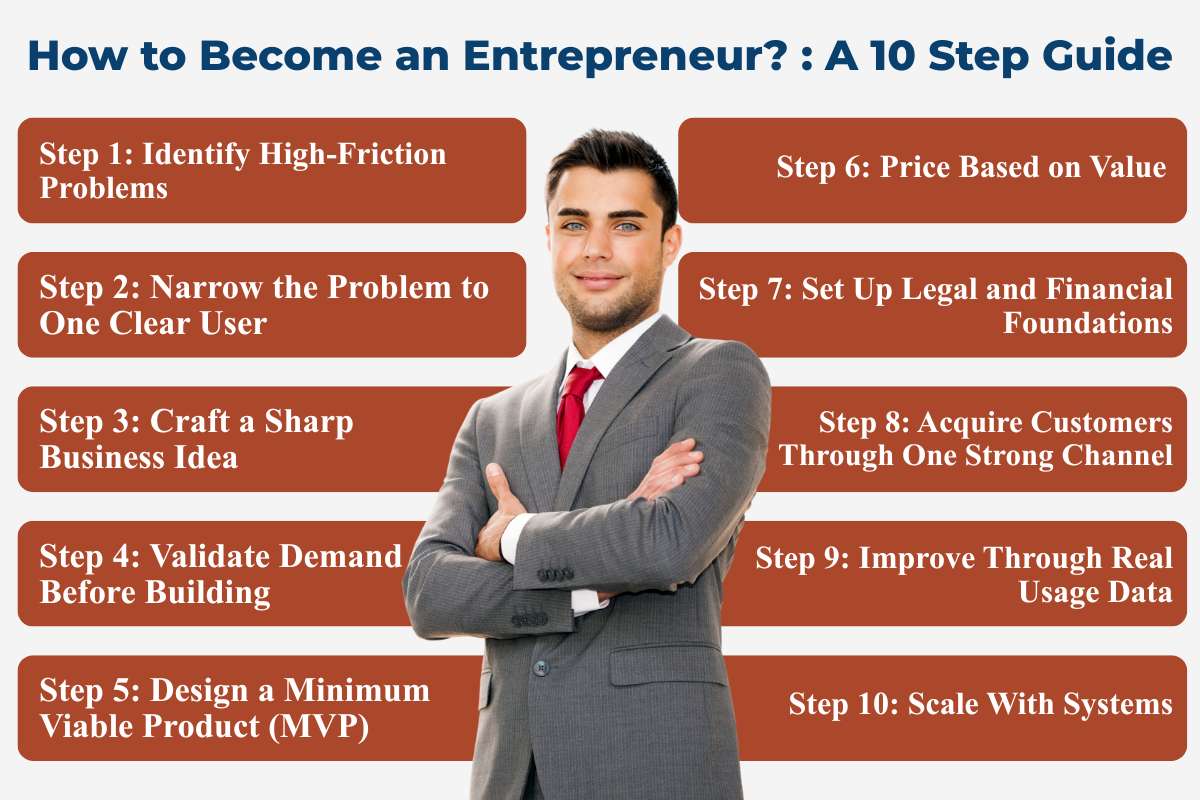
Becoming an entrepreneur is about methodical execution. We at The Enterprise World have identified these 10 key steps that will help you start your entrepreneurial journey. Each step below builds on the previous one. Skipping steps can often lead to avoidable failure.
Step 1: Identify High-Friction Problems
Start by observing friction in daily life or work. Friction means repeated frustration, delay, or wasted effort. These problems usually cost people time, money, or peace of mind. Keep a problem journal for two weeks. Write down every issue you notice more than once. Patterns matter more than one-time annoyances.
➣ How to evaluate a problem: Ask three questions. Does this problem happen often? Do many people face it? Are people already paying to fix it? If all three answers are yes, you may have a strong opportunity.
➣ Example: A corporate employee notices coworkers struggle to track reimbursements. Emails get lost. Payments are delayed by weeks. Companies already use tools, yet teams still complain. This signals a real, painful problem worth exploring.
Step 2: Narrow the Problem to One Clear User
Do not try to solve the problem for everyone. Broad solutions fail early. Pick one specific user group and study them deeply. Focus on age, job role, income level, location, and behavior. Precision improves product design and marketing later.
➣ What to do next: Interview at least 10 people from this group. Ask about their workflow. Avoid pitching your idea. Listen more than you speak. Document repeated complaints and emotional reactions.
➣ Example: Instead of building reimbursement software for all companies, the founder focuses only on startups with under 200 employees. These teams lack finance staff and feel the pain most.
Step 3: Craft a Sharp Business Idea
A business idea is a clear promise to the customer. Describe your idea in one sentence. State who it is for, what problem it solves, and why it works better. Make sure it focuses on the core value your solution provides. Avoid including extra features or optional elements at this stage. A simple, precise idea helps guide product development, marketing, and early testing decisions. Building a solid business idea is the backbone of learning how to become an entrepreneur.
➣ Framework to use: “For [specific user], who struggles with [specific problem], this product provides [specific outcome] by doing [key action].” If you cannot explain it simply, the idea is not ready.
➣ Example: “For startup employees who hate tracking reimbursements, this tool auto-captures expenses from emails and pays within 48 hours.”
Step 4: Validate Demand Before Building
Never assume people will pay. Validate demand with action, not opinions. Create a simple landing page explaining your solution. Add a signup or pre-order button. Share it with your target users. Track engagement carefully and see who actually shows interest. Collect feedback on what excites users and what confuses them.
➣ What success looks like: People sign up without heavy persuasion. Some ask when they can use it. A few offer to pay early. If nobody reacts, revisit the problem or the audience.
➣ Example: The founder shares the landing page in startup Slack groups. Within one week, 120 employees signed up. Five companies ask for demos. This confirms real interest.
Step 5: Design a Minimum Viable Product (MVP)
An MVP is the smallest product that delivers the core value. Remove every extra feature. Speed matters more than perfection. List all features you want. Then circle only the ones required to solve the main problem. Focus on solving the problem clearly for early users before adding anything else.
➣ Execution tip: Use no-code tools or simple software first. Launch within 30 to 60 days. Early feedback shapes better products than assumptions.
➣ Example: Instead of full accounting software, the founder builds only email receipt capture and reimbursement tracking. Nothing else ships in version one.
Step 6: Price Based on Value
A key step in learning how to become an entrepreneur is pricing. Pricing is a strategy decision. Do not copy competitors blindly. Ask users what the problem costs them today. Lost time, errors, or delays all have monetary value. Consider how much your solution saves or improves their workflow, then set a price that reflects that value. Test different price points with early users to see what they are willing to pay.
➣ How to test pricing: Offer two price points to different users. Track conversions. Adjust quickly. Pricing clarity also signals confidence.
➣ Example: Startups say delayed reimbursements hurt morale and retention. The founder prices the tool lower than one employee’s hourly cost per month. Adoption increases fast.
Step 7: Set Up Legal and Financial Foundations
Register your business early. This avoids future trouble. Choose a structure that fits your growth plans. Open a business bank account. Track every expense from day one. Keep all documents, receipts, and contracts organized to simplify taxes and audits later. Proper legal and financial setup also builds credibility with customers, partners, and potential investors. Discipline is key. It is one of the biggest soft skills you need to develop while learning how to become an entrepreneur.
➣ Why this matters: Clean records help with taxes, funding, and trust. Many startups fail audits due to poor early documentation.
➣ Example: The founder registers a private limited company and uses simple accounting software. When investors later ask for records, everything is ready.
Step 8: Acquire Customers Through One Strong Channel
Do not spread marketing across many platforms. Pick one channel where your users already spend time. Master that channel before expanding. Focus on creating consistent, high-quality messaging that resonates with your target audience. Track engagement, leads, and conversions carefully to see what works. Once you have a repeatable process, you can scale to additional channels without losing efficiency or impact.
➣ Good early channels include: Cold emails, LinkedIn outreach, partnerships, or niche communities. Measure results weekly.
➣ Example: The founder focuses only on HR managers at startups. He sends personalized LinkedIn messages. This brings the first 20 paying customers.
Step 9: Improve Through Real Usage Data
Watch how users actually use your product. Behavior can often reveal the truth if people like your product. Hence, learning how to become an entrepreneur often starts with observation. Track drop-offs, repeated actions, and support requests. Use this data to identify friction points and features that truly matter. Regularly review metrics and make small improvements to increase engagement and satisfaction. Listening to behavior rather than opinions ensures your product evolves in line with real user needs.
➣ Action step: Schedule monthly feedback calls with active users. Improve one key metric at a time.
➣ Example: Users abandon the app during setup. The founder simplifies onboarding to three steps. Activation rates double.
Step 10: Scale With Systems
Growth requires repeatable systems. Document processes for sales, support, and onboarding. Hire only when systems break due to volume. Standardize workflows to ensure consistent quality as your team grows. Automate routine tasks wherever possible to reduce manual effort and errors. Scaling with systems rather than relying on founder hustle allows the business to expand sustainably without losing control or customer satisfaction.
➣ Scaling focus: Protect product quality. Maintain customer trust. Expand slowly but deliberately.
➣ Example: After reaching 500 companies, the founder hires customer support and automates onboarding emails. Growth stays steady without chaos.
Skills Required to Become an Entrepreneur

Entrepreneurs need many skills, both personal and professional. If you want to know how to become an entrepreneur, then the following skills are a must to have. These skills help turn ideas into successful businesses.
- Problem Solving: This always comes first. Entrepreneurs solve market challenges every day.
- Communication and Sales: You must pitch your idea to customers, partners, and investors. Clear communication makes selling easier.
- Decision Making: Startups face uncertainty. Quick and confident decisions help you stay ahead.
- Financial Management: Understanding basic finance keeps your business healthy. Track cash flow, costs, and profits.
- Adaptability: Markets change fast. Successful entrepreneurs change plans based on real results.
You now know how to become an entrepreneur, the steps it takes, as well as the skills that are required. But how do entrepreneurs launching new startups and businesses affect the economy?
Impact of Entrepreneurs on the Economy

Entrepreneurs boost economic growth in many ways. They create jobs, increase productivity, and attract investment. New businesses often bring new products and services that stimulate consumer spending.
Startups and entrepreneur-led businesses have made a big impact in recent years. Recent global data shows there are around 665 million people engaged in entrepreneurial activities worldwide, meaning about one in eight working‑age adults is actively involved in starting or running a business.
Small and medium enterprises, many started by entrepreneurs, employ more than half of the global workforce and contribute trillions of dollars to the world economy each year. Entrepreneurs also help spread new ideas and make economies more competitive and resilient. Around the world, entrepreneurship drives innovation and creates millions of employment opportunities.

Entrepreneur and Intrapreneur: Choosing Between Control and Security
Conclusion:
Understanding how to become an entrepreneur is about more than starting a business. It involves building the right mindset, learning from mistakes, and taking consistent action. Success rarely happens overnight, but steady effort and clear goals make progress possible.
By focusing on problem-solving, adaptability, and continuous learning, aspiring entrepreneurs can turn ideas into real opportunities. Every step, whether small or bold, contributes to growth. Knowing how to become an entrepreneur helps you move forward with confidence and purpose.
FAQ
1. How do I start my journey as an entrepreneur?
Start by identifying a problem you want to solve and researching your market. Build basic skills, create a simple plan, and take small, practical steps.
2. Can anyone become an entrepreneur?
Yes. With the right mindset, willingness to learn, and persistence, people from different backgrounds can become entrepreneurs.
3. How long does it take to succeed as an entrepreneur?
There is no fixed timeline. Success depends on the idea, effort, and ability to adapt to challenges over time.