In a gray-walled data center, the hum of cooling fans is the only soundtrack as racks of servers blink in quiet rhythm. For decades, two names have been stenciled on those metal boxes: IBM and HP. One built the mainframe that landed Apollo 11 on the moon; the other started in a Palo Alto garage with an audio oscillator.
The rivalry IBM vs HP isn’t just about hardware; it’s a battle of philosophies: centralized control vs. engineering freedom, enterprise lock-in vs. channel agility. Today, both companies look unrecognizable. IBM is a hybrid cloud and AI consultancy, while HP has split into two: HP Inc. (printers & PCs) and Hewlett Packard Enterprise (servers & networking). Yet the question still echoes in boardrooms: When you need mission-critical infrastructure, who do you call?
The birth of Silicon Valley’s original Cold War
In the 1930s, IBM, under the iron fist of Thomas Watson Sr., dominated tabulating machines. HP, founded in a Palo Alto garage in 1939 by Bill Hewlett and Dave Packard, was an upstart oscilloscope maker. By the 1970s, they were locked in a struggle that would shape enterprise computing. IBM sold “total solutions” hardware, software, and services bundled into a single invoice. HP sold “excellence” best-of-breed components and a cult of employee autonomy.
The IBM vs HP rivalry peaked during the PC revolution (1980s–90s), cooled during the dot-com bust, and reignited in the 2010s after both firms split themselves apart. Today, IBM focuses on hybrid cloud and quantum computing, while HP Inc. (printers & PCs) and Hewlett Packard Enterprise (servers & networking) chase agility. Yet the core strategic tension remains: integration vs. specialization.
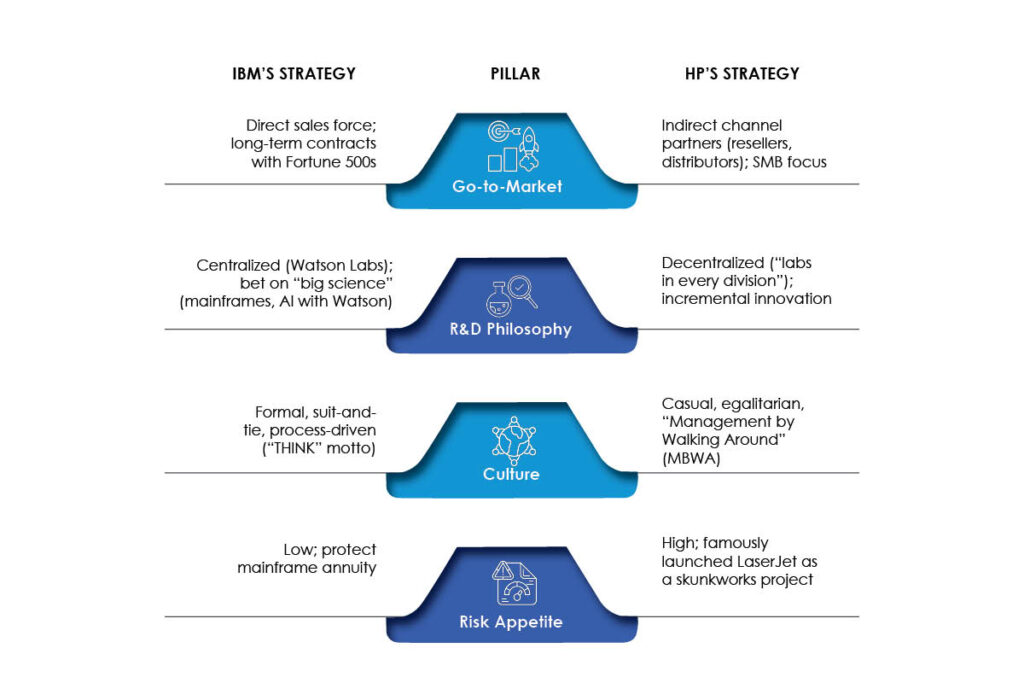
Logical points of contention: four pillars of rivalry
| Pillar | IBM’s Strategy | HP’s Strategy |
| Go-to-Market | Direct sales force; long-term contracts with Fortune 500s | Indirect channel partners (resellers, distributors); SMB focus |
| R&D Philosophy | Centralized (Watson Labs); bet on “big science” (mainframes, AI with Watson) | Decentralized (“labs in every division”); incremental innovation |
| Culture | Formal, suit-and-tie, process-driven (“THINK” motto) | Casual, egalitarian, “Management by Walking Around” (MBWA) |
| Risk Appetite | Low; protect mainframe annuity | High; famously launched LaserJet as a skunkworks project |
Key takeaway: IBM optimized for customer lock-in; HP optimized for engineer autonomy. Neither was universally superior; each excelled in different economic eras.
Pros and cons: a balanced scorecard
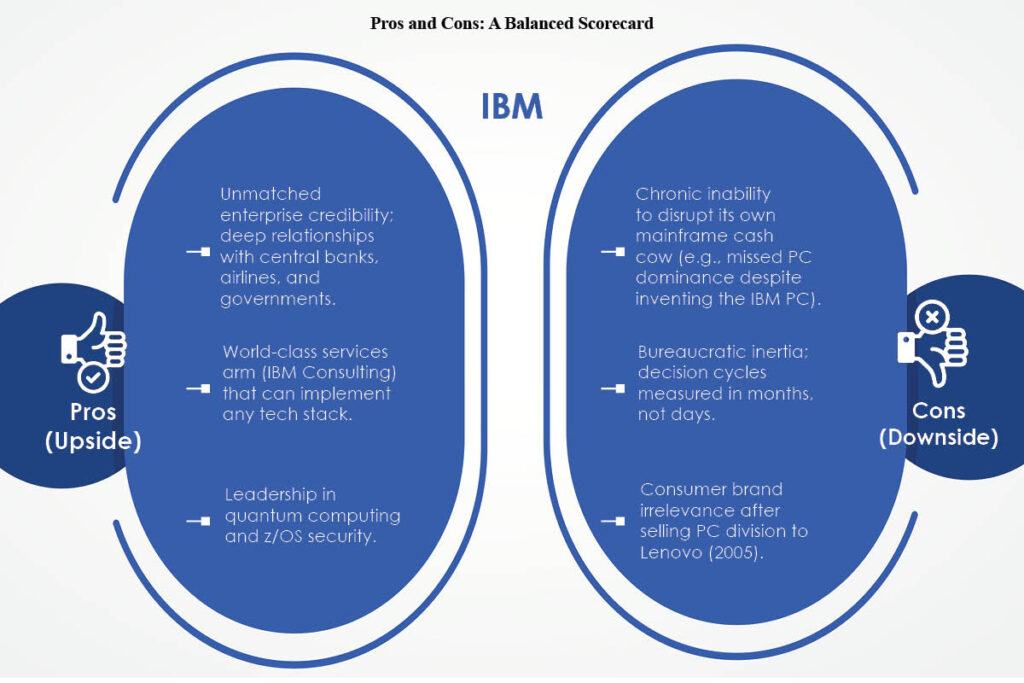
IBM
| Pros (Upside) | Cons (Downside) |
| Unmatched enterprise credibility; deep relationships with central banks, airlines, and governments. | Chronic inability to disrupt its own mainframe cash cow (e.g., missed PC dominance despite inventing the IBM PC). |
| World-class services arm (IBM Consulting) that can implement any tech stack. | Bureaucratic inertia; decision cycles measured in months, not days. |
| Leadership in quantum computing and z/OS security. | Consumer brand irrelevance after selling PC division to Lenovo (2005). |
HP (Pre-2015 split)
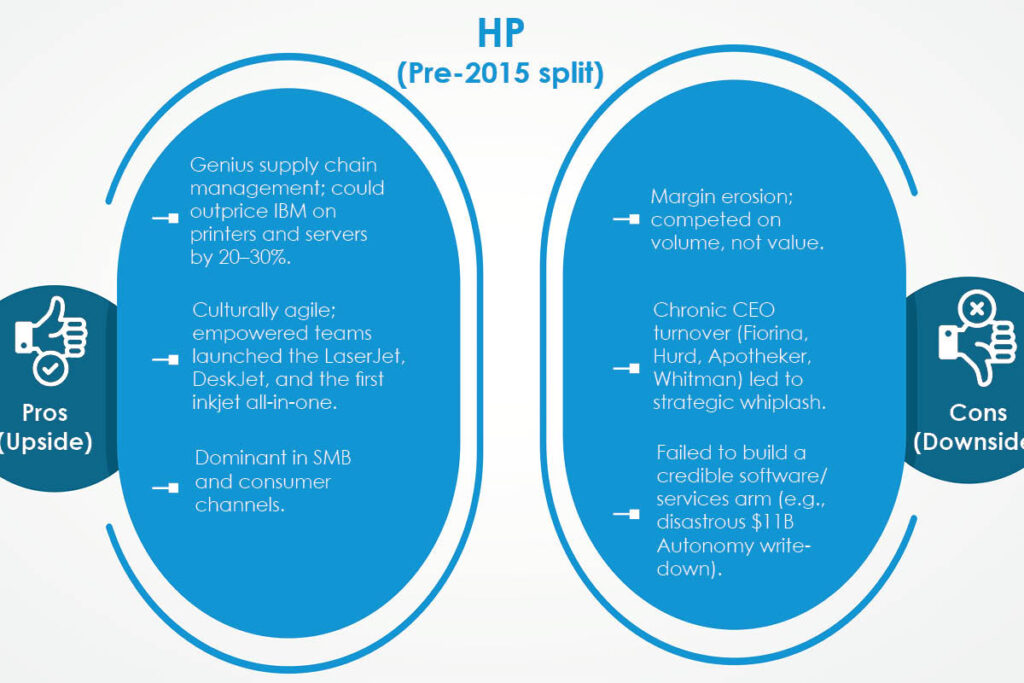
| Pros (Upside) | Cons (Downside) |
| Genius supply chain management; could outprice IBM on printers and servers by 20–30%. | Margin erosion; competed on volume, not value. |
| Culturally agile; empowered teams launched the LaserJet, DeskJet, and the first inkjet all-in-one. | Chronic CEO turnover (Fiorina, Hurd, Apotheker, Whitman) led to strategic whiplash. |
| Dominant in SMB and consumer channels. | Failed to build a credible software/services arm (e.g., disastrous $11B Autonomy write-down). |
Upside vs. Downside: the shareholder perspective (2000–2025)
A table comparing total shareholder returns (TSR) illustrates the IBM vs HP rivalry’s financial reality. Note: HP split into HP Inc. (HPQ) and HPE in 2015.
| Period | IBM (TSR) | HP Legacy (HPQ + HPE) | S&P 500 |
| 2000–2010 | -8% (lost decade) | +45% (printer profits peaked) | -9% (dot-com bust) |
| 2010–2020 | +22% (shift to cloud) | -15% (PC decline + Autonomy scandal) | +190% |
| 2020–2025 | +35% (mainframe revival + Watsonx) | HPQ: +28% (hybrid work boom); HPE: +12% (sluggish edge compute) | +60% |
Conclusion from data: IBM delivers stability but rarely growth. HP delivers volatility, massive upside during hardware cycles, crushing downside during strategic blunders.
The future of the IBM vs HP rivalry (2025–2035)
Neither company competes head-to-head as it once did. The battlefield has fragmented:
IBM’s Trajectory
- Focus: Hybrid cloud via Red Hat (acquired 2019), AI platform watsonx, and quantum computing as a service.
- Edge: IBM’s mainframe now runs 90% of global credit card transactions. They are pivoting to “confidential computing” zero-trust environments for regulated industries.
- Risk: Losing the AI race to Microsoft (OpenAI) and Amazon (Bedrock). IBM’s enterprise AI must prove ROI beyond chatbots.
HP’s Trajectory (Two Companies)
- HP Inc.: Betting on “future of work” (premium conferencing gear, 3D printing, subscription ink). Margin pressure from Chinese competitors (Lenovo, Xiaomi) is severe.
- Hewlett Packard Enterprise (HPE): Focusing on “edge-to-cloud” architecture servers for telco 5G and GreenLake (pay-as-you-go infrastructure). Direct competitor to Dell, not IBM.
Where they still clash
- Managed Print Services: IBM’s Ricoh partnership vs. HP’s Managed Print portfolio.
- AI Servers: IBM’s Power10 vs. HPE’s ProLiant (both using NVIDIA GPUs).
- Consulting: IBM Consulting vs. HPE Pointnext, both chase digital transformation budgets.
Bold prediction: By 2030, IBM will have exited commodity hardware entirely (selling remaining x86 server lines). HP Inc. will merge with a Japanese printer rival (Canon or Epson). HPE will be acquired by a cloud hyperscaler (Oracle or Cisco). The classic rivalry will exist only in business school case studies.
Conclusion: the paradox of persistence
The IBM vs HP rivalry endures not because they are winning, but because they are surviving a feat few technology firms achieve over 80+ years. IBM’s lesson: Loyalty to high-margin customers trumps innovation speed. HP’s lesson: Decentralized engineering breeds resilience but invites chaos.
For today’s executives, the IBM vs HP rivalry offers two competing playbooks:
- The IBM Way: When serving regulated industries (finance, healthcare, government), prioritize security, compliance, and long-term contracts.
- The HP Way: When entering a fast-moving market (edge AI, 3D printing), empower small teams, accept cannibalization, and fix supply chains first.
Neither playbook is obsolete. But the next decade will punish firms that try to hybridize both. As IBM’s former CEO Ginni Rometty once noted, “You cannot be everything to everyone.” HP’s disastrous 2011 attempt to spin off PCs (then reverse course) proved her right.
Final verdict: IBM won the mainframe era, HP won the printer era, and the cloud era belongs to Amazon and Microsoft, but in the coming age of quantum and neuromorphic computing, don’t be surprised if one of these old giants stages a final, furious comeback. Rivalries this deep never truly die; they just reboot.
Thank You For Reading!
See More
Adidas vs Nike: The Rivalry That Changed Sports, Style, and Billions in Sales