Ladies and gentlemen, welcome to the ultimate tech showdown!
In the high-stakes world of artificial intelligence, two tech giants, Google and Meta, are battling it out to shape the future of how we live, work, and connect online.
On one side, there’s Google: focused, methodical, and packed with deep research and long-term vision. On the other hand, Meta: fast-moving, bold, and not afraid to take big risks to change the game.
These aren’t just big tech companies. They’re two of the biggest forces in AI, and they’re going head-to-head. Google and Meta both dominate digital advertising. They both have a massive influence on the internet. But what sets them apart? Their approach. Their culture. Their way of thinking. Google bets on structure, moonshots, and steady progress. Meta pushes speed, experiments, and high-stakes innovation.
This isn’t just a business rivalry. It’s a battle of ideas.
And the outcome could decide the next chapter of the digital world.
Let the race begin.
Inside the Arena of the Tech Clash
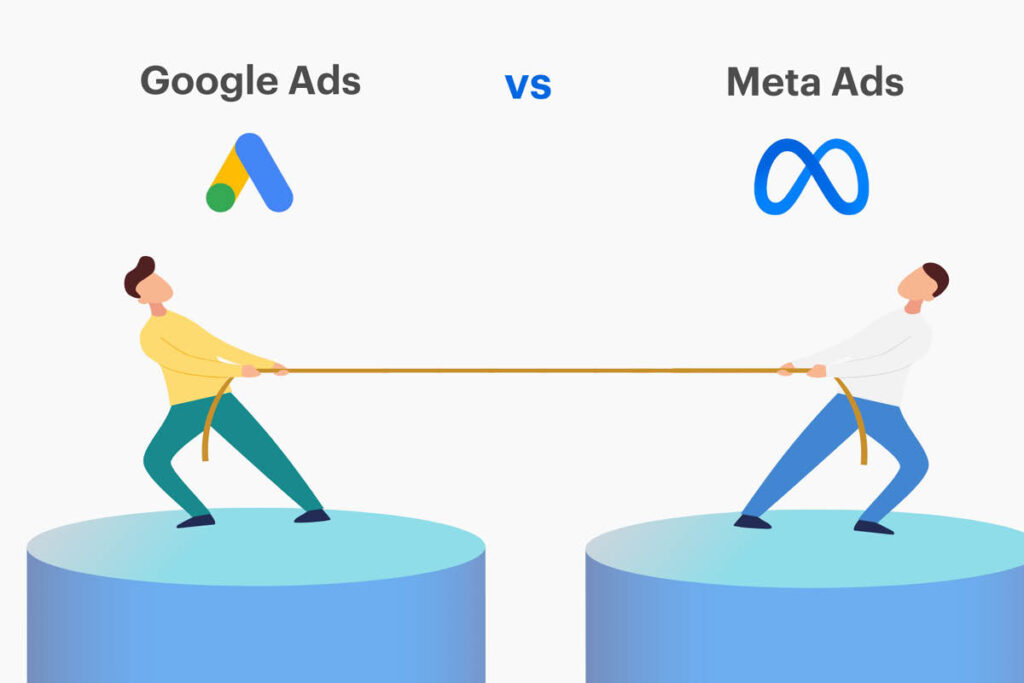
In the heart of Silicon Valley, a storm is brewing. Two tech giants, Google and Meta, are not just competing. They’re waging war, not with swords or soldiers, but with code, data, and intelligence far beyond human speed.
On one side stands Google, the undisputed leader in search, known for its precision, structure, and deep knowledge of the internet.
On the other hand, Meta is a bold force built on connection, speed, and a future powered by virtual worlds.
Their battleground? Artificial Intelligence.
The weapons they bring:
- Google deploys tools like Gemini (formerly Bard) and DeepMind’s research power.
- Meta strikes with LLaMA, its open-source large language model, and AI-powered social platforms.
- Google and Meta both invest billions to control the future of ads, content, and human interaction.
This isn’t just a competition.
More than just a competition, this is a defining battle for the future of technology, shaping how we search, connect, and even think. The stakes are massive: global influence, human attention, and digital dominance, at a time when the rules are shifting faster than ever.
The warriors in this war didn’t rise overnight:
They were built in dorm rooms and garages, not battlefields. But today, they command digital empires.
Two giants. Two paths to power.
➣ Google:
Once a quiet research project at Stanford in 1996, it was called BackRub, a crawler of the early web. But it didn’t stay in the shadows for long. Reborn as Google, a nod to the word googol (a number so big it sounds imaginary), it officially launched in 1998. What started in a garage became a global brain, organizing the world’s information and leading in AI through DeepMind and Gemini.
➣ Meta:
Born as Facebook, it conquered social connections, one friend request at a time. But after years of controversy and privacy concerns, the empire rebranded. In 2021, it became Meta, declaring its vision of the metaverse: a future of virtual worlds and immersive AI. With tools like LLaMA and massive platforms like Instagram and WhatsApp, it’s charging into the next digital frontier.
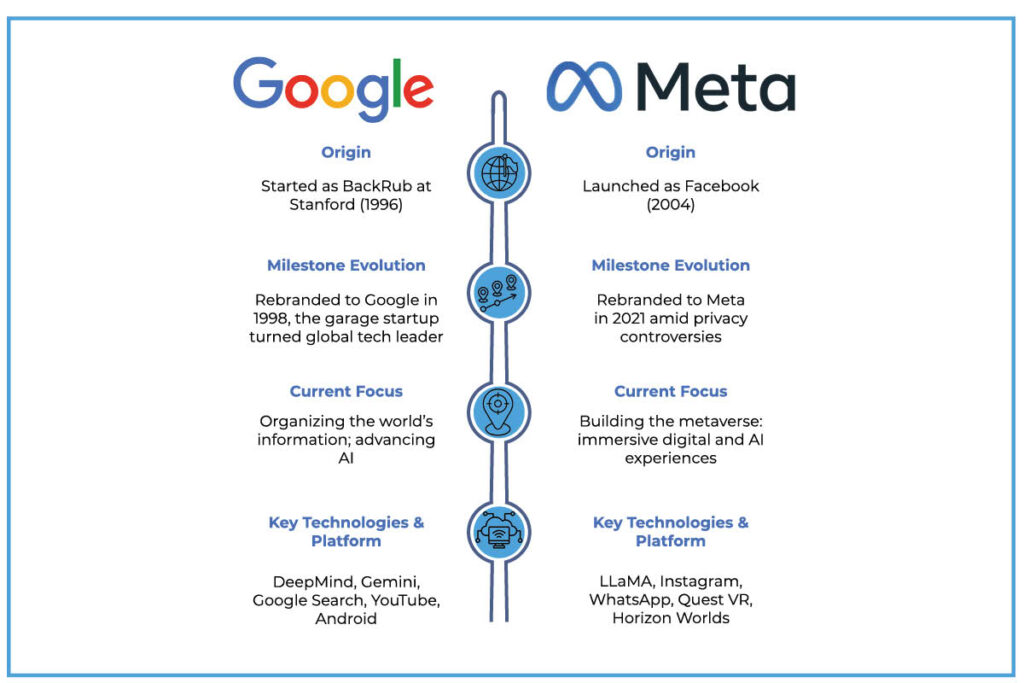
| Company | Origin | Milestone Evolution | Current Focus | Key Technologies & Platform |
| Started as BackRub at Stanford (1996) | Rebranded to Google in 1998, the garage startup turned global tech leader | Organizing the world’s information; advancing AI | DeepMind, Gemini, Google Search, YouTube, Android | |
| Meta | Launched as Facebook (2004) | Rebranded to Meta in 2021 amid privacy controversies | Building the metaverse: immersive digital and AI experiences | LLaMA, Instagram, WhatsApp, Quest VR, Horizon Worlds |
Inside the War Room: How Google and Meta Fight for AI Dominance
The battlefield has been drawn. Each side has its weapons. Each move is strategic.
Let’s break it down, round by round.
Round 1: The Power of the AI Core
- Google steps in with Gemini 1.5 Pro, a multi-modal powerhouse trained to understand text, images, code, and even audio. It fuels Gmail, Search, Docs, and Android, smooth, fast, and enterprise-ready.
- Meta counters with LLaMA 3, smaller but sharper, and most importantly, open-source. It may not be as polished, but it’s free, flexible, and catching fire in developer circles.
“Google is strong in performance and reliability.”
“Meta shines in accessibility and creative control.”
Round 2: Control of the Territory, Ecosystem Integration
- Google’s AI is everywhere: Search, Maps, Gmail, YouTube, and baked into Android itself. It feels like one smooth system, always ready to help.
- Meta’s AI takes over your social world, Instagram, WhatsApp, and Facebook. It talks, jokes, creates stories, and lives inside your DMs.
“Google wins in productivity.”
“Meta rules the social battlefield.”
Round 3: Speed of Innovation, Research and Development
- Google’s DeepMind brought us AlphaFold, an AI that solves protein structures, a leap for science.
- Meta AI’s FAIR team fired back with ESMFold, open-sourced and fast.
Google and Meta both push papers, break benchmarks, and publish research at war speed.
“Google leads with depth and scientific breakthroughs.”
“Meta counters with openness and speed.”
Round 4: Army of Developers, Openness vs Power
- Google’s tools (Vertex AI, PaLM APIs) are powerful, but locked behind paywalls and enterprise clouds.
- Meta’s LLaMA is open. Anyone can build, remix, and deploy. Its AI Studio invites creators, not just corporations.
“Google builds for business.”
“Meta builds for everyone.”
AI War: Google vs Meta, Round-by-Round Breakdown
| Battle Round | Meta | Key Takeaway | |
| Round 1: Power of the AI Core | Gemini 1.5 Pro: understands text, images, code, and audio. Runs in Gmail, Search, Docs, and Android. | LLaMA 3: smaller, open-source, flexible. Popular among developers. | Google: Reliable & strong. Meta: Open & creative. |
| Round 2: Ecosystem Control | Deep AI integration in Search, Maps, Gmail, YouTube, and Android. | AI in Instagram, Facebook, and WhatsApp helps chat, post, and create. | Google: Great for work. Meta: Great for social |
| Round 3: Innovation Speed | DeepMind created AlphaFold, a major scientific breakthrough. | FAIR created ESMFold, open, fast, science-ready. | Google: Deep research. Meta: Fast & open. |
| Round 4: Developer Support | Tools like Vertex AI & PaLM, but mostly for big businesses. | LLaMA is free and open. AI Studio helps creators and developers. | Google: Built for business. Meta: Built for all. |
Legacy & Leadership: Commanders of the AI War
This war isn’t just about code and models. It’s about power, history, and vision.
Two commanders. Two empires. And the battle for global authority in AI.
The Size of the Empires: Who Rules What?
On one side, we have
- Google: the wise old general of the internet.
It helps people find answers, watch videos, and use maps. Its tools, like Google Search, YouTube, and Android phones, are used by millions every day.
Google is the king of information.
On the other side stands
Meta is the ruler of friendships and fun online.
With apps like Facebook, Instagram, and WhatsApp, Meta lets people chat, post, and share with friends around the world.
Meta is the master of social connection.
- Two giants.
- One controls what we know.
- The other controls how we connect.
The battle lines are drawn, and each empire guards its land.
Google rules the world of information, shaping how we find, access, and understand knowledge. Meta, on the other hand, dominates digital connection, driving how people interact, share, and build communities online. While one organizes the internet, the other powers the social fabric of the digital age. With these distinct strengths, both companies play a central role in shaping our online experience from different angles.
We’ve looked at the size of their empires, who controls what, and how they shape the digital world. Now it’s time to step into the next round: The War Chest. Who’s armed with the bigger, better tools for the AI fight?
The War Chest: Who Has the Bigger Tools?
In this tech battle, Google and Meta both come with powerful gear.
- Google brings in its big machines and super-smart labs.
It has Google Cloud (like a giant brain in the sky), DeepMind (a team of genius scientists), and tons of real-world info from people using Google every day.
- But Meta is ready to fight back. It spends big on AI too, and it shares some of its tools with everyone, like its open AI models. Meta also holds huge amounts of social data from Facebook, Instagram, and WhatsApp.
- Google has science.
- Meta has the people.
Both sides are fully armed, and neither wants to lose the AI war.
The Commanders: Who’s Leading the Fight?
Every great army has a leader, and in this AI war, both sides have strong commanders.
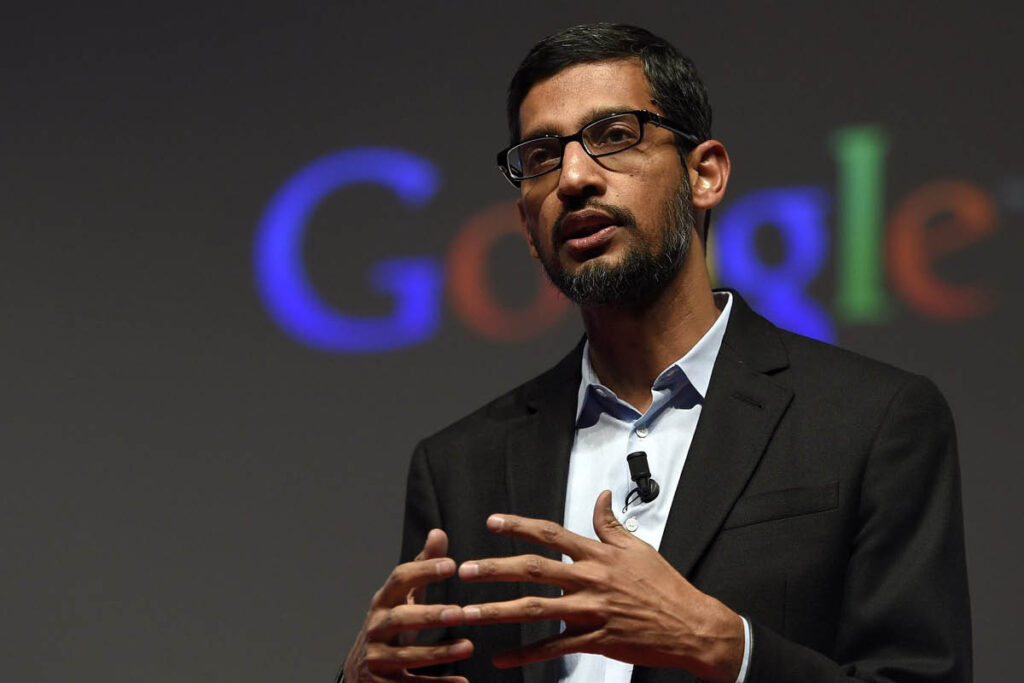
➩ Sundar Pichai leads Google like a wise and quiet general.
He doesn’t shout or rush. He plans carefully, takes his time, and makes sure all of Google’s tools work together like a smooth machine.
➩ Mark Zuckerberg leads Meta like a brave explorer.
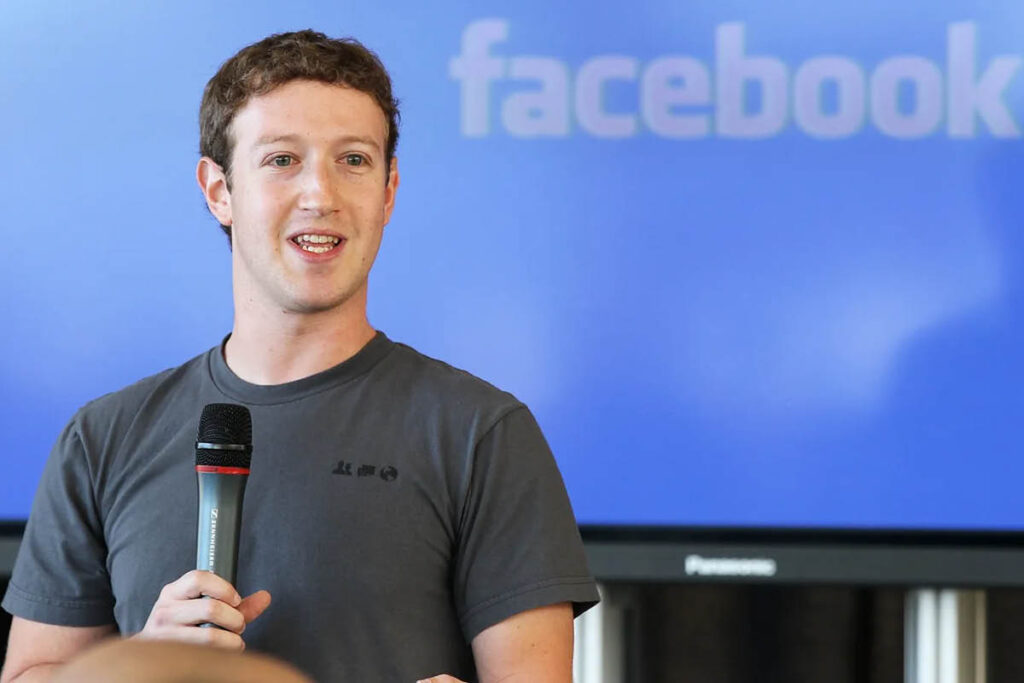
He takes big risks, loves new ideas, and dreams of future worlds where people live and play in virtual reality. He’s all in on AI and the metaverse.
- One leader builds with patience and order.
- The other charges ahead with bold moves and speed.
Different styles. Same goal: to win the AI war.
The Trust Factor: Battling for Public Confidence
This war isn’t just about cool tech; it’s also about trust.
Both Google and Meta don’t just build smart tools; they also share big ideas.
They talk to leaders, join important meetings, and help decide the rules for how AI should be used safely and fairly.
- Google tries to play it safe; it focuses on making AI that helps people responsibly.
- Meta had some trouble in the past; people worried it caused problems online.
- This isn’t just a tech battle.
- It’s a fight for the future of smart machines, and who the world chooses to lead that future.
Now, it’s fighting hard to earn back trust and show it can use AI in a good way.
Trust in the Fog of War, Who’s Playing Fair?
In this AI war, trust is the secret weapon.
- Google faces heat for data use but promotes clear rules.
- Meta still battles shadows from scandals like Cambridge Analytica.
Both promise AI safety, but face risks of bias, fake info, and control.
Conclusion: Who’s Winning the AI War?
The battle between Google and Meta is far from over.
Google moves like a strategic commander, steady, powerful, and rooted in deep research. Its strength lies in performance, productivity, and trust, though it can be slow and less open. Meta fights like a bold rebel, fast, creative, and driven by connection. It thrives on openness and innovation but still works to rebuild trust.
As AI evolves, the next phase begins:
- Generative AI is changing how we search.
- Agents that act, not just answer.
- Smart assistants are entering our homes and worlds
The war continues. The future is being coded right now.