Learn how the PDCA cycle in process improvement helps solve recurring process problems and drive continuous improvement. This guide explains the four PDCA stages, why businesses use them, how to implement the cycle step by step, when to choose it over Kaizen or DMAIC, and how real-world examples show measurable gains in quality, efficiency, and consistency through data-driven, repeatable improvements.
Most businesses have to cope with recurring errors, fluctuating quality, and inefficient processes. The PDCA Cycle in Process Improvement gives you a simple, repeatable framework for turning those problems into continuous progress. In this piece, you’ll learn how PDCA works, where it fits in your improvement toolkit, practical steps to implement it, common pitfalls to avoid, and the metrics to track real success.
Whether you are fixing a defect on the shop floor, streamlining a service process, or scaling up your operations, PDCA provides a disciplined way to test changes, learn fast, and establish sustainable improvement.
What Is the PDCA Cycle in Process Improvement?
PDCA Cycle in Process Improvement is a simple, repeatable method for improving work by testing changes, learning from results, and refining the process. It stands for Plan, Do, Check, and Act, and is widely used in continuous improvement because it helps teams make small, controlled changes instead of relying on guesswork.
Its purpose is to solve problems in a structured way and build continuous improvement into everyday work. Rather than treating improvement as a one-time project, PDCA creates a loop: plan a change, do it on a small scale, check the results, and act based on what you learn.
Four stages
| Stage | Meaning |
| Plan | Define the problem and decide what change to test. |
| Do | Implement the change on a small scale. |
| Check | Review the results against the target. |
| Act | Standardize the improvement or try another cycle. |
Benefits at a glance
| Benefit | Why it matters |
| Reduces errors | Finds root causes before scaling. |
| Improves quality | Supports consistent outcomes. |
| Uses data | Decisions are based on evidence. |
| Encourages learning | Teams improve through each cycle. |
W. Edwards Deming popularized PDCA as a practical improvement cycle, building on earlier quality thinking associated with Shewhart. Many quality organizations still link the method to his work.
When should you use PDCA?
Use it when a process is unstable, a problem keeps repeating, or you want to test an improvement before rolling it out widely.
Why Businesses Use the PDCA Cycle?

Businesses use the PDCA cycle in process improvement because it gives them a simple way to fix problems and keep getting better. Instead of making random changes, teams use Plan, Do, Check, Act to test improvements, learn from results, and standardize what works.
It helps reduce waste by spotting unnecessary steps, rework, and delays before they spread across the process. It improves quality by encouraging teams to measure results and correct defects early. It also supports standardization because successful changes can be turned into a repeatable process. Over time, this lowers operational costs, since fewer errors, less rework, and better process control usually mean less time and money spent fixing problems. PDCA can also improve customer satisfaction by making products and services more consistent and reliable. Finally, it encourages continuous learning because every cycle teaches the team something useful about the process.
| Business Challenge | How PDCA Helps |
| Waste and rework | Identifies and removes inefficient steps |
| Quality issues | Tests changes and checks results before scaling. |
| Inconsistent work | Standardizes successful improvements |
| High costs | Reduces defects, delays, and repeated fixes |
| Low customer satisfaction | Improves reliability and service quality |
In practice, PDCA works best when a business wants steady improvement without overcomplicating the process. ASQ describes it as a four-step model for carrying out change, and Lean Enterprise Institute links it to continuous improvement thinking.
The Four Stages of the PDCA Cycle Explained:
Plan:
Start by identifying the root cause, gathering data, and setting a clear SMART goal. Ask: What problem are we solving, and what does success look like? Common mistake: jumping to a solution before understanding the issue. Expected deliverable: a problem statement, baseline data, and a simple action plan.
Do:
Test the change with a small pilot instead of rolling it out everywhere. Ask: What is the smallest safe version we can try, and who will test it? Common mistake: making the trial too large, which makes it hard to learn from. Expected deliverable: a pilot test with documented results.
Check:
Compare KPIs and analyze whether the change worked as expected. Ask: Did the numbers improve, stay flat, or get worse? Common mistake: looking only at opinions and ignoring the data. Expected deliverable: a short review showing results versus the original target.
Act:
Standardize the improvement if it worked, or adjust and repeat if it did not. Ask: Can this change become the new normal, and what needs to be updated? Common mistake: scaling too fast without confirming the pilot is stable. Expected deliverable: an updated process, work instruction, or rollout plan.
PDCA Cycle in Process Improvement is useful because it keeps improvement practical, measurable, and repeatable. It helps teams learn from small tests instead of making costly big-bang changes.
How to Implement PDCA Step by Step?
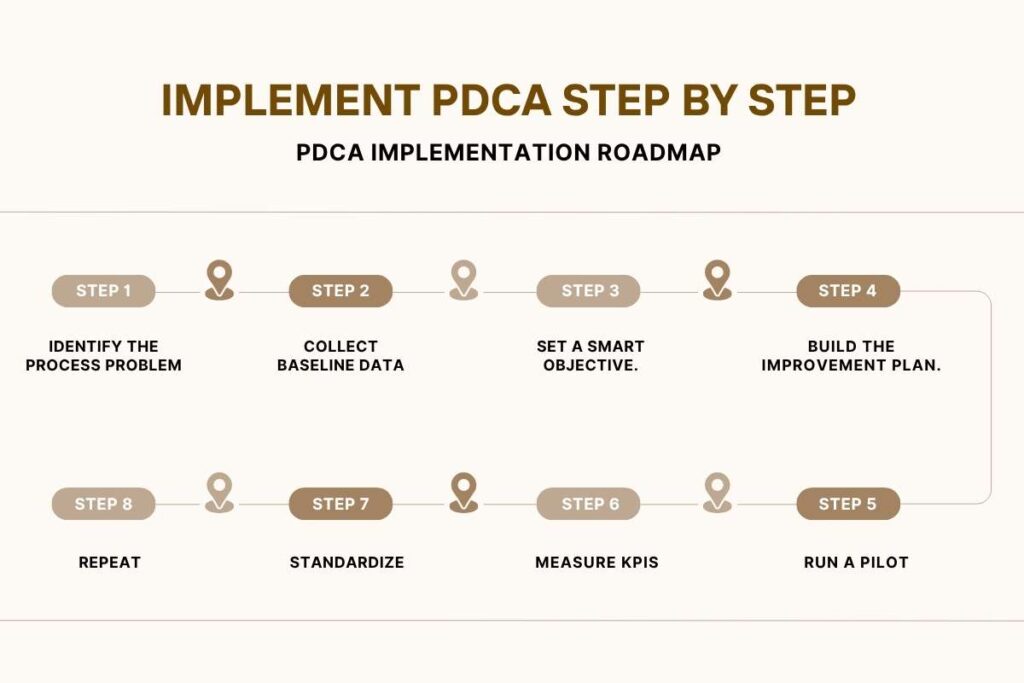
Here’s a simple step-by-step PDCA roadmap you can use to implement improvement in a real process.
PDCA Implementation Roadmap
1. Identify the process problem
Define what is going wrong, where it happens, and why it matters. Keep the problem specific and measurable.
2. Collect baseline data
Gather current numbers so you know the starting point. This may include defects, delays, costs, output, or customer complaints.
3. Set a SMART objective.
Create a goal that is specific, measurable, achievable, relevant, and time-bound. Example: reduce order errors by 20% in 60 days.
4. Build the improvement plan.
Decide what change to test, who will do it, and what success will look like. Keep the first test small.
5. Run a pilot
Test the change on a limited scale before full rollout. This reduces risk and makes learning easier.
6. Measure KPIs
Compare the pilot results with your baseline data. Look at quality, time, cost, or customer response.
7. Standardize
If the change works, update the process, train the team, and document the new method.
8. Repeat
If results are weak, adjust the plan and begin another cycle. PDCA works best as a loop, not a one-time project.
Simple Timeline
| Time | Step |
| Week 1 | Identify the problem, collect baseline data |
| Week 2 | Set the SMART objective, build the plan. |
| Week 3 | Run the pilot |
| Week 4 | Measure KPIs and review results. |
| Week 5 | Standardize or revise |
| Ongoing | Repeat the cycle for continuous improvement. |
A practical PDCA Cycle in process improvement works best when each step is small, clear, and based on real data.
PDCA vs Kaizen vs DMAIC:
PDCA is best for quick, simple improvement cycles, Kaizen fits everyday small improvements and team culture, and DMAIC is best for deeper, data-heavy problem solving. Here’s a brief comparison you can use in content writing.
| Feature | PDCA | Kaizen | DMAIC |
| Best use cases | Small process fixes, routine improvement, pilot changes | Continuous, low-cost, incremental workplace improvements | Complex, chronic problems, Six Sigma projects, root-cause analysis |
| Complexity | Low | Low to medium | Medium to high |
| Speed | Fast | Fast for small changes | Slower because it needs more analysis and control |
| Data requirements | Light to moderate | Low | High, data-driven |
Simple explanation
Use PDCA when you want a practical cycle to test and refine an improvement quickly. Use Kaizen when the goal is a culture of ongoing small improvements by everyone. Use DMAIC when the problem is important, measurable, and needs structured analysis before fixing it.
Real-World Example of PDCA in Action:

A good real-world PDCA example is a manufacturing line reducing defects in assembly. In one documented case, a team used PDCA to cut reject rates by finding the root cause, testing a fix on one line, measuring the result, and then standardizing the change across production.
Example scenario
Plan: The team found that inconsistent fill levels or assembly errors were causing rework and customer complaints, with defect rates around 3% to 4%. They set a clear target, such as reducing rejects to below 1%, and chose a simple countermeasure like a checklist, updated inspection routine, or calibrated tools.
Do: They piloted the change on one line instead of rolling it out everywhere at once. In one example, operators followed a new inspection routine and maintenance logs were added; in another, torque wrenches and a torque SOP were introduced.
Check: The team reviewed the numbers after the trial. Results showed defect rates dropping from 4% to 0.9% in one case, and from about 3% to 0.8% in another, confirming the change worked.
Act: Once the test succeeded, they made the new method standard practice across the line or plant and added it to audits and training. That turned a one-time fix into a repeatable process improvement.
Conclusion:
The PDCA Cycle in Process Improvement is useful because it makes problem-solving a repeatable habit, not a one-time fix. Careful planning, small-scale testing, checking results, and acting on what you learn can help businesses improve quality, reduce waste, and build stronger, more consistent operations.
It works best when teams stay data-driven, make incremental changes, and repeat the cycle until the process stabilizes. Whether you are reducing errors, improving a workflow, or increasing customer satisfaction, PDCA provides a simple structure to proceed with confidence.
Use PDCA on your next process problem and make one small improvement today.
FAQ:
What are the 4 cycles of continuous improvement?
The Plan-Do-Check-Act cycle (Figure 1) is a four-step model for carrying out change. Just as a circle has no end, the PDCA cycle should be repeated again and again for continuous improvement. The PDCA cycle is considered a project planning tool.
Is PDCA a part of Kaizen?
PDCA is the foundation of continuous improvement or kaizen. Leaders set targets (plan) against a stable baseline of performance.
What are the 4 P’s of quality improvement?
In quality management and operational excellence, the “4 Ps” refer to Purpose, Process, People, and Performance.
What are the 5 stages of improvement?
DMAIC (pronounced də-MAY-ick) stands for “Define, Measure, Analyze, Improve, and Control.” It is an essential element of the Lean and Six Sigma business methodologies.
What is the Deming 4-step cycle for improvement?
PDCA, or the Deming cycle, is a management methodology that aims to continually improve processes. This cycle is based on four stages: plan, do, check, and act.