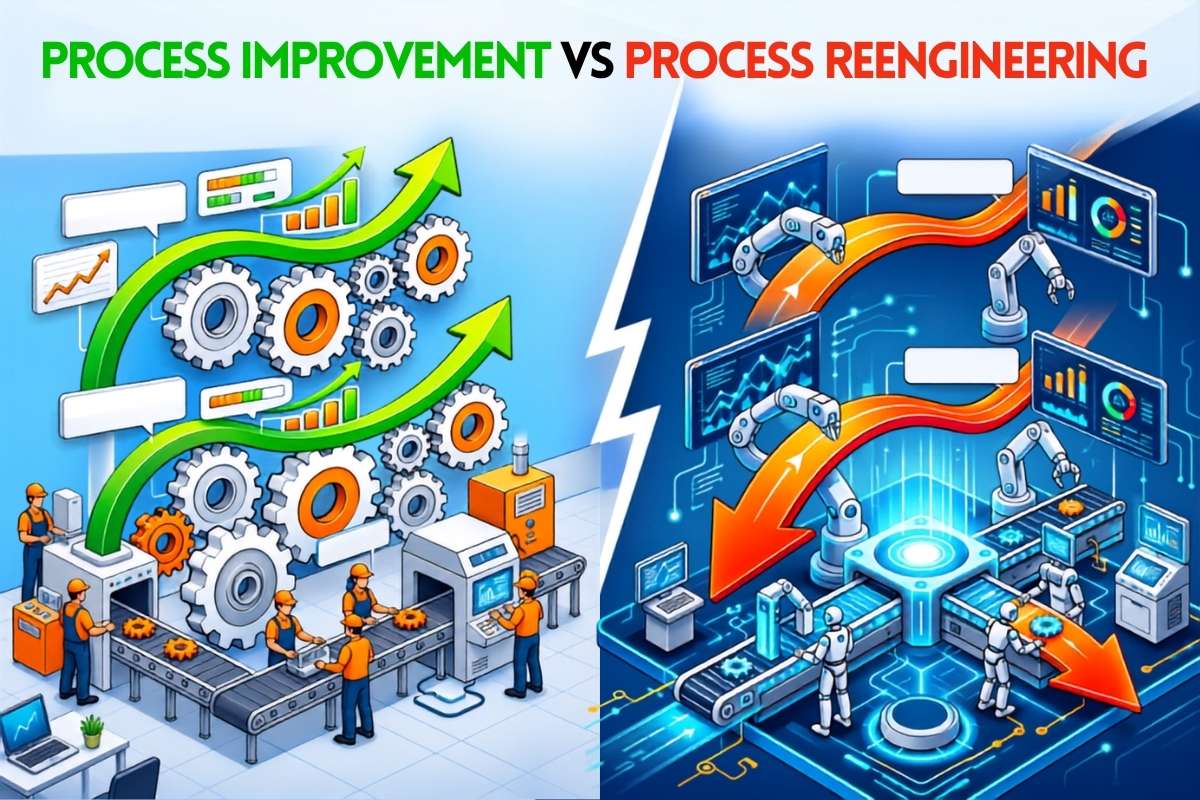
This guide explains that process improvement makes an existing process work better through small changes, while process reengineering redesigns the entire process to achieve major improvements in performance. It covers the key differences, when to use each approach, and what they can help you achieve. You will also find real examples, common mistakes to avoid, and easy tips to help you choose the right option for your business.
Many businesses want to work faster, lower costs, and serve customers better. But they often mix up process improvement vs process reengineering because both aim to make work more efficient. The difference is how they get there. One focuses on improving existing processes, while the other takes a fresh look at how work is done.
Knowing which approach fits your business can save time, money, and effort. In this guide, you will learn how these two methods differ, when each one makes sense, the costs and risks involved, and how to choose the right option for your goals. By the end, you will have a clear way to decide what your business really needs.
What is Process Improvement?
Process improvement means making an existing process work better. Instead of replacing the whole system, it focuses on fixing small problems that slow work down or cause mistakes.
The goal is to reduce waste, save time, improve quality, and make work easier. The main workflow stays the same, but each step becomes more efficient.
For example, a company may shorten its invoice approval process by removing an unnecessary review. The process stays the same, but employees finish the work faster.
According to the American Society for Quality (ASQ), continuous improvement uses methods such as PDCA, Lean, Six Sigma, and Total Quality Management to improve products, services, and processes. These methods help organizations improve quality over time while creating more value for customers. This shows that even small changes can make a real difference.
When comparing process improvement vs process reengineering, remember that process improvement builds on what already works instead of starting over.
What is Process Reengineering?
When comparing process improvement vs process reengineering, process reengineering means starting over instead of fixing small problems. It is used when a process is outdated, slow, or no longer supports business goals.
Instead of making minor changes, businesses redesign the entire workflow. This often includes:
- Removing unnecessary steps
- Combining tasks
- Creating a faster and simpler process
Technology can support these changes, but it is not the goal. The real aim is to build a process that works better from start to finish.
For example, a retailer may replace separate systems for online and in-store orders with one shared platform. This cuts duplicate work and speeds up order handling.
Process reengineering takes more planning and carries more risk, but it can bring major improvements when the existing process no longer works.
Process Improvement vs Process Reengineering: Key Differences
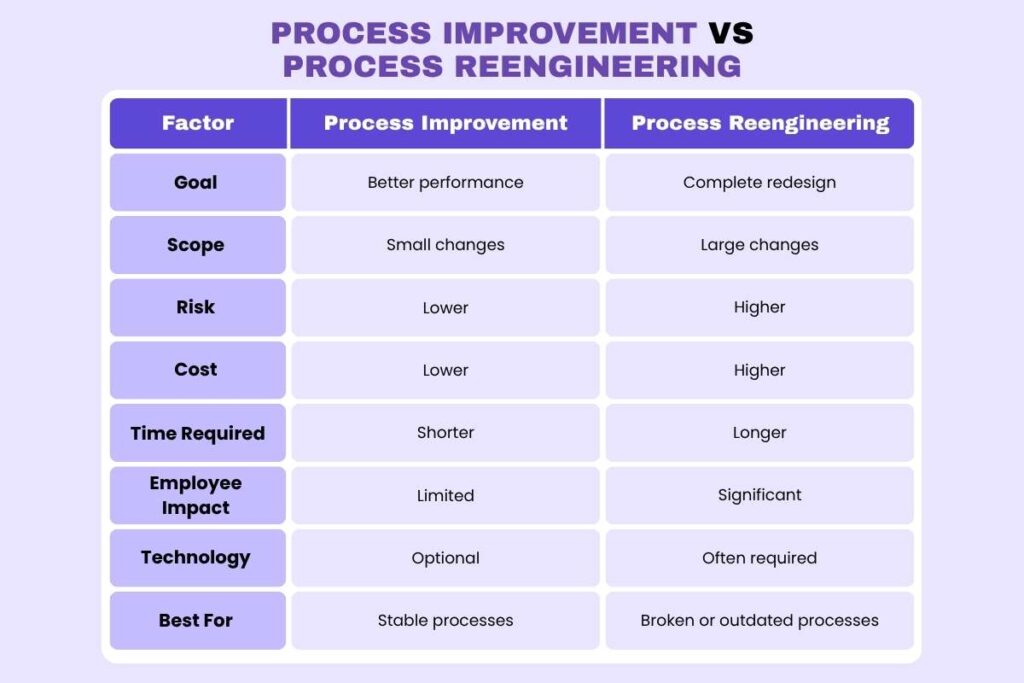
Both methods help businesses work better, but they solve different problems. One improves what already exists, while the other builds a new way of working.
| Factor | Process Improvement | Process Reengineering |
| Goal | Better performance | Complete redesign |
| Scope | Small changes | Large changes |
| Risk | Lower | Higher |
| Cost | Lower | Higher |
| Time Required | Shorter | Longer |
| Employee Impact | Limited | Significant |
| Technology | Optional | Often required |
| Best For | Stable processes | Broken or outdated processes |
For many businesses, process improvement is the first choice because it costs less, causes less disruption, and delivers results faster. Small fixes can often solve delays, reduce errors, and improve quality without changing the whole workflow.
Understanding process improvement vs process reengineering becomes important when those small fixes stop working. If a process is outdated, full of repeated tasks, or cannot support future growth, making more small changes will not solve the real problem.
In those cases, process reengineering is the better option. Although it takes more time, money, and planning, it can create lasting improvements by replacing an old process with one that is built for today’s business needs.
When Should a Business Choose Each Approach?

There is no single right answer. The better option depends on what is happening inside your business. Before making changes, look at where the process is failing and how much change is really needed.
Choose process improvement when:
- Most of the process already works, but a few steps slow everyone down.
- Small quality issues lead to extra work or customer complaints.
- You want to lower operating costs without changing how the business runs.
- Employees need simple workflow updates, not a whole new system.
- The business needs results quickly with as little disruption as possible.
Choose process reengineering when:
- Customers keep running into the same problems despite repeated fixes.
- Old systems make everyday work slower and limit business growth.
- Different teams enter the same data or repeat the same tasks.
- The business is moving to new digital systems that require new workflows.
- Company goals have changed, and the current process no longer supports them.
A rushed decision can be expensive. McKinsey & Company reports that about 70% of large-scale transformation programs fail to achieve their goals, often because of poor execution and weak change management rather than poor strategy. That is why understanding process improvement vs process reengineering starts with identifying the real problem before choosing the solution.
Common Mistakes Businesses Still Make in 2026

Understanding process improvement vs process reengineering also means knowing what can go wrong. Many businesses waste time and money because they choose the wrong approach.
Some common mistakes include:
- Redesigning a process that only needs a few simple fixes.
- Improving a process that is too outdated to deliver better results.
- Ignoring employee feedback from the people who use the process every day.
- Tracking how much work gets done instead of the results it creates.
- Forgetting how changes affect the customer experience.
Good planning helps avoid these problems. According to the Project Management Institute’s Organizational Change Management report, organizations that are highly effective at organizational change management are significantly more likely to meet project objectives and maintain schedules than organizations with weak change management practices. Taking time to understand the problem first often leads to better decisions and stronger results.
How to Decide Which One Fits Your Business
Before choosing a direction, take a close look at your current process instead of jumping to a solution.
Ask yourself:
- Is the process completely broken or just inefficient?
- Can small changes fix the problem?
- Do you have the budget and time for a major redesign?
- Will employees be able to adapt to the change?
Answering these questions helps you choose between process improvement vs process reengineering with more confidence. Start with the least disruptive option that can solve the problem. If the process still cannot support your business goals, then a full redesign is the better investment.
Conclusion
Both approaches help businesses perform better, but they solve different problems. One improves what already works, while the other rebuilds what no longer does. Choosing the right approach can save time, reduce costs, and avoid unnecessary disruption. The best results come from matching the solution to the actual problem, not following trends or making changes too quickly.
Before making any changes, take time to evaluate your current process, your business goals, and the resources available. A clear assessment helps you make smarter decisions and makes process improvement vs process reengineering much easier to choose with confidence.
Frequently Asked Questions
Can small businesses use process reengineering?
Yes, but only when the benefits clearly outweigh the costs. If an old process is holding back growth, creating repeated customer issues, or increasing operating costs, reengineering can be a smart investment. For smaller problems, process improvement is usually the more practical choice.
Does process improvement always require new software?
No. Many improvements come from changing how work is done, not the tools being used. Removing unnecessary approvals, improving communication, or standardizing tasks can make a process faster without buying new software.
How long does process reengineering usually take?
The timeline depends on the size and complexity of the business. A small business may complete a project in two to six months, while larger organizations often need six months to over a year because of planning, testing, training, and rollout.
Who should lead a process improvement project?
Managers usually guide the project, but employees should help identify everyday problems and suggest practical solutions. Senior leaders play an important role by setting goals, approving resources, and supporting changes across the business.
Can a company use process improvement and process reengineering together?
Yes. Many businesses start with process improvement to achieve quick wins in the short term. As the business grows, it may reengineer specific processes that can no longer meet future needs. Using both approaches at different stages often delivers better long-term results.