Getting leadership vs management right helps companies grow. While managers handle daily tasks and keep operations steady, leaders build long-term vision and drive innovation. Mixing up these roles hurts morale and stalls productivity. Read on to learn how to balance both roles effectively!
Have you ever noticed how job descriptions treat leadership vs management like a two-for-one deal? Companies hand out titles assuming the person organizing next week’s schedule can also inspire a team of tired employees.
That mix-up is why offices get stuck. Treating daily control and long-term vision as the same job creates hidden gaps in how a company runs.
Let’s break down the real differences between the two so you can clear up the confusion and get your teams moving in the right direction.
Does Leadership vs Management Mean the Same Thing?
No, leadership and management are not the same thing, even though companies frequently lump them into a single role. Think of leadership as choosing the mountain you want to climb, while management is packing the gear, mapping the trail, and keeping everyone moving safely.
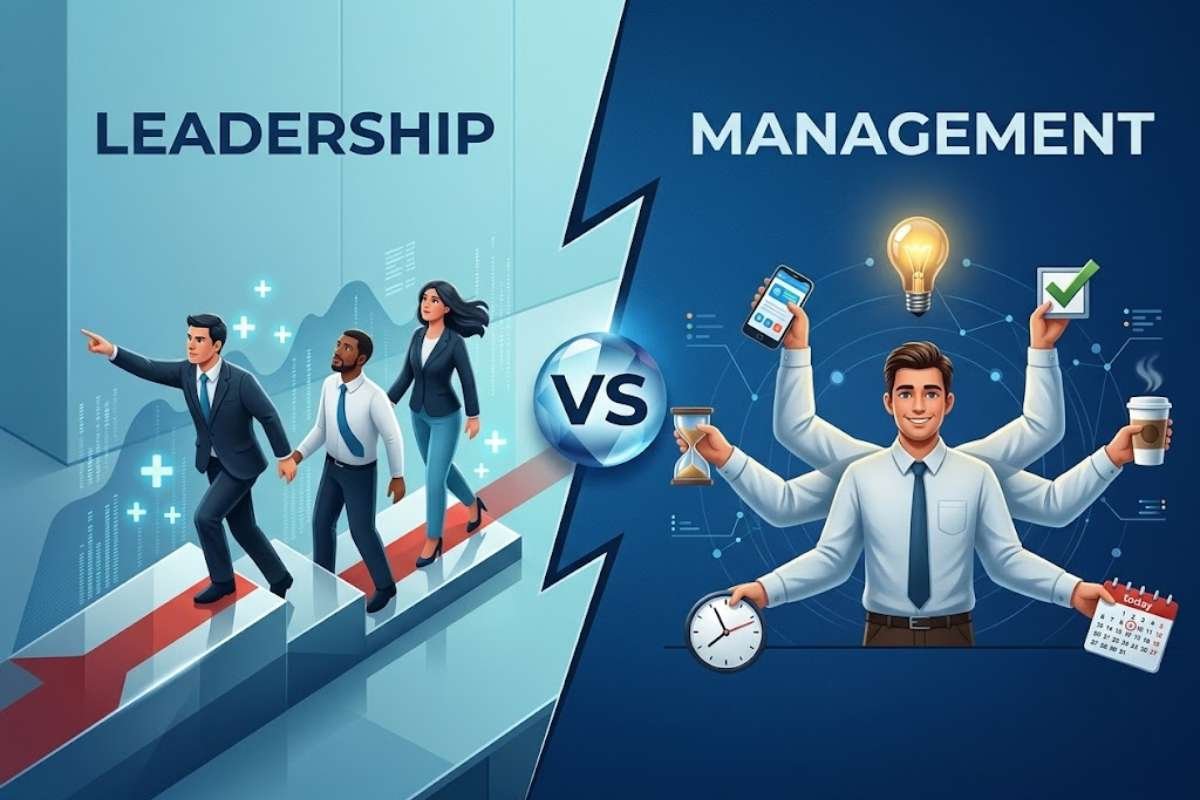
Leadership focuses on setting long-term vision, defining strategy, and challenging inefficient routines. Management focuses on executing daily tasks, controlling processes, and maintaining operational stability.
Research from Harvard Business School shows that failing to separate these functions causes severe organizational drag.
When a growing company scales up, casual communication breaks down. Without clear boundaries between high-level vision and daily execution, projects get caught in endless review loops, administrative costs rise, and teams experience burnout from constant confusion over responsibilities.
How Do Leaders and Managers Act Differently?

Leaders and managers act differently because they solve entirely different problems. To see this in action, imagine a traditional retail company deciding to launch an online delivery service.
A leader looks five years down the road. They pitch the e-commerce vision to investors, accept the risk that early app launches might flop, and push the company to enter an unfamiliar digital market.
Meanwhile, a manager handles the actual rollout. They set up the warehouse tracking software, schedule staff shifts for packing boxes, and make sure daily shipments go out without error.
This core behavioral split reflects what foundational management thinkers have long observed. As renowned organizational expert Warren Bennis famously noted in his book On Becoming a Leader, “The manager does things right; the leader does the right thing.”
When these behaviors work together, companies grow. But when they clash or lack support, performance drops. Global Workplace report notes that managers drive team performance directly, yet manager engagement has dropped to 22 percent globally.
When managers feel overworked by daily tasks and disconnected from a larger purpose, team alignment quickly suffers.
Here is how leadership vs management daily priorities compare:
| Feature | Leader | Manager |
| Main Goal | Set the long-term vision and inspire people | Keep daily operations running on schedule |
| Time Focus | Years ahead | This quarter |
| Risk View | Embraces big changes and uncertainty | Controls risks and maintains stability |
| Success Metric | Innovation and team buy-in | Efficiency and budget control |
How Do Different Leadership Styles Shape Daily Work?
Beyond solving different problems, leaders and managers lean on distinct styles to guide their teams. While these approaches naturally fit their titles, the most effective professionals actually blend both styles depending on the situation:
1. Transformational Leadership (Vision and Inspiration)
This style focuses on inspiring people, encouraging new ideas, and pushing teams toward a bigger vision.
Leaders rely heavily on it to drive major changes, but skilled managers also use it to motivate their teams during tough projects.
Imagine your company is launching an entirely new service or pivoting into a different market. Instead of handing out a strict checklist, a transformational approach paints a picture of the future and gets everyone excited to build something new together.
Also Read: 10 Must-Read Transformational Leadership Books to Inspire Growth and Innovation.
2. Transactional Management (Structure and Execution)
This style focuses on clear rules, daily structure, and tracking performance. Managers rely on it to keep operations steady, but visionary leaders also use transactional clarity to set hard milestones and accountability for big goals.
Imagine your team is processing weekly payroll, handling customer refunds, or shipping e-commerce orders. A transactional approach ensures everyone follows the exact steps, hits the checklist, and meets the daily deadline without errors.
Matching your approach to the task prevents you from stifling creativity with rigid rules or leaving daily execution without structure.
Why Companies Fail When They Mix Up Leadership vs Management
Many businesses fail because they promote top performers into management roles without checking if they have the right skill set.
Companies miss out on high managerial talent in 82 percent of their hiring decisions. Instead of assessing leadership traits, organizations frequently promote people based purely on tenure or technical skill in their current job.
When a pure executor is forced to act as a visionary leader, the team loses direction. Employees receive mixed signals. They get strict instructions on how to fill out forms or run spreadsheets, but zero guidance on why the work actually matters.
This mismatch dampens morale and stalls productivity. Managers account for at least 70 percent of the variance in team engagement, meaning a confused or poorly matched manager directly hurts overall company performance.
How is Automation Changing the Balance of Leadership vs Management?

Technology is actively reshaping daily operations. Roughly 50 percent of current work activities can be automated using existing technology.
When software handles repetitive data collection and tracking, managers no longer need to spend hours copying and pasting numbers.
Instead, they can move toward coaching people and solving complex issues. Employees whose managers actively support AI tools are 7.4 times as likely to report that AI gives them more opportunities to do their best work.
Automation lifts the administrative burden, giving leaders and managers more time to focus on human connection and long-term strategy.
How to Move From Tactical Execution to Strategic Vision?
Moving from a day-to-day executor to a high-level strategist requires a complete redesign of your daily habits. Here is how you make that shift stick:
1. Hand over daily tracking:
Stop doing individual tasks yourself. Delegate routine process monitoring to your team members so they learn to solve problems without asking for permission.
2. Rebuild your calendar:
Cut down the hours spent reviewing minor checklists. Reallocate that time toward long-range planning, team coaching, and building trust across departments.
3. Change your scorecard:
Stop measuring your success solely by how many daily tasks got checked off. Instead, evaluate your impact based on how well your team handles unexpected roadblocks and hits long-term targets.
4. Carve out thinking time:
Protect hours on your schedule for market research and strategic forecasting. Stepping back from constant firefighting gives you the mental space required to guide your company forward.
Also Read: Want to Be a Great Leader? Master These 10 Leadership Styles That Drive Success
Conclusion:
Getting the balance right in leadership vs management helps companies grow. Managers keep daily work running smoothly. Leaders create the main vision and push for new ideas. When you know the difference between the two, your team avoids confusion and hits its goals.
Frequently Asked Questions
1. Can a leader also be a manager?
Yes. Management is a specific job title focused on systems and daily execution, whereas leadership is about trust and influence. The most successful professionals learn to combine both roles to guide their teams effectively.
2. Which is more important: leadership or management?
Neither is more important because they work hand in hand. Leadership sets the long-term vision and direction, while management ensures daily operations run smoothly and tasks get delivered on time.
3. How do performance metrics differ for leaders versus managers?
Leaders are measured on long-term innovation, cultural health, and strategic growth. Managers are measured by budget compliance, error reduction, and team execution speed.
4. What is the biggest mistake new managers make?
New managers often try to do the work themselves instead of coaching others. This creates bottlenecks and burns out the manager while stunting team growth.