How prepared is your team when the usual rules stop working?
In 2026, just 1% of more than 1,300 global experts expected a calm world ahead. Cyber insecurity ranked sixth among the biggest two-year risks, showing how quickly technology, geopolitical, and operational threats can affect businesses.
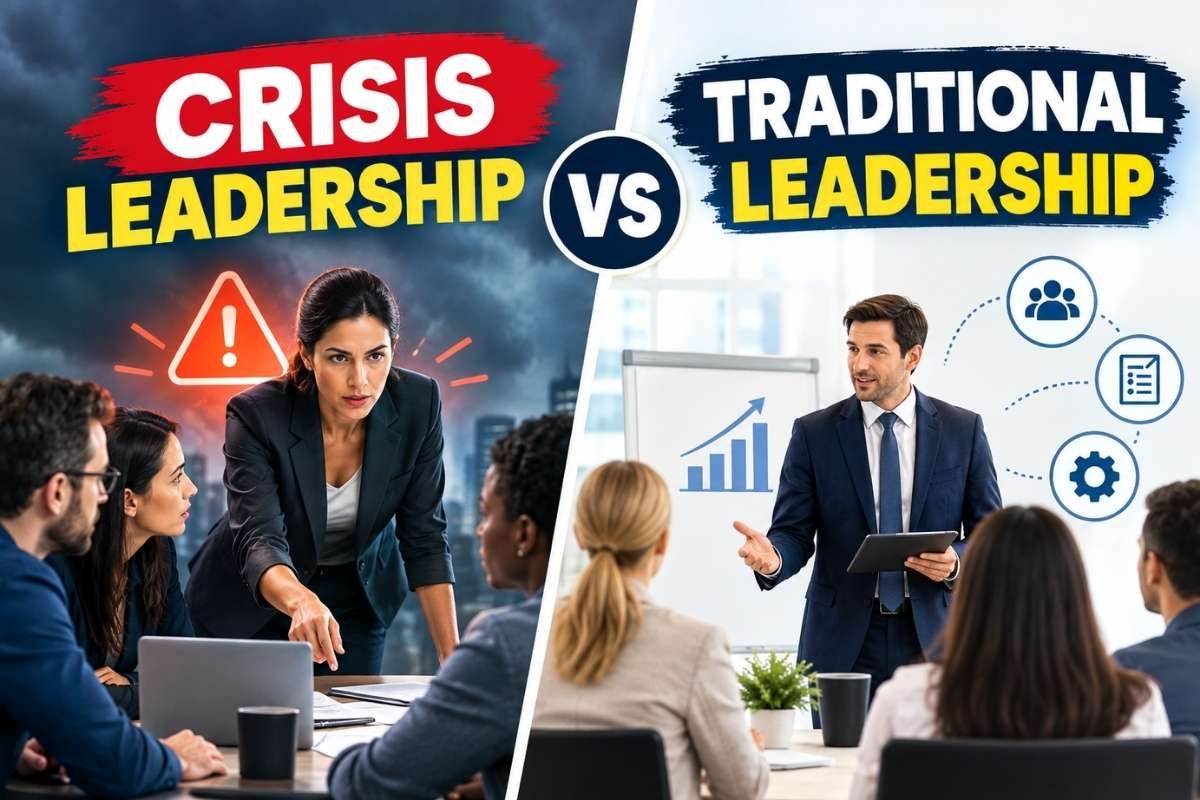
Crisis Leadership vs. Traditional Leadership comes down to how leaders respond under pressure. Traditional leadership focuses on planned performance and long-term goals, while crisis leadership prioritizes speed, containment, continuity, trust, and adaptation when information is limited and decisions cannot wait.
Knowing when to make that shift can shape how well the business responds. Here’s what changes.
What is the Difference Between Crisis Leadership vs. Traditional Leadership?
Traditional leadership works within known structures. Leaders set goals, manage performance, allocate resources, and make decisions through established processes.
Crisis leadership works under pressure, with incomplete information, changing risks, and little time to decide.
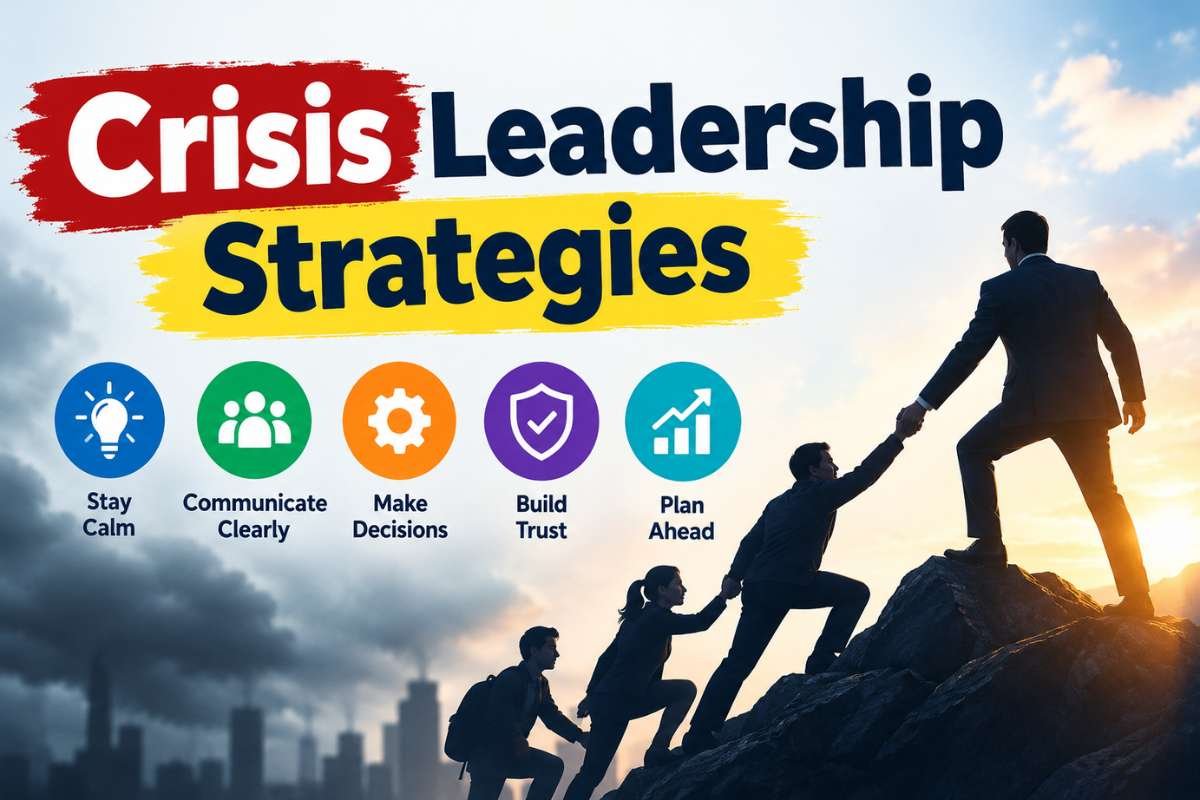
A crisis leadership model based on lessons from COVID-19 identified seven key areas, including care, clear communication, resilience, decisiveness, collaboration, and empowerment.
The difference is less about personality and more about the situation. A leader who usually seeks team agreement may need to make a quick decision during a crisis while still keeping the team accountable and maintaining trust.
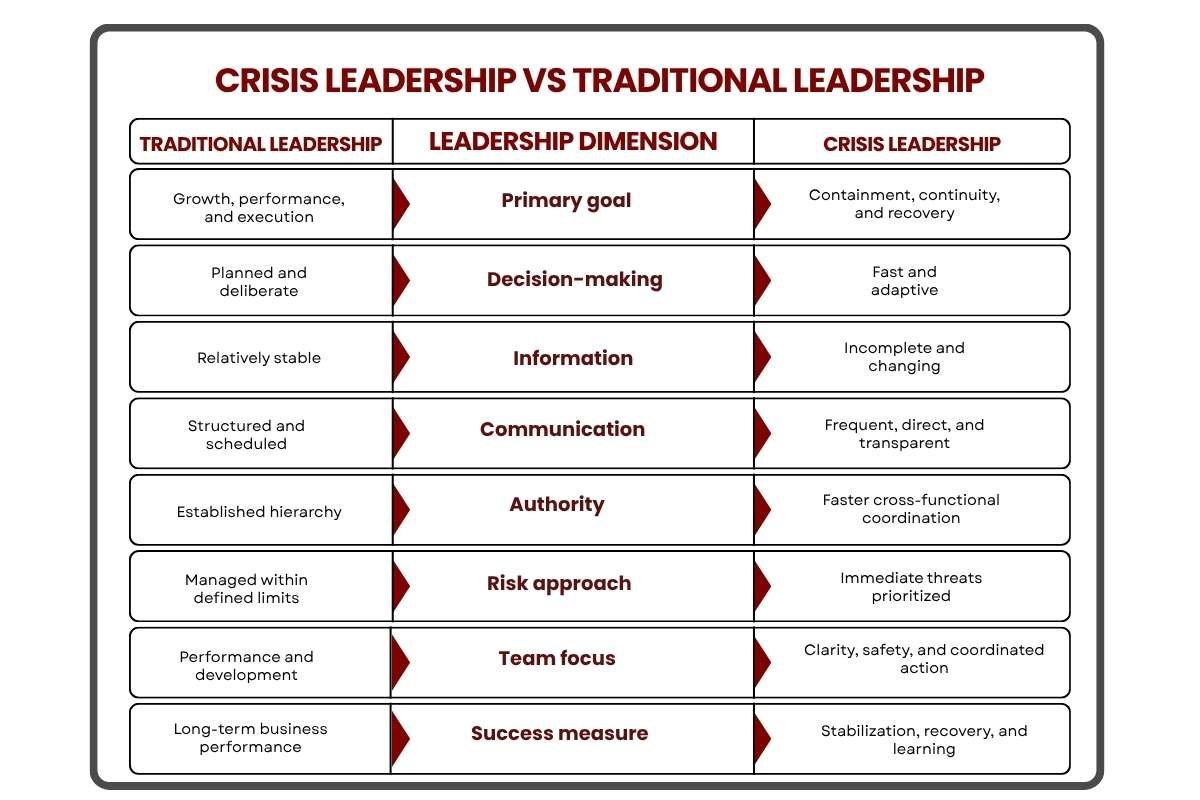
| Traditional Leadership | Leadership Dimension | Crisis Leadership |
| Growth, performance, and execution | Primary goal | Containment, continuity, and recovery |
| Planned and deliberate | Decision-making | Fast and adaptive |
| Relatively stable | Information | Incomplete and changing |
| Structured and scheduled | Communication | Frequent, direct, and transparent |
| Established hierarchy | Authority | Faster cross-functional coordination |
| Managed within defined limits | Risk approach | Immediate threats prioritized |
| Performance and development | Team focus | Clarity, safety, and coordinated action |
| Long-term business performance | Success measure | Stabilization, recovery, and learning |
A traditional leader asks, “How do we perform better?” Crisis leadership first asks, “What must we protect, decide, and stabilize right now?”
When Does Crisis Leadership vs. Traditional Leadership Apply?
Not every difficult business problem is a crisis. A missed quarterly target, delayed project, or normal customer complaint usually calls for traditional management and problem-solving.
Leadership mode needs to change when an event threatens critical operations, people, customers, financial stability, security, regulatory obligations, or organizational reputation, and the normal decision process is too slow.
For a technology organization, warning signs can include:
- A cybersecurity incident spreading across critical systems
- A major technology or cloud outage
- Loss of access to essential business data
- A serious AI or software failure affecting customers
- A supply-chain disruption affecting core operations
- A regulatory or reputational event requiring an immediate response
- A physical event that interrupts critical infrastructure
The shift to crisis leadership usually happens in stages: a threat emerges, the situation escalates, leaders contain the damage, restore operations, and learn from what happened.
It is important not to wait until the damage is obvious. ISO’s business continuity framework also focuses on leadership, planning, resources, competence, and communication.
How is Decision-Making Different in Crisis Leadership vs. Traditional Leadership?

The biggest difference is the cost of waiting.
Decisions often move through analysis, consultation, budgeting, and approval under normal conditions. During a crisis, that process may be too slow. Leaders still need evidence, but they may have to act before they have the full picture.
The first shift, then, is speed. Instead of waiting for every fact, leaders identify what they need to know to make the next safe decision. They act on reliable information, then adjust as new facts emerge.
Risk needs to be reassessed continuously as the situation develops, while decision rights may need to move closer to the people managing the problem. This prevents critical actions from getting stuck in the usual hierarchy.
Crisis leadership first focuses on limiting damage and restoring stability. Once the immediate threat is under control, leaders can return to longer-term decisions.
For a CIO, that could mean isolating affected systems before the investigation is complete. For a CEO, it could mean approving emergency spending before the full financial impact is known.
The goal is to make the right decision with enough reliable information to keep the situation from getting worse.
Why Does Communication Matter More During a Crisis?
Communication matters more during a crisis because people need clear information to make decisions while uncertainty is high. Without timely updates, employees, customers, partners, and investors may not know what has happened, what is being affected, or what they should do next.
In Crisis Leadership vs. Traditional Leadership, communication becomes more direct and frequent because leaders must keep people informed while events are still unfolding. Leaders need to communicate what is known, what remains unclear, what action is underway, and when the next update will come. Research published in 2025 also found that effective crisis communication can strengthen trust, stability, and organizational cohesion during disruption.
Crisis communication should be fast, accurate, clear, consistent, and honest about uncertainty.
How Do Crisis Leaders Manage Risk and Uncertainty?

When comparing Crisis Leadership vs. Traditional Leadership, traditional leadership looks at long-term goals, while crisis leadership focuses on immediate threats.
That means leaders must separate risks that can wait, risks that need monitoring, and risks that need immediate action. When a threat is actively spreading, containing it becomes more important than improving performance.
The World Economic Forum’s 2026 Global Risks Report shows why this matters. More than 1,300 experts identified geoeconomic confrontation as the leading risk for 2026. Misinformation and disinformation ranked second, while cyber insecurity ranked sixth in the two-year outlook.
These risks rarely stay within one department. A cyber incident can quickly become a legal, communications, customer, and financial problem at the same time.
That is why crisis leadership needs company-wide risk management rather than leaving each risk to a separate team.
How Should Leaders Manage Teams Under Extreme Pressure?
Leaders should give teams clear roles, clear priorities, and enough authority to act quickly. They should also keep communication open so employees know what is happening, what they need to do, and where to get reliable information.
During a crisis, senior leaders should avoid making every decision themselves. Instead, they should keep major decisions that need executive approval at the top and give operational teams the authority to handle problems they are closest to.
This approach helps teams move faster without losing accountability.
What Can CIOs and CTOs Learn From Crisis Leadership?

Crisis Leadership vs. Traditional Leadership becomes clear when a technology disruption puts the wider business at risk.
CIOs and CTOs need to protect business operations, make fast decisions, communicate clearly, and coordinate recovery during a crisis. Their role goes beyond fixing the technology issue because a major technology failure can stop sales, disrupt customer service, expose sensitive information, or prevent employees from working.
Cybersecurity shows the financial impact of this response. IBM’s Cost of a Data Breach Report 2025 found that the global average cost of a data breach was $4.44 million. It also reported that faster identification and containment helped drive a 9% year-over-year decline in average breach costs.
During a major incident, CIOs and CTOs should focus on five priorities:
- Protect critical operations before addressing less important systems.
- Establish the facts and separate confirmed information from assumptions.
- Contain the threat before starting full restoration.
- Explain the business impact of the technical issue to executives and key stakeholders.
- Coordinate recovery across technology, legal, communications, finance, and operations.
Which Leadership Skills Matter Most During a Crisis?
Crisis leadership does not require a completely different personality. It requires leaders to apply familiar leadership skills under much greater pressure and uncertainty.
For senior executives, the most important capabilities are:
- Rapid decision-making: Making timely choices when waiting creates greater risk.
- Sensemaking: Turn fragmented information into a usable picture of what is happening.
- Clear communication: Give stakeholders useful information without overpromising.
- Adaptability: Change the response as facts and conditions change.
- Delegation: Give capable teams authority to act without waiting for every approval.
- Stakeholder management: Balance employees, customers, regulators, partners, and investors.
- Accountability: Own decisions while creating space for teams to report problems honestly.
- Learning: Turn the response into stronger controls and better preparedness.
The strongest crisis leaders are decisive without becoming reckless, transparent without creating confusion, and adaptable without losing strategic direction.
How Can Organizations Prepare Leaders Before a Crisis Happens?

The best time to test crisis leadership is before the crisis.
Executives can prepare by:
- Defining crisis decision rights in advance
- Establishing escalation thresholds
- Creating cross-functional response teams
- Running tabletop exercises and simulations
- Testing backup communication channels
- Defining critical business services and recovery priorities
- Training leaders to communicate under uncertainty
- Reviewing incidents and updating response plans
Preparation also exposes organizational friction. If nobody knows who can shut down a compromised system, approve emergency spending, contact regulators, or communicate with customers, the crisis will reveal that gap at the worst possible time.
A crisis plan is only useful if leaders can execute it under pressure.
What Should Leaders Do After the Crisis Ends?
After a crisis, leaders should review what happened, fix what failed, and strengthen the response plan before the next disruption.
Start by reviewing how quickly the crisis was identified, whether decision-making was clear, whether leaders had reliable information, and whether employees and stakeholders knew what to do. Then identify the systems, processes, controls, or communication gaps that need to change.
A useful post-crisis review should ask:
- Did we identify the crisis quickly enough?
- Were decision rights clear?
- Did leaders have reliable information?
- Did employees know what to do?
- Did stakeholders receive timely updates?
- Which systems or processes failed?
- What should change before the next incident?
The goal is not to assign blame for decisions made under pressure. It is to use what happened to make the organization better prepared for the next crisis.
Conclusion:
Crisis leadership is not about replacing traditional leadership. It is about knowing when normal approaches are no longer enough. Crisis leadership vs. traditional leadership comes down to how leaders respond when speed, uncertainty, and business impact increase.
For CIOs, CTOs, and senior executives, the ability to make that shift can strengthen business resilience. Prepare the people, processes, and decision-making structures before a crisis arrives, so your team can respond with clarity when it does.
Frequently Asked Questions
1. What are examples of crisis leadership in the workplace?
Examples include leading through a cyberattack, product recall, natural disaster, executive resignation, major outage, or sudden regulatory action.
2. What is an example of traditional leadership in business?
A CEO setting annual goals, reviewing team performance, approving budgets, and planning long-term growth are common examples of traditional leadership.
3. Is crisis leadership only useful during emergencies?
No. Its principles can also help during periods of major change, uncertainty, or disruption when normal business routines are under pressure.
4. How does crisis leadership affect employee morale?
Clear direction and visible leadership can reduce uncertainty, while poor communication and unclear decisions can increase employee stress and disengagement.
5. Can traditional leadership work during a crisis?
Yes, traditional leadership principles such as accountability, clear goals, and trust remain valuable during a crisis. However, Crisis Leadership vs. Traditional Leadership comes down to how leaders adapt their decisions, communication, and priorities when time is limited and uncertainty is high.
Sources
ISO 22301: business continuity management requirements and leadership responsibilities.
COSO, Enterprise Risk Management: executive risk oversight and reporting.