
A major business crisis can cost millions of dollars, disrupt customer services, and damage stakeholder trust before leadership teams have a complete picture of what went wrong.
Effective crisis leadership strategies help contain these disruptions, support fast decisions, and keep essential business operations running. The priority is to establish clear authority, act on verified information, communicate honestly, and coordinate recovery across teams.
These strategies work best when you prepare in advance. Here are 10 crisis leadership strategies, a framework for managing a crisis, and ways to measure readiness.
What are the essential crisis leadership strategies every business leader needs?
Effective crisis leadership requires more than quick decisions. Leaders must protect people, coordinate teams, communicate credible information, and make changes that prevent the same problem from happening again.
Here are 10 crisis leadership strategies grounded in real business events.
1. Set clear priorities and focus on core business needs
Identify the business functions that need immediate attention. Direct resources toward essential operations, customer needs, and activities that support recovery instead of spreading teams across too many priorities.
When LEGO faced heavy losses in 2003, it refocused on core products instead of spreading resources across less-related ventures. As a result, its underlying result before special items, financial income and expenses, and tax improved from a DKK 1.061 billion loss in 2003 to a DKK 103 million profit in 2004.
2. Communicate honestly and acknowledge the problem

Tell customers and employees what has happened, how it affects them, and what the business is doing to resolve it. Avoid vague assurances or defensive statements that can weaken trust.
When KFC UK faced a chicken shortage in 2018 after problems with its new delivery arrangement, it issued a public apology and acknowledged the inconvenience caused to customers. The response showed the value of addressing a problem directly rather than avoiding it.
3. Coordinate decisions across departments
Strong crisis leadership strategies bring together teams from operations, finance, legal, communications, and customer service. Give each team clear responsibilities so everyone can work toward the same recovery goals.
During the July 2024 CrowdStrike outage, Microsoft described working with CrowdStrike, AWS, and Google Cloud to help customers recover. The incident showed how coordinated action across business and technology partners can support recovery from a widespread disruption.
4. Prepare for supplier and partner disruptions
Identify critical suppliers, understand where the business depends on them, and develop alternatives for essential goods and services. Test supplier changes before relying on them at scale.
Businesses should assess logistics capacity, test transitions, and prepare backup arrangements before changing critical suppliers.
5. Base decisions on business evidence

Use sales figures, customer feedback, and operating costs to identify what is working and what needs to change. Make decisions based on current results rather than past investments or assumptions.
In 2008, Starbucks announced plans to close around 600 underperforming US stores. The decision helped the company address weak store performance and focus on improving its business.
6. Protect customer experience during a turnaround
A business crisis can expose declining service quality or inconsistent customer experiences. Identify the causes, set clear service standards, and give employees the training and resources needed to meet them.
In 2008, Starbucks temporarily closed nearly 7,100 company-operated US stores for a barista training session focused on coffee preparation. The move showed its willingness to interrupt normal operations briefly to reinforce service quality during a business turnaround.
7. Give teams clear authority to act
Define who can approve emergency spending, change operating procedures, contact suppliers, or make other time-sensitive decisions. Set escalation rules so that important actions do not stall while teams wait for approvals.
In a supply shortage, for example, a designated crisis leader should know who can approve an alternative supplier and what checks are required before production resumes.
8. Adapt to changing customer needs
A crisis can change what customers value, how they buy, and which services they need. Monitor these changes and adjust products, delivery methods, and spending priorities accordingly.
As travel demand changed during COVID-19, Airbnb reported that domestic trips, shorter-distance travel, and longer stays helped its business begin recovering within two months of the initial decline. The company adapted to changing customer preferences rather than relying solely on pre-crisis travel patterns.
9. Support employees and business partners during recovery

Consider how recovery decisions affect employees, franchisees, suppliers, and other partners. Explain changes clearly, provide practical support where possible, and recognize the people responsible for restoring operations.
When announcing store closures during its 2008 restructuring, Starbucks said it expected to place many affected employees in available positions at nearby stores. This shows how leaders can consider employee outcomes while making difficult business decisions.
10. Turn lessons from the crisis into lasting improvements
Review the causes of the disruption, identify weaknesses in existing processes, and assign responsibility for corrective action. Test the changes to confirm that they reduce the chance of the same problem happening again.
After the 2024 outage, CrowdStrike published a report explaining what went wrong and how it planned to fix the problem. The company also outlined steps to improve its processes and reduce the risk of similar outages.
These crisis leadership strategies help leaders manage a crisis and prevent the same problems from happening again. A before, during, and after framework helps put these actions into practice.
What is the three-phase crisis leadership framework?
A crisis leadership framework helps businesses prepare for disruptions, manage their impact, and recover with fewer setbacks.
Phase 1: before the crisis
Identify risks and prepare the business to respond.
Map risks across finance, operations, supply chains, people, compliance, and reputation. Identify which business functions are most critical and how a disruption in one area could affect the rest of the organization.
You should:
- Assign clear responsibilities: Define who leads the response and who makes key decisions.
- Prepare contingency plans: Set out alternative suppliers, spending controls, backup processes, and communication plans where relevant.
- Set performance targets: Define acceptable downtime, minimum service levels, cash reserves, and recovery timelines based on business needs.
- Run crisis simulations: Test how teams respond to realistic scenarios and identify gaps before a crisis occurs.
Phase 2: during the crisis
Limit the impact and coordinate the response.
Bring together leaders from relevant departments, such as finance, operations, HR, legal, and communications. Assess the impact on employees, customers, cash flow, suppliers, and business operations, then focus resources on the most urgent risks.
You should:
- Establish a central response team: Coordinate decisions and prevent departments from working at cross-purposes.
- Use verified information: Track confirmed facts, financial exposure, operational disruptions, and emerging risks.
- Communicate with stakeholders: Give employees, customers, investors, suppliers, and regulators timely, accurate updates as appropriate.
- Review priorities regularly: Adjust plans as the situation changes and escalate decisions that exceed the response team’s authority.
Phase 3: After the crisis
Restore performance and strengthen business resilience.
Recovery involves more than resuming normal operations. You must also rebuild stakeholder confidence, assess financial and operational losses, and address the weaknesses that made the disruption harder to manage.
You should:
- Measure recovery: Track service levels, revenue, cash flow, customer retention, and the time needed to restore normal operations.
- Review decisions and outcomes: Identify what worked, where delays occurred, and which plans failed.
- Rebuild stakeholder trust: Explain corrective actions and follow through on commitments to employees, customers, partners, and investors.
- Update risk plans: Assign owners and deadlines for improvements, then test whether those changes work.
Using crisis leadership strategies across all three phases helps you prepare for risks, manage disruptions, and address weaknesses after a crisis.
What are the most common crises businesses face today?
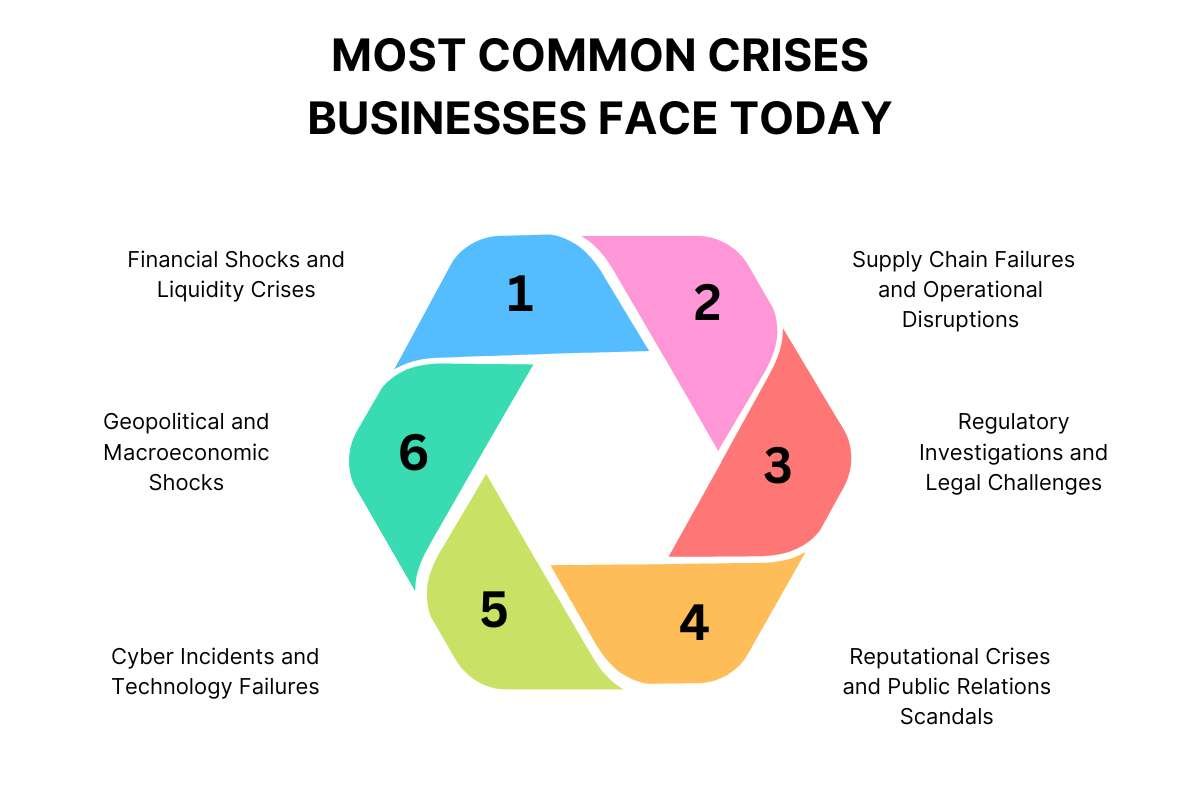
Businesses should be prepared for these six common types of disruption.
1. Financial shocks and liquidity crises
Falling sales, rising borrowing costs, or late customer payments can leave you short of cash. Without enough cash, paying employees, suppliers, and lenders becomes harder.
2. Supply chain failures and operational disruptions
Supplier failures, transport delays, extreme weather, or trade restrictions can disrupt deliveries and stop production. Depending on a few suppliers can make recovery harder.
3. Regulatory investigations and legal challenges
Regulatory investigations, rule violations, or changes in trade laws can lead to fines, legal costs, and delays. These issues can affect your finances, daily operations, and public image.
4. Reputational crises and public relations scandals
Misconduct, false claims, product failures, or poor treatment of employees can damage trust.
5. Cyber incidents and technology failures
Data breaches, ransomware, or payment outages can disrupt sales, customer service, and daily operations.
6. Geopolitical and macroeconomic shocks
Tariffs, political unrest, inflation, and rising energy prices can raise costs or limit access to key markets and materials. These changes can affect profits, supplier deals, and customer demand.
How do you measure crisis readiness and post-incident recovery?
After a crisis, track both the direct financial loss and the time it takes to return to normal business performance.
Which metrics should you track?
| Business Metric | What to Measure | Why It Matters |
| Financial Impact per Hour of Downtime | Lost revenue, extra operating costs, penalties, and other losses for each hour of disruption. | Shows how quickly losses grow and helps set response priorities. |
| Customer Churn Rate Post-Incident | The share of customers who stop buying or cancel contracts after a crisis. | Shows whether the incident has weakened customer loyalty. |
| Reputation and Sentiment Recovery Time | How long customer, employee, and public sentiment takes to return to normal levels. | Helps assess damage to trust and the effect of public communication. |
| Supply Chain Restoration Speed | Time taken to restore key supplies, production levels, and order deliveries. | Shows how quickly the business can meet customer needs again. |
| Corrective Action Closure Rate | The share of actions completed by their deadlines and checked for results. | Shows whether the company is fixing the causes of the crisis. |
| Crisis Readiness Rate | The share of critical business functions with tested response plans and named owners. | Shows whether teams know their roles before a crisis occurs. |
Set a baseline for each metric before a crisis. Your targets should reflect the cost of disruption, customer needs, cash reserves, supplier risks, and the level of service your business must maintain.
How Do You Measure the Human and Financial Cost of a Crisis?

Crisis leadership strategies account for both financial losses and lost trust. Track lost sales, higher costs, fines, and recovery expenses. Also watch for falling employee confidence, lost customers, and concerns from suppliers or investors.
Track employee feedback, staff turnover, customer complaints, renewal rates, supplier confidence, and investor concerns alongside financial results. Compare these measures with pre-crisis levels to see whether trust is returning or further action is needed.
How Can Leaders Build a Crisis-Ready Leadership Culture?
Crisis leadership strategies work best when readiness becomes part of daily work, not a task saved for emergencies.
1. Make Risk Checks Routine: Discuss risks to cash flow, suppliers, staff, and customer trust during regular business meetings.
2. Reward Early Warnings: Encourage employees to raise concerns before they cause major losses. Thank people who flag risks, even when the concern turns out to be minor.
3. Lead With Honesty: Share clear updates about business risks and setbacks. When leaders speak openly, employees are more likely to raise concerns.
4. Include Readiness in Business Plans: Consider possible disruptions when setting budgets, choosing suppliers, and planning major changes.
Conclusion:
A business crisis can affect cash flow, customer trust, daily operations, and long-term growth. Crisis leadership strategies help you make clear decisions, protect key business needs, and guide your teams through uncertainty.
Prepare before a crisis hits, act on facts when it happens, and fix the gaps you find afterward. Strong leadership is not about avoiding every setback. It is about helping your business recover and respond better next time.
Frequently Asked Questions
1. Which crisis leadership strategies help when senior executives disagree?
Set a clear decision owner, review the available facts, and agree on the business priority. Record the final decision so teams can act without delay.
2. How should a CEO respond when a crisis spreads on social media before the facts are clear?
Acknowledge the concern, share only confirmed facts, and state when the next update will come. Avoid guessing or making promises you cannot keep.
3. When should a business bring in an external crisis management expert?
Seek outside help when the crisis needs skills your team lacks, such as legal advice, public relations support, or specialist supply chain recovery.
4. How can a founder manage a business crisis with limited resources?
Protect cash, focus on essential work, and contact key customers and suppliers early. Delay non-essential spending until the business has a clearer view of the impact.
5. What should a board of directors do during a major business crisis?
The board should oversee major risks, question key decisions, and support the CEO without taking over daily operations. It should also ensure that legal and reporting duties are met.