“The cheque lands. The valuation jumps. The headlines follow.”
For a moment, everything looks like success. A startup raises a huge round, crosses the billion-dollar mark, and becomes the next big business story. Then comes the harder question: what does that valuation actually say about the company?
“Is venture capital overhyped in India, or has India simply become better at attracting risk capital?”
Funding can help a company hire talent, enter difficult markets and survive long product cycles. Yet abundant capital can also push founders to chase growth before the business is ready for it.
A funding announcement is an event. A viable business is a much harder achievement. That is the tension behind venture capital overhyped India.
The years when valuation became the story
India’s startup story changed when funding became a measure of progress, shaping the venture capital overhyped India narrative.
2015 | The funding story begins
India’s startup culture starts treating funding rounds as signals of momentum. Bigger cheques bring attention, while valuations become shorthand for potential.
2021 | The unicorn rush
The funding boom changes the scale of the game. Paytm, CRED, Byju’s, OYO and others see valuations climb on expectations of future growth. For many startups, the next round becomes a milestone almost as important as the business itself.
2022 to 2025 | The correction
Reality catches up. Profitability concerns, governance issues, and operating weaknesses expose the limits of valuation-led success.
2026 | Fundamentals return
Capital remains available, but investor expectations have changed. Product Growth reports that Indian VC funding stayed significant in 2025, while unit economics and profitability gained greater weight. Gaurav Singhvi Ventures notes a similar preference for businesses with stronger fundamentals.
The scorecard is changing: funding boom → unicorn rush → corrections → fundamentals.
The business behind the billion-dollar number
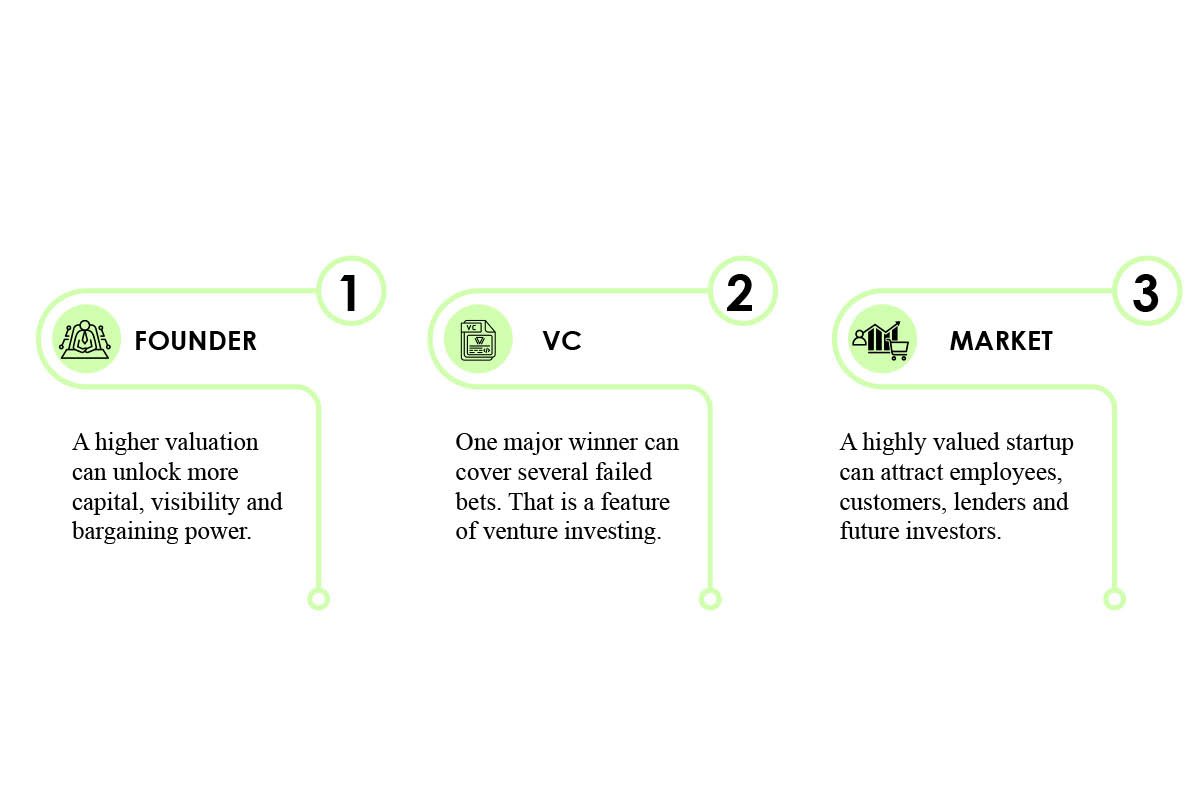
A rising valuation can create value before the business has proved itself. That is why the number matters to three different players in the venture capital overhyped India story.
| Founder | VC | Market |
| A higher valuation can unlock more capital, visibility and bargaining power. | One major winner can cover several failed bets. That is a feature of venture investing. | A highly valued startup can attract employees, customers, lenders and future investors. |
The catch is the benchmark. Each funding round can set a higher price for the next one. If growth, revenue or margins fail to justify that price, the correction can hurt founders, investors and employees alike.
Startup Chai’s examples show both sides. Strong funding can help companies gain market leadership, yet inflated expectations can collide with weak economics, governance problems or sudden market changes.
- KEY QUESTION
When does a high valuation become a liability?
AI is the new stress test for VC hype

“The AI test is simple: does the money create a better business?”
YourNest’s investor discussion captures the tension. 41% of surveyed Indian investors were allocating 20% to 40% of their portfolios to AI, yet only 7% called AI a core investment focus. Investors also flagged inflated valuations and asked harder questions about customer demand, profitability and proprietary technology.
The numbers are still climbing. Indian AI companies raised $1.07 billion in the first half of 2026, up 33% year-on-year, according to Mint. Yet Accel argues that investors must examine the economics behind delivering each product. AI businesses can face recurring model, cloud and infrastructure costs, making revenue growth alone an incomplete measure of health.
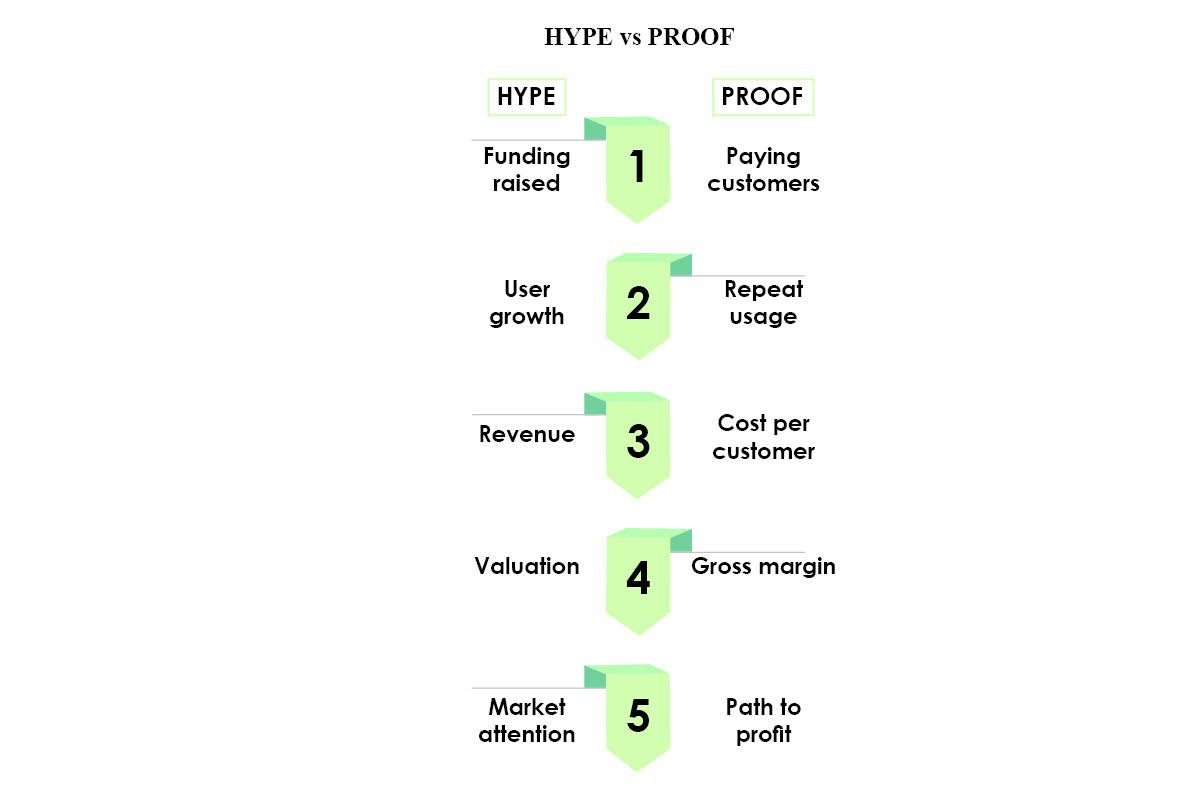
HYPE vs PROOF
| Hype | Proof |
| Funding raised | Paying customers |
| User growth | Repeat usage |
| Revenue | Cost per customer |
| Valuation | Gross margin |
| Market attention | Path to profit |
AI may be the clearest current test of whether venture capital overhyped India has become a problem.
The part of VC that gets lost in the hype
Venture capital exists for a simple reason: some businesses need serious investment before they can produce serious revenue.
Deeptech, enterprise software, AI infrastructure and other difficult categories may require years of research, specialist hiring and repeated experimentation. Traditional financing often struggles with that uncertainty.
That makes large funding rounds reasonable in the right context. Current investment trends also point to continued institutional interest in profitable technology, B2B SaaS, manufacturing and infrastructure-linked businesses.This nuance matters to the venture capital overhyped India narrative.
Flipkart offers a useful example. Startup Chai notes how aggressive capital helped the company build market leadership before its major exit.
“The real test is what the capital accomplishes.”
Capital can help a strong business become larger and more capable. It can also temporarily hide a weak business beneath impressive numbers. The cheque itself tells us little without the business results that follow.
What investors are asking now ?
The investor conversation around venture capital overhyped India is becoming more demanding. A compelling pitch may open the door, but the numbers must support the story.
1. Is the product genuinely needed?
Real demand matters more than user curiosity.
2. Does each customer improve the economics?
LTV/CAC and CAC payback reveal whether growth creates value.
3. Can the company operate without another round?
Cash discipline matters when fresh capital becomes harder to secure.
4. Does performance support the valuation?
Net revenue retention and profitability offer stronger evidence than hype.
5. Is there a credible path to a profitable exit?
Investors need a clear route to returns.
For AI companies, Mint highlights another test: can revenue cover recurring model, cloud and infrastructure costs?
“The scorecard is simple: prove the economics, then justify the valuation.”
Is India mistaking funding for business success?

Yes, when: funding announcements become shorthand for business success, valuations are treated as proof of quality, and sector excitement runs ahead of customer demand.
No, when: capital backs genuinely difficult businesses with strong customers, sensible economics and a realistic path to scale.
The real issue is less about capital itself and more about how success gets measured. India does not have a venture capital problem as much as it has a measurement problem. Public attention often celebrates the size of a funding round while overlooking what the money actually produces.
Venture capital overhyped India? The answer depends on whether capital is creating lasting business value or simply creating a bigger headline.
The verdict
India does not need to choose between more venture capital and less hype. It needs to distinguish the two. Venture capital overhyped India becomes a concern when funding and valuation are mistaken for proof of a strong business. Yet when capital backs real demand, sound economics and difficult ideas, it can create lasting value. The better measure is simple: judge the business by what the capital helps it build, not by how large the cheque looks.