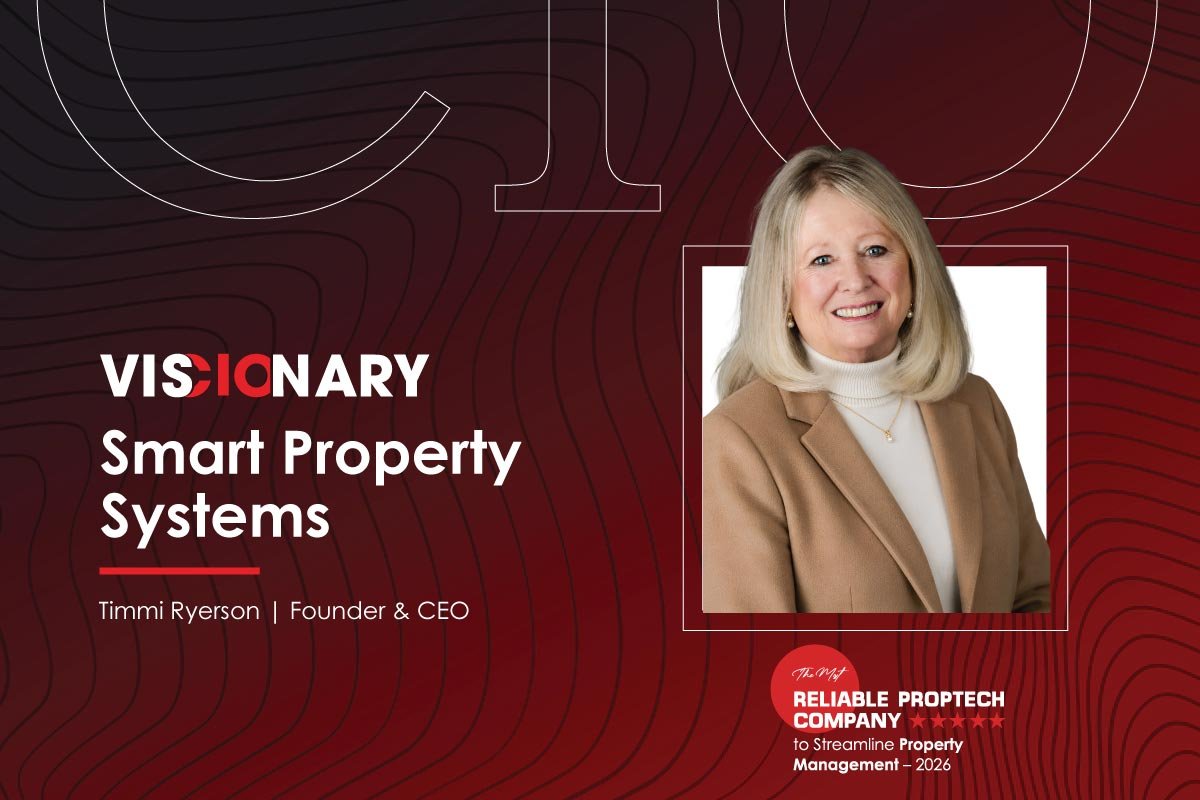
Property management has outgrown software built solely to record completed tasks. Today’s professionals require connected systems that simplify operations, improve financial accuracy, and support informed decision-making throughout the rental lifecycle. Responding to this shift, Smart Property Systems (SPS), under the leadership of Founder & CEO Timmi Ryerson, has developed a platform designed around the realities of modern property management rather than the limitations of conventional software.
Built on an accounting-first foundation with intelligent capabilities integrated into everyday workflows, SPS brings together financial management, operations, and stakeholder collaboration within a unified environment. Through this approach, the company aims to reduce administrative complexity while helping property managers operate with greater confidence, consistency, and efficiency.
As the PropTech industry continues to advance, SPS reflects a practical vision for technology that actively contributes to business performance instead of simply documenting it.
The core philosophy of SPS
SPS reflects a clear purpose to transform the role of property management software beyond recordkeeping. The company focuses on helping property management professionals manage operations through technology that interprets information, supports timely decisions, and maintains continuity across every stage of the rental lifecycle.
Its accounting-first foundation ensures every capability aligns with the practical demands of day-to-day property management while simplifying complex processes with accuracy and consistency.
Vision
SPS envisions property management technology as an active operational partner that supports professionals with practical, reliable, and intelligent solutions.
Mission
SPS aims to equip property managers with a unified platform that combines accounting, operations, and workflow management within a single environment to improve efficiency and business performance.
“Software should contribute to the work, not simply record what has already happened. That belief continues to shape every decision we make at SPS.”
Timmi Ryerson
Forty-five years in the field — the education no classroom provides
Most PropTech founders arrive at property management from the outside — from software, from finance, from venture capital. Timmi Ryerson arrived from the inside, and that difference is embedded in every decision SPS has made.
Forty-five years of direct property management experience means Timmi Ryerson has lived every failure mode the industry produces. She has managed portfolios through paper ledgers and spreadsheets, through first-generation software that promised integration and delivered fragmentation, through platforms that treated accounting as an afterthought and then left property managers reconciling the consequences at month end. She has been the person on the phone at 11 PM when a tenant’s heat fails, the person reviewing a trust account discrepancy that no software flagged, and the person explaining to an owner why their statement doesn’t match their bank.
That depth of field experience is not background color. It is the architecture of SPS. Every workflow, every data relationship, every Grace AI response, and every integration decision in the platform traces directly to a problem Timmi Ryerson encountered, managed, and refused to accept as inevitable.
“I did not build SPS to disrupt the industry. I built it because I had spent decades watching capable property managers fail the people they served because their software failed them first.”
Timmi Ryerson
Three versions. One uncompromising standard
SPS Version 3 is a pivot. It is a 180-degree shift from a system that records what property managers do to a system that does the work with them. Built on the foundation of two prior versions and 45 years of field experience, V3 represents the moment the platform stopped documenting property management and started practicing it.
Version 1 established the accounting-first principle: every payment is an accounting event the moment it occurs, not a transaction that gets reconciled later. Version 2 proved the multi-portal model, establishing that subscribers, staff, tenants, and owners each require a purpose-built experience, not a filtered view of the same generic interface. Version 3 brings those principles to their logical conclusion: a single platform where every stakeholder operates in their own environment while every transaction, document, communication, and workflow remains connected to a single source of truth. AI isn’t bolted onto SPS after the fact; it is natively embedded into the system from the ground up
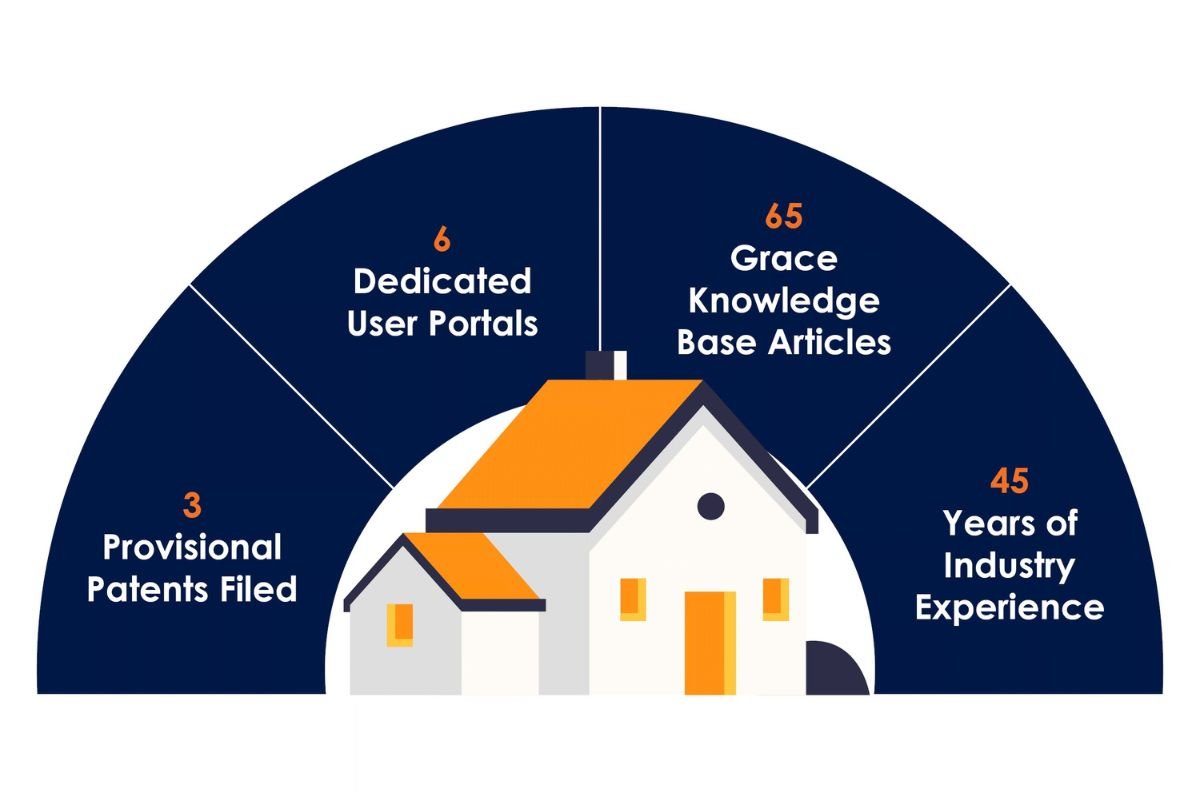
| 3Provisional Patents Filed | 6Dedicated User Portals | 65Grace Knowledge Base Articles | 45Years of Industry Experience |
The architecture that changes everything
The property management software industry has a structural problem that most platforms have not addressed: they were built to record what happened, not to support what should happen next. The result is a category of software that is comprehensive in its data capture and passive in its operational value.
SPS is built on the opposite premise. Every event on the platform, a payment, a repair request, a lease expiration, a vendor invoice, an owner statement. triggers a chain of automated responses. Late fees post at midnight without staff intervention. NSF fees apply the moment a payment returns. Trust account balances update in real time. The Priority Action Feed surfaces what needs attention today, ranked by urgency, with the most critical items pinned at the top regardless of when they occurred. Nothing important is buried under routine activity.
Six portals serve the six stakeholder types that property management actually involves: Subscriber, staff members, Tenants, Owners, Vendors, Inspectors, and Agents. Each portal is purpose-built for its user, and each user has a separate and secure access to the portal. Tenants submit maintenance requests, sign documents, and make rent payments without calling anyone. Owners review statements, monitor reserve balances, and communicate with their property manager without emailing or calling anyone. Vendors receive request for bids and work orders, submit invoices, and track payment status all thrught the vendor portal. Every interaction is documented, timestamped, and connected to the financial record it belongs to.
“Property management works best when every stakeholder operates within the same connected environment; Not separate systems that occasionally share data. This new software platform creates a single software environment where every action by every participant creates a complete operational record.”\
Timmi Ryerson
Grace: AI that knows the difference between information and action
The PropTech industry’s relationship with artificial intelligence has produced a predictable pattern: platforms bolt a chatbot onto existing architecture, label it AI, and describe it as intelligent. The result is a system that can answer general questions and retrieve data but cannot participate in the operational work the platform was built to support.
Grace is designed from a different premise. She is not a general-purpose assistant that happens to know property management. She is a domain-specific AI trained on the knowledge base articles covering every function of every SPS portal, with retrieval-augmented access to the subscriber’s own portfolio data. When a staff member asks Grace about a tenant’s payment history, Grace responds with that tenant’s actual ledger, not a general explanation of how ledgers work. When a subscriber asks what needs attention today, Grace summarizes the live Priority Action Feed for the properties in that account, not a generic list of property management best practices.
Grace also knows what she cannot do, which matters as much as what she can. She cannot post ledger entries. She cannot modify financial records. She cannot approve payments or alter accounting entries. Those boundaries are absolute and enforced by architecture, not policy. The integrity of the financial record is not a feature Grace can override. It is the foundation she operates on top of.
Grace is present in all six portals, with a system prompt and knowledge scope calibrated to each user type. A tenant asking Grace a question receives guidance appropriate to a tenant. A subscriber asking Grace the same question receives the operational depth appropriate to someone running the portfolio.
“The measure of an AI assistant in property management is not how much it knows. It is how precisely it applies what it knows about the situation when answering the person asking.”
Timmi Ryerson
Financial integrity as a non-negotiable
Property management is a fiduciary business. Property managers hold other people’s money: tenant security deposits, owner reserves, and collected rents pending distribution. The legal and professional obligations that attach to that responsibility are significant, and the consequences of accounting failures in this industry extend well beyond financial loss.
SPS treats financial integrity as architecture, not policy. Every payment processes through PaySafe under SAQ-A PCI DSS compliance. Every late fee posts through a predefined rules engine that applies the subscriber’s configured terms consistently, without exception and without manual intervention. Every NSF event triggers an immediate ledger update, a fee posting, and a staff notification. Bank reconciliation is supported with flagging that surfaces discrepancies before they become compliance issues. Trust account monitoring watches for conditions that require immediate attention.
The accounting-first design means that financial events are never waiting for an administrative process to catch up. The ledger reflects reality at the moment reality changes. That is not a convenience feature. It is the operational standard that professional property management requires and that most software has historically failed to deliver.
Pricing built for the market that needs this most
Enterprise-grade property management infrastructure has historically been priced for enterprise portfolios. The companies managing 50 to 500 units, professional operations with real complexity, real fiduciary obligations, and real owner relationships to maintain, have been left choosing between underpowered consumer tools and enterprise platforms priced far beyond what their portfolios justify.
SPS addresses this directly with a flat $5 per unit per month pricing model. No feature tiers. No capability gates. No premium add-ons required to access the accounting functions or the AI layer. Every subscriber, regardless of portfolio size, operates on the same platform with the same capabilities. A company managing 75 units has access to the same Grace AI, the same six-portal architecture, the same automated workflows, and the same financial integrity infrastructure as a company managing 500.
This is a deliberate market position. The 50-to-500 unit segment is large, underserved, and ready for a platform that takes its operational complexity seriously. SPS was built for exactly that segment and priced to be accessible to it. But SPS can serve any sized account from 1 unit to 250,000 units under management.
What forty-five years teaches you about building for the long term
SPS Version 3 is on the verge of launch, with its first cohort of subscribers already lined up to begin onboarding. What it carries into that launch is something most PropTech startups cannot claim: a founder who has managed the problems the platform solves, for longer than most of the industry has existed in its current form.
The three provisional patents filed by SPS, covering document-centric operations, lifecycle state management, and structured AI document generation, reflect the precision of that experience. These are not broad defensive filings. They protect specific architectural decisions that emerged from understanding what property management software has consistently failed to do and designing the mechanisms that address those failures directly.
The platform’s industry recognition, including Top 100 Real Estate Leader at WREconf, 2026 Forbes Technology Council membership, and regular podcasts and other contributions about AI and PropTech, reflects a consistent voice in the conversation about where property management technology should go. Timmi Ryerson does not write about what property management software could theoretically do She writes from the position of someone who has built it, rebuilt it, and is now preparing to launch a complete platform designed to run quietly in the background of a real business.
“The industry does not need more software that documents what property managers already know. It needs a platform that helps them act on information brought to them, faster, more accurately, and with the confidence that the financial records created will hold up to scrutiny.”
Timmi Ryerson

Advice for the next generation of proptech leaders
“Timmi’s counsel to aspiring PropTech founders is grounded in the specific lessons that fifteen years in the software development field produce, not the general wisdom that fills conference keynotes.
- Build accounting first, not last. Every platform that treats financial management as a feature to add later pays the cost of that decision for the life of the product. Accounting is not a module. It is the foundation everything else stands on.
- Know the work before you build the tool. Too much of the property management software that has failed this industry was built by people who understood software but not the job it was meant to serve. The platform that will serve it properly requires understanding what it actually costs a property manager when their system lets them down.
- Refuse to ship what you would not trust. The version of the platform that reaches subscribers must be the version you would run your own portfolio on. That standard eliminates a great deal of the compromises that produce mediocre software.
- Build for the operator, not the demo. Software that performs beautifully in a sales demonstration and breaks under real operational load is not property management software. It is a prototype with a price tag.
“Build a platform people can trust. Stand behind every promise the platform makes. And never forget that the person using your software at 11 PM to resolve an emergency did not choose this moment. They need the tool to work.”
Timmi Ryerson
Smart Property Systems (SPS) is currently in final pre-launch preparation. The platform is built on a modern, cloud-native technology stack designed to support AI natively at its core rather than as an add-on, with PaySafe and TransUnion integrations certified and three provisional patents protecting core architectural innovations. SPS is led by Timmi Ryerson, Founder and CEO, whose 45 years of direct property management experience informs every aspect of the platform’s design.