
What does employee disengagement cost the world? An estimated $10 trillion in lost productivity. Gallup’s State of the Global Workplace 2026 report found that only 20% of employees worldwide were engaged at work in 2025.
These numbers show a challenge for business leaders: how can they help employees feel supported and perform at their best? The servant leadership style addresses this by putting employee growth first. You can apply it by removing work barriers, coaching employees, sharing decision-making power, and tracking results.
A clear understanding of servant leadership can help you put this approach into practice.
What is the servant leadership style, and how does it work?
Servant leadership is a management style that puts employees’ growth and well-being first. Instead of relying on authority alone, leaders listen to their teams, solve problems, share decisions, and help employees build their skills.
Robert K. Greenleaf introduced the modern idea of servant leadership in his 1970 essay, The Servant as Leader. This approach puts people before power.
This does not mean employees make every decision or managers stop setting rules. Leaders still set goals, manage risks, solve conflicts, and deal with poor performance.
The difference is how they lead. They do not just ask if employees have finished their work. They also ask if the team has the tools, guidance, and support it needs to succeed.
For example, a software team keeps missing release dates because security reviews take too long. A traditional manager might tell developers to work faster. A servant leader would find the cause of the delay, bring the teams together, clarify who handles each task, and fix the process while keeping security checks in place.
Four steps to implement the servant leadership style
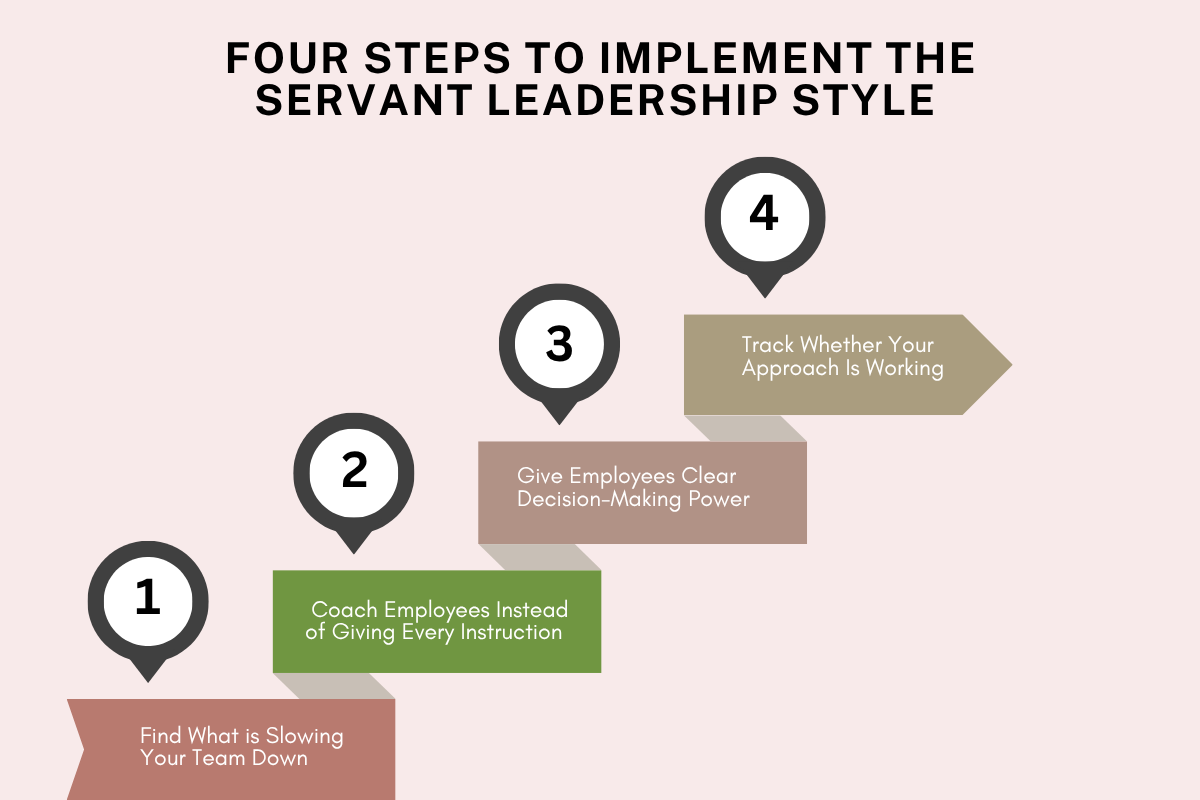
To put the servant leadership style into practice, leaders need to remove work barriers, coach employees, share decision-making power, and track results. These four steps give managers a clear way to start.
Step 1. Find what is slowing your team down
Ask employees what makes their work harder. Look for slow approvals, unclear roles, missing tools, poor communication, and tasks that depend on too many people.
Use team meetings, one-to-one talks, and workflow reviews to find repeated problems.
Action: Pick the three biggest barriers, assign someone to fix each one, and set a date to review progress.
Step 2. Coach employees instead of giving every instruction
When work falls behind, ask what is blocking progress before telling employees what to do. This helps you understand the problem and gives employees a chance to solve it.
Ask questions such as:
- What is stopping you from finishing this task?
- What support or information do you need?
- What solutions have you considered?
- Which decision can you make on your own?
Give direct guidance when needed, but avoid taking over tasks employees can manage themselves.
Action: In your next one-to-one meeting, ask the employee to suggest a solution first. Review the risks and agree on the next step together.
Step 3. Give employees clear decision-making power
Employees need to know which decisions they can make, which require input from others, and which need manager approval. Without clear limits, managers can become bottlenecks, or teams may make choices that conflict with business needs.
For example, a product team might decide how to organize its daily work while following set security rules and release requirements.
Action: Choose one routine decision your team can make without senior approval. Set clear limits, assign ownership, and review the result.
Step 4. Track whether your approach is working
The servant leadership style should lead to changes you can measure. Set a baseline before making changes, then track employee feedback and team results over time.
| Metric | What to measure |
| Employee trust | Survey responses about trust in managers |
| Voluntary turnover | Share of employees who leave by choice |
| On-time delivery | Projects or milestones completed on schedule |
| Rework and delays | Defects, repeated work, and time spent waiting for approvals |
| Employee growth | New skills, internal moves, and readiness for new roles |
These measures help you spot progress and areas that need work. However, changes may also result from pay, workload, new tools, or other management decisions.
Action: Review these measures each quarter. Ask employees what has improved, identify what still blocks their work, and adjust your approach based on the results.
What are the core principles of a servant leader?

The servant leadership style is built on five key principles:
1. Active listening and empathy
Servant leaders listen to employees before judging a problem. They consider their concerns and workload without agreeing to every request.
For example, if an employee says a deadline is unrealistic, the manager reviews the workload and competing tasks before deciding what to change.
2. Commitment to employee growth
Servant leaders help employees build skills and take on more responsibility. They give clear feedback, support learning, and let team members lead projects or make decisions.
The goal is to build a team that can solve problems without waiting for the manager to step in every time.
3. Awareness and foresight
Leaders need to spot current problems and think about future risks. This means watching for team conflict, heavy workloads, skill gaps, and plans that may fail.
For example, before approving a product launch, a manager checks whether the team has enough staff, time, and technical support.
4. Persuasion and shared decision-making
The servant leadership style relies on clear reasons and team input, not job titles alone. Leaders explain their decisions, listen to concerns, and let employees question a plan.
They must still make firm choices when time is short, or risks are high. The key is to explain why the decision was made.
5. Stewardship and community
Stewardship means using company resources and authority with care. Leaders consider how their choices affect employees, customers, and business goals.
Building community means helping teams share knowledge, work across departments, and take responsibility for shared goals. It also means dealing with unfair behavior before it harms trust.
Together, these principles help leaders support employee growth without losing sight of results.
How does the servant leadership style help businesses?

The servant leadership style helps leaders build trust, improve teamwork, and support employee growth. These benefits matter when teams must solve problems, share knowledge, and adapt to change.
Research supports these links. A 2015 review of 85 studies involving 16,803 people found that servant leadership was linked to higher trust in leaders, greater job satisfaction, and better job performance.
This approach can support three key areas:
1. Stronger employee trust: Managers who listen, explain decisions, and treat people fairly make it easier for employees to raise concerns early.
2. Better teamwork and problem-solving: When employees can question plans and share ideas without fear of unfair treatment, leaders get more information to make sound decisions.
3. Employee growth and retention: Regular feedback, learning opportunities, and greater ownership help employees build skills. These steps may support retention, though pay, workload, and career options also affect whether people stay.
How does this apply to technology and distributed teams?
Technology and distributed teams need clear communication, shared knowledge, and defined responsibilities to work well. The servant leadership style helps leaders remove barriers, address team concerns, and give employees more control over their work while keeping decisions and responsibilities clear across departments, locations, and time zones.
How does the servant leadership style compare with other leadership approaches?
The servant leadership style shares traits with other leadership models, but each has a different focus.
| Leadership Style | Main Focus | Role of the Leader | Potential Limitation |
| Servant leadership | Employee growth, well-being, and service | Supports employees, removes barriers, and builds their ability to act independently | Can be misunderstood as weak leadership when expectations are unclear |
| Transformational leadership | Shared vision and organizational change | Inspires people to work toward ambitious goals | May place too much attention on the leader’s vision if employee needs receive less attention |
| Situational leadership | Adapting direction and support to the task and employee’s readiness | Changes the level of guidance based on the circumstances | Requires managers to judge what kind of support each situation needs |
| Command-and-control leadership | Clear authority, direction, and compliance | Makes decisions and assigns work through established reporting lines | Overuse can limit employee input and create approval bottlenecks |
Conclusion:
The servant leadership style puts the growth and success of employees at the center of leadership. It asks managers to listen carefully, remove barriers, develop people’s skills, and give teams the authority to take responsibility for their work.
For executives, the value lies in making these behaviors part of everyday management. Start by identifying what slows employees down, clarify who can make decisions, and measure changes in trust, retention, delivery, and development.
Frequently asked questions
1. Can servant leadership work during a business crisis?
Yes. Leaders can support employees while giving clear, direct instructions during urgent situations. The key is to match the level of direction to the risk and time available.
2. Is servant leadership suitable for small businesses?
Yes. Small-business owners can apply it by listening to employees, sharing appropriate decisions, offering development opportunities, and removing everyday work barriers. These practices do not require a large HR department.
3. How can you identify a servant leader in a job interview?
Ask candidates to describe a time they helped an employee grow, handled difficult feedback, or removed a barrier affecting a team.
4. Does a servant leader avoid difficult performance conversations?
No. Servant leaders address poor performance directly and fairly. They explain expectations, understand the reasons for the problem, agree on improvements, and follow up on results.