AI is already used by 88% of organizations, according to Stanford’s 2026 AI Index. But this widespread adoption does not answer: how should leaders make AI work with people?
AI-centric human leadership combines AI’s speed and scale with human judgment, accountability, trust, and purpose. It helps you decide what AI should handle, where human oversight matters, and how to build teams that can work effectively with both.
The sections ahead break down the six pillars of AI-centric human leadership, the CIO’s role, practical examples, and the mistakes that can weaken AI adoption.
Why do you need AI-centric human leadership?
You need AI-centric human leadership because AI is taking on more work and influencing more decisions, while leaders still need to remain responsible for the results. As AI becomes part of daily work, leaders must decide what AI should handle and where people need to take over.
The World Economic Forum expects the share of tasks done mainly by humans alone to fall from 47% today to about one-third by 2030, as more tasks are shared between people and technology.
AI agents add another layer to this change. They can plan tasks, use tools, and complete some work with limited human input. Leaders therefore need clear boundaries around what AI can do, what people must decide, and who is responsible for the outcome.
That is the role of AI-centric human leadership. It uses AI to handle work it can do well while keeping people responsible for goals, important decisions, judgment, and accountability.
In simple terms, AI does more of the work, but people remain responsible for deciding what matters and what happens next.
How can leaders help people and AI work together?

The first step is to stop treating AI adoption as a collection of software purchases.
You should start with the work itself. Which activities need speed? Which require large-scale analysis? Which decisions can be automated safely? Which decisions involve values, risk, customers, employees, or long-term strategy and therefore need human oversight?
A practical model looks like this:
| Business activity | AI’s role | Human leadership role |
| Data analysis | Process information and identify patterns | Interpret the business meaning |
| Routine decisions | Automate within defined limits | Set rules and exceptions |
| Strategic decisions | Generate scenarios and insights | Set direction and make the final decision |
| Customer interactions | Handle routine requests | Manage complex or sensitive cases |
| Risk management | Detect signals and anomalies | Assess consequences and accept accountability |
This approach also changes how leaders think about workforce planning. Instead of asking which jobs AI can eliminate, you should ask which tasks AI can absorb and what higher-value work people can take on as a result.
Workforce transformation is part of AI strategy rather than a separate HR exercise.
AI adoption works best when workflow redesign, employee capability, governance, and technology move together.
What are the 6 pillars of AI-centric human leadership?
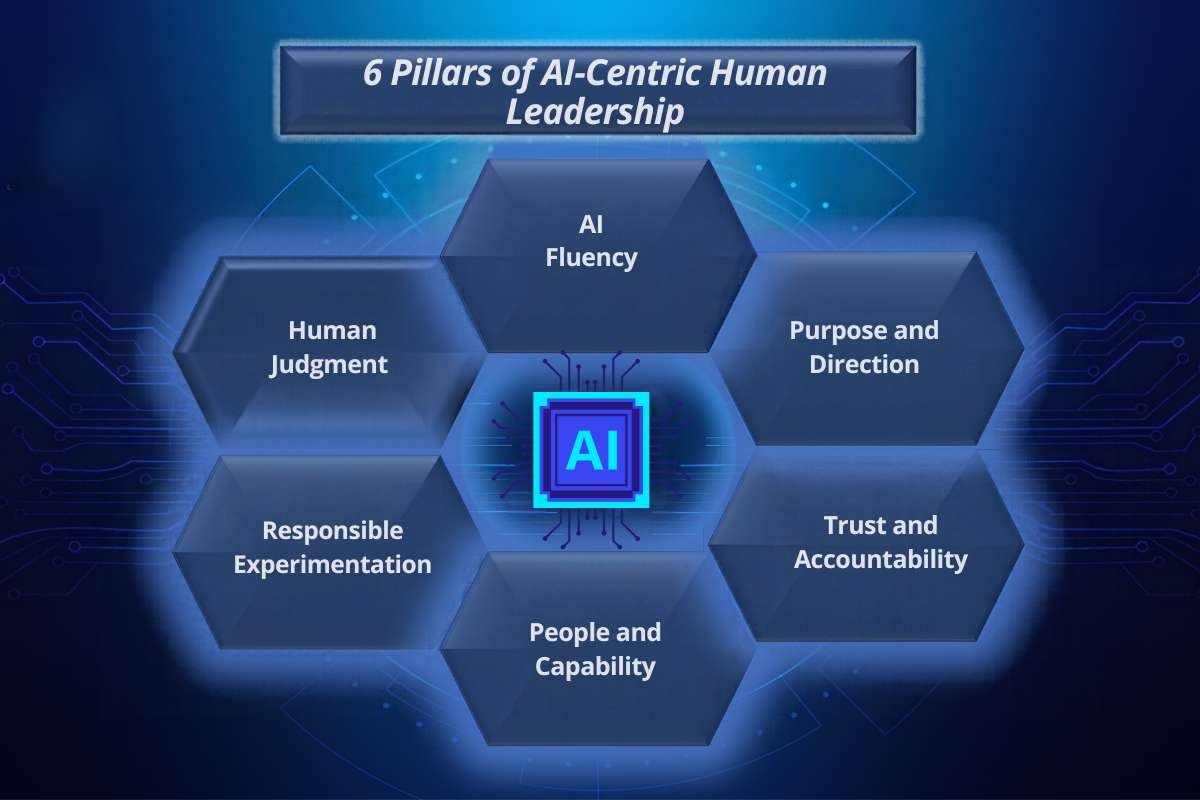
The strongest AI leadership model needs more than technical fluency. It needs a clear structure for deciding how technology and people should work together.
These six pillars provide that structure.
1. Human judgment
AI can compare options, spot risks, and recommend a course of action. It can support a decision, but the leader remains responsible for the outcome.
For example, an AI system may analyze sales, costs, and market data and recommend closing an underperforming business unit. A leader still needs to consider the impact on employees, customers, the company’s long-term strategy, and its reputation before making the final decision.
2. AI fluency
Leaders do not need to become AI engineers. They do need enough AI fluency to understand what a system can do, where it can fail, what data it uses, and when its output requires deeper review.
This becomes particularly important for CIOs and senior executives overseeing AI agents. Leaders need to understand workflows, escalation paths, evaluation methods, data inputs, and failure modes.
LinkedIn data shared through the World Economic Forum found that professionals were more than twice as likely to add AI skills in 2025 as they were in 2018. At the same time, the importance of human skills in roles less associated with them had grown by 20% since 2018.
3. Purpose and direction
AI can optimize for a goal, but leaders decide which goals matter.
For example, AI may recommend the fastest or cheapest option, but leaders still need to ask whether it fits the company’s strategy, values, customers, and long-term goals.
The leader’s role is therefore to set clear goals, ask the right questions, and make sure AI supports the right business outcomes.
4. Trust and Accountability
AI adoption can move faster than employee trust.
Adecco’s 2026 study of 2,000 C-suite leaders across 13 countries found that 45% expected AI agents to enter their workflows within a year. But only 36% said their talent strategy clearly showed how AI would create opportunities for workers, and just 39% said employees were involved in redesigning their jobs.
That gap creates a leadership problem. Employees need to know where AI is being used, how decisions are reviewed, how their roles may change, and who is responsible when an AI-supported decision goes wrong.
5. People and capability
A company cannot become AI-centric if its workforce is not ready to work with AI.
That requires more than sending employees to a one-time training session. Leaders need ongoing AI literacy, role redesign, coaching, experimentation, and opportunities to apply new skills in real workflows.
AI transformation without workforce transformation is incomplete.
6. Responsible experimentation
Leaders need to move quickly enough to learn, but carefully enough to avoid creating unnecessary risk.
That means creating controlled environments where teams can test AI use cases, measure results, identify failure points, and improve workflows before scaling them.
Responsible experimentation should include clear data controls, security requirements, evaluation criteria, human oversight, and escalation paths.
Which human capabilities matter most when AI takes on more work?
AI capabilities will keep changing, and some tasks that once required human skills may become easier to automate or support. As AI takes on more work, skills such as judgment, communication, creativity, empathy, and critical thinking become increasingly important for leaders and teams.
- Judgment: Leaders must weigh priorities, risks, and possible outcomes. AI can support the decision, but leaders still need to decide what matters most.
- Strategic Thinking: AI can generate scenarios and identify patterns. Leaders must connect those insights to the company’s strategy and decide where to invest, compete, or change direction.
- Empathy and Relationship Building: Companies still depend on trust between leaders, employees, customers, partners, and other key groups. AI can help draft messages, but strong relationships still need human care, trust, and clear communication.
- Ethical Reasoning: Business decisions can affect people in different ways. Leaders must decide what the company should do when the fastest or most profitable choice is not the right one.
- Accountability: AI does not sit before a board, employee, customer, regulator, or investor to explain why a high-impact decision was made. Leaders do. They must know where AI is being used, set clear decision boundaries, and ensure a person remains responsible for the outcome.
What role should CIOs play in AI-centric human leadership?
The CIO’s role is no longer limited to managing technology. CIOs need to connect AI with business goals, people, data, security, governance, and measurable results.
Five priorities matter most:
- Set the AI strategy: Choose AI initiatives that support clear business goals.
- Set governance: Define what AI can do, where human oversight is needed, and who is accountable.
- Prepare the workforce: Build AI skills and help teams adapt their roles and workflows.
- Strengthen the technology foundation: Ensure the organization has reliable data, infrastructure, and security.
- Measure results: Track AI adoption, productivity, business value, and risks.
The CIO also needs to connect different C-suite priorities. The CEO may focus on growth, the CFO on returns, the CHRO on workforce impact, and the CISO on security. The CIO helps bring these priorities together into an AI operating model that can work across the business.
What does AI-centric human leadership look like in practice?

The model becomes easier to understand when applied to real business situations.
Microsoft: Microsoft has introduced AI tools such as Copilot across workplace tasks, including writing, meetings, analysis, and software development. The leadership challenge is deciding where AI can speed up work and where employees still need to review, verify, and make the final call.
JPMorgan Chase: The bank uses AI and machine learning across areas such as fraud detection, risk management, customer service, and operations. Here, the value of AI depends on more than accurate predictions.
Walmart: The retailer uses AI for areas such as inventory, product search, customer support, and supply-chain operations. This shows how AI-centric leadership can involve redesigning everyday workflows while giving employees new tools and responsibilities rather than treating AI as a separate technology project.
What mistakes should leaders avoid when adopting AI?
Leaders should avoid these seven common mistakes when adopting AI:
- Choosing AI tools before defining the business problem.
- Automating inefficient processes without fixing them first.
- Deploying AI without assigning clear accountability.
- Introducing AI without preparing and training employees.
- Measuring AI adoption instead of business results.
- Scaling AI before establishing proper governance.
- Trusting AI outputs without appropriate human review.
Conclusion
AI is changing how companies work, but leadership responsibility remains human. AI-centric human leadership gives businesses a practical way to combine AI capabilities with human judgment, accountability, and clear business goals.
The leaders who create value with AI will be those who know what to automate, where human oversight matters, and how to measure the results.
Frequently asked questions
1. How does AI affect leadership decision-making?
AI can provide faster analysis and recommendations, helping leaders compare options and make better-informed decisions.
2. What is the difference between AI leadership and AI-centric human leadership?
AI leadership focuses on leading AI initiatives, while AI-centric human leadership combines AI use with human judgment and accountability.
3. How can leaders build trust in AI systems?
Set clear rules for AI use, explain how important decisions are made, monitor performance, and provide ways to challenge AI-driven outcomes.
4. What are the benefits of AI-centric human leadership for businesses?
It can improve decision quality, productivity, employee capability, and responsible AI adoption while keeping business accountability clear.
5. How should leaders evaluate an AI use case before deployment?
Assess its business value, data needs, risks, affected employees, level of human oversight, and measurable success criteria.