
In 2026, smart investors will have excellent opportunities as market volatility spikes amid an AI-driven rally and quick sector rotation. Good stocks to buy right now require careful selection. It is not just chasing hype. It is based on sector performance data, analyst insights from Goldman Sachs and Morningstar, and global market trends.
Cooling semiconductor rallies indicate a shift toward undervalued gems in consumer tech, healthcare, and renewable energy, while the AI boom continues. Beyond just listing stock names, this guide gives investors frameworks for strategic thinking. It includes how to identify changes in momentum, manage risk, and time entries for long-term profits.
Understanding the Current Market Landscape:
AI and data center spending explode into a multi-trillion-dollar frenzy. Hyperscalers like Amazon and Microsoft plan $200B+ in 2026 capex. This is fueling demand for chips, power gear, and cooling tech.
Semiconductors roar ahead. NVIDIA’s revenue doubled last year. But sky-high valuations spark pullbacks. P/E ratios top 50x for leaders, urging caution amid supply gluts.
Sector rotation accelerates: Tech fades as financials (+12% YTD), services, and industrials draw capital. Banks thrive on steeper yield curves; industrials ride infrastructure bills.
Global macros add twists:
- Interest rates ease to 3-4% Fed funds, boosting cyclicals.
- Geopolitics, US-China tensions. This lifts domestic manufacturing.
- Inflation cycles hover at 2.5%, pressuring bonds but aiding commodities.
Why 2026 favors stock pickers over broad rallies? Dispersion widens, top decile stocks crush the bottom by 30%. Precision beats passive bets.
Here Are Some of the Good Stocks to Buy Right Now:
| No. | Stock Name | Category |
| 1 | NVIDIA | AI & Semiconductor |
| 2 | Broadcom | |
| 3 | AMD | |
| 4 | TSMC | |
| 5 | ASML | |
| 6 | Amazon | Consumer Growth |
| 7 | Tesla | |
| 8 | LVMH | |
| 9 | Nike | |
| 10 | Costco Wholesale | |
| 11 | Johnson & Johnson | Value & Defensive |
| 12 | Procter & Gamble | |
| 13 | Coca-Cola | |
| 14 | Walmart | |
| 15 | Nestlé | |
| 16 | Palantir Technologies | High-Growth Speculative |
| 17 | Snowflake Inc. | |
| 18 | Rivian | |
| 19 | Coinbase | |
| 20 | Unity Software |
➤ AI & Semiconductor Stocks (High Conviction Growth):
AI and semiconductor stocks sit at the core of the 2026 growth stack. They are not just a theme play. But they are structural beneficiaries of a multi‑trillion‑dollar AI and data‑center build‑out.

Why AI & chips matter now?
Global hyperscalers are on track to spend hundreds of billions annually on AI infrastructure. This is pushing demand for accelerators, custom ASICs, and advanced manufacturing capacity. This turns AI into a multi‑year secular tailwind for companies that own the core of the compute stack, not just the headline GPUs.
Key AI & semiconductor picks (with metrics)
1. NVIDIA:
NVIDIA remains the dominant platform for AI training and inference, with a GPU market share estimated well above 75% in high-end AI chips and gaming. Because of this massive lead, many investors frequently list it among good stocks to buy right now to capture the ongoing tech boom. Revenue growth has run in the high double-digit to triple-digit range in recent years, but that success has bid forward P/E ratios into the 50x+ zone. This valuation reflects both strong market conviction and premium pricing.
2. Broadcom:
Broadcom is emerging as a major beneficiary of custom AI ASICs. Its AI-focused semiconductor business is growing around 70–100% year‑on‑year in recent quarters. Estimates suggest it could hold roughly 60% of the AI server‑compute ASIC design segment by 2027. This gives it a strong niche while trading at a lower forward P/E than many pure‑GPU names.
3. AMD:
AMD is gaining share in data‑center GPUs and CPUs. Along with analysts projecting it to hold around 20% of the discrete GPU market versus NVIDIA’s 75–80% as of 2024–2026. Its AI‑related revenue is growing in the mid‑ to high‑20s percent range. This is supported by cloud‑provider wins. While its valuation typically sits below NVIDIA’s. This reflects both competition risk and upside potential.
4. TSMC:
TSMC is the backbone of the entire advanced node supply chain, producing roughly 90%+ of the most advanced wafers used in AI accelerators and HPC chips. Because the foundry targets close to 30% revenue growth in 2026 and expects AI-related chip revenue to grow at a 60% CAGR through 2029, many analysts consider it one of the good stocks to buy right now for long-term growth. With forward P/E multiples that are more moderate than pure design peers, it offers a compelling valuation for its dominant market position.
5. ASML:
ASML plays a critical role in the AI chip industry as the world’s leading supplier of EUV lithography machines, technology required to manufacture advanced semiconductors. Nearly every major chipmaker depends on ASML’s equipment, giving it a powerful competitive advantage. As global AI demand drives new semiconductor factories and capacity expansion, the company benefits regardless of which chip designer leads the market. With steady growth and strong industry positioning, many investors consider it among the good stocks to buy right now for long-term AI exposure.
Risks to highlight
- Overvaluation
- Many AI and semiconductor names trade at rich forward P/E and price‑to‑sales multiples, leaving limited margin for error if growth slows or margins compress.
- Slowing momentum after the rally
- After multi‑year rallies, a pullback in memory prices or hyperscalers’ capex can quickly cool near‑term sentiment even if long‑term demand remains intact.
- Cyclical semiconductor nature
- The sector is inherently cyclical, with inventory cycles and order‑book swings that can slam earnings even for high‑quality names.
In this environment, AI and semiconductor exposure must be selective, favoring players with strong revenue growth (30–60 %+), reasonable forward valuation spreads, and durable market share in AI infrastructure or advanced manufacturing.
➤ Consumer Growth Stocks (Demand-Driven Winners):
Consumer growth stocks are becoming long‑term demand‑driven engines, fueled by the steady expansion of the global middle class and rapid digital adoption across emerging and developed markets.

Key Consumer Growth Stocks picks:
6. Amazon
Amazon continues to dominate global e-commerce while expanding high-margin businesses like advertising and cloud computing. Its growing Prime ecosystem, logistics advantage, and AI-driven personalization make it a strong long-term consumer growth story supported by recurring revenue streams.
7. Tesla
Tesla remains a major player in electric vehicles, energy storage, and autonomous driving technology. Beyond car sales, software upgrades and AI-powered driving systems provide additional growth avenues, positioning Tesla as both a consumer brand and technology innovator.
8. LVMH
LVMH benefits from rising global wealth and premium consumer spending. Its portfolio of luxury brands maintains strong pricing power, allowing consistent revenue growth even during economic slowdowns, making it a resilient consumer growth stock.
9. Nike
Nike is strengthening direct-to-consumer sales through digital platforms and global brand expansion. Innovation in performance products and strong marketing partnerships continue driving demand among younger consumers worldwide.
10. Costco
Costco Wholesale combines steady consumer demand with a highly loyal membership model. Consistent traffic growth, international expansion, and pricing discipline make Costco a defensive yet growing consumer business favored by long-term investors.
Why consumer stocks matter now?
Research suggests the middle-class population in emerging markets could nearly double over the next decade, with India, Brazil, and Southeast Asia accounting for a large share of new middle-income households. As more consumers gain access to smartphones, faster internet, and digital financial services, companies that stitch together e-commerce, fintech, and subscription platforms are positioned to compound revenue over many years. For investors looking to capitalize on this global shift, identifying good stocks to buy right now in these sectors could offer significant long-term growth as these digital economies continue to mature.
Key consumer themes
- E‑commerce & cloud‑enabled brands
- Amazon‑like businesses benefit from rising online penetration, logistics modernization, and cloud‑based infrastructure. This lets merchants scale quickly. In India, Brazil, and Southeast Asia, local platforms are capturing first‑time digital shoppers. This is creating monetizable user bases that reward owners of marketplaces, logistics, and cloud services.
- Fintech disruptors (SoFi, Nu Holdings–style models)
- Fintech platforms tap underbanked or underserved consumers. This offers digital banking, credit, and investment tools at lower friction than traditional banks. In markets like Brazil and parts of Southeast Asia. Rising smartphone ownership and lax branch penetration give these players a “leapfrog” advantage, converting basic users into recurring fee‑paying customers.
- Digital platforms & subscription models
- Streaming, SaaS, and subscription‑based services thrive where disposable income is rising, and digital habits are sticky. These models lock in recurring revenue and higher lifetime value per user. This is making them attractive in India, Brazil, and fast‑growing Southeast Asian economies.
Insight to anchor the section
“Consumer stocks thrive on demographics + digital adoption” captures the core thesis: long‑term earnings potential in this segment is less about quarterly news. It is more about the number of new middle‑class households logging on, spending online, and using digital finance for the first time. In 2026, the best‑positioned consumer growth stocks are those that sit at the intersection of rising incomes, smartphone penetration, and scalable digital platforms in India, Brazil, and key Southeast‑Asian markets.
➤ Value & Defensive Stocks (Stability in Volatility):
Value and defensive stocks are essential for balancing high‑growth exposure. Especially in a volatile 2026 environment, where good stocks to buy right now need both upside potential and downside resilience. These names tend to offer stable cash flows, lower beta, and often meaningful dividend yield, making them natural anchors in a diversified portfolio.
Key Value & Defensive Stocks Picks:
11. Johnson & Johnson
Johnson & Johnson is widely viewed as a defensive healthcare giant thanks to its diversified pharmaceutical and medical device businesses. Stable cash flows, strong dividends, and consistent demand for healthcare products make it attractive during market uncertainty.
12. Procter & Gamble
Procter & Gamble owns globally recognized household brands that consumers purchase regardless of economic conditions. Its pricing power, steady earnings growth, and reliable dividend history position it as a classic defensive investment.
13. Coca-Cola
Coca-Cola benefits from one of the world’s strongest distribution networks and brand recognition. Consistent global demand and dependable dividend payments make it a favorite among investors seeking stability and income.
14. Walmart
Walmart tends to perform well during economic slowdowns as consumers shift toward value-focused shopping. Its expanding e-commerce platform and grocery dominance provide both defensive strength and moderate growth potential.
15. Nestlé
Nestlé offers exposure to essential consumer products ranging from packaged foods to nutrition and beverages. Its global footprint, recurring demand, and stable earnings profile make it a dependable long-term defensive stock.
Why defensive stocks matter?
Defensive stocks, such as healthcare leaders, consumer staples, and high‑quality financial services. They typically enjoy recurring demand even during slowdowns. Healthcare companies like large‑cap innovators (Eli Lilly–style franchises). They benefit from inelastic demand, recurring prescriptions, and strong free cash flow. This supports both dividends and buybacks. Consumer staples see steady sales of food, beverages, and household essentials. This makes them low‑beta, cash‑cow candidates in turbulent markets.
Where to look for stability?
- Healthcare
- Big‑cap pharma and med‑tech names often combine mid‑single‑digit revenue growth with dividend yields in the 2–4% range and forward P/E ratios below the broader growth‑tech average, offering a mix of income and relative safety.
- Consumer staples
- Global and regional staples producers usually carry low beta, stable margins, and a history of dividend growth, cushioning portfolios when high‑flyers pull back.
- Financial services
- Transaction‑driven outfits like Mastercard‑style networks typically show resilient fee income, high cash conversion, and moderate beta, with investors often collecting dividend yield instead of relying purely on capital‑gains volatility.
Insight to anchor the section
Defensive stocks provide cash flow plus downside protection. Like lower beta, steadier earnings, and a visible dividend yield. This helps investors sleep better during market swings. While still offering participation in long‑term economic growth. In 2026, good stocks to buy right now are not just the fastest‑growing names. But also those that deliver reliability, income, and relative stability across cycles.
➤ High-Growth Speculative (High Risk, High Reward):
High‑growth speculative picks are an optional allocation for aggressive investors. They already have a core portfolio built on quality growth and defensive names. These positions sit at the far end of the risk spectrum. It targets outsized gains rather than steady income or stability.

16. Palantir Technologies
Palantir Technologies is gaining attention for its AI-powered data platforms used by governments and enterprises. Rapid adoption of artificial intelligence solutions is driving strong revenue growth, though the stock remains volatile due to high valuation expectations.
17. Snowflake
Snowflake Inc. focuses on cloud-based data storage and analytics, enabling companies to manage massive datasets efficiently. As businesses increasingly rely on AI and real-time data insights, Snowflake offers significant upside alongside short-term profitability challenges.
18. Rivian Automotive
Rivian represents a high-risk, high-reward electric vehicle startup targeting premium trucks and commercial delivery vans. Growth depends on scaling production successfully and managing costs, making it a speculative but potentially transformative investment.
19. Coinbase
Coinbase provides exposure to the expanding digital asset ecosystem. Its performance is closely tied to cryptocurrency market cycles, offering strong upside during bullish periods but significant volatility when crypto markets decline.
20. Unity Software
Unity Software powers real-time 3D development used in gaming, simulation, and emerging metaverse applications. Growth potential comes from expanding use cases beyond gaming, though profitability and industry competition create speculative risk.
What does this bucket cover?
- Emerging AI startups
➙ Pre‑profit AI and data‑centric ventures that are still building scale. It is often backed by big‑tech or elite VC capital. These names can reprice violently on product wins, partnerships, or funding news. But may lack revenue visibility or robust balance sheets.
- Space tech, EV, and biotech
➙ Capital‑intensive, innovation‑driven sectors where success can be binary: a regulatory nod, contract win, or breakthrough trial can unlock 2x–10x moves, while setbacks can erase large chunks of market value overnight.
- Small‑cap disruptors
➙ Niche software, fintech, or hardware players that serve fast‑growing niches. For example, vertical‑specific AI tools, embedded finance, or new EV‑adjacent hardware. Their small size and low institutional coverage mean higher volatility and potential for explosive rallies.
One key insight:
Speculative growth plays carry the potential for 10x‑style returns over multi‑year horizons. But come with extreme volatility, low liquidity, and high risk of permanent loss. That is why they are best treated as a satellite, not a core holding.
Guardrail rule
A common rule for these positions is: never allocate more than 10–15% of the total portfolio to high‑risk, high‑growth speculative picks. It ensures that extreme drawdowns in one bet do not derail the overall investment plan.
How to Evaluate Any Stock Before Buying?
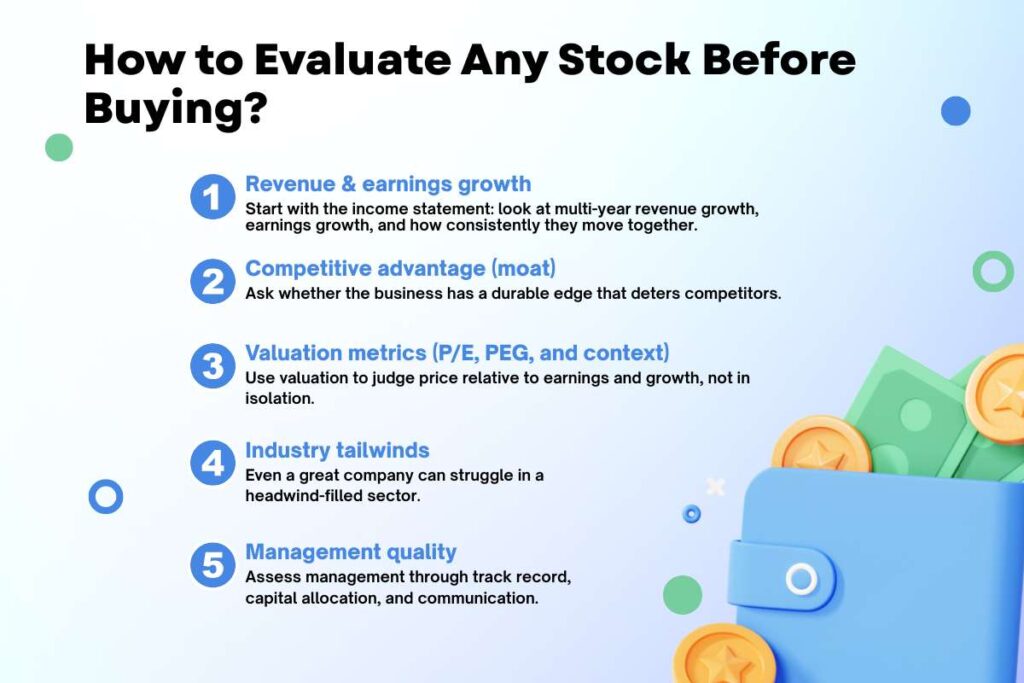
Picking good stocks to buy right now requires a repeatable framework. It is not just a hunch. A disciplined 5‑step checklist helps investors separate high‑conviction ideas from noise. It also helps build true expertise over time.
1. Revenue & earnings growth:
Start with the income statement: look at multi‑year revenue growth, earnings growth, and how consistently they move together.
➙ Example: A company growing sales 10–15% annually with EPS growth in the high‑teens likely has pricing power or margin expansion backing the top line, not just one‑time cost cuts.
➙ Red flags: shrinking sales, erratic earnings, or profit growth that consistently outpaces cash flow may signal accounting‑driven paper gains rather than real business strength.
2. Competitive advantage (moat):
Ask whether the business has a durable edge that deters competitors.
A “moat” can come from scale (lower unit costs), network effects (payments, social platforms), brand loyalty (luxury or staple brands), or high switching costs (enterprise software).
➙ Example: A software company with recurring subscription revenue and high customer retention usually has a narrower but more defensible moat than a commodity‑style hardware reseller.
3. Valuation metrics (P/E, PEG, and context):
Use valuation to judge price relative to earnings and growth, not in isolation.
P/E ratio compares price per share to earnings per share; a low P/E may signal value or a broken business, while a very high P/E demands strong growth justification.
PEG ratio (P/E divided by EPS growth rate) adjusts for growth; a PEG below 1 often suggests a growth stock may be reasonably priced, assuming the growth rate is realistic.
➙ Example: A tech firm with 30x P/E and 40% earnings growth has a PEG of 0.75; the same P/E with only 10% growth implies a PEG of 3, which is expensive unless idiosyncratic catalysts exist.
4. Industry tailwinds:
Even a great company can struggle in a headwind‑filled sector.
➙ Favor industries with secular tailwinds. Such as AI‑driven software, healthcare digitization, or digital payments. This is where structural demand supports pricing and margin stability.
➙ Example: A fintech facing rising regulation and saturated domestic markets may grow more slowly than a cloud‑infrastructure player riding a global data‑center build‑out.
5. Management quality:
Assess management through track record, capital allocation, and communication.
Look for consistent free‑cash‑flow generation, disciplined reinvestment (ROIC above the cost of capital), and shareholder‑friendly capital allocation (buybacks, dividends, or tuck‑in acquisitions that strengthen the moat).
➙ Example: A CEO who repeatedly spins narratives without delivering on margins or debt reduction signals execution risk, even if the idea sounds exciting.
One simple rule
“If you can’t explain the business simply, don’t invest.” This forces investors to strip away jargon and focus on who the customers are. This is how the company earns money, and why it can keep winning over time. For investors seeking good stocks to buy right now, you can apply this 5‑step framework across candidates. Whether in AI, consumer, or defensive sectors. This converts speculation into a repeatable, skill‑based process.
Here Is How You Can Build Your Portfolio Strategy:
Building a portfolio strategy means turning ideas into a clear, repeatable plan. Instead of chasing every “hot tip.” A good framework helps investors identify good stocks to buy right now. While staying aligned with risk tolerance and time horizon.
A simple model allocation:
A practical starting point for many investors is:
- 40% Growth (AI, tech, innovation)
- Focus on high‑conviction growth names in AI infrastructure, cloud, and digital platforms. But avoid overcrowding a single theme.
- 30% Stable (consumer, financials, services)
- Hold profitable, cash‑generating businesses with steady demand and moderate volatility, such as consumer‑focused brands and transaction‑driven financial services.
- 20% Defensive (healthcare, staples, utilities)
- Use lower‑beta, cash‑flow‑rich names to cushion drawdowns and provide income through dividends or steady earnings.
- 10% Speculative
- Reserve this slice for high‑risk, high‑reward ideas. The emerging AI vendors, small‑cap disruptors, or theme‑driven bets. With strict position‑sizing and exit rules.
Diversification across dimensions
- Geographies
- Spread exposure across developed markets (U.S., Europe) and fast‑growing regions (India, Brazil, Southeast Asia) to balance macro and currency risk.
- Sectors
- Avoid loading one sector even if it feels “hot.” Instead, let each theme be like AI, consumer, healthcare, and financials. They have a defined band in the portfolio.
- Time horizon
- For long‑term goals, emphasize compounding compounders and dividend‑paying stalwarts. For shorter-term objectives, lean more on liquidity and lower‑volatility names.
Common Mistakes To Avoid:
Avoiding common mistakes is as important as finding good stocks to buy right now. Because even the best names can underperform when psychology and discipline go out the window.
✧ Chasing hype (especially AI stocks)
When a theme like AI lights up the headlines. It is easy to buy because everyone is talking about it. Not because the business fundamentals support the price. Strong stories often lure investors into paying premium valuations for companies that may not yet prove their profitability or scalability.
✧ Ignoring valuation
Ignoring how much is being paid for growth can turn a great business into a bad investment. A stock that looks exciting can still deliver poor returns if bought at an extreme P/E or PEG. It is simply because the market has already priced in many years of growth.
✧ Lack of diversification
Putting too much money into one theme, sector, or stock turns a portfolio into a single bet rather than a plan. Even if AI or tech are the strongest areas today. It is spreading across geographies, sectors, and styles. This helps cushion the impact when one segment disappoints.
✧ Emotional investing
Reacting to daily swings, buying more in euphoria and selling in fear. This tends to move investors in the wrong direction. Strong stocks often dip sharply even when nothing structurally has changed. Punishing those who panic-sell and rewarding those who stick to a rational plan.
✧ Timing the market instead of time in the market
Trying to pick the perfect entry and exit date is usually less effective than staying invested consistently. Even strong stocks can stagnate or drift sideways in the short term. This tests patience but rarely invalidates their long-term potential if the underlying business remains sound.
Keeping these mistakes in mind helps investors focus on quality, valuation, and discipline. Turning the search for good stocks to buy right now into a repeatable process. It is not an emotional rollercoaster.
Conclusion:
Not because every headline name is a winner. But rather because markets are unpredictable and thematic. 2026 presents significant opportunities. Finding good stocks to buy right now is more about using a clear framework. That is strong fundamentals, fair valuations, and disciplined position-sizing. Instead of chasing the newest AI hype. Perfect timing is not as important as patience, diversification, and a long-term mindset. Because even the best-quality companies can stagnate or retreat in the short term. Investors can turn today’s noise into a straightforward, repeatable strategy that grows over time. It is not just in the next quarter. But by concentrating on industries with structural tailwinds. AI infrastructure, consumer tech, healthcare, and renewable energy, while balancing growth, stability, and defensive exposure.
FAQ:
1. What are considered good stocks to buy right now?
Good stocks to buy right now are companies with strong financials, consistent revenue growth, competitive advantages, and exposure to high-growth sectors. Like AI, cloud computing, and digital finance. However, the “best” stock depends on your risk tolerance, investment horizon, and market conditions, not just popularity.
2. Are AI and tech stocks still good investments in 2026?
AI and tech stocks remain promising. Due to massive global investment in automation and data infrastructure. However, many are highly valued. So investors should look for companies with sustainable growth and reasonable valuations. Rather than blindly chasing trending names.
3. How long should I hold stocks for maximum returns?
Historically, the best returns come from long-term investing (5–10 years or more). Short-term trading is unpredictable. While long-term investing allows you to benefit from compounding and business growth.