The Role of AI in BCI systems is employed to translate complex brain signals into accurate, real-time machine actions, leading to applications such as prosthetic control, speech restoration, and cursor movement. In this blog, you’ll discover why brain signals are difficult to interpret, how AI analyzes them in a step-by-step fashion, the models behind modern BCIs, and real-world breakthroughs. It also hints at how AI-driven shared autonomy is making brain-computer interfaces more practical, adaptive, and life-changing.
The human brain carries out on the order of 10^16 neural operations per second. However, conventional BCIs decode less than 5% of the intended commands correctly. How do we unlock the rest? The role of AI in BCI systems is to act as the vital translator of noisy, complex neural signals into precise, real-time actions. Deep learning models have now increased BCI accuracy by 30-40% over classical methods, allowing paralyzed people to control robotic limbs or type 39 characters per minute with just thought.
Here, we explain why brain signals are so hard to decode, take you through how AI interprets them, identify the AI models driving today’s BCIs, and the real-world applications that are revolutionizing medicine, mobility, and human-machine interactions today.
Role of AI in BCI Systems: Why AI Is the Core of Modern Brain Interfaces
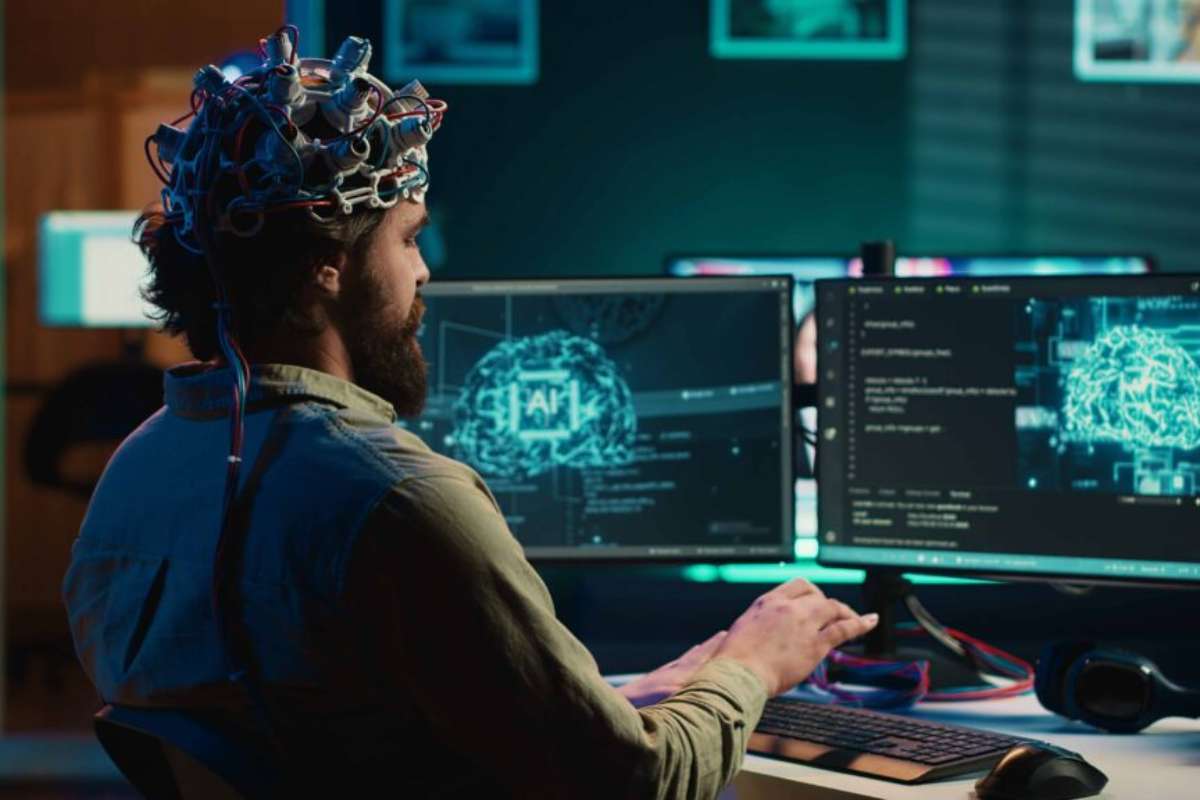
The Role of AI in BCI Systems is transformative, moving brain-computer interfaces from rigid laboratory tools to fluid, everyday applications. In short, AI acts like an interpreter between electrical brain activity and machines.
1. Bridging Brain and Machine
Traditional BCIs rely on manual, rule-based programming that requires pristine neural signals to execute basic actions. In contrast, AI-powered BCIs use machine learning to decode complex intention directly from raw neurological output.
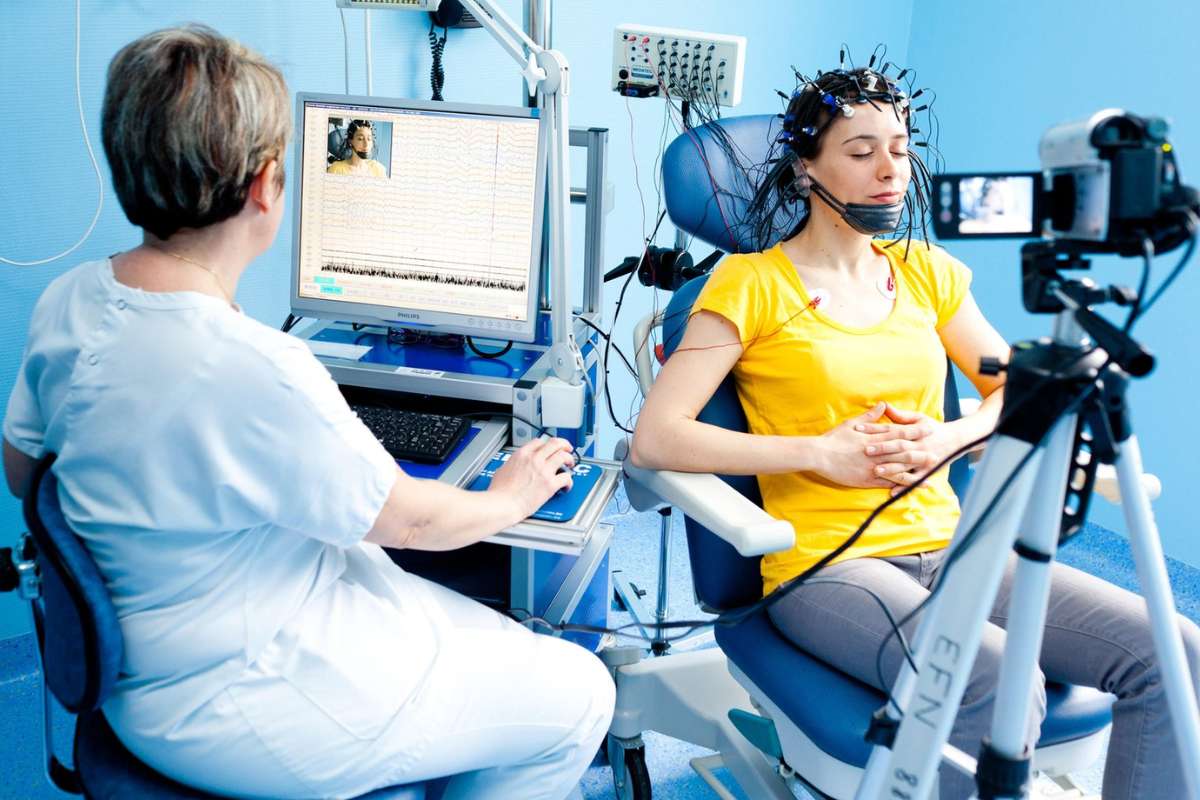
This processing power is critical when dealing with Electroencephalography (EEG) data. EEG signals are inherently noisy, chaotic, and inconsistent. They shift based on a user’s fatigue, focus, and minor physical movements, such as eye blinks.
2. The Core Mechanisms
Modern neural interfaces rely on AI to solve these real-world data challenges through two core capabilities:
Pattern Recognition & Prediction: Instead of looking for exact electrical values, AI treats brain waves as fluctuating datasets. It acts as a predictive engine, identifying the core patterns of user intent despite surrounding signal noise.
Real-Time Adaptation: Brain chemistry and signal baselines change continuously. AI models continuously learn and personalize their parameters in real time, adapting to the user’s current mental state without requiring constant, tedious manual recalibrations.
3. Shared Autonomy and Copilots
The latest evolution in the Role of AI in BCI Systems introduces shared autonomy. Instead of forcing the user to micro-manage every specific movement, the system embeds AI copilots. For example, if a user intends to move a robotic arm toward a cup, the BCI detects the high-level goal, while the AI copilot smoothly handles the fine-grained mechanics of grasping it. This collaboration significantly lowers the cognitive workload, making human-machine interactions seamless and highly efficient.
Why Brain Signals Are So Difficult to Decode?
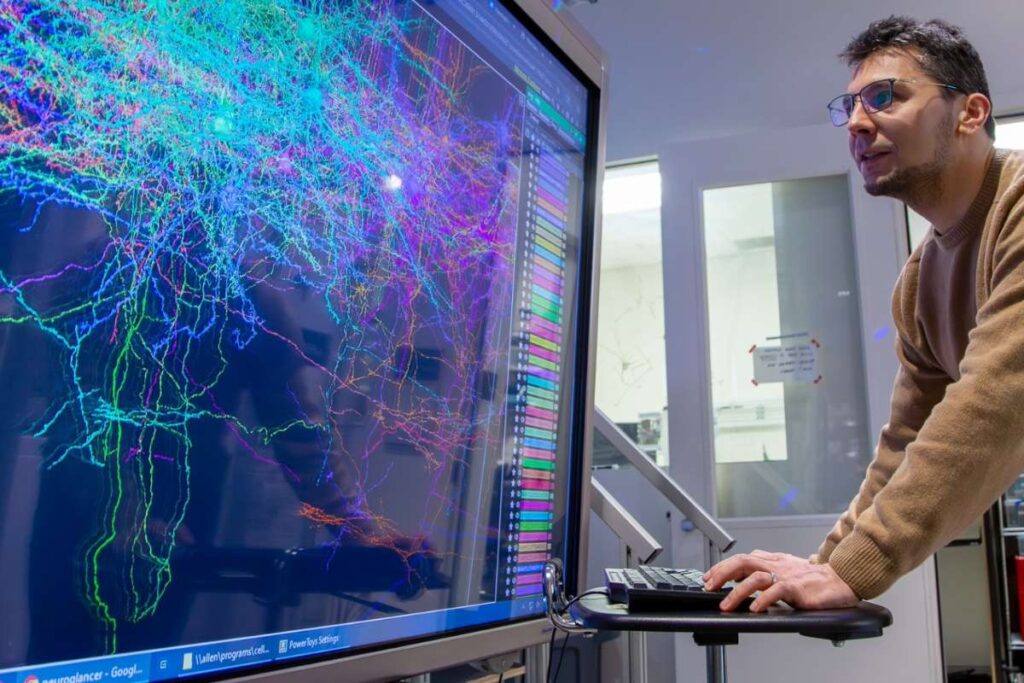
Decoding neurological data presents challenges that far exceed traditional digital pattern recognition. In fields like speech or image recognition, AI models analyze standardized inputs. This is a specific pixel array or a defined acoustic frequency. Brain-computer interfaces, however, must grapple with the fact that thoughts do not generate clean digital commands.
Decoding brain signals is exceptionally complex due to the inherent limitations of current sensor technology and biological variability:
Pervasive Noise & Artifacts: Non-invasive Electroencephalography (EEG) signals suffer from extremely low spatial resolution because electrical currents must pass through the skull. The resulting data is deeply obscured by motion artifacts, subtle eye-blinking, and shifts in emotional variability.
The Individuality Barrier: Unlike a universal spoken language, every brain produces slightly different neural signatures. A pattern representing a specific intent in one user will look entirely different in another.
The role of AI in BCI systems is critical since neural data is inherently chaotic and dynamic. AI doesn’t just filter out physical noise. It is an adaptive translation engine that learns an individual’s unique baseline in real time, enabling reliable thought-to-machine communication.
How AI Processes Neutral Signals Step by Step?
AI processes neural signals through a six-step pipeline that forms the core of the role of AI in BCI Systems:
Step 1: Signal Acquisition
Neural data is captured via EEG sensors (non-invasive) or invasive implants such as Utah arrays, which record neuronal electrical activity.
Step 2: Noise Reduction
AI filters out artifacts from eye blinks, motion, and muscle activity using deep learning-based denoising, ensuring clean data for analysis.
Step 3: Feature Extraction
AI identifies meaningful neural patterns using techniques like Fourier transforms, wavelet analysis, and PCA to isolate informative signals in time, frequency, or spatial domains.
Step 4: Intent Classification
Machine learning models (CNNs, LSTMs) predict user intent, whether movement, speech, or commands, by classifying extracted patterns.
Step 5: Adaptive Learning
The system continuously learns from new data, personalizing to the user’s evolving neural signatures and improving accuracy over time.
Step 6: Real-Time Feedback
Decoded intent drives immediate actions: cursor movement, robotic arm control, or prosthetic limb operation, all within milliseconds.
This end-to-end workflow transforms raw brain activity into precise, real-time machine control.
Types of AI Models Used in Modern BCIs:
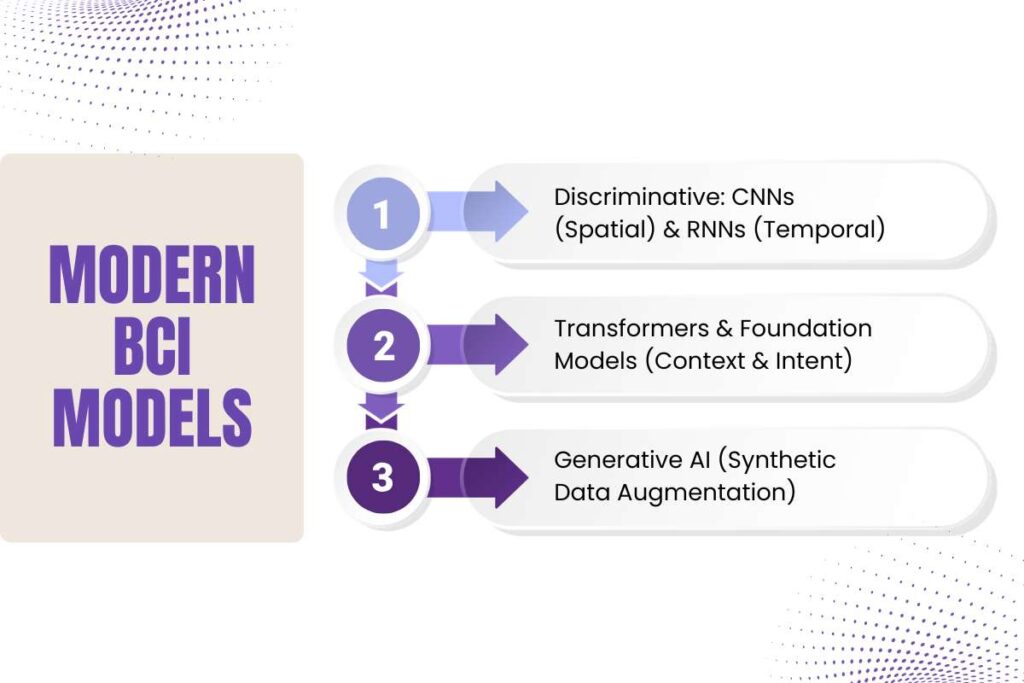
Modern BCIs use several AI model types, each playing a critical role in the role of AI in BCI Systems:
┌── Discriminative: CNNs (Spatial) & RNNs (Temporal)
Modern BCI Models ┼── Transformers & Foundation Models (Context & Intent)
└── Generative AI (Synthetic Data Augmentation)
Machine Learning (ML)
Traditional algorithms like SVM and decision trees provide baseline classification of neural patterns for simple tasks.
Deep Learning
Neural networks automatically learn complex features from raw EEG data, eliminating manual feature engineering.
CNNs (Convolutional Neural Networks)
CNNs excel at extracting spatial patterns from EEG electrode arrays, ideal for motor imagery classification.
RNNs (Recurrent Neural Networks)
RNNs process sequential neural data over time, capturing temporal dependencies in brain signals.
Transformers
Transformers matter because they use self-attention to understand temporal sequences and context, predicting user intent more accurately by modeling long-range dependencies in EEG data. They outperform RNNs in decoding intricate brain patterns and improving robustness to noise.
Generative AI
Generative models like GANs create synthetic EEG data to overcome data scarcity, improving model training and enabling augmentation for rare conditions.
Foundation Models
Large pre-trained models enable adaptive decoders that personalize across users and support multimodal learning (combining EEG with eye-tracking, motion sensors).
These models work together to build adaptive, high-accuracy BCIs that learn continuously and generalize across users.
Real-World Application of AI-Powered BCI Systems:
1. Tristin Froma – Cerebral Palsy Patient Controlling Wheelchair with BCI
Tristin, 19, has cerebral palsy and limited mobility. He now uses a non-invasive BCI to drive his electric wheelchair using only his brain activity.
“I love using BCI to move my wheelchair. It makes me feel free.”
2. Paralyzed Participant – UCLA AI-Co-Pilot BCI Study
A paralyzed participant (paralyzed from the waist down) used UCLA’s wearable non-invasive AI-BCI system with an AI co-pilot. With AI assistance, he completed a robotic arm pick-and-place task in 6.5 minutes. Without AI, he couldn’t complete it at all.
3. Sheila Irvine – Dry AMD Patient Regaining Vision with BCI Implant
Sheila, enrolled in the PRIMAvera clinical trial at Moorfields Eye Hospital in London, had dry age-related macular degeneration and lost her ability to read. After receiving a BCI eye implant, she regained reading ability.
“I was an avid bookworm, and I wanted that back… It was dead exciting when I began seeing a letter.”
4. Ian Burkhart – First Person to Restore Movement to a Paralyzed Limb Using BCI
Ian, a C5 complete tetraplegic from a 2010 diving accident, became the first person in the world to restore movement to a paralyzed limb using a BCI neuroprosthetic. He shares his story at Georgia Tech’s “Wired Lives” storytelling event.
Conclusion:
AI has transformed BCIs from delicate experiments in the laboratory to life-altering devices that can restore movement, speech, and independence. The role of AI in BCI systems enables paralyzed people to control robotic limbs, type with their thoughts, and interact with smart environments through shared autonomy and adaptive learning. To understand how the heart works is to understand the engine of life. To understand how AI decodes neural signals is to understand the future of human-machine collaboration.
Want to know more about brain technology and how it’s changing the world? Explore guides to neural interfaces, AI health tech, and the science behind the latest medical innovations.
FAQ:
What exactly does AI do in BCI systems?
AI acts as the interpreter between brain signals and machines. It filters noisy neural data, identifies patterns, and converts them into meaningful commands like moving a cursor, controlling a prosthetic, or typing text.
Can AI really read human thoughts in BCI systems?
Not exactly. AI does not “read thoughts” in a literal sense. Instead, it detects patterns in brain activity that are associated with specific intentions, like movement or speech.
How does AI improve over time in BCI systems?
Most modern AI-powered BCIs use machine learning models that adapt based on user feedback. Over time, the system becomes more accurate at predicting intended actions with fewer errors.
Where is AI-powered BCI technology used in real life today?
It is used in medical prosthetics, paralysis rehabilitation, and communication tools for speech-impaired patients, and experimental neural control of computers and robotic devices.
What are the biggest challenges AI still faces in BCI systems?
Challenges include noisy brain data, individual differences in brain signals, limited datasets, calibration time, and ethical concerns around privacy and neural data security.
Link and Sources:
- https://ieeexplore.ieee.org/document/11387439
- https://pubmed.ncbi.nlm.nih.gov/40040096
- https://papers.ssrn.com/sol3/papers.cfm?abstract_id=4447601
- https://oiccpress.com/mjee/article/view/5051
- https://www.meegle.com/en_us/topics/neuromorphic-engineering/neural-signal-processing
- https://www.cerebralink.com/post/eeg-signal-processing-pipeline-for-enhanced-model-performance