AI may already be part of your business. The question is whether it is delivering results.
Stanford found that 88% of surveyed organizations used AI in 2025, while 70% used generative AI in at least one business function. But many are still struggling to turn these tools into business value.
The problem is knowing where to use it, how to scale it, and how to prove it is creating value.
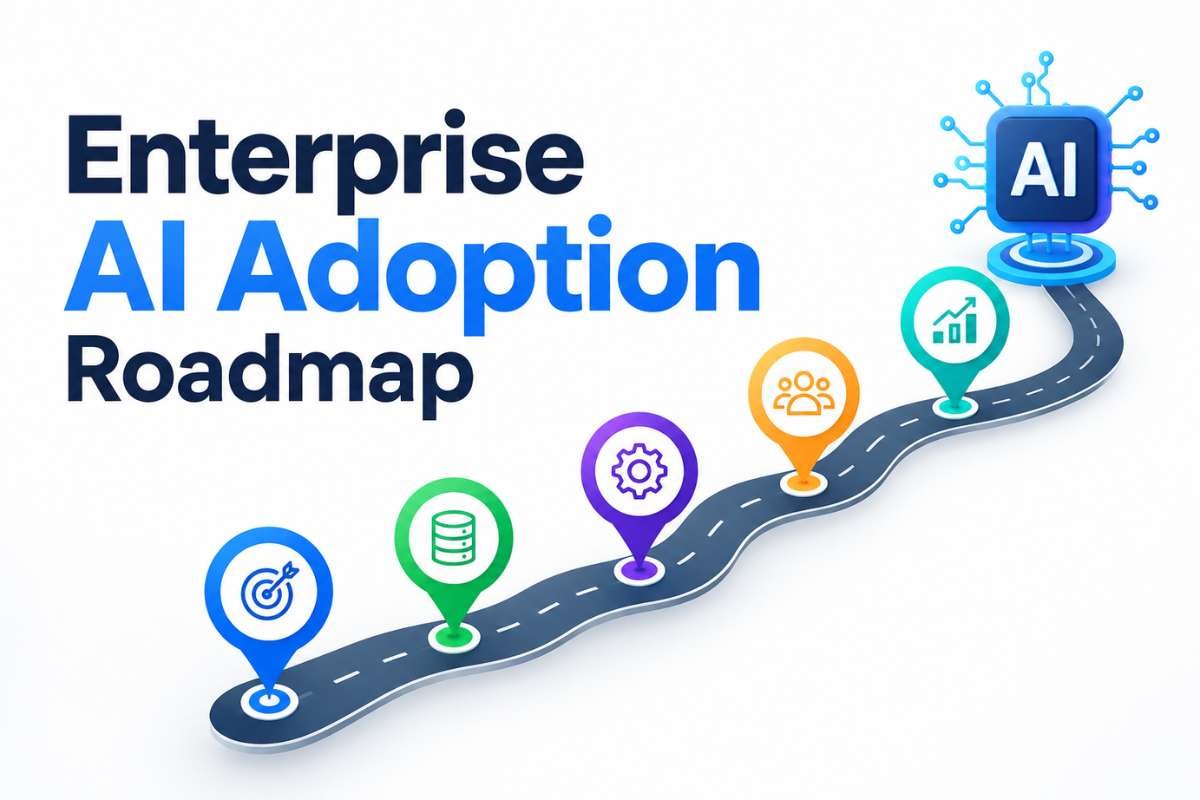
An enterprise AI adoption roadmap gives a clear way to solve this. It starts by checking business and technical readiness, then helps teams choose the right use cases, test them, manage risks, scale what works, and measure the results.
The next step is understanding what each stage means and what you should decide before moving forward.
What does an enterprise AI adoption roadmap look like?
It is a structured plan for taking AI from small tests to regular business use. It helps you to know what to do, what to measure, and when to move to the next step.
The seven stages provide a practical sequence:
| Stage | Main goal | Key action | Decision |
| Assess | Understand readiness | Review data, technology, people, and governance | Are we ready? |
| Prioritize | Select valuable use cases | Compare impact, feasibility, cost, and risk | What should we do first? |
| Prepare | Build foundations | Strengthen data, infrastructure, integration, and security | Can we support it? |
| Pilot | Prove value | Test a defined workflow against measurable KPIs | Does it work? |
| Govern | Control risk | Create oversight, accountability, and controls | Can we operate it safely? |
| Scale | Expand proven AI | Reuse platforms, processes, and capabilities | Can it scale? |
| Measure | Track sustained value | Monitor adoption, outcomes, cost, and risk | Is it creating value? |
This is where many get stuck. Gartner found that only 41% of generative AI prototypes and 42% of non-generative AI prototypes made it into production.
It means the goal is not to maximize the number of pilots. It is to create a repeatable system for selecting, proving, governing, and scaling the right AI initiatives.
Which stage should your enterprise start with?
Start with readiness and not technology.
Before choosing another AI model, agent platform, or application, check if your company is ready to support it. Look at the business problem, data, systems, workforce, security, and ownership.
A simple readiness check should cover five areas:
- Business: Is there a clear problem to solve? If not, AI may be adopted without a clear business outcome.
- Data: Is the right data available, reliable, and easy to access? If teams spend more time preparing data than using it, the foundation needs work.
- Technology: Can the AI solution connect with existing systems? Legacy systems may make integration harder.
- People: Do employees have the skills and support to use AI? If they see it as extra work, adoption may remain low.
- Governance: Are privacy, security, risk, and accountability clear? Adding controls only after deployment can slow the rollout.
This check does not mean every AI project has to wait. It helps you see which initiatives can move ahead and which need more preparation.
IBM surveyed 2,000 CEOs across 33 countries and 24 industries. Half said fast AI investment had led to disconnected technology, while 68% said integrated data systems were key to better collaboration across teams.
It means that, without the right foundation, AI can add more technology silos instead of reducing them.
How do you choose the right AI use cases?

Once you are ready, the next question is where to invest.
Start with a business problem. Then assess each use case based on five things: business value, feasibility, risk, adoption, and scalability.
- Business value: Can it increase revenue, reduce costs, improve productivity, or improve customer outcomes?
- Feasibility: Do you have the data, systems, and skills needed to deploy it?
- Risk: Can you manage its security, privacy, compliance, and operational risks?
- Adoption: Will employees or customers actually use it within their existing workflows?
- Scalability: Can the solution be extended to other teams, processes, or business units?
For example, a use case that cuts processing time by 30% and uses existing data may be easier to scale than a high-risk project that needs new systems and large amounts of data.
What does it take to prepare an enterprise for AI?
After choosing the use case, you need to prepare the environment around it.
The model may work in a controlled test, but the surrounding systems may not provide the data access, identity controls, APIs, security, or monitoring required for production.
The preparation stage should address:
- Data quality and access
- Cloud and computing infrastructure
- APIs and system integration
- Identity and access management
- Cybersecurity controls
- Model selection and evaluation
- Monitoring and observability
- Data classification and privacy
Data deserves particular attention. IBM found that 72% of CEOs said their own company data is important for getting value from generative AI. That makes data preparation a business issue, not simply an IT task.
How should you run an AI pilot before scaling it?

An AI pilot should show whether a use case delivers measurable business value. Start by setting a clear baseline and target.
A strong pilot should define:
- Business problem
- Current baseline
- Target KPI
- User group
- Required data
- Human review
- Pilot timeline
- Scale criteria
The pilot also needs a clear owner. The technology team can build the solution, but the business team should own the outcome.
Deloitte’s research found that more than two-thirds of respondents expected 30% or fewer of their GenAI experiments to reach full scale within three to six months. Yet nearly three-quarters said their most advanced GenAI initiative was meeting or exceeding ROI expectations.
This shows that a successful pilot is not always ready to scale. Before scaling, you should check user adoption, output quality, costs, risks, and how well the solution fits existing workflows.
When is an AI pilot ready to scale?
A pilot is ready for scale when it has produced enough evidence across value, quality, adoption, cost, integration, and risk. Model performance alone is not enough.
For example, an AI assistant may produce accurate responses but still fail as an enterprise solution if employees do not use it, the integration creates excessive operating costs, or the workflow requires too much manual correction.
Use decision gates such as these:
| Signal | Question to answer |
| Value | Did the pilot improve the target business outcome? |
| Adoption | Are intended users actually using it? |
| Quality | Does the output meet the required standard? |
| Cost | Does economics remain viable at larger volumes? |
| Risk | Are identified risks controlled? |
| Integration | Does the solution work within existing workflows? |
| Ownership | Is someone accountable for the system after launch? |
AI initiatives are more likely to deliver value when companies have strong AI maturity and the right systems in place. Scaling AI is not only about deployment. It also requires good governance, strong engineering, clear measurement, and business ownership.
How should you govern an enterprise AI adoption roadmap?

Set AI governance before deployment, with controls based on the risk of each use case. The framework should cover privacy, security, access, human oversight, model risk, accountability, and ongoing monitoring.
The NIST AI Risk Management Framework gives you a structure for managing these risks across the AI lifecycle.
The level of oversight should match the use case. A low-risk productivity tool may need basic controls, while AI used in financial decisions or other sensitive processes may require stronger validation, human review, documentation, and monitoring.
Good governance should make responsible AI adoption easier to scale, not create a separate process after deployment.
How to scale AI without creating fragmented systems?
You can scale AI without fragmentation by building shared systems and standards instead of letting each department build its own AI setup.
This means reusing common data access, security controls, governance, monitoring, and integration across use cases.
It’s important to scale what has already been proven. A successful customer-service AI workflow, for example, can provide the data, security, evaluation, and training standards for similar deployments across the business.
How should you measure an enterprise AI adoption roadmap?
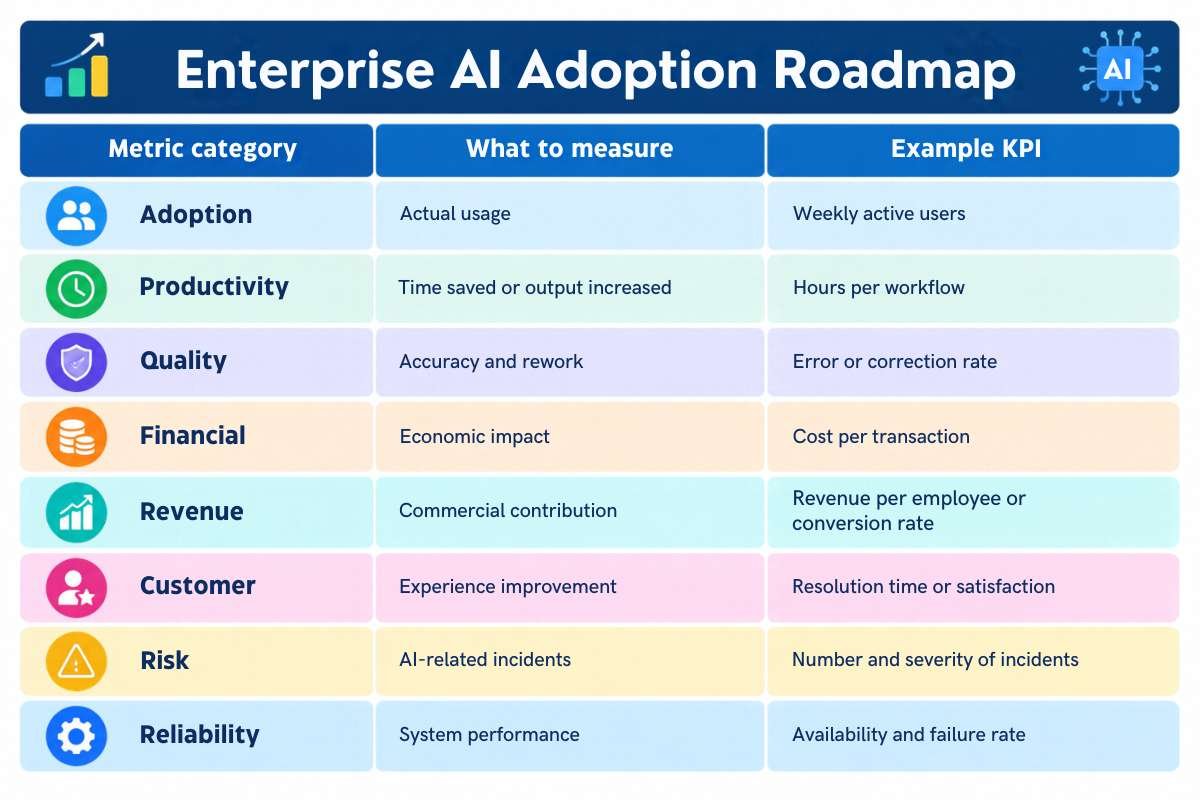
The final stage of the roadmap is measurement, but measurement should continue throughout the entire process.
A dashboard that only tracks the number of AI users or deployed models can create a misleading picture of progress. CIOs need metrics that connect technology activity to business performance.
| Metric category | What to measure | Example KPI |
| Adoption | Actual usage | Weekly active users |
| Productivity | Time saved or output increased | Hours per workflow |
| Quality | Accuracy and rework | Error or correction rate |
| Financial | Economic impact | Cost per transaction |
| Revenue | Commercial contribution | Revenue per employee or conversion rate |
| Customer | Experience improvement | Resolution time or satisfaction |
| Risk | AI-related incidents | Number and severity of incidents |
| Reliability | System performance | Availability and failure rate |
Workforce skills also need to keep pace with AI adoption.
PwC found that companies most exposed to AI had 40% higher productivity growth than the least-exposed companies. Its analysis of more than one billion job postings across six continents also found that skills in AI-exposed jobs were changing more than twice as fast.
This means AI adoption also requires employee training, new skills, and changes to how work is done.
What mistakes can affect an enterprise AI adoption roadmap?
Even well-funded AI programs can lose momentum when they focus on using more AI instead of creating more value. Here are some mistakes to avoid:
- Buying an AI platform does not create a business case. Start with the problem, then choose the technology.
- Too many pilots can drain time, data, and engineering resources. Focus on use cases that can grow.
- A successful demo does not mean the system is ready for production. Scale only after proving its value.
- Poor data can lead to poor AI results. Check data quality before deployment.
- Late controls can raise costs and slow adoption. Build governance into the use case from the start.
- High usage does not always mean high value. Track results such as cost, productivity, revenue, quality, and risk.
- AI adoption depends on people using the new tools and workflows. Give employees clear roles, training, and support.
How to make the enterprise AI adoption roadmap ongoing?
You can turn the roadmap into an ongoing AI operating model by making AI adoption a continuous process, not a series of separate projects.
After each AI deployment, teams should review the results, capture lessons, fix gaps, and use them to guide the next initiative. This helps to improve data, technology, governance, skills, and processes over time.
Identify valuable use cases, deploy them responsibly, measure results, and scale what delivers value.
Conclusion:
AI adoption works best when it follows a clear plan. An enterprise AI adoption roadmap helps leaders move from small pilots to scalable solutions while keeping business value, governance, people, and risk in focus.
The goal is to scale what works, measure the results, and build a stronger foundation for what comes next.
FAQs
How long does an Enterprise AI adoption roadmap take to implement?
It depends on the number of use cases, data readiness, infrastructure, governance needs, and scale of deployment.
What is the role of the CIO in an Enterprise AI adoption roadmap?
The CIO typically aligns AI investments with business priorities, coordinates technology and governance, and ensures AI capabilities can scale across the organization.
How much does enterprise AI adoption cost?
Costs vary by use case and scale. Key expenses can include AI platforms, cloud infrastructure, data preparation, integration, security, training, and ongoing operations.
How do you get employees ready for AI adoption?
Start with role-specific training, clear usage guidelines, hands-on practice, and communication about how AI will change existing workflows.
What tools are needed to support enterprise AI adoption?
Common requirements include data platforms, cloud infrastructure, AI or model platforms, APIs, security controls, monitoring tools, and workflow integrations.