Artificial intelligence can help a business make faster decisions, serve customers better, and reduce routine work. But what happens when an AI tool rejects a qualified job applicant, shares private data, or gives a customer the wrong advice?
These are not just technical problems, but they are important leadership decisions.
AI leadership ethics is the practice of guiding AI use through clear values, rules, and human accountability. It helps business leaders decide where AI belongs, which risks are acceptable, and when a human must step in.
Using AI is one thing. Making it safe, useful, and reliable across a business is another. Here’s how leaders can do that.
Why is AI leadership ethics a business priority?
AI ethics may sound like a matter for legal teams or technical experts. In practice, it affects customer trust, staff decisions, company data, and the quality of business choices.
Consider a company that uses AI to screen job applicants. If the system unfairly ranks candidates based on patterns in past hiring data, the company could lose good talent and face legal or reputational harm. The model may work as designed, but the outcome can still be unfair.
That is why AI leadership ethics must be part of business strategy from the start. Leaders need to look beyond what a tool can do and ask whether it should be used for a particular task.
Three business needs make this especially important:
- Protecting trust: Customers and employees need to know how AI affects them and how they can challenge harmful decisions.
- Reducing risk: Weak controls can expose a business to data leaks, biased outcomes, false information, and legal disputes.
- Building lasting value: AI should solve real problems, not create new ones that cost more to fix later.
Leaders must connect AI projects to clear business goals, set measures of success, and review their effects over time. Good governance helps make that work more disciplined.
What are the four pillars of AI leadership ethics?

A strong ethics policy needs more than broad promises about fairness and safety. It needs rules that employees can follow and leaders can measure.
The four pillars below offer a practical starting point for executive teams. They draw on the principles of transparency, accountability, safety, and human oversight set out by the National Institute of Standards and Technology (NIST), the OECD, and UNESCO.
1. Transparency and explainability
Leaders should make sure people understand how AI affects important decisions. For example, a lender using AI to assess loan applications should explain the key factors behind its decisions and allow customers to request a review.
What leaders should do:
- Explain what each AI tool does and where it falls short.
- Tell people when AI affects important decisions.
- Keep records of decisions so teams can review them when needed.
2. Data quality, privacy, and intellectual property
AI tools can expose customer data, company secrets, or copyrighted material if employees use them without clear rules. Poor or biased data can also lead to unfair results.
Leaders should decide which tools employees can use and what data they can share. They also need to check how AI vendors store data, use it for training, and handle confidential information.
What leaders should do:
- Approve AI tools for handling sensitive data.
- Check data quality and access permissions.
- Review vendor policies on data storage and model training.
- Set clear rules for copyright and ownership of AI-generated work.
3. Human oversight and accountability
Every high-risk AI system needs a person who is responsible for its decisions and outcomes. Leaders must decide who checks the system, who handles errors, and who can stop it when something goes wrong.
For decisions about hiring, finance, health, or safety, give reviewers the authority to question AI recommendations. They should be able to reject a result and explain why.
What leaders should do:
- Assign an owner to each high-risk AI system.
- Set clear rules for when human review is required.
- Let employees report errors and pause unsafe systems.
- Record key decisions, errors, and fixes.
4. Workforce transformation and psychological safety
AI can change people’s roles, daily tasks, and career paths. Leaders need to explain these changes early and give employees time to learn new skills.
What leaders should do:
- Explain how AI will affect roles and daily tasks.
- Train employees before rolling out new tools.
- Give staff a safe way to report problems.
- Track changes in workload, job quality, and training needs.
Employees need to know how AI will affect their work and where they can get help. Clear communication and practical training can help teams adapt with less confusion.
How can leaders measure AI governance maturity?
Every company uses AI in different ways. A small team testing a writing tool has different needs from a bank that uses AI to review loan applications.
AI leadership ethics helps you assess how well your company manages AI risks. Start by checking three things: clear ownership, regular risk reviews, and ongoing monitoring. These show whether your company has clear rules for AI use or only reacts when problems arise.
What does good AI governance look like?
Look for these signs as your company improves its AI practices:
- Clear rules: Employees know which AI tools they can use and what data they can share.
- Defined roles: Leaders, IT teams, and legal teams know their responsibilities.
- Regular checks: Teams test AI systems for errors, bias, and privacy risks.
- Ongoing monitoring: Teams track results and act when problems appear.
The goal is to make AI risk checks part of daily work, not a one-time task.
What should you track to keep AI use ethical?
To make sure your AI leadership ethics efforts are working, we need to track clear metrics that reflect each AI system’s risks and goals, rather than rely on a single company-wide score.
| Metric | What it tells leaders | Example of what to track |
| Data privacy | Whether sensitive information is protected | Confirmed data incidents and response time |
| Fairness | Whether outcomes differ unfairly across groups | Differences in error or selection rates |
| Human oversight | Whether people review decisions when needed | Share of required reviews completed |
| Reliability | Whether the system works as expected | Error rates and performance changes |
| Accountability | Whether teams can act when problems arise | Time to assign and resolve incidents |
| Business value | Whether the tool meets its purpose | Time saved, service quality, or cost per task |
These measures should have named owners, clear targets, and regular reporting dates. Where possible, record the baseline before deployment so the team can compare results fairly.
A dashboard is useful only if someone acts on what it shows. If errors rise or a system starts producing harmful results, leaders need a clear path to investigate, correct, or stop it.
How do global AI regulations affect business leaders?
Global AI rules affect what you can build, buy, and use in your business.
AI leadership ethics means knowing which rules apply, assigning responsibility, and making sure teams follow them. Three key frameworks can help you understand what to do.
1. EU AI Act: check your legal duties
The EU AI Act sets legal requirements based on the risks an AI system poses. Some uses are banned, while certain high-risk systems face stricter rules.
If your business develops or uses AI in the EU, start by checking:
- Your role: Are you providing an AI system or using one in your business?
- The risk level: Does the system fall under a banned, high-risk, or other category?
- Your duties: Do you need risk checks, records, human oversight, or clear information for users?
- The deadlines: When do the rules for your system and role take effect?
The European Commission confirms that the Act applies from 2 August 2026, with exceptions and later dates for some requirements.
2. NIST AI risk management framework: build a risk review process
The US National Institute of Standards and Technology (NIST) provides a voluntary framework to help businesses manage AI risks. It does not create legal duties by itself.
Its four functions give your team a clear way to review AI systems:
- Govern: Set rules, roles, and accountability.
- Map: Understand how the system will be used and who it may affect.
- Measure: Test for risks such as errors, bias, and security gaps.
- Manage: Decide how to reduce risks, monitor results, or stop unsafe use.
You can use this process before buying or launching an AI tool and continue to review it while it is in use.
3. OECD AI principles: set standards for responsible AI
The OECD AI Principles are international guidance, not a law that directly sets company penalties. They promote AI that respects human rights, supports fairness, is transparent, and remains safe and accountable.
Use these principles to shape your internal AI policy. For example, set rules for explaining important AI decisions, protecting people from unfair outcomes, and assigning responsibility when a system causes harm.
What should you do first?
Start with a list of the AI tools your business uses or plans to adopt. For each tool, record its purpose, the data it uses, the people it affects, and the person responsible for it.
Then ask your legal, IT, security, and business teams to check the rules that apply. Set up regular risk reviews and keep records of key decisions.
Legal compliance is the starting point, not the whole of AI leadership ethics. Your business also needs to consider fairness, trust, and the harm an AI system could cause, even when no specific law requires an extra safeguard.
Why must CIOs be part of an AI ethics committee?
CIOs play a key role in AI leadership ethics because they know how AI systems, data, and security work in practice. Legal teams can explain the rules, but CIOs help turn those rules into controls that teams can use.
Without CIO involvement, your business may miss risks such as poor data access controls, unsafe third-party tools, or AI systems that change over time. The CIO also helps teams monitor these risks after launch.
5 steps to apply AI leadership ethics in your business
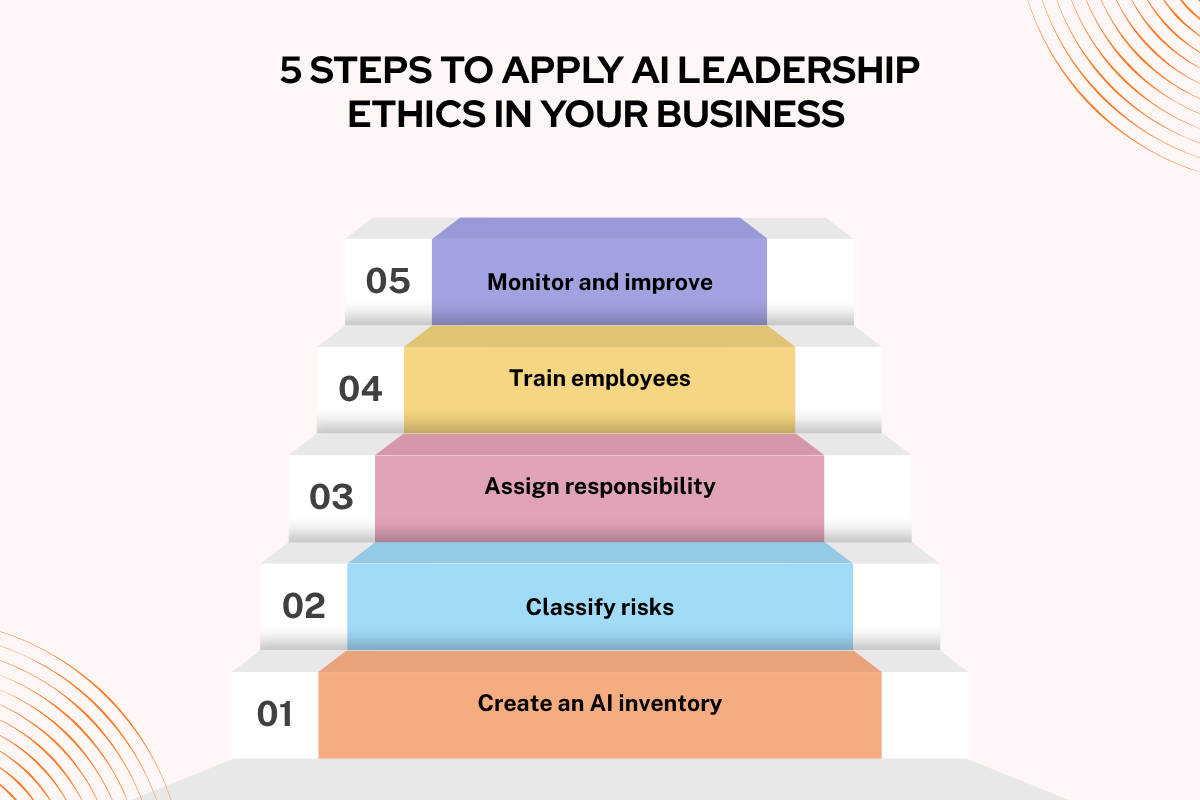
You can put AI leadership ethics into practice with five clear steps.
- Create an AI inventory: List the AI tools your teams use, what they do, what data they access, and who owns them.
- Classify risks: Identify high-risk uses, such as hiring, finance, and personal data, and apply stronger checks where harm is more likely.
- Assign responsibility: Name who approves AI use, reviews risks, and handles problems.
- Train employees: Teach staff to protect data, check AI results, and report mistakes.
- Monitor and improve: Track errors, complaints, and risks, then update controls when things change.
Review key risks and actions with senior leaders and the board at set times. This keeps AI ethics part of daily work, not just a written policy.
Conclusion:
AI can help your business grow, but success depends on how you use it. AI leadership ethics helps you manage risks, protect trust, and make better decisions as your use of AI grows.
Start with clear rules, assign responsibility, train your teams, and review AI systems on a regular basis. When leaders take these steps, they can support innovation while keeping people, data, and business goals in mind.
Frequently asked questions
1. How should a company audit an AI tool bought from an outside vendor?
Check the vendor’s data use, security, testing, known limits, and incident reporting. Review risks before purchase and set clear contract terms.
2. Who should approve the use of AI in a small business?
The owner or a senior manager can approve low-risk tools. Sensitive uses may need technical, legal, or privacy review.
3. How can a company respond when an employee reports an AI ethics concern?
Provide a confidential reporting channel and protect employees from retaliation. Investigate the concern, document findings, and take appropriate action.
4. How often should an AI leadership ethics policy be reviewed?
Review it at least once a year and after major changes, incidents, or new legal requirements. High-risk AI may need more frequent reviews.