
When leaders try to handle every report, decision, and project themselves, work can slow down, priorities get missed, and employees lose opportunities to develop new skills.
Strong delegation skills help solve this challenge by distributing ownership, not simply transferring workload. Whether you lead a startup, manage a department, or coordinate a small team, effective delegation helps people work independently while keeping business goals on track. The key is knowing what to delegate, who should own it, and how much authority and support to provide.
Table of contents
- What Are Delegation Skills and Why Are They Important?
- What Are the Essential Skills for Effective Delegation?
- How to Improve Delegation Skills in 6 Practical Steps; Overcome Common Challenges
- How Is AI Changing Delegation Skills in 2026?
- How Can You Measure the Success of Delegation?
- FAQs
What are delegation skills and why are they important?

Delegation skills are the abilities needed to assign responsibility, provide appropriate authority and resources, and support someone in completing a task while retaining overall accountability where applicable.
Delegation goes beyond giving instructions. Assigning a task means asking someone to complete specific work. Delegating ownership also gives them defined responsibility and room to make decisions within agreed boundaries.
Leadership speaker and New York Times bestselling author Craig Groeschel emphasizes the value of delegation, saying,
“When you delegate tasks, you create followers, but when you delegate authority, you create leaders.”
Effective delegation helps businesses:
- Improve productivity
- Develop employees
- Strengthen decision-making
- Support business growth
What are the essential skills for effective delegation?
- Clear communication: Explain deliverables, deadlines, quality standards, reporting requirements, and success criteria.
- Task and skill alignment: Match responsibilities with an employee’s capability, interests, development goals, and workload.
- Context and decision-making authority: Explain the purpose, decision limits, approval requirements, and escalation conditions.
- Coaching and feedback: Provide relevant training, resources, constructive feedback, and recognition while allowing reasonable independence.
- Active listening: Ask what the employee needs before assigning work, and confirm they understood the handover.
- Accountability: Agree on how results will be reviewed, and own the outcome when you remain accountable.
How to improve delegation skills in 6 practical steps
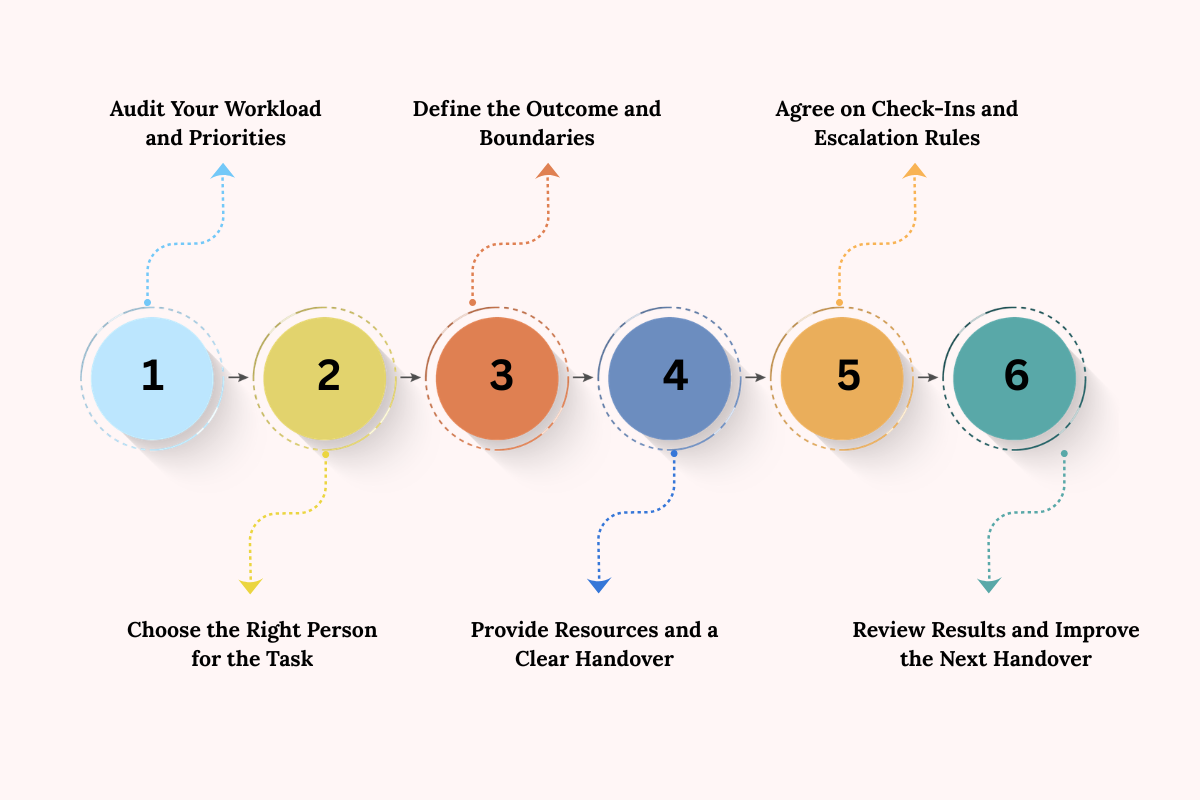
Effective delegation is easier with a repeatable process.
1. Audit your workload and priorities
Review your weekly responsibilities and categorize each task as delegate, retain, automate, or eliminate. Identify recurring work that consumes time but does not require your direct involvement. A short time log can reveal where your attention is going.
Not every task should be handed off. The table below shows which responsibilities typically work well to delegate and which are better kept.
| Delegate | Keep |
| Recurring reports and data prep | Performance reviews and disciplinary decisions |
| First drafts and documentation | Confidential HR or legal matters |
| Scheduling and coordination | Vision and strategic direction |
| Tasks that build someone’s skills | Crisis decisions that need your authority |
2. Choose the right person for the task
Consider capability, experience, interest, availability, and learning potential. Discuss existing commitments before assigning additional responsibilities.
Delegation should distribute opportunities fairly, rather than repeatedly overloading reliable employees.
3. Define the outcome and boundaries
Explain what success looks like without prescribing every action. Specify the deliverable, deadline, quality standards, budget, decision rights, and approval requirements. Clarify which decisions the employee can make independently.
A useful approach is to define three levels of decision authority:
- Recommend: Research options and propose a decision.
- Decide within limits: Make decisions within approved boundaries.
- Own and execute: Manage delivery and routine decisions, escalating exceptions.
4. Provide resources and a clear handover
Share relevant documents, tools, contacts, templates, and background information. Arrange training when the assignment involves unfamiliar processes.
A documented handover reduces repeated explanations and makes future delegation easier.
5. Agree on check-ins and escalation rules
Choose updates based on complexity and risk. A recurring administrative task may need one progress update, while a time-sensitive project may require milestone reviews.
Agree on escalation triggers, including missed milestones, unexpected costs, scope changes, or security concerns. Check progress without controlling every action.
6. Review results and improve the next handover
Compare the outcome against the agreed standards. Discuss what worked, where support was missing, and what could improve. Recognize good performance and expand responsibility gradually as capability grows.
Practical example: Imagine a team leader delegating a monthly performance report.
A weak handover is: “Prepare the report and send it to me.”
A stronger handover defines the reporting period, approved data sources, required metrics, deadline, quality standards, and decision boundaries.
The employee owns report preparation, while the leader reviews material discrepancies and approves external reporting when required.
To make the handover clear, use this Delegation Brief checklist before assigning work:
- Task and desired outcome
- Task owner and supporting team
- Deadline and milestones
- Quality standards and success metrics
- Decision-making authority and limits
- Resources, tools, and training
- Check-in schedule and escalation triggers
Overcome common challenges
Here are practical ways to overcome these barriers:
- Perfectionism: Set quality standards, not working-style rules.
- Lack of trust: Start with low-risk tasks and gradually expand authority.
- Limited time: Use reusable instructions and templates.
- Employee overload: Review priorities before assigning more work.
- Micromanagement: Use milestone-based check-ins instead of constant updates.
How is AI changing delegation skills in 2026?

Delegation increasingly involves deciding what work belongs to an employee, an AI tool, or automation.
AI can assist with:
- Summarizing meeting notes and lengthy documents.
- Preparing first drafts of reports and internal updates.
- Organizing information and supporting research.
- Assisting with repetitive documentation workflows.
G2 Research found that 82% of respondents were most willing to delegate administrative and documentation tasks to AI, while 75% cited reliability and the need for human review as key concerns. Although 68% said AI had increased their workplace value, effective AI delegation still depends on human judgment, oversight, and clear accountability.
How can you measure the success of delegation?
| Key Indicator | What to measure |
| Productivity | Output and turnaround time |
| Quality | Error rates and rework |
| Time saved | Leaders’ hours freed for strategic work |
| Employee growth | Skills development and independent decision-making |
| Business outcomes | Project completion and customer satisfaction |
Conclusion
Effective delegation begins with identifying suitable responsibilities, setting clear expectations, and giving employees the authority and support to deliver results. Reviewing outcomes helps leaders refine their approach and strengthen future delegation.
Strong delegation skills help leaders build capable teams, improve productivity, and focus on strategic business priorities.
FAQs
1. What are the most common delegation mistakes?
Unclear expectations, mismatched responsibilities, insufficient support, and excessive control are common delegation mistakes.
2. How do delegation skills differ from leadership skills?
Delegation skills focus on distributing responsibility and authority, while leadership skills cover broader areas such as vision, motivation, decision-making, and team development.
3. Can delegation skills improve employee retention?
Effective delegation may support employee retention by creating growth opportunities, increasing trust, and improving job satisfaction, although retention depends on several factors.
4. What is reverse delegation?
Reverse delegation occurs when an employee passes an assigned responsibility back to the manager instead of handling it within their agreed authority.