Every major business outcome is shaped by the decisions a CEO makes. The challenge isn’t simply deciding quickly; it is knowing what to evaluate, whom to involve, and when to act.
How CEOs make decisions depends on the stakes, uncertainty, and potential consequences of each choice. From strategic investments and market expansion to leadership and risk management, CEOs combine evidence, judgment, structured frameworks, and clear accountability to make better decisions.
Here is how CEOs approach strategic decision-making:
1. 6 Key steps of the decision-making process of a CEO
| Step | What CEOs Do | Key Focus |
| 1. Define the business objective | Identify the problem, desired outcome, constraints, and urgency. | Prevent solving the wrong problem. |
| 2. Gather relevant evidence | Review financial performance, customer feedback, market conditions, operational data, and expert input using verified facts rather than assumptions. | Build an evidence-based view of the situation. |
| 3. Compare alternatives | Evaluate available options against business priorities, expected returns, costs, risks, and resource requirements. | Identify the most suitable option. |
| 4. Make the decision | Assign decision ownership, consider competing perspectives, and select the option that best supports strategic objectives. | Make a clear, strategically aligned choice. |
| 5. Communicate and execute | Explain the rationale, responsibilities, resources, timelines, and success measures to relevant teams. | Turn the decision into coordinated action. |
| 6. Monitor results | Track performance against agreed measures and adjust the decision or implementation plan when evidence reveals a gap. | Improve outcomes through ongoing review. |
Not every decision requires all six steps in equal depth. A reversible operational choice may need a quick assessment, while an acquisition or major investment requires extensive due diligence and governance.
2. Decision-Making Frameworks that CEOs Use
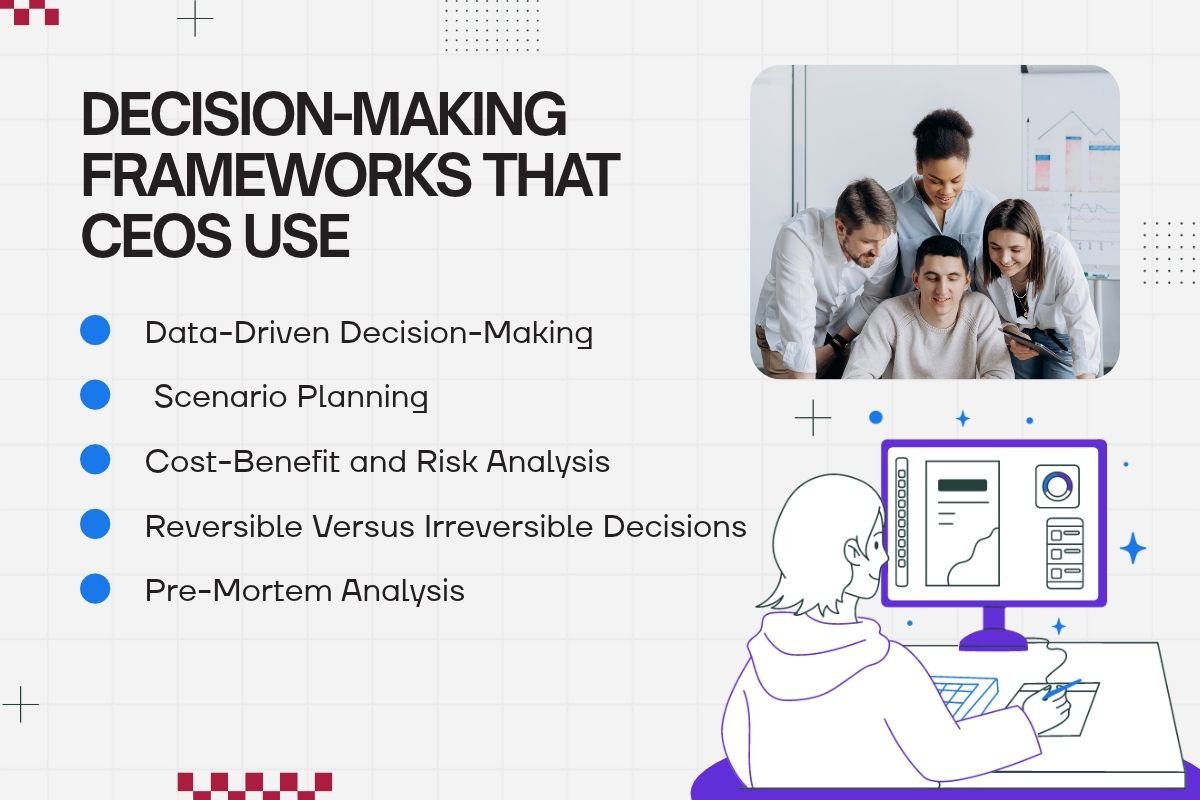
Decision-making frameworks help CEOs evaluate choices systematically. The right method depends on the decision’s uncertainty, financial exposure, and reversibility.
1. Data-Driven Decision-Making
CEOs use business intelligence, financial reports, customer research, and operational metrics to understand performance and identify opportunities.
- Business application: Before expanding into a new market, a CEO can assess customer demand, acquisition costs, competitive intensity, distribution requirements, and projected margins.
- Practical approach: Establish decision criteria before reviewing the results. Check data quality, source reliability, and possible bias rather than treating every metric as equally meaningful.
Data supports judgment but does not replace it. Historical trends may not accurately reflect new markets, emerging technologies, or changing customer behavior.
2. Scenario Planning
Scenario planning helps leaders prepare for different possible business conditions instead of depending on one forecast.
- Business application: If a business relies on imported components, leadership can evaluate scenarios involving stable prices, higher supplier costs, or delivery disruptions.
- Practical approach: Develop a small number of plausible scenarios, estimate their implications, and identify triggers for action. For example, a defined increase in input costs could trigger supplier renegotiation or alternative sourcing.
Scenarios are planning tools, not predictions. Their value lies in preparing responses before conditions change.
3. Cost-Benefit and Risk Analysis
CEOs assess the financial and operational implications of significant decisions before committing resources.
- Business application: When considering new technology, compare implementation costs, licensing, employee training, maintenance, cybersecurity, expected productivity gains, and potential downtime.
- Practical approach: Evaluate expected benefits alongside downside exposure, payback period, and sensitivity to changing assumptions. Consider what happens if adoption is slower or costs exceed estimates.
This prevents leaders from approving investments based solely on optimistic projections.
4. Reversible Versus Irreversible Decisions
Not all decisions require the same level of scrutiny. Reversible choices can often be tested and refined, while difficult-to-reverse commitments deserve greater evaluation.
- Business application: A company can test a new marketing channel with a limited budget before expanding spending. An acquisition, by contrast, may involve substantial capital, integration complexity, and long-term obligations.
- Practical approach: Match the decision process to the cost of being wrong. Use controlled experiments for low-risk choices and stronger review, due diligence, and approval mechanisms for major commitments.
5. Pre-Mortem Analysis
A pre-mortem asks a team to imagine that a proposed initiative has failed and identify the reasons behind that outcome.
- Business application: Before launching a new product, leaders can examine possible causes such as weak demand, distribution delays, pricing problems, or inadequate customer support.
- Practical approach: Document potential failure points, assign preventive actions, and identify early warning indicators.
This exercise helps teams challenge optimistic assumptions before implementation begins.
3. Skills that Help CEOs Make Better Decisions
Decision-making frameworks organize information, but leadership skills determine how effectively CEOs interpret it and act.
Strategic Thinking and Second-Order Reasoning
CEOs need to assess how decisions affect business priorities beyond their immediate results.
For example, reducing customer support costs may improve short-term margins but damage retention if service quality declines. Leaders should consider both the immediate financial impact and the longer-term consequences.
Financial and Analytical Acumen
Understanding cash flow, profitability, working capital, investment returns, and financial exposure helps CEOs compare opportunities realistically.
Financial judgment is particularly important when balancing growth investments with liquidity, operational needs, and shareholder expectations.
Emotional Intelligence and Self-Awareness
High-pressure decisions can be influenced by stress, personal preferences, overconfidence, and fear of failure.
Self-awareness helps CEOs recognize these influences, seek objective feedback, and avoid allowing emotions to dominate business judgment.
Active Listening and Constructive Conflict Management
Senior leaders need input from people with different expertise and perspectives. Finance teams may emphasize financial exposure, while operations teams identify execution constraints.
Constructive disagreement can expose overlooked risks. CEOs must encourage honest discussion without allowing debates to delay decisions indefinitely.
4. How Do CEOs Build Systems for Better Decision-Making?

Strong decision-making depends on organizational processes, not only individual leadership ability.
Establish Clear Decision Rights
Define who recommends, contributes, approves, decides, and executes. Bain’s RAPID framework provides a role-based approach to clarifying decision responsibilities:
- Recommend: Develop the proposal.
- Agree: Provides required approval or agreement within defined boundaries.
- Perform: Implements the decision.
- Input: Contributes relevant information and expertise.
- Decide: Holds final decision authority.
Not every decision needs every role. CEOs should use clear ownership to avoid unnecessary approvals and confusion.
Set Decision Thresholds and Escalation Rules
Establish which decisions teams can make independently and which require senior approval.
For example, department heads may approve routine spending within agreed budgets, while significant capital commitments or decisions outside risk limits require escalation.
This allows teams to act faster without weakening governance.
Maintain Decision Logs and Review Outcomes
Record major decisions, the reasoning behind them, key assumptions, responsible owners, and review dates.
After implementation, compare expected outcomes with actual results. Identify whether differences resulted from flawed assumptions, execution issues, or unexpected market changes.
A decision log supports organizational learning and makes future decisions more informed.
5. What Decisions Should CEOs Prioritize?
CEOs should concentrate on decisions that materially affect business direction, resilience, and long-term value.
| Decision area | Key consideration |
| Business strategy | Which markets, customers, and opportunities deserve focus? |
| Capital allocation | Where can financial resources create sustainable value? |
| Leadership and talent | Does the organization have the capabilities to execute its strategy? |
| Risk and resilience | Which threats could materially disrupt business operations? |
| Organizational direction | Are teams aligned on priorities, responsibilities, and performance expectations? |
6. Real-World Example of CEO Decision-Making: IBM’s Strategic Shift

IBM CEO Arvind Krishna provides a recent example of strategic decision-making. In a January 2026 McKinsey interview, Krishna explained how IBM shifted its portfolio toward software, increased R&D investment, and divested businesses that no longer fit its strategy.
Krishna said, “Whenever there’s uncertainty, there’s opportunity,” reflecting his approach to using changing market conditions to identify areas for growth. IBM’s software business grew from about 22% to 45% of the company, while the company added more than $3 billion annually to R&D over five years.
Decision-making lesson: CEOs must decide where to invest, what to exit, and which opportunities fit their long-term strategy. IBM’s example shows how strategic choices and resource allocation can reshape a company’s direction.
Conclusion:
Business growth often depends on the quality of choices made at the top. Learning how CEOs make decisions can help leaders approach complex situations with greater confidence, balance short-term demands with long-term priorities, and create stronger outcomes.
The next step is to review a few high-impact decisions in your business, identify what influenced their outcomes, and refine your decision-making process based on those lessons.
FAQs
1. How CEOs make decisions under pressure?
CEOs can prioritize the most consequential choices, establish clear decision criteria, and focus on the information that can materially change the outcome.
2. How do CEOs make decisions when there is not enough data?
They can combine available evidence with expert judgment, scenario analysis, and small experiments while clearly identifying the assumptions behind the decision.
3. What makes a CEO a good decision-maker?
A good CEO decision-maker can distinguish important choices from routine ones, consider competing perspectives, and act decisively without ignoring uncertainty.
4. How can CEOs improve their decision-making skills?
CEOs can improve by reviewing past decisions, identifying recurring judgment errors, seeking constructive challenges, and learning from actual business outcomes.