A small AI API workload could cost around $35 per month under certain usage assumptions, while continuously running an eight-GPU cloud server could exceed $40,000 monthly. Actual AI cloud costs depend on workload design, usage, and infrastructure choices.
For businesses, understanding these expenses is essential for budgeting, choosing AI services, and avoiding unexpected bills. Here’s how AI pricing works, what drives spending, and how businesses can control it.
Table of Contents
- What Are AI Cloud Costs?
- How Much Do AI Cloud Costs Vary?
- Key Factors Influencing AI Cloud Costs
- Why Multi-Step AI Agents Can Cost More Than Single Model Calls
- How Can Businesses Calculate AI Cloud Costs?
- A Simple AI Cost Planning Framework: Comparing AI Deployment Models to Find the Right Fit for Your Business
- How Can Businesses Measure AI Cost Efficiency?
- Conclusion
- FAQs
What are AI cloud costs?
AI cloud costs are the expenses of using cloud-based services and infrastructure to develop, train, deploy, and run AI systems.
These expenses include:
- Computing: Processing power from CPUs, GPUs, and other infrastructure.
- API usage: Charges for sending information to an AI model and receiving responses.
- Storage and data transfer: Costs of storing information and moving it between services.
- Operations: Monitoring, security, databases, retrieval systems, and application hosting.
A business using an AI API has a different cost structure from one renting GPU servers to run its own models.
How much do AI cloud costs vary?
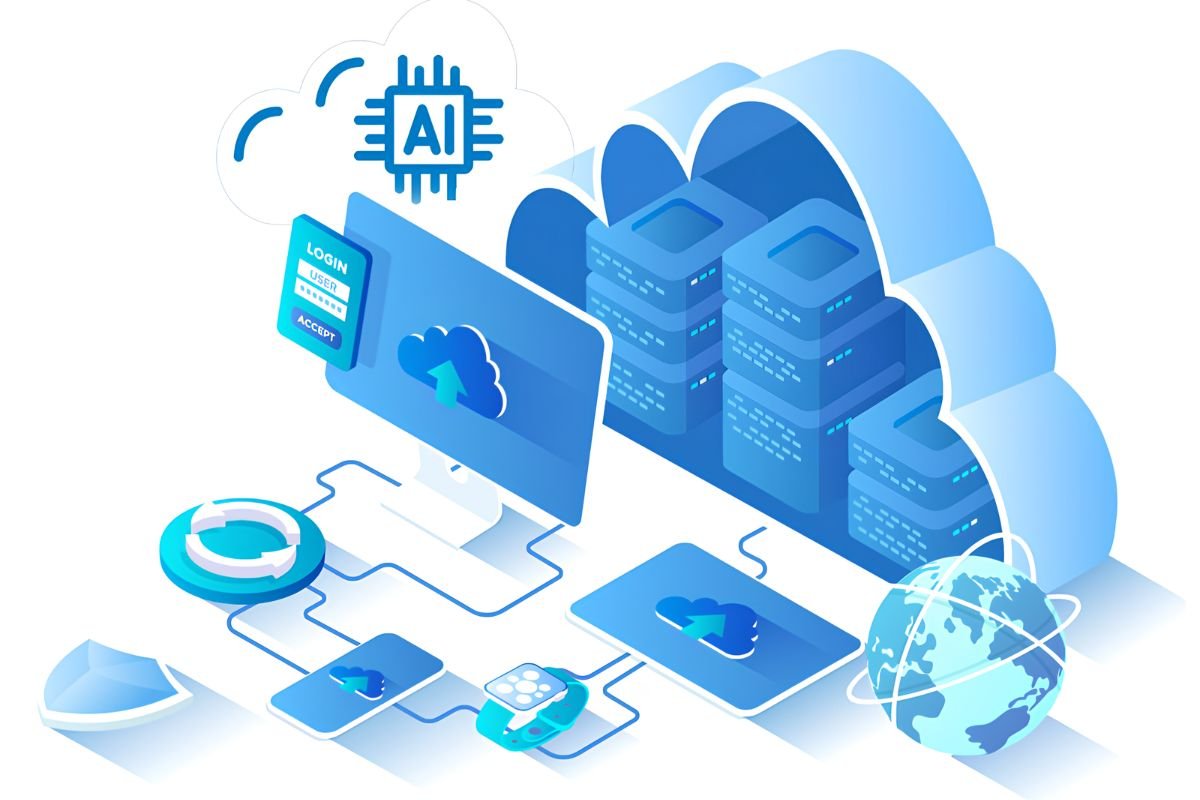
AI pricing depends on the service, usage, model, and pricing agreement. Businesses commonly pay through usage-based APIs or rented cloud infrastructure.
1. AI API pricing
An application programming interface (API) allows software to communicate with an AI model. Many providers charge according to input and output tokens, which are small pieces of text processed by the model.
Here are examples of API rates:
| AI model | Input/1M Tokens | Output/ 1M Tokens |
| Claude Haiku 5.5 | $0.10 | $0.50 |
| Claude Sonnet 5.5 | $2 | $10 |
| Claude Opus 5.5 | $4 | $20 |
| OpenAI GPT-5.4 | $2.5 | $15 |
| OpenAI GPT-5.5 | $5 | $30 |
(Note: These are standard published rates for the listed models. Haiku’s rates shown here apply to prompts up to 100K tokens. Actual charges depend on token usage, context length, caching, and processing options.)
What could 100,000 requests cost?
Suppose a business processes 100,000 requests monthly, averaging 1,000 input tokens and 500 output tokens per request.
- Claude Haiku 5.5: $35/month
- Claude Sonnet 5.5: $700/month
- Claude Opus 5.5: $1,400/month
- OpenAI GPT-5.4: $1,000/month
- OpenAI GPT-5.5: $2,000/month
(Note: Before this, add a note that cached input, batch processing, long-context pricing, and other discounts can change the effective rate.)
2. AI cloud infrastructure
Businesses can rent GPU-powered servers to train or run AI models.
| Provider | GPU configuration | Example hourly price |
| AWS EC2 P5.48xlarge | 8 NVIDIA H100 GPUs | $55.04/instance-hour |
| Lambda GPU Cloud | 8x H100 SXM node, per GPU | $3.99/GPU-hour |
Infrastructure utilisation also matters. Idle GPUs can increase costs without delivering useful work.
Key factors influencing AI cloud costs
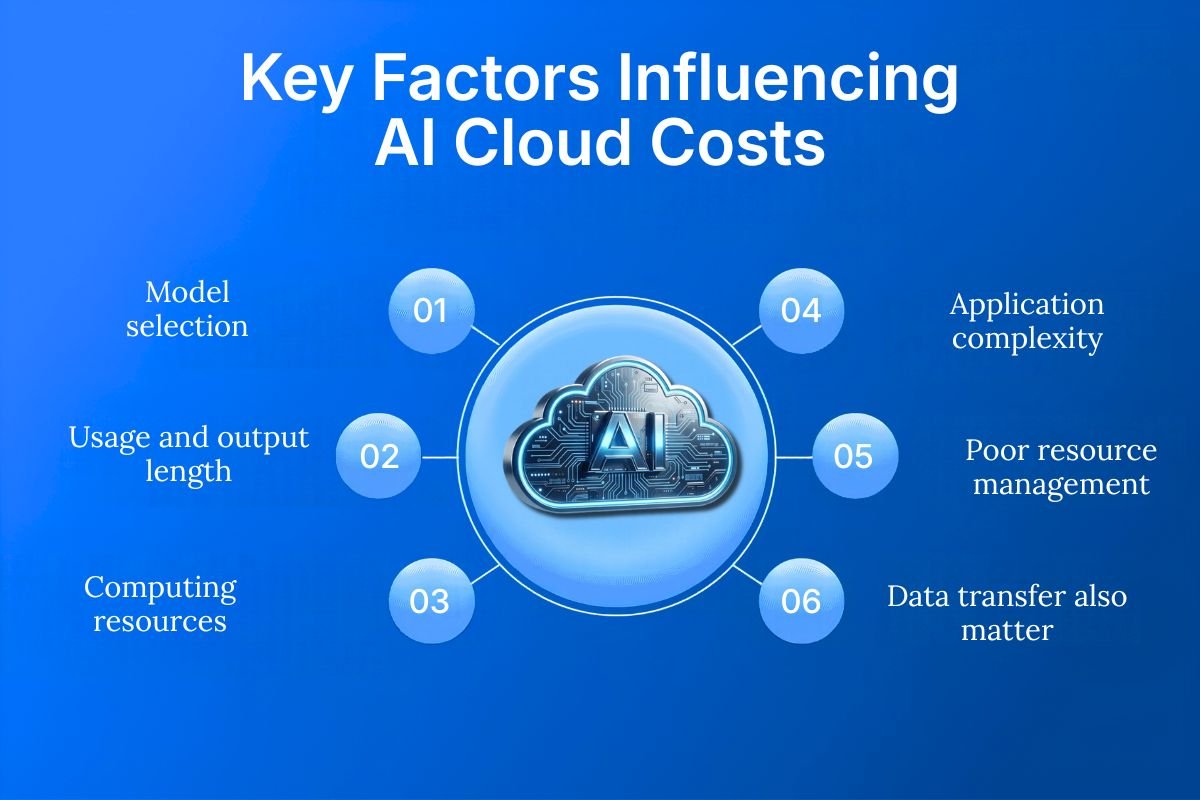
Several factors influence how much a business spends.
- Model selection: More capable models often cost more per request, although performance and pricing differ.
- Usage and output length: More requests, longer prompts, and longer responses increase API charges.
- Computing resources: GPU type, processing time, memory requirements, and utilisation affect infrastructure expenses.
- Application complexity: Retrieval-augmented generation (RAG), databases, external tools, security, and monitoring add costs beyond model usage.
- Poor resource management: Idle servers, duplicated processing, unnecessary retries, and unmonitored workloads increase bills.
- Data transfer also matters. AWS lists a $0.09/GB rate for applicable outbound data transfer, subject to service, region, and free-tier conditions. Applications moving large volumes of data between services should include these charges in their budgets.
Why multi-step AI agents can cost more than single model calls?
An AI agent can interpret a request, search documents, call tools, analyse results, and produce a final response. Each step consumes resources or triggers charges.
Consider this illustrative Claude Sonnet 5.5 example:
| Workflow | Cost per task |
| Single chat call | $0.007 |
| Eight-step agent | $0.112 |
Single chat call
- Input: 1,000 tokens × $2 per million = $0.002
- Output: 500 tokens × $10 per million = $0.005
- Total: $0.007
Eight-step agent
- Step 1 sends 1,000 input tokens. Each later step also re-sends the 1,000 tokens added by the previous step (500 output plus 500 tool results).
- Input per step: 1,000 + 2,000 + 3,000 + 4,000 + 5,000 + 6,000 + 7,000 + 8,000 = 36,000 tokens
- Output: 8 steps × 500 = 4,000 tokens
- Input cost: 36,000 × $2 per million = $0.072
- Output cost: 4,000 × $10 per million = $0.040
- Total: $0.112
Ratio: $0.112 ÷ $0.007 = 16 times
(Note: This is a calculated illustration, not a measured industry result. Businesses should measure cost per completed task because a low-cost request is not valuable if it requires repeated attempts or produces unreliable results.)
How can businesses calculate AI cloud costs?
For token-priced APIs:
Estimated API cost = (Input tokens ÷ 1,000,000 × Input rate) + (Output tokens ÷ 1,000,000 × Output rate)
Suppose a business processes 100,000 monthly requests, with 1,000 input and 500 output tokens each.
Using Claude Sonnet 5.5:
| Cost component | Monthly estimate |
| Input: 100M tokens | $200 |
| Output: 50M tokens | $500 |
| Total API charges | $700 |
This excludes hosting, storage, monitoring, retrieval, data transfer, and other charges.
A simple AI cost planning framework
- Define the task: What problem should AI solve?
- Estimate usage: How many requests, users, and tokens are expected?
- Calculate the full cost: Include infrastructure, APIs, storage, and operations.
- Run a pilot: Test actual usage, response quality, speed, and failure rates.
- Set a budget: Establish spending limits, alerts, and review schedules.
This gives finance and technical teams a shared basis for approving AI spending.
How can businesses reduce AI cloud costs?
Cost optimisation should remove waste without reducing useful outcomes.
| Strategy | Potential saving or benefit |
| Model routing | Uses lower-cost models for suitable tasks |
| Prompt optimisation | Reduces unnecessary tokens |
| Prompt caching | Claude cache reads cost 90% less for Haiku and 95% less for Sonnet and Opus than standard input rates |
| Batch processing | Claude Batch API offers a 50% discount on input and output tokens |
| Right-sizing | Matches resources to workload needs |
| Scheduling | Reduces idle infrastructure |
| Spot capacity | US East AWS P5.48xlarge spot prices have ranged roughly 32% to 62% of on-demand example |
| Budget alerts | Helps teams detect unusual spending |
AWS CEO Matt Garman emphasises balancing AI investment with business value, stating,
“How do you drive costs down?” and “How do you drive value up?”
This principle encourages businesses to assess AI cloud costs against measurable outcomes, such as productivity improvements and cost savings.
Hidden costs and real-world lessons from BCG
AI expenses extend beyond tokens and GPU rental.
In its June 2026 report, Cloud Cover: There’s More to Cloud AI Cost Than Token Price, Boston Consulting Group (BCG) examines how AI economics depend on workload architecture and platform decisions.
BCG’s analysis estimates about 30% additional operational overhead for each added cloud provider. This reflects costs such as networking, security, governance, skills, and management, not a universal surcharge on every cloud bill.
The lesson for businesses is to consider the complete cost of their AI environment. Adding another provider can increase complexity, even when its GPU or API prices look attractive.
Comparing AI deployment models to find the right fit for your business
| Deployment option | Best suited for | Main consideration |
| Public cloud AI | Flexible workloads and faster deployment | Usage and service charges |
| On-premises infrastructure | Predictable workloads requiring control | Hardware, maintenance, staffing, and utilisation |
| Hybrid deployment | Businesses with mixed workloads | Integration and operational complexity |
On-premises AI is not automatically cheaper. Businesses must include hardware purchases, electricity, cooling, maintenance, upgrades, and staffing.
A total cost of ownership (TCO) comparison helps teams assess the full operating expense.
How can businesses measure AI cost efficiency?

Track these indicators:
- Cost per successful task: How much does each correctly completed task cost?
- Quality: Does the output meet business requirements?
- Latency: How quickly does the system respond?
- Failure and retry rates: How often does the workflow need another attempt?
- Budget variance: How far does actual spending differ from the forecast?
- Business impact: Does AI save time, improve service, or support revenue?
A cheaper AI system that produces incorrect answers can create more work for employees. Measure spending alongside quality and business results.
Conclusion:
AI cloud costs vary because businesses use AI in different ways. API pricing, GPU infrastructure, model selection, and operational overhead all affect spending.
Businesses can control costs by forecasting usage, monitoring the complete workflow, choosing suitable models, and measuring cost per successful outcome. The goal is to build AI systems that deliver reliable business value without unnecessary expense.
FAQs
1. Which AI pricing model is best for a small business?
Usage-based AI API pricing is often best for small businesses because it reduces upfront infrastructure costs and allows flexible spending based on actual usage.
2. Are AI cloud costs different from traditional cloud costs?
AI workloads may introduce model inference, training, token-based billing, and specialised GPU expenses. They can also include ordinary cloud costs such as storage, networking, and hosting.
3. How can a small business reduce AI spending?
Start with a clear use case, estimate monthly usage, choose a suitable model, monitor consumption, and review whether the tool delivers measurable value.
4. Is on-premises AI cheaper than cloud AI?
Not always. Hardware, electricity, maintenance, staffing, and utilization must be included in the comparison.