
Sustainable business growth requires strategies that balance revenue, profitability, and customer satisfaction.
The best business growth strategies include increasing sales, retaining customers, entering new markets, developing products, building partnerships, and improving efficiency.
This guide covers six practical strategies, explains how to choose the right approach, and highlights the metrics businesses can use to track progress.
Table of content
- Here are the Six Most Effective Business Growth Strategies
- Why Do Business Growth Strategies Matter?
- How Can You Choose the Right Growth Strategy for Your Business?
- Track the Metrics That Match Your Goal. Common mistakes to avoid
- Conclusion
- FAQs
Six effective strategies to drive business growth
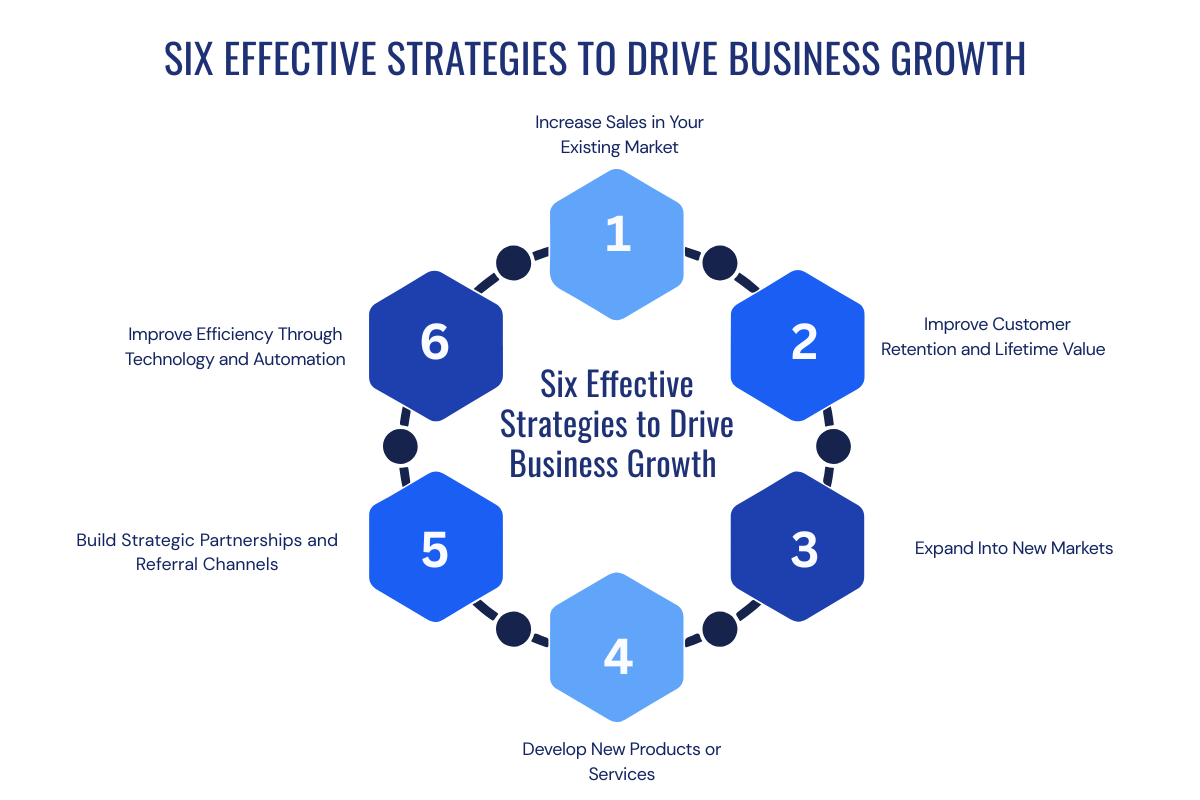
The following six business growth strategies help companies increase sales, strengthen customer relationships, reach new markets, and improve operational efficiency.
1. Increase sales in your existing market
Market penetration focuses on selling more existing products or services to customers in the current market. Businesses can improve sales through targeted marketing, competitive pricing, better product positioning, and simpler purchasing processes.
Best suited for: Established businesses such as local bakeries, clothing stores, and restaurants that want to increase sales among existing customers.
2. Improve customer retention and lifetime value
Customer retention encourages existing customers to continue buying from a business through reliable service, loyalty programmes, and personalised communication. Tracking customer lifetime value alongside retention rates and acquisition costs helps businesses assess the long-term value of their customer relationships.
Best suited for: Subscription services, e-commerce stores, gyms and beauty salons that depend on repeat purchases or long-term customer relationships.
3. Expand into new markets
Market development involves introducing existing products or services to new geographic regions, customer segments, or industries. Businesses should research customer demand, competitors, pricing, and distribution requirements before investing in expansion.
Best suited for: Established clothing brands, food manufacturers, and software companies looking to reach new geographic regions or customer segments.
4. Develop new products or services
Product development involves creating new offerings or improving existing ones to meet changing customer needs. Customer feedback, sales data, and support requests can help businesses identify opportunities before investing in development.
Best suited for: Technology companies, skincare brands, and food businesses that want to introduce new offerings based on customer needs.
5. Build strategic partnerships and referral channels
Strategic partnerships help businesses access new audiences, share expertise, and develop additional sales channels. Clear agreements on costs, responsibilities, and customer relationships can reduce misunderstandings and partnership risks.
Best suited for: Wedding photographers, event planners, travel agencies, and digital marketing firms that can generate referrals through complementary businesses.
6. Improve efficiency through technology and automation
Technology can help businesses manage increasing workloads by reducing repetitive tasks and improving access to operational data. Customer relationship management (CRM) systems, accounting software, and workflow automation can support more efficient business operations.
Best suited for: E-commerce stores, logistics companies, growing retailers, and service businesses that handle repetitive tasks or increasing workloads.
Let’s look at how leading companies like Microsoft combine different business growth strategies to expand their market presence, strengthen customer relationships, and drive sustainable growth.
How Microsoft combines multiple business growth strategies
Increase sales: Microsoft combines multiple growth strategies to strengthen its market position. In fiscal 2025, Microsoft 365 Commercial cloud revenue grew 15%.
Improve Customer Retention: Microsoft connects services such as Teams, OneDrive, and Microsoft 365 to support ongoing customer use.
Expand Into New Markets: Microsoft generated $137.2 billion in revenue from other countries in fiscal 2025, compared with $120.4 billion in fiscal 2024, highlighting its international business reach.
Develop New Products: Microsoft integrates Copilot AI into its productivity tools, expanding its product capabilities.
Build Strategic Partnerships: Microsoft’s partnership with OpenAI supports the integration of AI technology into its products and cloud services.
Improve Efficiency: Microsoft Power Automate helps businesses automate repetitive tasks and workflows.
Growth lesson: Microsoft’s approach shows how combining complementary growth strategies can create new revenue opportunities and help businesses adapt to changing markets.
Why a clear growth strategy matters?

- Create opportunities: The U.S. Small Business Administration reported that small businesses account for 99.9% of U.S. businesses and employ 62.3 million people, or 45.9% of private-sector workers. This highlights their importance to the economy.
- Expand Business: A clear strategy helps companies evaluate new markets, customer segments, and distribution channels before committing resources.
- Retain Customers: Loyalty programmes and customer-focused improvements can encourage repeat purchases and strengthen customer relationships.
- Guide finances: Growth plans help businesses evaluate revenue, operating costs, cash flow, and profitability before scaling.
- Improve efficiency: Technology and automation can help businesses manage increasing workloads and customer demand.
How can you choose the right growth strategy for your business?
Choose a growth strategy based on your business challenges, stage, resources, and goals. Use this table to identify the right approach and key considerations.
| Business challenge or stage | Strategy to consider | Key Action | What to Evaluate |
| Low sales conversion | Improve sales processes | Refine pricing, marketing, and purchasing processes | Conversion rate and sales revenue |
| Few repeat purchases | Strengthen customer retention | Improve customer service and loyalty programmes | Retention rate and repeat purchases |
| Limited existing market demand | Explore new markets | Research new locations or customer segments | Market demand and expansion costs |
| Unmet customer needs | Develop products or services | Use customer feedback to improve offerings | Development costs and customer demand |
| Limited customer reach | Build strategic partnerships | Collaborate with complementary businesses | Referral quality and partnership costs |
| Increasing workload | Improve operational efficiency | Automate repetitive tasks and streamline workflows | Productivity and implementation costs |
| Startup stage | Validate demand | Test the product with potential customers | Customer feedback and initial sales |
| Established or mature business | Expand or diversify | Enter new markets or introduce new offerings | Investment requirements and financial risks |
Track the metrics that match your goal

Businesses need measurable indicators to understand whether a growth plan is working. Choose metrics that directly reflect the objective.
- Revenue growth: Measures changes in sales over a defined period.
- Profit margin: Shows how much revenue remains as profit after relevant costs.
- Customer acquisition cost (CAC): Estimates the cost of acquiring a customer.
- Customer retention rate: Measures the proportion of customers retained over a period.
- Cash flow: Tracks money moving into and out of the business.
Common mistakes to avoid
Even well-designed business growth strategies can fall short when companies overlook key risks.
- Ignoring Customer Needs: Relying on assumptions instead of customer feedback can lead to missed opportunities and unsuitable offerings.
- Failing to Adapt: Strategies that work during early growth may become less effective as a business evolves.
- Prioritising Scale Over Value: Expanding too quickly can strain resources and reduce product or service quality.
As Jessica Neilas, President and Creative Director of Wolfe Interior Design, explains, “Growth is exciting, but not if it costs you your identity.”
Her insight highlights the importance of maintaining quality and brand identity while scaling a business.
Conclusion
The right business growth strategies depend on your goals, resources, and customer needs. Assess your current performance, identify your biggest growth opportunity, set measurable targets, and review results regularly.
Businesses do not need to pursue every approach at once. Start by identifying the biggest obstacle, choose a strategy that addresses it, and measure the results against clear targets.
Sustainable growth comes from creating customer value, managing resources carefully, and adapting decisions as the business evolves.
FAQs
1. How can small businesses grow faster?
Small businesses can accelerate growth through targeted marketing, customer referrals, repeat purchases, and efficient resource management.
2. What are the four main business growth strategies?
The four main business growth strategies are market penetration, market development, product development, and diversification.
3. How do you measure business growth?
Businesses measure growth using revenue, profit margins, customer retention, customer acquisition costs, and cash flow.
4. How can a small business grow with a limited budget?
A small business can focus on customer referrals, organic marketing, repeat sales, and low-cost partnerships to grow without heavy investment.