When every decision requires a leader’s approval, work can slow down, opportunities can be missed, and employees may struggle to take initiative. Excessive control can limit team performance and make business operations less efficient.
Understanding delegation vs micromanagement helps leaders find the right balance between employee independence and managerial oversight. By setting clear expectations, sharing decision-making authority, and maintaining accountability, leaders can empower teams to deliver results while keeping business goals on track.
What is the difference between delegation and micromanagement?
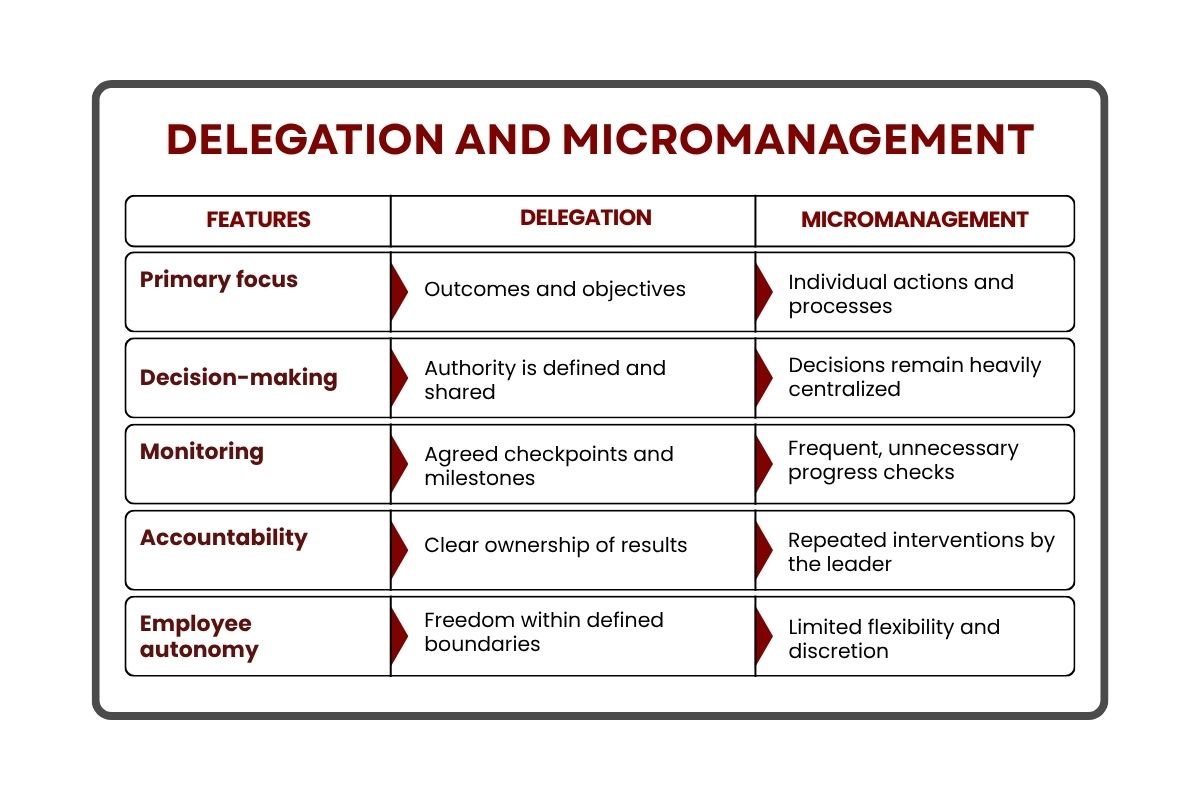
Delegation is assigning responsibility and decision-making authority to another person while setting clear expectations and accountability. Micromanagement occurs when leaders exercise excessive control over how employees perform their work, often limiting their independence.
| Features | Delegation | Micromanagement |
| Primary focus | Outcomes and objectives | Individual actions and processes |
| Decision-making | Authority is defined and shared | Decisions remain heavily centralized |
| Monitoring | Agreed checkpoints and milestones | Frequent, unnecessary progress checks |
| Accountability | Clear ownership of results | Repeated interventions by the leader |
| Employee autonomy | Freedom within defined boundaries | Limited flexibility and discretion |
Effective delegation does not mean leaders stop monitoring performance. Instead, they establish suitable controls and let employees manage execution within agreed boundaries.
Why leaders struggle to delegate without micromanaging
Even experienced leaders can struggle to delegate. Three common challenges explain why.
- Fear of losing control: Leaders may worry that employees will make mistakes, miss deadlines, or deliver work that does not meet expectations. This can encourage unnecessary involvement.
- Unclear ownership: When employees receive tasks without clear decision authority, they may repeatedly seek approval. Leaders then become the default decision-makers.
- Weak operational systems: If businesses lack reliable reporting, defined responsibilities, and escalation processes, leaders may rely on constant check-ins to stay informed.
These problems are not always caused by an individual’s leadership style. Sometimes, organisational structures make micromanagement more likely.
How micromanagement affects business, leaders, and teams

Micromanagement can affect more than employee autonomy. When excessive control becomes a routine management practice, it can create operational bottlenecks, increase leadership workload, and weaken team ownership.
Business impact
- Slower decision-making: Routine approvals and repeated reviews can delay execution and cause businesses to miss time-sensitive opportunities.
- Reduced operational efficiency: Excessive reporting, duplicated reviews, and unnecessary rework can consume resources without proportionate business value.
Leadership impact
- Leadership bottlenecks: Managers become involved in routine decisions, leaving less time for strategic planning, cross-functional priorities, and business growth.
- Reduced scalability: Teams may struggle to operate independently as the business expands, increasing reliance on leadership approval.
Team impact
- Lower initiative: Employees may hesitate to make decisions or suggest improvements when their judgment is frequently questioned or overridden.
- Slower professional development: Limited decision-making opportunities can restrict employees’ ability to build problem-solving skills, confidence, and leadership capability.
Signs your leadership style may be becoming too controlling
Consider whether:
- Employees need approval for routine decisions within their responsibilities.
- You repeatedly request updates despite having agreed reporting processes.
- You override employees’ decisions without a material reason.
- You take over tasks instead of coaching employees through challenges.
How to delegate work and build trust within your team
Business leaders can create a practical delegation system by combining clear expectations, appropriate authority, and structured oversight.

1. Delegate outcomes with clear success criteria
Assigning a task is not the same as communicating what success looks like. Employees need to understand the business objective, expected deliverables, deadlines, and quality standards.
For example, instead of instructing a marketing lead on every step of a campaign, a business owner can define the target audience, campaign budget, launch date, and performance goals while allowing the lead to select suitable channels and execution methods.
Use a delegation brief to clarify:
- Objective: What business outcome should the task achieve?
- Deliverables: What needs to be completed?
- Decision authority: Which decisions can the employee make independently?
- Constraints: What budget, quality, or compliance requirements apply?
- Deadline: When should the work be completed?
- Success measures: How will performance be evaluated?
- Accountability owner: Who is responsible for delivery?
This gives employees direction without unnecessarily restricting their approach.
2. Define decision rights before assigning work
Delegation becomes difficult when employees are responsible for results but cannot make the decisions needed to achieve them.
Leaders should clarify which decisions employees can make independently, which require consultation, and which need approval.
For example, during a software implementation project, a project lead may be authorized to coordinate schedules and assign routine tasks. Material budget changes, security exceptions, or changes to approved project scope may require additional authorization.
A simple decision-rights framework can help:
| Decision category | Appropriate authority |
| Routine execution decisions | Assigned employee or project lead |
| Decisions affecting other departments | Consultation with relevant stakeholders |
| Material financial or security risks | Authorized approver |
| Major strategic commitments | Executive leadership or designated authority |
The exact boundaries depend on the organization, its policies, and the risk involved.
Leaders should also avoid giving overlapping decision authority to multiple people without clarifying who has the final say.
3. Match oversight to risk and employee experience
Not every responsibility requires the same level of supervision. Leaders should consider employee capability, task complexity, potential business impact, and how easily a decision can be reversed.
For example, an experienced employee managing a routine vendor renewal may need only a deadline and a review checkpoint. A new employee handling a regulated process may need detailed instructions, training, documented reviews, and approval controls.
A practical approach:
- Low-risk, familiar tasks: Provide broad autonomy and review outcomes.
- New responsibilities: Offer closer coaching and more frequent feedback.
- High-impact decisions: Establish approval thresholds, documentation, and formal controls.
- Critical incidents: Coordinate immediate oversight until the situation stabilizes.
Closer supervision is not automatically micromanagement. It becomes problematic when unnecessary control continues despite changing circumstances and demonstrated capability.
4. Establish regular progress reviews
Leaders need visibility into progress without interrupting employees throughout the day.
Agree on review points based on project milestones, risk exposure, and deadlines. Use concise status updates that communicate progress, upcoming decisions, blockers, and potential risks.
For example, during a cloud migration, project owners can review milestones, costs, dependencies, and security risks at agreed checkpoints, with critical issues escalated immediately. EGL Tours, during its AWS migration, held weekly meetings to discuss issues, identify solutions, and test them. Its CIO, Alfred Kam, explained:
“If our team found an issue, they just raised it for discussion. Every week, we’d have a meeting to find a resolution and then test and test and test again.”
This is how regular communication and collaborative problem-solving can help teams address issues without constant managerial intervention.
5. Coach through problems without taking back ownership
Mistakes and unexpected challenges are part of business operations. If leaders take over whenever employees encounter difficulties, they can create long-term dependency.
Instead, encourage employees to explain the problem, assess available options, and recommend a solution.
For example, if a project lead misses a milestone, the leader can ask what caused the delay, what corrective action is possible, and whether additional resources or a decision is required.
Intervention is appropriate when risks exceed agreed boundaries or the employee lacks the necessary authority. Otherwise, leaders should provide guidance while allowing the assigned owner to manage the recovery.
How can leaders measure delegation vs micromanagement?
Leaders can evaluate delegation through decision-making efficiency, employee confidence, and delivery quality. Track these indicators over time to identify bottlenecks and gaps in support.
| Metric | What it measures |
| Routine decision escalation rate | How often routine decisions are referred to senior leadership |
| Approval turnaround | Time between an approval request and the decision |
| Employee decision confidence | Whether employees understand their authority and feel confident using it |
| On-time delivery | Completion against agreed deadlines |
| Rework rate | Repeated work, corrections, or defects |
How to use these measures:
- Establish a baseline before changing delegation practices.
- Monitor trends over a consistent period.
- Review delays and rework alongside task complexity and risk.
- Gather employee feedback to understand why approvals or interventions occur.
- Adjust decision boundaries, resources, or coaching accordingly.
When should leaders step in instead of delegating?
Delegation does not require leaders to remain uninvolved when a project goes off track. The key is to intervene for a defined reason without permanently taking ownership away from the employee.

Leaders may need to step in when:
- A decision exceeds delegated authority.
- A material financial or cybersecurity risk emerges.
- Regulatory compliance or safety requirements are threatened.
- The team lacks essential resources or cross-functional support.
- An urgent business situation requires coordinated action.
When intervention becomes necessary:
- Define the issue: Explain what requires intervention and why.
- Set temporary boundaries: Specify which decisions need leadership involvement and which remain with the employee.
- Agree on recovery measures: Establish actions, responsibilities, and review timelines.
- Restore decision authority: Return control to the employee when the risk is addressed and agreed conditions are met.
Conclusion
Delegation vs micromanagement depends on how leaders distribute authority, build trust, and maintain appropriate oversight.
Leaders should review decision-making processes, clarify responsibilities, and set clear decision limits, success measures, and escalation rules. The goal is to give employees ownership of their work, measure outcomes, and intervene when necessary rather than control every step.
FAQs
1. How can delegation and micromanagement affect employee retention?
Delegation can support retention by encouraging growth and ownership, while excessive control may reduce employee motivation and job satisfaction.
2. Why do employees resist delegated responsibilities?
Employees may resist delegated work when expectations are unclear, workloads are already high, or they lack the skills, resources, or confidence to take it on.
3. How can leaders delegate to experienced employees differently from new hires?
Leaders can give experienced employees broader discretion while providing new hires with more structured guidance as they build competence.
4. How can leaders identify whether their management style is discouraging initiative?
Leaders can review employee feedback, observe how often routine choices are deferred, and assess whether team members feel safe proposing ideas or challenging decisions.