
Understand the pillars of process improvement before investing in Lean, Six Sigma, or automation. This guide explains the foundational elements that make improvement initiatives successful. And why many projects fail despite using proven methodologies, and how six core pillars create lasting results. You’ll also learn how to assess your organization’s process maturity and build a sustainable improvement culture that delivers measurable business value.
Many companies spend millions on Lean, Six Sigma, automation, or AI. But still struggle to improve performance. If that sounds familiar, you want to know why, right now. The problem is not typically the methodology itself. But rather the missing Pillars of Process Improvement that should support those initiatives. Even the best tools will fail without clear leadership, aligned metrics, good data, capable people, and sustainable change routines.
This guide outlines the basic elements that determine the success of any improvement effort. It shows how to bridge the gap between technique and result. Read on to learn about the pragmatic pillars that turn projects into sustained performance gains. So your investments deliver predictable, measurable value.
What Are the Pillars of Process Improvement?
The Pillars of process improvement are the foundational elements that make improvement efforts work consistently. In simple terms, they are the core supports underneath any Lean, Six Sigma, automation, or AI initiative, helping teams improve performance in a repeatable way.
Process improvement means identifying gaps in a process, fixing them, and measuring whether the change actually helps. The pillars are not the same as methodologies or tools; they are the conditions that let those methods succeed.
Pillars vs Methods
| Concept | Meaning | Example |
| Pillars | Foundational supports for improvement | Process ownership, measurement, and customer focus |
| Methodologies | Structured ways to improve work | Lean, Six Sigma, PDCA |
| Tools | Practical items used inside a method | Value stream mapping, root cause analysis, dashboards |
The difference matters because methods tell you how to improve, while pillars explain what must be in place before improvement can last. Tools help execute the method, but they do not replace leadership, data, or clear process design.
Common pillars include identifying critical processes, understanding customer requirements, documenting work, measuring performance, and managing ongoing improvement. These foundations matter because every initiative depends on them to stay focused, measurable, and sustainable.
In practice, without strong pillars, even a good framework becomes a short-lived project. With them, improvement becomes part of how the organization operates.
Why Most Process Improvement Initiatives Fail?

Most process improvement efforts fail because teams treat the symptoms instead of fixing the root cause. They make quick changes, but the underlying process still behaves the same. The Pillars of process improvement break down when ownership, data, and standard work are missing.
Another common failure is weak accountability. If nobody clearly owns the process, improvements fade after the project ends. Poor data creates the same problem. Because teams end up guessing instead of measuring the real issue.
No standardization also hurts results. When every person follows a different version of the work, improvements cannot stick. Resistance to change makes this worse, especially when people are not involved early or do not understand the reason for the change.
A major mistake is chasing automation too soon. Automation accelerates broken processes if the foundation is weak. That is why process design should come before technology. Fix the workflow first, then automate the stable version.
In simple terms, process improvement fails when organizations rush the fix, skip ownership, ignore the data, and automate too early. Strong Pillars of process improvement keep efforts practical, measurable, and sustainable.
The Six Pillars of Process Improvement:
The Pillars of process improvement are the six basics that make improvement work: customer value, process visibility, data, ownership, culture, and enabling technology. Together, they keep improving practicality instead of turning it into a one-time project.
1. Customer Value
- Definition: Focus on what the customer actually needs.
- Why it matters: Improvement should remove waste and increase value.
- Common mistakes: Optimizing internal convenience instead of customer impact.
- Example: A claims team removes unnecessary approval steps.
- Success metric: Higher customer satisfaction or faster turnaround.
2. Process Visibility & Standardization
- Definition: Make the workflow visible and consistent.
- Why it matters: You cannot improve what you cannot see.
- Common mistakes: Letting every team member work differently.
- Example: A hospital uses one standard intake form.
- Success metric: Fewer errors and less variation.
3. Data-Driven Decision Making
- Definition: Use facts, not guesses, to choose actions.
- Why it matters: It reveals the real problem.
- Common mistakes: Relying on opinions or incomplete data.
- Example: A service desk tracks first-response time and backlog.
- Success metric: Measurable performance improvement.
4. Employee Engagement & Ownership
- Definition: Involve the people who do the work.
- Why it matters: They know the process best.
- Common mistakes: Designing changes without frontline input.
- Example: Nurses help redesign patient handoffs.
- Success metric: Higher adoption and fewer workarounds.
5. Continuous Improvement Culture
- Definition: Improve regularly, not just once.
- Why it matters: Gains fade without reinforcement.
- Common mistakes: Treating improvement as a project with an end date.
- Example: A team reviews defects every week.
- Success metric: Ongoing reduction in defects or delays.
6. Technology & Automation Enablement
- Definition: Use technology to support a stable process.
- Why it matters: It scales good work.
- Common mistakes: Automating broken steps too early.
- Example: Automating invoice routing after standardizing approvals.
- Success metric: Faster cycle time with fewer manual errors.
These six pillars keep improvement efforts grounded, measurable, and sustainable. Without them, even strong methods like Lean or Six Sigma lose impact.
How Do the Six Pillars Work Together?
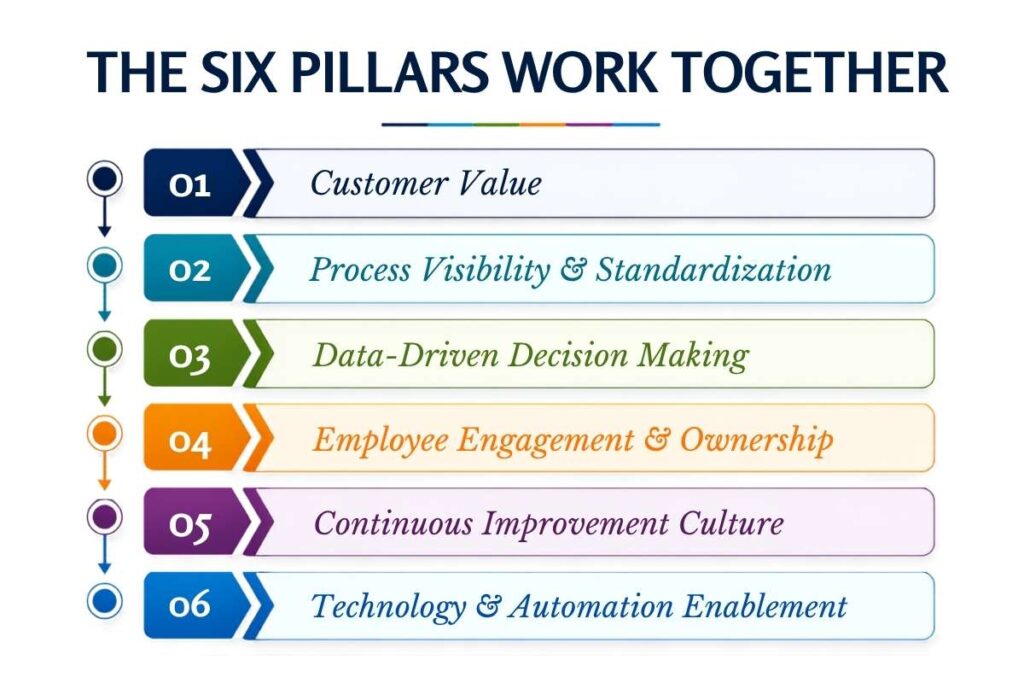
The Pillars of process improvement do not work well in isolation; they form a chain. Start with customer value, then map and standardize the process, measure it, involve the people who do the work, improve it continuously, and finally automate the stable version.
- Here is the simple flow:
Customer Value
↓
Process Visibility & Standardization
↓
Data-Driven Decision Making
↓
Employee Engagement & Ownership
↓
Continuous Improvement Culture
↓
Technology & Automation Enablement
Each step depends on the one before it. If customer value is unclear, teams optimize the wrong thing. If the process is not visible or standardized, measurement becomes noisy, and comparisons break down. If data is weak, decisions are guesses. If people are not engaged, changes do not stick. If there is no improvement culture, gains fade. If automation comes too early, it speeds up a flawed process instead of fixing it.
That is why missing one pillar weakens the others. A good example is order processing: first define what the customer wants, then document the steps, track delays, involve the team, remove waste, and only then automate approvals. This sequence avoids rework and makes improvements durable.
In short, the six pillars are not separate checkboxes. They are a connected system that keeps improving, practical, measurable, and sustainable.
How to Assess Your Current Process Maturity?
Use this quick checklist to see how strong your Pillars of process improvement are before starting a bigger initiative. A readiness check helps teams avoid launching change without clear workflows, metrics, or ownership.
Answer yes or no:
- Are your workflows documented?
- Do you know who owns each process?
- Do you measure cycle time or turnaround time?
- Are KPIs reviewed regularly?
- Can employees suggest improvements?
- Do you know your biggest bottleneck?
- Are problems tracked with data, not opinions?
- Are process steps standardized across teams?
- Is training in place for the current way of working?
- Have you identified which tasks should be improved first?
If you answer “no” to several items, your improvement effort is still early-stage. That usually means the team needs better process clarity, stronger measurement, and more employee involvement before automation or advanced optimization.
Readiness levels
- Beginner: Workflows are unclear, and success depends on individual effort.
- Developing: Some processes are documented, but measurement and ownership are inconsistent.
- Mature: Processes are defined, measured, and reviewed regularly.
- Optimized: Improvement is continuous, data-driven, and supported by teams and technology.
A simple rule: the more “yes” answers you have, the stronger your foundation. That means your pillars of process improvement are in place, and your changes are more likely to stick.
Building a Sustainable Improvement Culture:
The best way to build lasting improvement is to evolve the organization in stages, not “implement” a one-time fix. The pillars of process improvement work best when each phase builds on the last: first stabilize, then measure, then improve, then scale.

30 Days
Focus on clarity. Document the current workflow, identify the owner, define customer value, and pick one or two bottlenecks to study. Success looks like a visible process map, baseline metrics, and agreement on what “good” means.
90 Days
Focus on control. Test small changes, review KPI trends, and build standard work so results are repeatable. At this stage, teams should already see fewer errors, shorter cycle time, or better handoffs.
6 Months
Focus on adoption. Expand what works, coach employees, and make continuous improvement part of weekly routines. The goal is not just better results, but a team that can improve without constant outside help.
12 Months
Focus on scale. Connect process improvement to performance management, governance, and technology support. By then, automation should support a stable process, not repair a broken one.
A simple rule applies:
Each phase depends on the one before it. If documentation is weak, measurement is unreliable; if measurement is weak, people cannot improve confidently; if ownership is weak, gains fade; if culture is weak, progress stops; and if automation comes too early, it speeds up the wrong workflow.
Conclusion:
Improvement is sustained when the pillars of process improvement are seen as a system, not a project. Change sticks when clear goals, visible processes, reliable data, engaged people, and the right technology align. If one pillar is weak, the whole endeavour slows down. The real goal is not to “complete” improvement, but to embed it into everyday work. Start small, measure what matters, and proceed from there. Build the foundation first if you want lasting results. Then scale the gains with confidence.
FAQ:
What are the 5 steps of process improvement?
Process improvement typically follows the DMAIC framework (Define, Measure, Analyze, Improve, and Control).
What are the three pillars of improvement?
Three Pillars for Successful Continuous Improvement: Direction, Structure, and Metrics.
What is the 7-step improvement process?
The 7-step improvement process involves: (1) defining metrics to measure, (2) determining what can actually be measured, (3) gathering data, (4) processing the data, (5) analyzing the results, (6) presenting the information, and (7) implementing corrective actions.
What are the 5S’s of process improvement?
Five S (5S) stands for sort, set in order, shine, standardize, and sustain.
What are the top 3 skills to improve?
The top three universal skills to improve are Communication, Problem-Solving, and Time Management.
Links and Source:
https://www.pipefy.com/blog/process-improvement-definition
https://blogs.mtu.edu/improvement/2014/12/17/creating-customer-value
https://www.blueprintsys.com/blog/the-9-principles-of-continuous-process-improvement