Do you need someone to solve the problem, or someone to help you solve it better?
Companies face strategy changes, new technology, restructuring, and pressure to improve. Consulting vs coaching helps leaders choose the right support for each need.
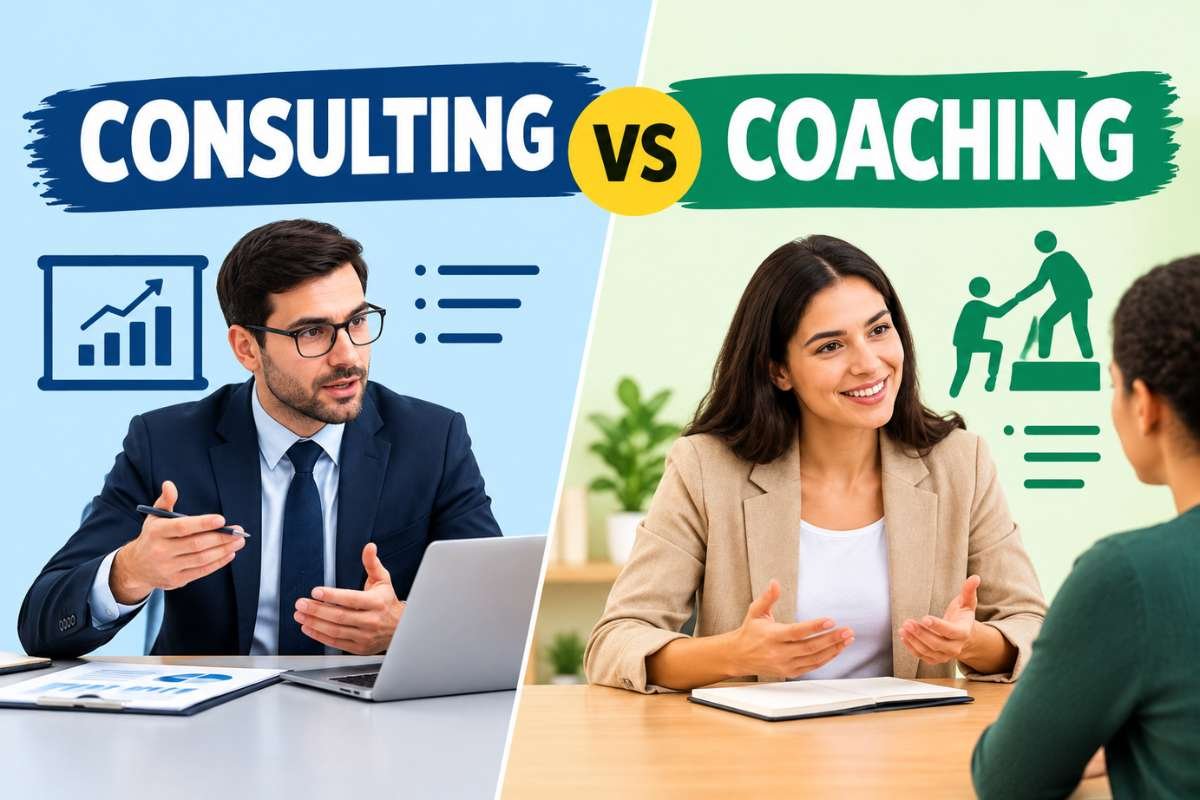
Consultants typically bring subject-matter expertise, analyze a problem, and recommend or support solutions. Coaches work with clients through a structured process focused on goals, thinking, behavior, and performance.
For leaders deciding where to spend time and money, the question is what problem needs to change, who needs to own that change, and what outcome should follow?
What is the difference between consulting vs coaching?
The simplest difference is that consulting is usually expertise-led, while coaching is client-led.
A consultant is brought in because the organization needs knowledge, analysis, or experience that it may not have internally. A coach works with a leader or professional who wants to improve performance, decision-making, leadership behavior, or another defined development goal.
The difference becomes clearer when looking at the role each professional plays.
| Factor | Consulting | Coaching |
| Purpose | Solve a defined business problem | Develop performance or leadership |
| Contribution | Expertise, analysis, recommendations | Questions, reflection, challenge, and accountability |
| Problem ownership | Consultant may diagnose and recommend solutions | Client remains responsible for the solution |
| Focus | Strategy, operations, technology, finance, transformation | Leadership, communication, decision-making, performance |
| Deliverables | Analysis, recommendations, roadmaps or implementation support | Goals, action plans and development progress |
| Engagement model | Often project-based | Often recurring sessions |
| Success measures | Business or project outcomes | Behavioral, leadership or performance outcomes |
This does not mean the boundaries are rigid. In fact, the ICF’s 2025 Global Coaching Study found that 57% of professional coaches also offer consulting, while 60% offer training and 55% offer facilitation.
That overlap makes it even more important to define the professional’s role before an engagement begins.
What does a consultant do?
A consultant helps a company understand a problem and determine what it should do about it. In consulting vs coaching, this means the consultant is typically brought in when a business needs outside expertise to assess a challenge and recommend a course of action.
The work may involve analyzing financial performance, reviewing operations, developing a growth strategy, assessing technology, redesigning processes, or supporting a major transformation. Depending on the engagement, the consultant may stop at recommendations or stay involved during implementation.
A consulting engagement typically involves:
- Diagnosing the problem: Understand the business challenge and its causes.
- Analyzing the situation: Review data, processes, and market conditions.
- Recommending solutions: Provide expert advice and practical recommendations.
- Supporting implementation: Help the client put the recommendations into action.
- Measuring results: Track outcomes and adjust the approach when needed.
The exact process varies by specialty, but clients generally expect an external perspective backed by expertise.
For example, a company entering a new market may need help with market research, pricing, regulations, or expansion strategy. A consultant provides the expertise and analysis needed to support those decisions.
What does a coach do?

The difference between consulting vs coaching becomes clearer when you look at the coach’s role in the client’s development.
A coach works with a client to improve performance, thinking, behavior, or professional development.
Rather than arriving with a prescribed solution to a business problem, the coach creates a structured process in which the client identifies goals, examines assumptions, considers options, takes action, and reviews progress.
In consulting, the outside professional brings expertise and advice; in coaching, the coach helps the client develop and act on their own goals.
Coaching can focus on:
- Leadership development
- Decision-making
- Communication
- Delegation
- Conflict management
- Executive presence
- Performance
- Accountability
- Managing organizational change
Consider a newly appointed senior leader who understands the business but struggles to delegate. A consultant might examine the organization’s structure or operating model. A coach might help the leader understand why they hold onto decisions, test new behaviors, and stay accountable for changing them.
More than half of coaching clients are sponsored by their employers, according to ICF’s study. This shows that companies are using coaching as part of leadership and employee development programs, not just as an individual service.
How do consulting vs coaching compare?
The difference comes down to what the client needs, how the work is delivered, and what success looks like.
- Focus: Consulting addresses business problems, while coaching focuses on goals, leadership, and performance.
- Deliverables: Consultants may provide analysis, recommendations, plans, or implementation support. Coaches provide structured conversations, feedback, questions, and accountability.
- Engagement: Consulting is often project-based and tied to a specific business need. Coaching is usually delivered through recurring sessions over a set period.
- Success measures: Consulting may be measured through cost savings, process improvements, project results, or business growth. Coaching may be measured through progress toward goals, behavior change, communication, or decision-making.
- Client role: In consulting, clients often act on expert recommendations. In coaching, clients develop and apply their own solutions with the coach’s support.
The scope of work matters more than the job title. Some professionals combine consulting and coaching, so buyers should review their experience, deliverables, engagement structure, and expected outcomes before hiring.
When should you choose consulting?

Consulting makes sense when the company has a defined problem and needs expertise to address it.
For example, a company may know that its operating costs are too high but lack the internal capacity to determine why. A consultant could analyze processes, benchmark performance, identify inefficiencies, and develop recommendations.
Consulting is also relevant when a company needs specialized knowledge quickly. This can happen during a technology transformation, market expansion, restructuring, acquisition, cybersecurity program, or major operational change.
Consider consulting when:
- The problem is clearly defined.
- Specialized expertise is missing internally.
- You need an independent assessment.
- The organization needs a strategy or roadmap.
- The project has specific deliverables.
- Business results can be measured.
Companies often bring in external specialists when they need expertise without building a permanent internal function.
When should you choose coaching?
Coaching becomes more relevant when the central challenge is how a person leads, thinks, communicates, or performs.
Imagine a senior executive who has been promoted into a larger role. The business strategy may be sound, but the leader now has a bigger team, more stakeholders, and more complex decisions. The need may not be another strategy document. It may be structured support in changing how the leader operates.
Coaching can be useful when:
- Leadership effectiveness is the main concern.
- The person needs greater accountability.
- A leader is moving into a larger role.
- Communication or delegation needs improvement.
- The individual needs to work through a complex decision.
- The goal involves sustained behavioral change.
Coaching is not only for people with performance problems. It is a way to develop and improve performance, including for people already performing at a high level.
Coaching often involves recurring sessions, while consulting is more commonly structured around a defined project. However, both models can vary.
Can consulting and coaching work together?
Yes. Some business challenges require both expert problem-solving and leadership support, which is where consulting vs coaching can become a combined approach rather than an either-or choice.
For example, during a business transformation, a consultant can assess the operating model and create an implementation plan. A coach can help leaders improve communication, decision-making, and accountability during the change.
The client should know what the consultant will deliver, what the coach will support, and where expert advice ends and coaching begins.
How should you choose the right consultant or coach?
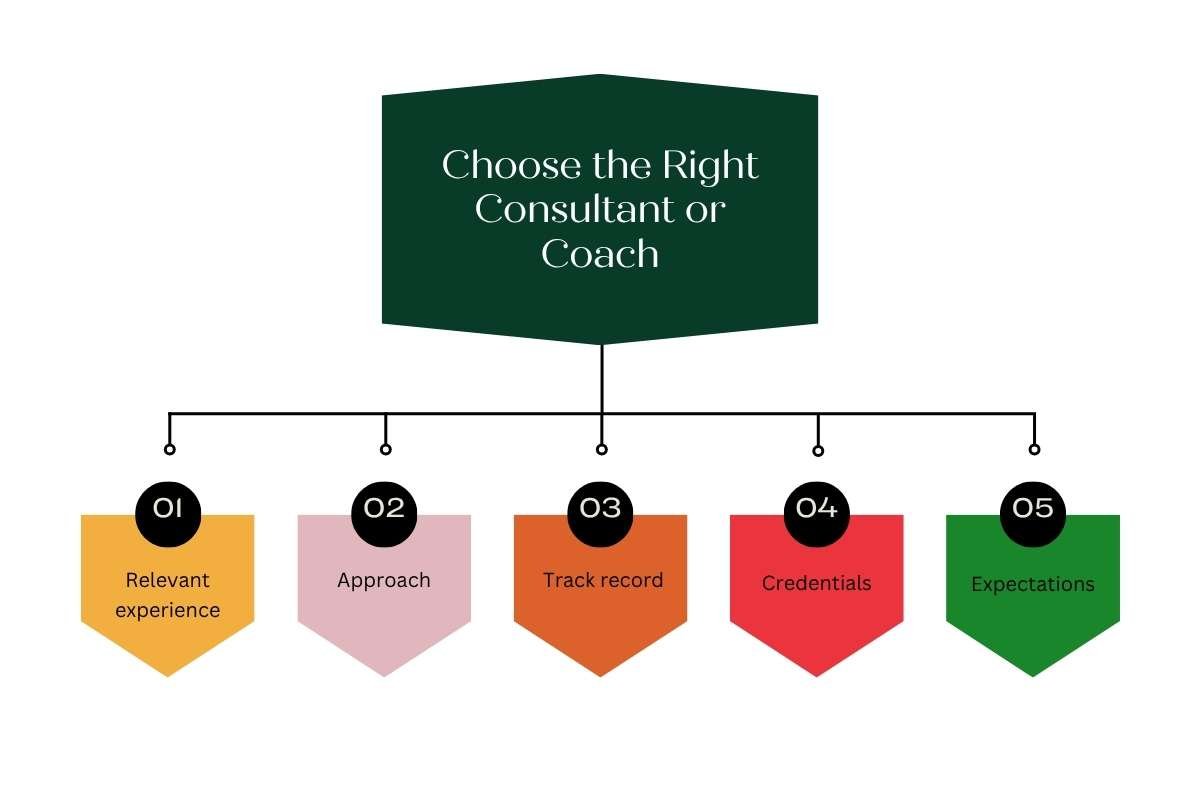
Once you know whether you need consulting or coaching, focus on choosing the right provider.
Before hiring, check:
- Relevant experience: Has the provider worked with similar businesses, industries, or challenges?
- Approach: Can they clearly explain how they will work with you and what the engagement includes?
- Track record: Can they provide relevant case studies, references, or examples of previous work?
- Credentials: For coaches, check relevant training or professional credentials.
- Expectations: Are the scope, fees, timelines, confidentiality, and expected outcomes clear before the engagement starts?
Also, be cautious about guaranteed income or large-return claims from coaching programs. The U.S. Federal Trade Commission has warned consumers about deceptive claims in the business coaching industry.
The goal is to find a provider whose experience, approach, and scope match your specific needs.
Conclusion:
The right choice in consulting vs coaching depends on what your business or leadership team needs. Consulting brings specialized expertise to defined problems, while coaching supports better decisions, leadership, and performance.
Start with the outcome you need, then choose the service and provider that best fits it.
Coaching vs. Consulting: frequently asked questions
1. How much does executive coaching typically cost?
The average fee for a one-hour coaching session was $244 globally and $272 in North America in 2022. Executive coaching fees can vary by coach, experience, and client type.
2. How long does a business consulting project usually take?
It depends on the problem and project scope. A focused engagement may last a few weeks, while larger strategy or transformation projects can take several months.
3. Can a small business hire a management consultant?
Yes. Small businesses can hire consultants for specific needs, including growth strategy, operations, technology, finance, or market research.
4. Is executive coaching confidential?
Professional coaching generally includes confidentiality, but the exact terms depend on the coaching agreement. Clients should confirm confidentiality rules before starting.
5. Should a CEO choose consulting vs coaching first?
It depends on the immediate need. A defined business problem may call for consulting, while a leadership development goal may call for coaching.