EEG Market Trends are revolutionizing the way we monitor brains with AI, wearable devices, and new healthcare applications. With an increase in neurological disorders, aging populations, and a need for early diagnosis, EEG is expanding from hospitals to homes, wellness platforms, and brain-computer interfaces. Advances in portable monitoring, AI-assisted analysis, and consumer neurotechnology are making EEG more accessible and shaping the future of personalized healthcare, neuroscience research, and continuous brain health management.
EEG Market Trends are transforming the way we monitor, analyze, and apply brain activity in the healthcare and neuroscience space. EEG technology, once used primarily for diagnosis of epilepsy and neurological testing, is now expanding into AI-powered diagnostics, wearable health devices, neurorehabilitation, mental wellness, and brain-computer interfaces. EEG is becoming more accessible, portable, and data-driven as researchers, healthcare providers, and technology companies invest in smarter neurotechnology.
Understanding these developments is key to revealing where the industry is going and why EEG may be one of the most impactful technologies in future healthcare ecosystems.
EEG Market Trends Driving Industry Growth:
The demand for EEG is increasing because more people need brain testing, not just because technology is improving. Here’s why EEG Market Trends are driving growth:
Why Demand Is Increasing:
| Driver | Why It Creates More EEG Need |
| Increasing neurological disorders | 1 in 3 people will face a neurological disease; deaths from these disorders rose 40% in 30 years |
| Aging populations | People live longer → more age-related brain conditions (stroke, dementia, epilepsy) need diagnosis. |
| Early diagnosis demand | Treating brain disorders early works better; people want to catch problems before they worsen. |
| Remote monitoring expansion | Elderly patients prefer staying home; a wearable EEG lets doctors monitor continuously without hospital visits. |
| Neuroscience research funding | More research = more EEG use in studies; governments/investors fund brain research to understand diseases |
| Hospital-to-continuous shift | Single hospital tests miss ongoing problems; continuous monitoring catches seizures/sleep issues that happen at home. |
Key Market Numbers
- EEG devices market: US$1.42 billion (2025) → US$2.30 billion (2032) at 5% CAGR
- EEG biosensors market: US$1.8 billion (2026) → US$3.1 billion (2033) at 8.2% CAGR
Why Portable and Wearable EEG Devices Are Expanding Rapidly?
Portable and wearable EEG devices are expanding rapidly because wireless systems, dry electrodes, and single-channel innovations make brain monitoring simple enough for home use. This shift is central to current EEG Market Trends.
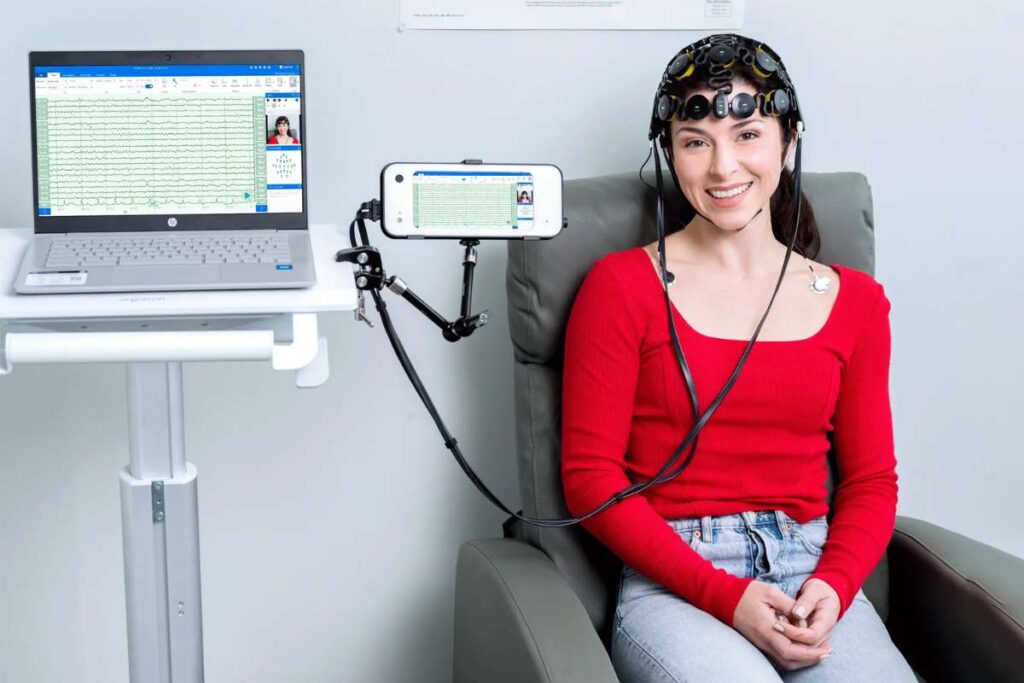
Difference between a traditional EEG and a wearable EEG?
| Traditional EEG | Wearable EEG |
| Hospital-only, wired systems | Wireless, portable devices |
| Wet electrodes with conductive gel | Dry electrodes (no gel needed) |
| Single hospital test (minutes) | Continuous home monitoring (days) |
| Requires a trained technician | User-friendly, self-applied |
| Stationary, limits movement | Works during daily activities |
Reasons for Rapid Expansion:
- Home-based monitoring: 8.7% CAGR; market grows from $396M (2024) to $695M (2031)
- Dry-electrode tech: Eliminates messy gel, reduces prep time, minimizes skin irritation
- Remote patient care: Elderly patients prefer home monitoring; reduces hospital burden
- Consumer wellness: EEG now in gaming, fitness, productivity, and neuromarketing devices
- Single-channel innovations: Affordable, miniaturized devices for targeted monitoring
Wearable EEG captures brain activity in real-world settings instead of controlled labs, enabling detection of seizures, cognitive impairment, and sleep issues during everyday life.
How Artificial Intelligence Is Transforming EEG Analysis?
AI is transforming EEG analysis by automating tasks that previously took clinicians hours, dramatically improving diagnostic speed and reducing workload.
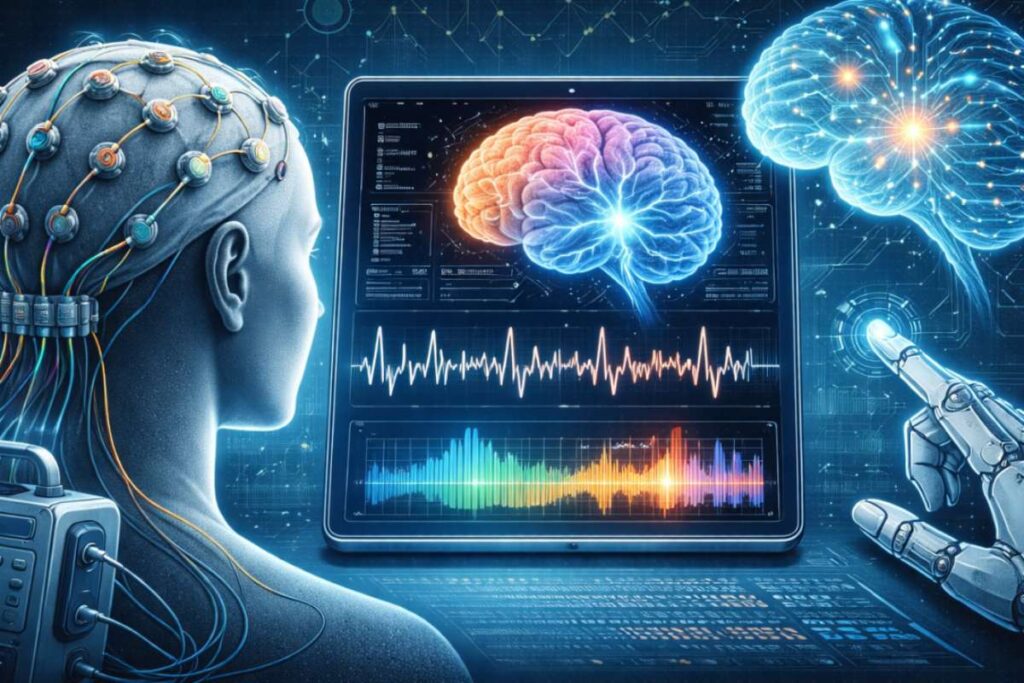
How AI Reduces Clinician Workload
Manual EEG analysis requires clinicians to review hours of brainwave data, spot patterns, and identify abnormalities. This is a time-consuming process prone to human error. AI automates this by:
| AI Capability | Workload Reduction |
| Automated signal interpretation | AI extracts key patterns in seconds; the clinician reviews only flagged abnormalities. |
| Seizure prediction | AI detects subtle seizure patterns too faint for human eyes, alerting clinicians before events occur. |
| Real-time brain monitoring | Continuous AI analysis replaces manual chart review; clinicians are alerted only when intervention is needed. |
| AI-assisted diagnosis | AI identifies early dementia signs (Alzheimer’s, Lewy body) in EEG data, typically unexamined by humans. |
| Predictive analytics | AI predicts seizure hotspots during surgery, reducing hospital time and enabling faster surgical decisions. |
Diagnostic Speed Improvement
Mayo Clinic’s AI system significantly speeds up analysis by auto-highlighting abnormal patterns too subtle for humans to detect, while putting precise numbers on what experts see. For rare epileptic seizures, AI improves detection by 12% over traditional methods while needing less data.
Key Benefit
AI doesn’t replace doctors. It supplements their knowledge in hard-to-detect cases, making diagnosis” easier, faster, and more reliable” for clinicians. This enables early diagnosis in rural communities without specialty equipment.
Emerging Applications Beyond Traditional Neurology:
EEG is expanding far beyond traditional neurology into everyday wellness, mental health, and rehabilitation. Creating the fastest-growing segment in the current EEG Market Trends.
Mental Health and Stress Monitoring
- Cognitive state tracking: AI-powered platforms detect focus, fatigue, and cognitive performance in real-time
- Emotional analysis & stress detection: EEG biosensors monitor stress levels and emotional states for mental wellness apps
Sleep and Wellness Technologies
- Sleep staging: Consumer wearables track sleep stages (light, deep, REM) continuously at home
- Home sleep monitoring: 32% increase in wearable neurotech adoption for sleep analysis outside clinics
Neurorehabilitation
- Stroke recovery: fNIRS-EEG combined monitoring evaluates cortical activity during rehabilitation, supporting BCI development
- Motor function training: The neurorehabilitation devices market is growing at 12.55% CAGR to $6.2 billion by 2033
Consumer Neurotechnology
| Application | How It Works |
| Focus enhancement | Lightweight headsets (<300g) track attention during work/study |
| Neurofeedback | Real-time brainwave training improves stress management and cognitive performance. |
| Brain-training platforms | 64% of consumer neurotech firms use EEG for gaming, productivity, and cognitive enhancement |
Why This Matters
- EEG dominates consumer neurotech: 64% of consumer firms use EEG vs. 26% in the medical sector due to portability, safety, and low cost
- Market growth: EEG biosensor market grows 7.9% CAGR to $2.83B by 2034, driven by mental health and BCI applications
- Sleep tech expansion: Sleep devices market reaching $79.88B by 2031 at 18.12% CAGR
EEG’s shift from hospital-only to consumer wellness represents the largest untapped opportunity in brain monitoring.
What Does the Future of EEG Look Like Through 2030?
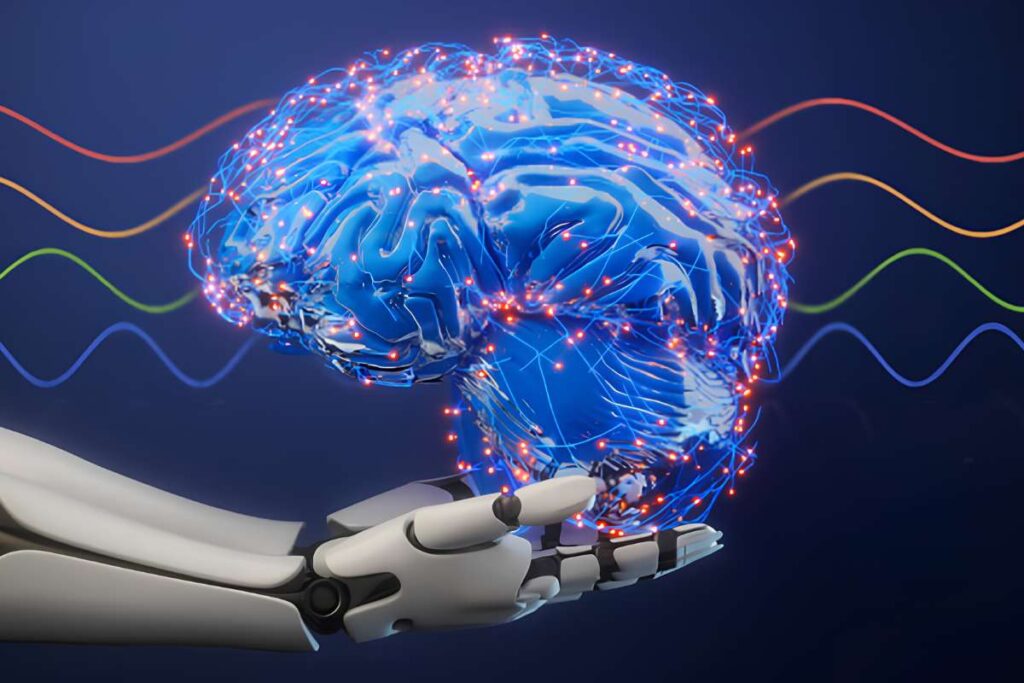
By 2030, EEG will shift from episodic hospital tests to continuous, AI-powered brain monitoring integrated into daily care.
AI-native EEG platforms will analyze brainwaves in real-time, detecting seizures as they occur and providing instant alerts to healthcare teams. Continuous brain monitoring using subscalp devices beneath the skin will enable weeks-long recording at home, replacing subjective seizure diaries with objective data.
Cloud-connected neurodiagnostics will let neurologists analyze patient data remotely with secure telemedicine and collaborative tools. Digital biomarkers extracting anesthesia levels, cognitive load, and epilepsy markers from brain signals will enable therapy adjustments based on real-time recordings.
Personalized neurological care will emerge as AI identifies individual seizure patterns and predicts events, helping patients manage epilepsy proactively. Foundation-model-powered brain analytics will integrate AI carefully into expert human interpretation workflows, not replacing clinicians but enhancing detection accuracy.
This shift supports the broader EEG Market Trends, with the market growing 8.0% CAGR (2026-2030) to $931.2 million in expansion.
Conclusion:
EEG is no longer just a hospital test. It is becoming a continuous, AI-powered brain monitor that is extending into homes, wellness apps, and everyday life. These EEG Market Trends are transforming healthcare and neuroscience, from real-time seizure detection to stress tracking and stroke recovery enhancement. The market is expected to reach $2.30 billion by 2032, and the availability of wearable devices for brain monitoring makes EEG one of the most impactful technologies to be found in future health ecosystems.
Learn the newest EEG innovations, research, assess tools for your needs, and find out how brain monitoring can help you reach your health, fitness, or work goals today.
FAQ:
Are EEG techs in high demand?
Yes, EEG techs are in high demand. Driven by an aging population, rising awareness of neurological disorders, and increased use of brain monitoring in ICUs, the field is growing significantly faster than average.
How big is the EEG market?
According to analysts at Vantage Market Research, the Global Electroencephalography Devices Market size is worth USD 1.43 billion in 2024 and is projected to reach USD 4.17 billion by 2035.
What is the 10 20 rule for EEG?
The “10-20 rule” (or 10-20 system) is an internationally standardized method for uniformly placing electrodes on the scalp during an EEG (electroencephalogram).
Why did the EEG price increase?
EEG machines can cost anywhere from a few hundred dollars to over $50,000, and the price often reflects the technology inside.
Will EEG techs be replaced by AI?
No, EEG (Electroencephalogram) technologists will not be replaced by AI.
Links and Sources