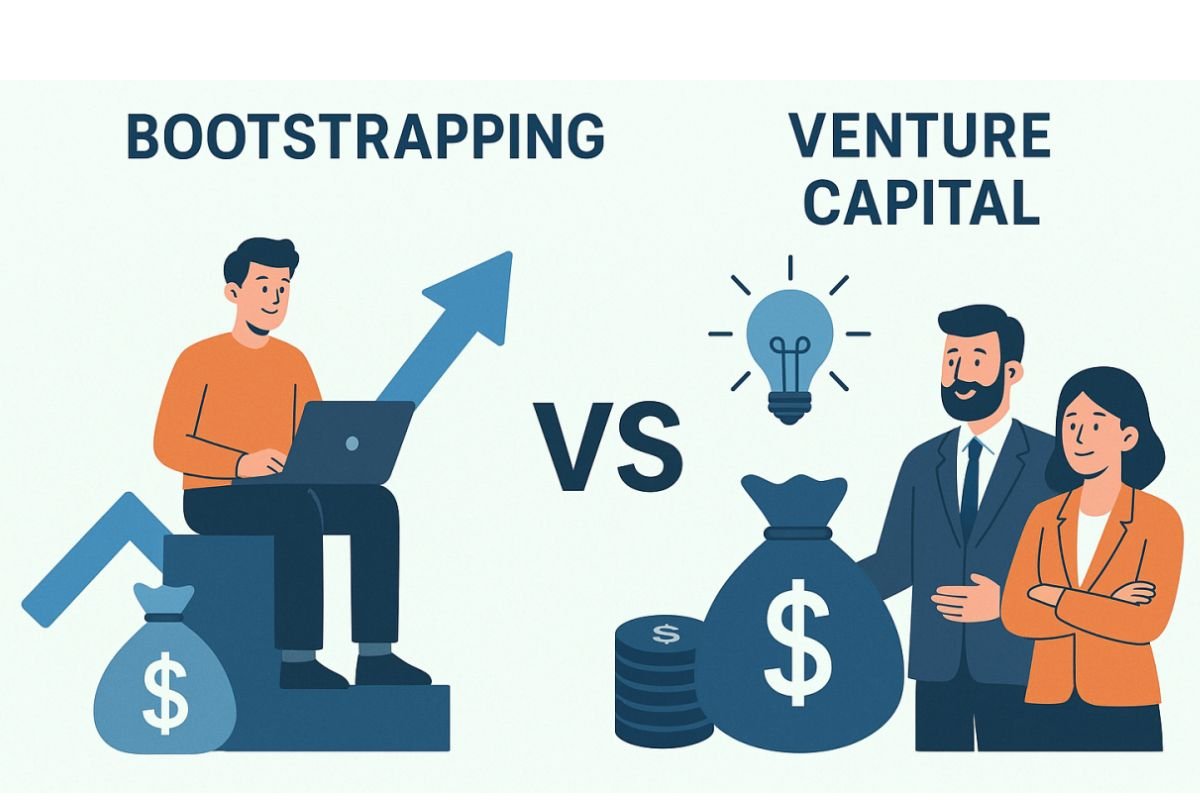
Every startup faces a funding decision: either go for bootstrapping or venture funding. Bootstrapping means starting and growing a business using the founders’ personal savings and the revenue it generates, rather than relying on outside investment, while Venture funding is capital invested in a startup by venture capital firms or funds in exchange for equity, giving investors a share of ownership in the business.
The choice affects ownership, control, growth, and investor involvement. This article compares both models and explains when founders should choose each or combine them.
Bootstrapping vs Venture Funding: Which Path Fits Your Startup?
| Decision factor | Bootstrapping may be a better fit when… | Venture funding may be a better fit when… |
| Capital requirements | The business can launch and grow with limited upfront investment | Product development, infrastructure, research, or expansion requires substantial capital |
| Revenue generation | Customers can start paying relatively early | The business needs significant investment before meaningful revenue can be generated |
| Ownership and control | Founders want to retain greater ownership and decision-making authority | Founders are comfortable exchanging equity and some governance influence for capital |
| Growth timeline | The market allows the company to expand gradually | Speed and market timing are important to capturing the opportunity |
| Financial priorities | Preserving cash and building toward sustainable cash flow are important | The company needs to invest ahead of revenue to build and scale |
| Investor involvement | Founders prefer greater independence in business decisions | Strategic guidance, investor networks, and additional resources could support growth |
What Do These Differences Mean for Founders?
1. Ownership and Decision-Making Control
- Bootstrapping generally allows founders to retain a larger share of the company because they are not selling equity to venture investors. This can give them greater independence over decisions involving products, hiring, pricing, and expansion.
- Venture funding changes that structure. Investors receive equity and may negotiate board seats, voting rights, or other governance protections depending on the investment agreement.
- The key question is not simply how much ownership founders give up. It is whether the capital, expertise, and connections received in return are valuable enough to justify that trade-off.
2. Growth Speed and Market Opportunity

- A bootstrapped startup typically grows through customer revenue, founder capital, and reinvested cash. This can encourage disciplined spending and keep expansion closely connected to actual demand, but it may take longer to hire teams, build infrastructure, or enter new markets.
- Venture capital can provide the financial capacity to pursue these activities sooner. A startup might use funding to expand its engineering team, increase customer acquisition, build infrastructure, or enter new regions.
- More capital does not automatically create growth. Funding works best when the company has a clear opportunity and knows what additional capital will allow it to achieve.
3. Financial Risk and Cash Flow
- Bootstrapping can expose founders more directly to financial losses, particularly when they use personal savings or personally guaranteed loans to fund the business. If the business struggles, founders may have to absorb these losses themselves.
- With venture funding, investors bear the risk of losing the capital they invest. However, founders remain responsible for business operations, expenses, and financial decisions. Poor performance can also affect their ownership and future fundraising prospects.
- The key difference is the level of personal financial exposure. Bootstrapping can put more of the financial burden on founders, while venture funding shifts some investment risk to external investors.
4. Cash Flow, Profitability, and Investor Expectations
- Bootstrapped companies often depend on customer revenue to fund daily operations and future development. This encourages founders to control expenses, prioritise paying customers, and maintain a clear path to profitability.
- Venture-backed startups may have more flexibility to spend before reaching profitability. They can invest in product development, hiring, and market expansion with the expectation of generating returns over time.
- Investors expect founders to use capital responsibly, follow credible growth plans, and demonstrate measurable progress. They may also offer industry knowledge, business connections, and hiring support that help the company grow.
When Does Bootstrapping Make More Sense?

Bootstrapping can be a practical choice when a startup can test its product, attract customers, and generate revenue without significant upfront investment.
It can work particularly well for consulting firms, professional services, niche software companies, and other capital-efficient businesses. These companies may be able to begin with a small team and use customer revenue to finance further development.
Bootstrapping may make more sense when:
- The product or service can be developed with limited upfront investment.
- Customers can start paying relatively early.
- Revenue can support the next stage of business growth.
- Founders want to retain ownership and decision-making control.
For example, a small software company could launch a focused product for a specific customer group, generate subscription revenue, and reinvest that income into new features. If customer revenue can fund the next major milestone, founders may not need to exchange equity for capital at that stage.
Bootstrapping does have limits. If the company has proven demand but repeatedly lacks the capital to meet customer demand, hire necessary talent, or capture a time-sensitive opportunity, relying only on internal funds may restrict growth.
When Is Venture Funding the Better Choice?
Venture funding becomes more relevant when the business opportunity requires more capital than founders and early revenue can reasonably provide.
Some startups face substantial costs before they can generate significant revenue. Deep technology, biotechnology, advanced manufacturing, and businesses requiring major infrastructure or research and development may need external investment to reach commercial scale.
Market timing can also influence the decision. If competitors are expanding quickly, securing distribution relationships, or building strong positions in a new market, a slower growth path may reduce the opportunity available to the startup.
Venture funding may be worth considering when:
- Product development or research requires substantial upfront investment.
- The business needs significant infrastructure or specialised talent.
- Entering new markets requires more capital than current revenue can provide.
- The opportunity requires faster execution to remain competitive.
For example, the plan might involve expanding the engineering team, completing a product launch, or entering new markets, with clear milestones attached to each investment.
If customer demand has not been validated, additional capital may not solve the underlying problem. Funding is most useful when it addresses a specific constraint that is preventing the business from reaching its next stage.
Hybrid Funding: Combining Bootstrapping and Venture Funding

The choice between bootstrapping and venture funding does not have to be permanent. A startup can begin with founder resources, validate demand, generate revenue, and later raise external capital when funding becomes the main barrier to growth.
This approach allows founders to build evidence around customer demand before giving up equity. If the business later reaches a point where additional capital could unlock a proven opportunity, raising investment becomes a more informed decision.
A possible funding path is:
Build → Validate demand → Generate revenue → Identify the capital gap → Raise if needed → Scale
Real-World Example: Atlassian
Founded in Sydney in 2002, Atlassian operated without outside financing for eight years and was profitable from its inception. In July 2010, it raised $60 million from Accel Partners in exchange for a minority equity stake. The investment supported expansion into Europe and Asia and acquisitions to add complementary products.
- Current Business Performance: Atlassian reported $6.57 billion in revenue for FY2026, a 26% increase year over year, demonstrating how the company scaled its business after initially growing through bootstrapping and later securing venture investment.
- What founders can learn: Atlassian demonstrates how startups can establish a profitable business through internal resources before raising external capital to support further expansion.
Conclusion
Bootstrapping and venture funding offer different routes to startup growth. Bootstrapping helps founders retain ownership and build through revenue, while venture funding provides capital to pursue larger opportunities. The right choice depends on the business model, financial requirements, and growth ambitions.
Before deciding, assess how much capital your startup needs, when it can generate revenue, and what milestones it must achieve next. Choose the funding approach that supports sustainable growth without creating unnecessary financial or ownership pressure.
FAQs
1. Can a startup switch from bootstrapping to venture funding?
Yes, a startup can raise venture capital after bootstrapping to finance expansion, product development, or new market opportunities.
2. Is bootstrapping better than venture capital for small businesses?
Bootstrapping can suit small businesses with low startup costs, early revenue, and no immediate need for large-scale expansion.
3. What are the alternatives to venture capital for startups?
Startups can consider bootstrapping, business loans, grants, crowdfunding, angel investment, and revenue-based financing, depending on their eligibility and funding needs.
4. What happens if a venture-backed startup fails?
Investors may lose their investment, while founders may lose their equity and face other financial or contractual consequences depending on the agreements involved