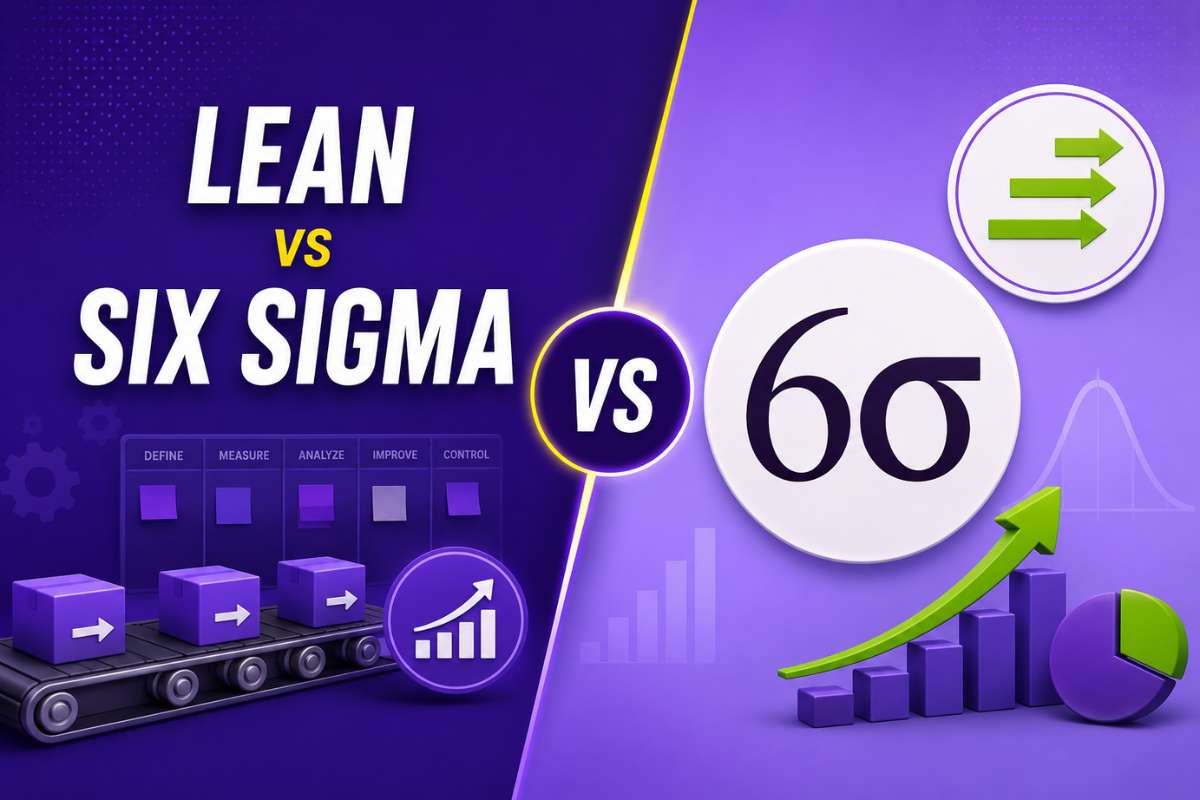
Are you struggling to choose between Lean vs Six Sigma? Lean focuses on speeding up your workflow by removing waste, while Six Sigma ensures precision by reducing errors. Mastering both creates a balanced, efficient, and profitable business model. Read on to learn the specific goals of each methodology, how they function, and how you can integrate these frameworks for your maximum ROI.
Many companies lose significant revenue because their processes are bogged down by administrative friction and poor quality control.
In 2026, these inefficiencies are direct threats to your bottom line.
Lean cuts out the wasted time that slows down your team, while Six Sigma removes the errors that cause you to lose deals.
If you are building a startup or leading a big firm, understanding Lean vs Six Sigma is the best way to fix those leaks. Let’s look at how these two methods can turn your daily work into a steady path for growth. But to use them effectively, you first need to understand the main purpose behind each one.
What Are the Main Goals of Lean vs Six Sigma?
If you are looking to fix your business processes, you have likely heard of these two methods. While they are often grouped together, they tackle different problems.
Lean methodology, derived from the Toyota Production System, views waste as the primary enemy of productivity. Its main objective is to identify and remove any step that does not add value to the customer.
By cutting out these wasted steps, you shorten your process time and get results faster. If your biggest hurdle is speed or a slow cycle time, Lean is the answer.
Six Sigma takes a different approach. Its primary goal is consistency. Instead of focusing just on speed, it uses statistical data to find the root cause of mistakes and defects. The aim is to reduce variation so that your output is near-perfect every time.
You might see terms like “Green Belt” or “Black Belt” while researching this method. These are simply ranking levels for Six Sigma experts that show how much training they have completed. If your biggest hurdle is poor quality or inconsistent results, Six Sigma provides the rigor you need.
The easiest way to think about the Lean vs Six Sigma debate is to look at the core question each method asks:
- Lean asks, “How can we do this faster?”
- Six Sigma asks: “How can we do this right every single time?”
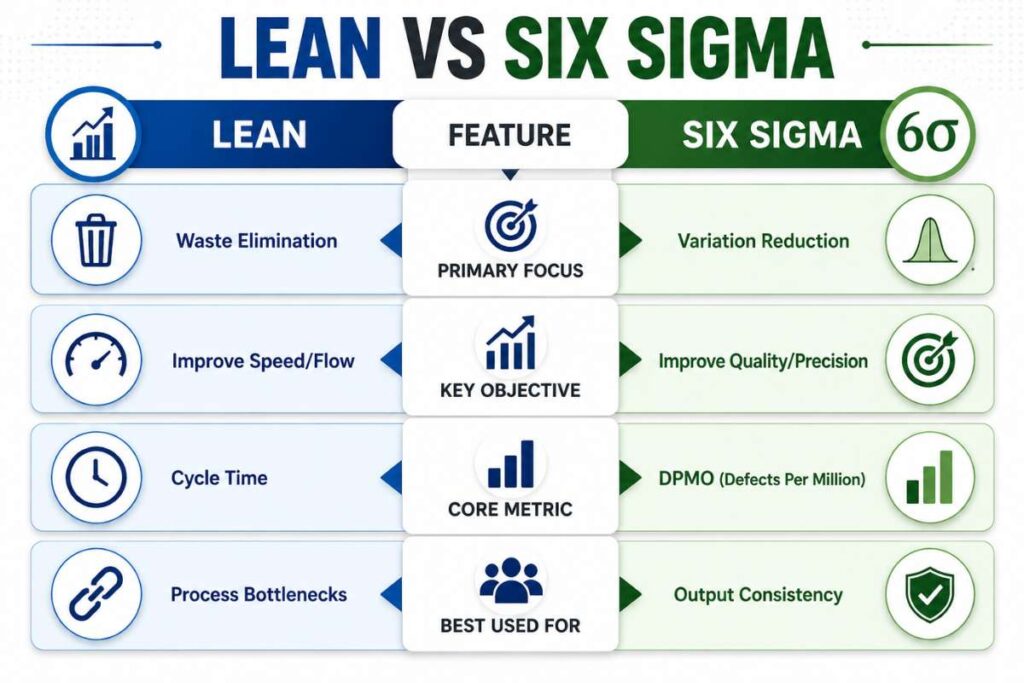
To quickly compare how these approaches differ, use the breakdown below:
| Lean | Feature | Six Sigma |
| Waste Elimination | Primary Focus | Variation Reduction |
| Improve Speed/Flow | Key Objective | Improve Quality/Precision |
| Cycle Time | Core Metric | DPMO (Defects Per Million) |
| Process Bottlenecks | Best Used For | Output Consistency |
How Do Lean vs Six Sigma Work in Manufacturing?
To understand these methods, look at the factory floor. Toyota famously built the Lean framework to cut waste. By using a “Just-in-Time” system, they ensured parts arrived exactly when needed, which stopped inventory from piling up and saved the company millions in storage costs. This proved that removing unneeded steps creates massive speed and efficiency.
Motorola took a different path by pioneering Six Sigma. They used statistical analysis to find tiny flaws in their production lines. By aiming for a 99.99966% success rate, they dramatically lowered return rates and boosted buyer trust. In this setting, Six Sigma proved that extreme consistency creates high-quality products that customers can rely on.
These two approaches became the gold standard for global industrial growth. While they started in massive factories, the core lesson is that operational discipline pays off. When you find the root cause of an error, you stop repeating it. When you cut out a useless step, you reclaim the time you lost.
How Can Lean vs Six Sigma Transform Your B2B Sales Pipeline?
Your sales pipeline functions just like a production line. When leads stall or your team chases unqualified prospects, your revenue engine suffers from ‘process waste.’
Many B2B companies struggle to find enough good leads. Their biggest challenge is filling the sales pipeline with the right people. On top of that, CRM data is often incorrect. This creates hidden costs, as your team wastes time on bad contact information and extra paperwork.
Applying Lean vs Six Sigma principles allows you to audit your sales funnel with clinical precision. Lean principles help you strip away administrative friction, such as redundant follow-ups or manual data entry, that keeps your reps from selling.
Meanwhile, Six Sigma provides the statistical guardrails to ensure that the leads entering your pipeline fit your ideal customer profile, preventing your team from burning hours on defective prospects.
By treating a lead like a raw material, you can spot where the defect happens. Is the data poor? Is the follow-up too slow? By identifying these issues, you turn a pipeline into a predictable growth engine.

How to Use Lean vs Six Sigma Effectively?
These tools are powerful, but they aren’t magic. If you use them without a plan, you might create more work instead of less. Use these rules to get the best results without slowing your team down.
- Don’t over-analyze: Use data to guide your decisions, but don’t let it replace selling time. If your team talks more about spreadsheets than prospects, you’ve gone too far.
- Focus on waste, not budgets: Lean helps you cut useless tasks, not essential resources. Never cut the tools or training that actually help your reps close deals.
- Get the team on board: If reps feel like they are being watched, they will fight the new process. Explain that these tools exist to help them hit their quotas with less stress.
- Start with small tests: Don’t change everything overnight. Test a new process on one small team first to see if it works before rolling it out to the whole company.
How to Use Lean vs Six Sigma For Maximum ROI?

Successful companies do not choose one method over the other. Instead, they blend them to create a system that is both fast and precise.
The real return on investment (ROI) comes from fixing the speed of your workflow (Lean) while ensuring the accuracy of your output (Six Sigma). This dual approach eliminates wasted time while preventing costly errors that damage your bottom line.
Start by applying Value Stream Mapping (VSM) to your primary business processes. This tool helps you visualize the entire lifecycle of a project or product. By mapping every touchpoint, you can identify dead zones where work stalls or resources are tied up without producing value.
Once you spot these problems, you can fix them to speed up your sales and stop wasting money on slow processes.
Once your workflow is streamlined, apply the DMAIC (Define, Measure, Analyze, Improve, Control) framework to maintain stability. This method acts as a safety net, using data to identify why errors occur. By analyzing the variables in your output, you can implement strict standards that prevent defects from happening in the first place. This reduces the cost of rework and ensures that every dollar spent on production delivers a high-quality result.
When you use Lean to work faster and Six Sigma to work better, you cut business costs and get more done. Companies that use this system often see their revenue forecasts become more accurate. This changes unpredictable growth into a steady, reliable business.
Conclusion:
Choosing the right approach for your business isn’t about picking a winner between Lean vs Six Sigma. It is about using the best tool for the specific job you need to finish. Lean helps you move fast, and Six Sigma helps you work without errors. By using both, you can grow your business and reach your goals with confidence. Start today by looking at your current process and finding one area where you can cut waste or fix a mistake.
FAQ
Can Lean Six Sigma principles apply to remote sales teams?
Absolutely. You can apply these principles to remote workflows by mapping digital communication processes to remove bottlenecks and using data to measure the effectiveness of virtual lead qualification.
Why do most sales teams fail at implementation?
Teams often fail because they treat these methodologies as one-time projects rather than as a culture of continuous improvement. Successful adoption requires long-term commitment to data-based decision-making.
Are these methods expensive to start?
Not at all. Most initial improvements come from better communication and smarter process planning, which costs time rather than money.
What do Green Belt or Black Belt terms mean?
These are simply ranking levels for Six Sigma experts. They show how much training a person has, but you do not need these titles to start improving your own company’s processes.